Margin Call
A margin call is a broker's demand that a trader deposit additional funds — or close open positions — when account equity falls below the required maintenance margin level. It is the mechanism that prevents a leveraged account from going into negative balance.
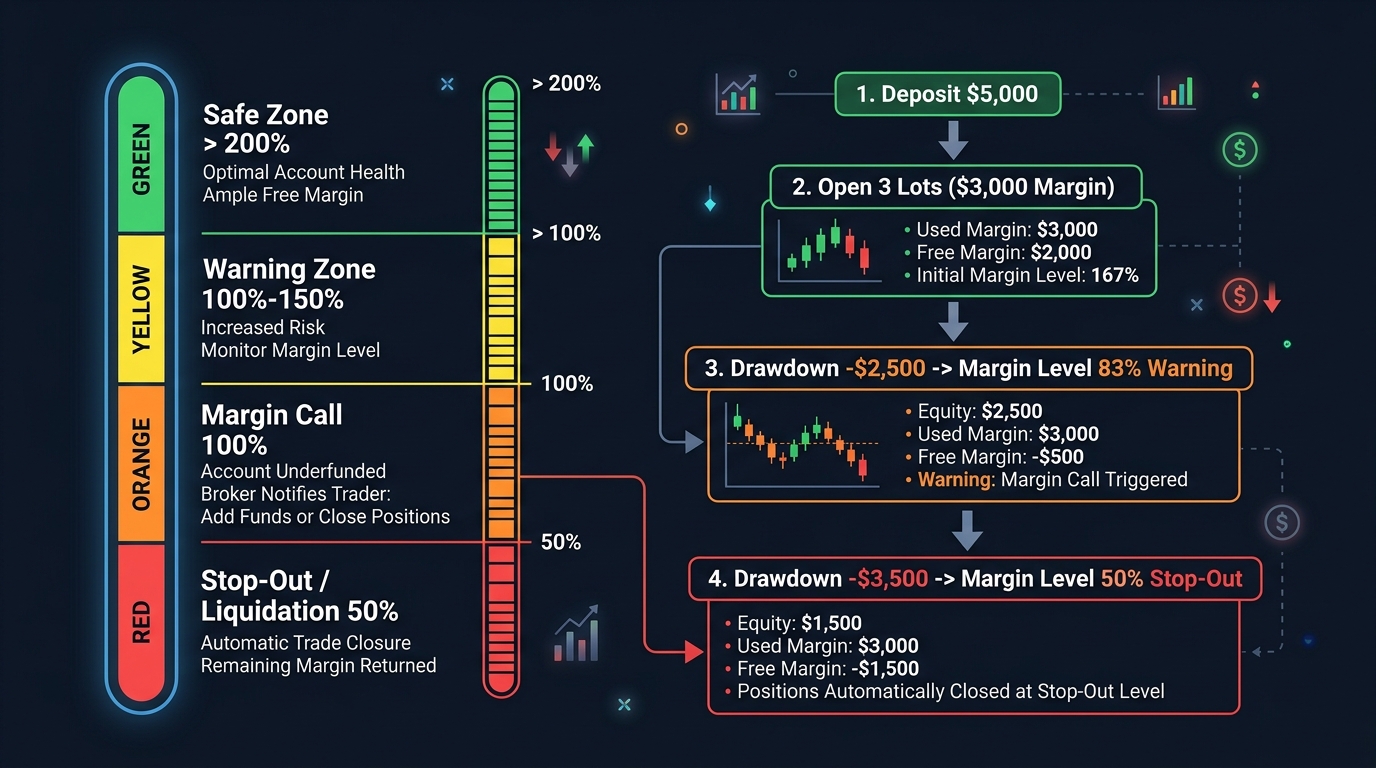
What Is a Margin Call?
A margin call is one of those phrases that traders learn to fear before they fully understand it. At its core, it’s simple: you’ve lost enough on open positions that your broker no longer trusts the remaining balance to cover further losses. They’re asking you to either put in more money or reduce your exposure. If you don’t act, they will.
The mechanism exists because of leverage. When you control $100,000 worth of currency with $1,000 of your own capital, a 1% adverse move wipes out your entire deposit. Brokers cannot legally absorb those losses — so they built automatic tripwires into their systems to stop the bleeding before your account balance hits zero.
How Margin Levels Work
Your broker tracks one key ratio in real time: Margin Level.
Margin Level = (Equity / Used Margin) × 100%
Where Equity = account balance ± open P&L, and Used Margin is the collateral locked to maintain your open positions.
Most brokers set two thresholds:
- Margin Call Level (typically 100%): At this point, you can no longer open new positions. The broker notifies you that your account needs attention.
- Stop-Out Level (typically 50%): If equity falls to 50% of used margin, the broker starts auto-liquidating your open positions — largest losing position first — until margin level recovers above the stop-out threshold.
These numbers vary by broker. Always check yours before trading.
A Concrete Example
Your account balance: $5,000. You open three standard lot positions on EUR/USD, USD/JPY, and GBP/USD. At 100:1 leverage, each standard lot requires $1,000 margin. Total used margin: $3,000.
Market moves against you. Open P&L reaches -$2,500.
- Equity = $5,000 - $2,500 = $2,500
- Margin Level = ($2,500 / $3,000) × 100 = 83%
You’ve already passed the 100% margin call level. The broker can’t let you open new positions. If losses continue to -$3,500 (equity = $1,500):
- Margin Level = ($1,500 / $3,000) × 100 = 50%
Stop-out triggered. The broker closes your biggest losing position automatically.
Why Margin Calls Happen to Experienced Traders
It’s tempting to think margin calls only happen to beginners who don’t know what they’re doing. That’s not accurate. They happen to experienced traders too — usually because of:
Overleveraging: Running too many positions simultaneously. Each one individually might be fine; collectively, they require so much margin that a normal market swing trips the threshold.
No stop-losses: Holding a losing position “because it’ll come back.” Markets can move against you further than you expect, faster than you can react.
News events: A major surprise — an unexpected rate decision, a flash crash, a geopolitical shock — can gap through multiple price levels instantly. By the time the market prints a new price, you’re already below stop-out.
Low-liquidity sessions: Asian session gaps on Monday morning can catch positions that were fine on Friday’s close in a completely different margin situation by Sunday’s market open.
How to Avoid a Margin Call
The most reliable protection is keeping your margin utilization low — never using more than 20–30% of available margin at any time. This leaves buffer for adverse moves without triggering the broker’s automated responses.
Second, always use stop-loss orders. A hard stop-loss ensures that the worst-case loss on any position is known in advance, and that it gets executed before margin levels become critical.
Third, monitor your margin level actively, especially when holding positions through news events or over weekends. Most platforms display it prominently on the trading terminal.
Key Takeaways
- A margin call is triggered when equity falls below the broker’s margin call level (typically 100% margin level)
- Stop-out is the automatic liquidation that follows if equity continues falling (typically 50% margin level)
- Overleveraging and missing stop-losses are the two primary causes
- Keeping margin utilization below 30% provides a meaningful safety buffer
FAQ
Is a margin call always my fault? Sometimes gaps in the market (particularly over weekends) can cause margin calls even with proper stop-losses in place, because price can gap straight through a stop-loss level. This is called slippage, and it’s a known risk of leveraged trading.
Will the broker warn me before liquidating my positions? Modern platforms display margin warnings in real time. Many also send email or SMS notifications when margin level drops to critical thresholds. But there’s no legal requirement for a broker to wait for your response before triggering stop-out.
Ready to trade forex?
Open a free demo account with a regulated broker. Practice with virtual funds before risking real money.