MACRS
The Modified Accelerated Cost Recovery System (MACRS) is the statutory tax depreciation system in the United States, established under the Tax Reform Act of 1986 to accelerate capital expenditure cost recovery for tangible business assets.
The Modified Accelerated Cost Recovery System (MACRS) is the primary tax depreciation framework utilized in the United States. Enacted under the Tax Reform Act of 1986 and codified in Section 168 of the Internal Revenue Code (IRC), MACRS dictates how businesses recover the capitalized cost basis of qualifying tangible personal and real property through annual deductions on federal tax returns.
MACRS allows corporations and individual enterprises to accelerate depreciation expense into the earlier years of an asset’s useful life. By concentrating non-cash depreciation expenses upfront, businesses reduce taxable net income during early operating periods, lower immediate cash tax liabilities, and optimize project net present value (NPV) through accelerated tax shields.
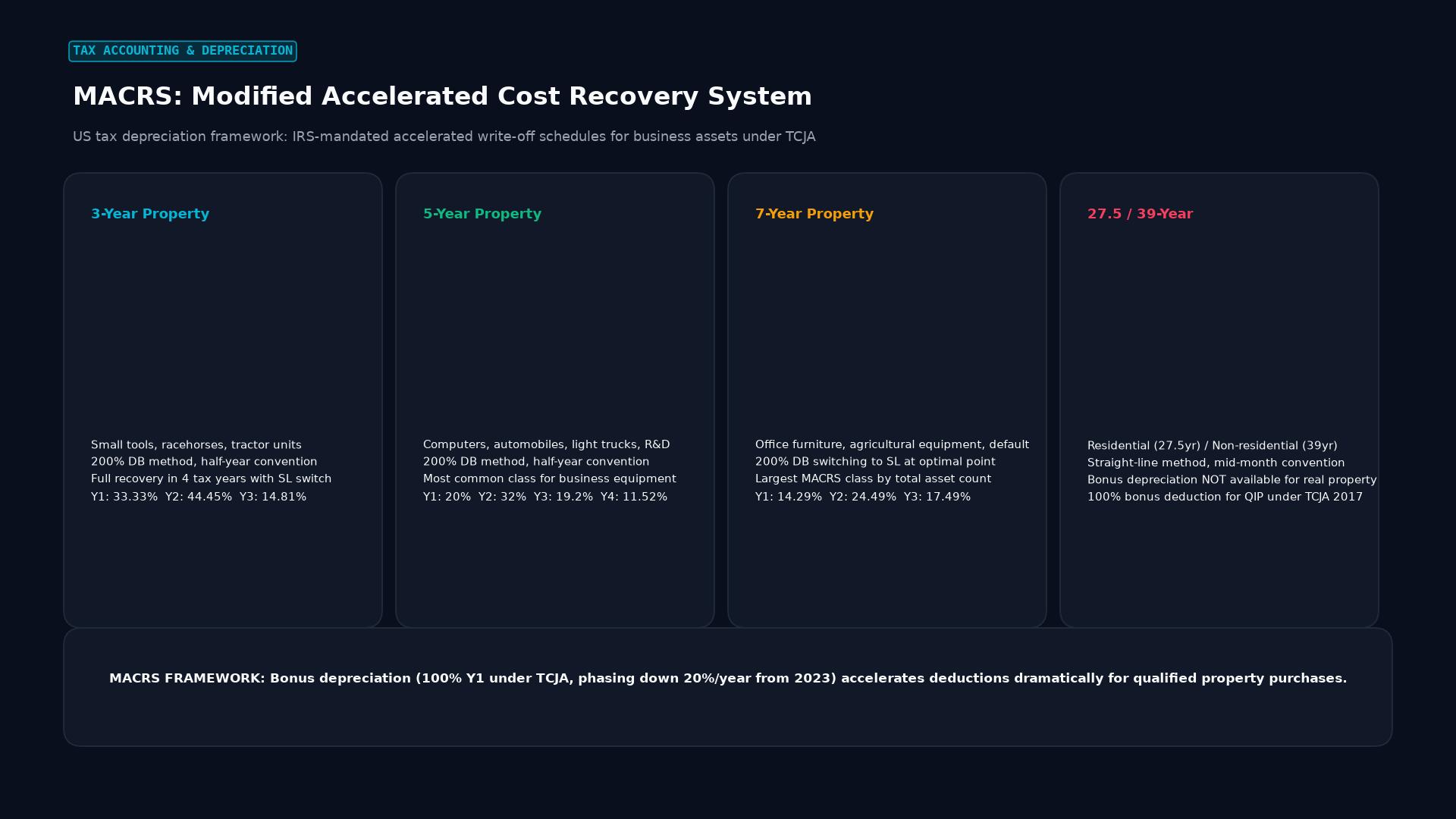 Figure: US tax depreciation framework: IRS-mandated accelerated write-off schedules for business assets under TCJA
Historical and Statutory Background
The tax treatment of capital equipment depreciation has experienced continuous statutory transformation over the past century:
1. Pre-1981 Useful Life Rules and Bulletin F
Prior to 1981, US taxpayers determined asset depreciation using the subjective “useful life” standard outlined in IRS Bulletin F. Corporations negotiated asset lifespans with IRS auditors, generating frequent tax litigation regarding salvage value calculations and estimated obsolescence rates.
2. The Economic Recovery Tax Act of 1981 (ERTA) and ACRS
To combat stagflation and incentivize private capital investment, the Reagan administration enacted the Accelerated Cost Recovery System (ACRS) under ERTA in 1981. ACRS eliminated subjective useful life determinations, discarded salvage value requirements, and introduced ultra-short statutory recovery periods (e.g., 3-year and 5-year buckets) with steep accelerated rates. While successful in stimulating capital expenditure, ACRS created widespread corporate tax shelter abuses and excessive tax revenue losses.
3. The Tax Reform Act of 1986 and MACRS
Congress introduced MACRS in 1986 to curb ACRS excesses while preserving accelerated investment incentives. MACRS lengthened recovery schedules for real estate (extending commercial property from 19 years under late ACRS to 31.5 years, and subsequently to 39 years under the 1993 Omnibus Budget Reconciliation Act). It also introduced the mid-quarter convention to prevent corporations from purchasing all equipment in December to claim full half-year depreciation deductions.
4. TCJA and 100% Bonus Depreciation
Under the Tax Cuts and Jobs Act of 2017 (TCJA), Congress temporarily permitted 100% “bonus depreciation” under IRC Section 168(k) for qualifying property acquired and placed in service between September 2017 and December 2022. This allowed immediate full expensing of 3-year, 5-year, 7-year, 10-year, 15-year, and 20-year MACRS property in year one. Beginning in 2023, bonus depreciation phases down annually by 20 percentage points (80% in 2023, 60% in 2024, 40% in 2025, 20% in 2026, reaching 0% in 2027), restoring standard MACRS tables as the primary cost-recovery mechanism.
Systems, Methods, and Property Classifications
MACRS consists of two primary operational systems: the General Depreciation System (GDS) and the Alternative Depreciation System (ADS). GDS is the default framework applied to most business assets, whereas ADS is mandated for specific foreign-use property, tax-exempt bond-financed property, agricultural assets, or by taxpayer election.
Property Classes Under GDS
Personal property is segmented into specific asset classes based on IRS Revenue Procedure 87-56:
| Class | Typical Assets Included | Depreciation Method | Recovery Period |
|---|---|---|---|
| 3-Year | Tractor units, racehorses, specialized manufacturing tools | 200% Declining Balance | 3 years |
| 5-Year | Automobiles, light general-purpose trucks, computers, peripheral equipment, semiconductor manufacturing equipment | 200% Declining Balance | 5 years |
| 7-Year | Office furniture, fixtures, cellular telecommunications equipment, agricultural machinery, all property without a class life | 200% Declining Balance | 7 years |
| 10-Year | Vessels, barges, tugs, petroleum refining assets, single-purpose agricultural structures | 200% Declining Balance | 10 years |
| 15-Year | Land improvements (fences, sidewalks, drainage), gas utility distribution facilities, qualified improvement property | 150% Declining Balance | 15 years |
| 20-Year | Farm buildings, municipal sewer systems, electrical transmission assets | 150% Declining Balance | 20 years |
| 27.5-Year | Residential rental property (buildings where >=80% of gross income is derived from dwelling units) | Straight-Line | 27.5 years |
| 39-Year | Nonresidential real property (office buildings, warehouses, retail stores, industrial facilities) | Straight-Line | 39 years |
Mathematical Mechanics: Declining Balance and Averaging Conventions
MACRS utilizes an accelerated declining balance formula that switches automatically to the straight-line method in the tax year where straight-line depreciation yields an equal or greater deduction over the remaining recovery period. Salvage value is treated as zero ($S = 0$).
1. The 200% Declining Balance Formula
For 3-, 5-, 7-, and 10-year property, the initial declining balance depreciation rate ($R_{\text{DB}}$) is double the straight-line rate:
$$R_{\text{DB}} = \frac{2}{\text{Recovery Period (Years)}}$$
For a 5-year asset, the base rate is:
$$R_{\text{DB}} = \frac{2}{5} = 0.40 \text{ (or 40% per annum)}$$
2. Averaging Conventions
Tax regulations mandate specific conventions regarding when an asset is deemed placed in service:
- Half-Year Convention: The default convention for personal property. Any asset acquired during the tax year is treated as placed in service at the exact midpoint of the tax year (July 1 for calendar-year filers), entitling the owner to exactly one-half of the full-year depreciation deduction in Year 1. Because the first half-year is deducted in Year 1, a 5-year asset requires 6 calendar tax years to fully recover.
- Mid-Quarter Convention: Triggered automatically if more than 40% of the aggregate depreciable basis of all personal property acquired during the tax year is placed in service during the fourth quarter (October 1 to December 31). When triggered, all assets acquired during the year must be depreciated based on the midpoint of the specific quarter in which they were placed in service.
- Mid-Month Convention: Mandated for 27.5-year residential and 39-year nonresidential real property. The asset is treated as placed in service at the midpoint of the month of acquisition, regardless of the exact day the transaction closed.
3. Switch to Straight-Line Example (5-Year GDS Property, Half-Year)
For a $100,000 asset with a 5-year recovery period under the half-year convention:
- Year 1: Base rate = 40%. Applying the half-year convention (50%): Rate = 20.00%. Deduction = $20,000. Remaining adjusted basis = $80,000.
- Year 2: 40% applied to adjusted basis: $80,000 \times 40% = $32,000$ (32.00% of initial basis). Remaining adjusted basis = $48,000.
- Year 3: 40% applied to adjusted basis: $48,000 \times 40% = $19,200$ (19.20% of initial basis). Remaining adjusted basis = $28,800.
- Year 4: 40% of $28,800 is $11,520. However, remaining recovery period is 2.5 years. Straight-line on remaining basis: $\frac{28,800}{2.5} = $11,520$ (11.52% of initial basis). The method switches to straight-line. Remaining adjusted basis = $17,280.
- Year 5: Straight-line deduction: $\frac{28,800}{2.5} = $11,520$ (11.52% of initial basis). Remaining adjusted basis = $5,760.
- Year 6: Half-year balance remaining: $$5,760$ (5.76% of initial basis). Final adjusted basis = $0.
       5-YEAR MACRS GDS PERCENTAGE DEDUCTION PROFILE

Annual %
Deduction
   ^
   |      32.00%
   |      +----+
   |      |    |
   |      |    |  20.00%
   |      |    |  +----+        19.20%
   |      |    |  |    |        +----+
   |      |    |  |    |        |    |  11.52%  11.52%
   |      |    |  |    |        |    |  +----+  +----+
   |      |    |  |    |        |    |  |    |  |    |   5.76%
   |      |    |  |    |        |    |  |    |  |    |  +----+
   +------+----+--+----+--------+----+--+----+--+----+--+----+->
           Yr 2    Yr 1          Yr 3    Yr 4    Yr 5    Yr 6
Corporate Capital Budgeting and the Depreciation Tax Shield
In corporate finance and discounted cash flow (DCF) valuation, depreciation is a non-cash expense that generates value exclusively by shielding pre-tax operating income from cash corporate income taxes. The nominal annual tax shield ($TS_t$) is defined as:
$$TS_t = D_t \times T_c$$
Where:
- $D_t$ is the MACRS depreciation deduction in year $t$.
- $T_c$ is the marginal corporate income tax rate (e.g., 21% US federal statutory rate plus applicable state taxes).
The present value of the depreciation tax shield ($PV_{\text{TS}}$) discounted at the firm’s cost of capital ($k$ or WACC) is:
$$PV_{\text{TS}} = \sum_{t=1}^{N} \frac{D_t \times T_c}{(1 + k)^t}$$
Because MACRS concentrates deductions ($D_t$) in early years when the discount factor $\frac{1}{(1+k)^t}$ is largest, MACRS yields a higher net present value than book straight-line depreciation.
Financial Accounting vs Tax Differences (ASC 740)
Under US GAAP (ASC 740) and IFRS (IAS 12), financial statements report book depreciation using straight-line schedules matching an asset’s economic useful life (often 10 to 15 years for machinery, with an estimated salvage value). For tax returns, the company reports MACRS accelerated depreciation.
This creates a temporary book-to-tax timing difference:
- Early Years: MACRS tax depreciation exceeds GAAP book depreciation ($D_{\text{tax}} > D_{\text{book}}$). Taxable income is lower than pre-tax accounting book income, meaning cash taxes paid to the IRS are lower than GAAP income tax expense. The company records a Deferred Tax Liability (DTL) on its balance sheet.
- Later Years: Book depreciation exceeds MACRS tax depreciation ($D_{\text{book}} > D_{\text{tax}}$). Taxable income exceeds accounting income, cash taxes paid exceed income tax expense, and the Deferred Tax Liability is systematically reversed.
       BOOK VS TAX TIMING DIFFERENCE (ASC 740)

       Years 1 - 3: Accelerated Cost Recovery Phase
       Tax Depreciation > Book Depreciation
       Current Tax Paid < Book Tax Expense
       ====> Balance Sheet: Credit Deferred Tax Liability (DTL)

       Years 4 - 10: Reversal Phase
       Book Depreciation > Tax Depreciation
       Current Tax Paid > Book Tax Expense
       ====> Balance Sheet: Debit Deferred Tax Liability (DTL)
Real-World Case Study: Semiconductor Fabrication Facility
In 2024, a semiconductor manufacturer invests $50,000,000 in specialized clean-room photolithography equipment classified as 5-year GDS property. The corporate cost of capital is 9.0%, and the combined federal-state tax rate is 25.0%.
Under standard MACRS 5-year GDS (half-year convention, no bonus depreciation elected), the depreciation schedule and resulting tax shields are calculated as follows:
+-------------------------------------------------------------------------+
|                  SEMICONDUCTOR EQUIPMENT TAX SHIELD                     |
+-------------------------------------------------------------------------+
| Year | MACRS % | Tax Deduction | Tax Shield (25%) | PV Factor | PV @ 9% |
| :--- | :---    | :---          | :---             | :---      | :---    |
| 1    | 20.00%  | $10,000,000   | $2,500,000       | 0.9174    | $2,293,500
| 2    | 32.00%  | $16,000,000   | $4,000,000       | 0.8417    | $3,366,800
| 3    | 19.20%  | $9,600,000    | $2,400,000       | 0.7722    | $1,853,280
| 4    | 11.52%  | $5,760,000    | $1,440,000       | 0.7084    | $1,020,096
| 5    | 11.52%  | $5,760,000    | $1,440,000       | 0.6499    | $935,856
| 6    | 5.76%   | $2,880,000    | $720,000         | 0.5963    | $429,336
+------+---------+---------------+------------------+-----------+---------+
| Total| 100.0%  | $50,000,000   | $12,500,000      | -         | $9,898,868
+-------------------------------------------------------------------------+
If the company were forced to use 10-year straight-line book depreciation for tax purposes ($5,000,000 per year, yielding an annual tax shield of $1,250,000), the present value of the tax shield at 9% would be $8,022,080.
By applying MACRS, the enterprise accelerates cash flows and captures an additional $1,876,788 in present value. This capital efficiency directly expands project return on invested capital (ROIC) and supports corporate capital investment.
Depreciation Recapture Rules (IRC Section 1245 and 1250)
When a business sells a depreciated asset for an amount greater than its adjusted tax basis (original basis less accumulated MACRS deductions), the IRS enforces depreciation recapture to prevent taxpayers from transforming ordinary income deductions into lower-taxed capital gains:
- Section 1245 Recapture (Personal Property): Gain realized on the sale of personal property (5-year, 7-year equipment) is recharacterized as ordinary income up to the total amount of accumulated MACRS depreciation taken. Any sale price exceeding the original unadjusted cost basis is taxed as long-term capital gain.
- Section 1250 / Unrecaptured Section 1250 Gain (Real Estate): For depreciable real property, accumulated straight-line depreciation is taxed upon sale at a maximum federal rate of 25%, while true capital appreciation above original purchase price qualifies for standard long-term capital gain rates (0%, 15%, or 20%).
Frequently Asked Questions
Can an enterprise choose between straight-line depreciation and MACRS on its federal tax return?
Under IRC Section 168, a taxpayer may make an irrevocable election to use the straight-line method under either the General Depreciation System (GDS) or the Alternative Depreciation System (ADS) for an entire property class placed in service during that tax year. An enterprise cannot cherry-pick individual assets within the same property class. Once elected for a property class during a tax year, the straight-line election cannot be revoked.
What occurs if an asset is sold before the end of its MACRS recovery schedule?
If an asset subject to the half-year convention is disposed of prior to the end of its recovery period, the taxpayer is entitled to claim exactly half of the scheduled MACRS depreciation deduction for that final year of disposition. The asset’s adjusted tax basis is reduced by this half-year deduction, and the remaining adjusted basis is compared against the net sale proceeds to compute the taxable gain or loss.
Why is commercial real estate depreciated over 39 years under MACRS while residential property is depreciated over 27.5 years?
Congress established these recovery periods in the Tax Reform Act of 1986 and subsequent budget legislation based on public policy priorities and economic obsolescence studies. Residential rental housing was granted a shorter 27.5-year schedule to encourage domestic housing construction and affordability. Commercial buildings (office towers, factories, retail shopping centers) were assigned longer lifespans (extended from 31.5 to 39 years in 1993) to reflect their longer physical durability and to generate federal tax revenues.
Ready to trade forex?
Open a free demo account with a regulated broker. Practice with virtual funds before risking real money.