Accumulated Depreciation
Accumulated Depreciation is a cumulative contra-asset account on the balance sheet that tracks the total depreciation expense allocated against a company's tangible fixed assets since they were placed in service.
What Is Accumulated Depreciation?
Accumulated Depreciation is a cumulative long-term balance sheet account that records the aggregate amount of wear, tear, physical deterioration, and obsolescence expensed against a corporation’s tangible fixed assets over time.
Under the accrual accounting framework mandated by US GAAP (ASC 360) and IFRS (IAS 16), when a business purchases physical capital assets (such as manufacturing equipment, delivery trucks, corporate buildings, or computer hardware), it cannot deduct the full purchase cost immediately on the income statement. Instead, the expenditure is capitalized on the balance sheet under Property, Plant, and Equipment (PP&E) and expensed incrementally across the asset’s estimated useful economic life.
Accumulated depreciation functions as a contra-asset account, meaning it carries a natural credit balance that directly offsets the debit balance of the corresponding gross asset account, arriving at the net asset value reported to investors.
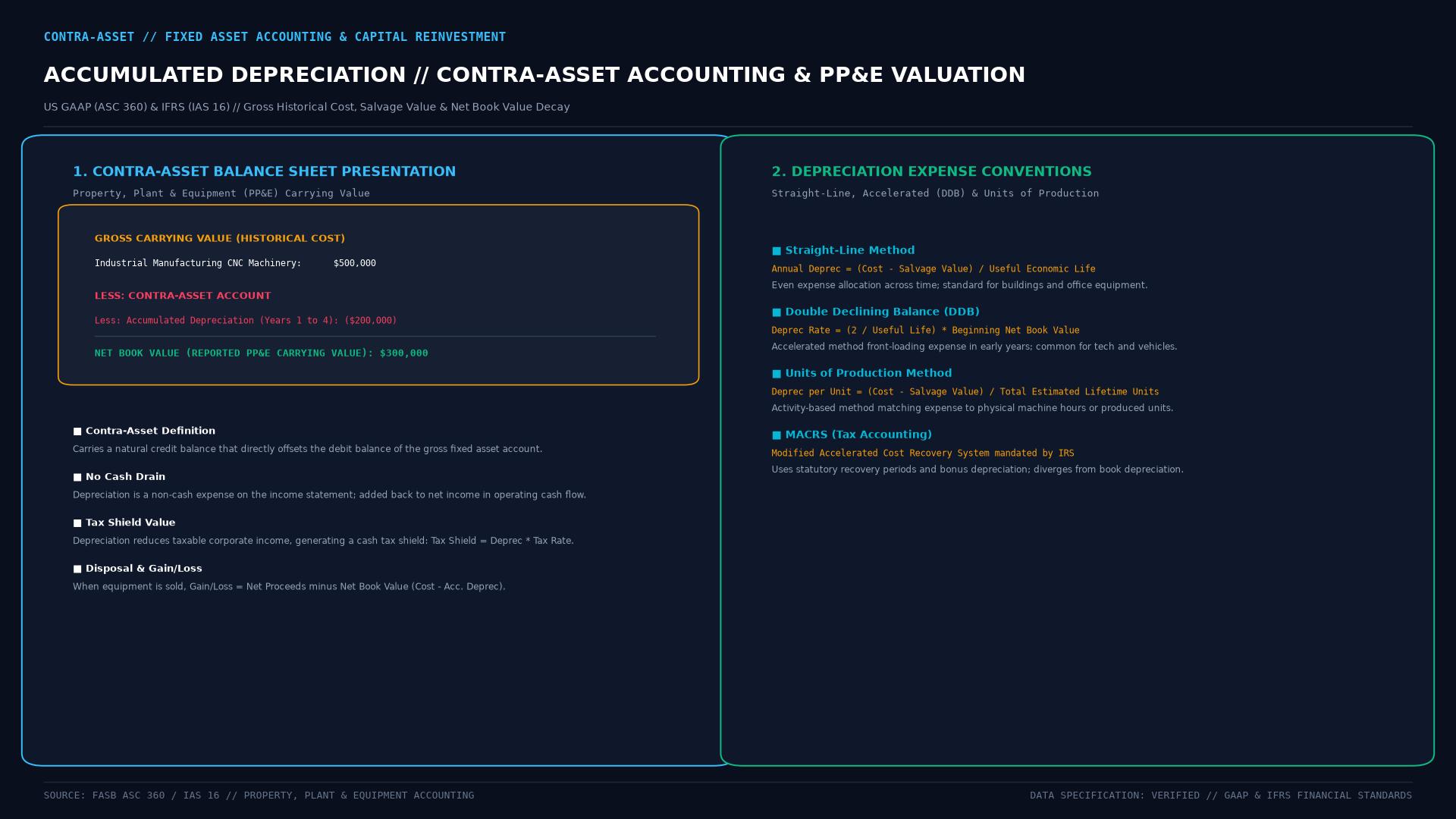 Figure: Contra-asset accounting mechanics for Accumulated Depreciation under US GAAP (ASC 360) and IFRS (IAS 16), illustrating Property, Plant & Equipment (PP&E) Net Book Value decay, straight-line, DDB, and units-of-production conventions.
Technical Mechanics & Calculation Methods
The annual allocation transferred into accumulated depreciation is determined by the specific depreciation convention selected by corporate treasury:
1. Straight-Line Depreciation
The straight-line convention divides the depreciable base evenly over the asset’s productive life:
Annual Depreciation = (Historical Cost - Estimated Salvage Value) / Useful Economic LifeIf an enterprise purchases a specialized cargo aircraft for $20,000,000 with an expected salvage value of $2,000,000 and an 18-year useful life, annual depreciation is $1,000,000 ($18M / 18). Each year, $1,000,000 is debited to Depreciation Expense (income statement) and credited to Accumulated Depreciation (balance sheet).
2. Accelerated Depreciation (Double Declining Balance)
Accelerated methods front-load expense recognition into earlier operating years when machinery operates at peak mechanical efficiency:
DDB Depreciation Rate = (2 / Useful Life) × Beginning Net Book ValueUnder this method, salvage value is not subtracted in the initial rate formula, though net carrying value cannot be depreciated below estimated salvage value.
3. Units of Production Method
Depreciation is tied directly to physical equipment utilization rather than the passage of calendar time:
Depreciation per Unit = (Historical Cost - Salvage Value) / Total Estimated Lifetime Output UnitsAccounting Entries on Asset Disposal and Retirement
When an asset completes its operational service or is sold on secondary markets, the accumulated depreciation account must be fully derecognized alongside the original historical cost:
Cash Received (if sold)                        [DEBIT]
Accumulated Depreciation (Full historical sum) [DEBIT]
    Gross Equipment Asset (Original Cost)      [CREDIT]
    Gain on Asset Disposal (if Cash > NBV)     [CREDIT]
    (or Loss on Asset Disposal if Cash < NBV)  [DEBIT]
If an asset with an original cost of $100,000 and accumulated depreciation of $85,000 (Net Book Value of $15,000) is sold for $22,000, the company records a recognized pre-tax operating gain of $7,000.
Comparative Matrix: Depreciation vs. Amortization vs. Impairment
| Dimension | Accumulated Depreciation | Accumulated Amortization | Asset Impairment |
|---|---|---|---|
| Target Assets | Physical tangible property, machinery, vehicles | Intangible assets (patents, software, trademarks) | Any asset whose fair value drops below carrying cost |
| Schedule Type | Predictable schedule over estimated useful life | Linear schedule over contractual or legal term | Sudden, non-recurring, one-off write-down |
| Land Inclusions | Strictly excluded (land has infinite useful life) | Not applicable | Applicable if property value permanently collapses |
| Cash Impact | Non-cash operating adjustment on Cash Flow Statement | Non-cash operating adjustment on Cash Flow Statement | Non-cash charge directly reducing net income |
| Reversibility | Irreversible under US GAAP and IFRS | Irreversible under US GAAP and IFRS | Reversible under IFRS (except goodwill); prohibited under GAAP |
Real-World Case Study: Semiconductor Fabrication Foundry
In 2021, an international semiconductor manufacturer invested $1.2 billion in extreme ultraviolet (EUV) photolithography fabrication tools. The company scheduled depreciation across an eight-year useful life using straight-line methodology with an estimated $120 million residual scrap recovery value:
- Annual Depreciation Expense: ($1,200,000,000 - $120,000,000) / 8 = $135,000,000 per year.
- Year 4 Position (2025):
- Gross Equipment: $1,200,000,000
- Accumulated Depreciation: $540,000,000 ($135M × 4)
- Net Book Value: $660,000,000
When technological advancements rendered the EUV tools partially obsolete in late 2025, an independent appraisal placed the market liquidation value of the tools at $450,000,000. Under ASC 360 impairment testing, because the net book value ($660M) exceeded fair market value ($450M), the firm recorded a $210 million non-cash asset impairment charge, resetting the asset carrying base and recalculating subsequent annual depreciation schedules.
Frequently Asked Questions (FAQ)
Is accumulated depreciation a cash reserve fund for replacing equipment?
No. Accumulated depreciation is an accounting allocation mechanism, not a cash bank account. It does not represent segregated money set aside to purchase future replacement machinery. Replacing physical assets requires liquid corporate cash flow or debt financing.
Why is accumulated depreciation added back on the Statement of Cash Flows?
On the indirect Statement of Cash Flows, depreciation expense is added back to net income because it is a non-cash expense. The company recorded an accounting expense that reduced reported net income on the income statement, but no physical cash left the corporate bank accounts during the period.
Can accumulated depreciation exceed the historical cost of an asset?
No. Once accumulated depreciation reaches the asset’s depreciable base (cost minus salvage value), depreciation ceases completely. An asset can remain in active operational use with a Net Book Value equal to its salvage value, but accumulated depreciation can never exceed gross capitalized cost.
Ready to trade forex?
Open a free demo account with a regulated broker. Practice with virtual funds before risking real money.