Maggie Mae (MGIC)
Maggie Mae is the financial market colloquialism for pass-through mortgage-backed securities issued by the Mortgage Guaranty Insurance Corporation (MGIC), the pioneer of the private mortgage insurance (PMI) industry in the United States.
Maggie Mae is the bond market nickname for the residential pass-through securities and mortgage conduit programs originated and insured by the Mortgage Guaranty Insurance Corporation (MGIC). Formed in Milwaukee, Wisconsin, in 1957 by real estate attorney Max H. Karl, MGIC invented the modern private mortgage insurance (PMI) industry.
In the secondary mortgage market, Wall Street traders coined the phonetic moniker “Maggie Mae” to differentiate MGIC’s privately backed mortgage pools from government-sponsored enterprise (GSE) and government-agency paper: Fannie Mae (Federal National Mortgage Association, FNMA), Freddie Mac (Federal Home Loan Mortgage Corporation, FHLMC), and Ginnie Mae (Government National Mortgage Association, GNMA). While GSE paper carried implicit or explicit government backstops, Maggie Mae securities represented the earliest successful wave of private-label mortgage securitization, supported by private insurance capital rather than sovereign credit guarantees.
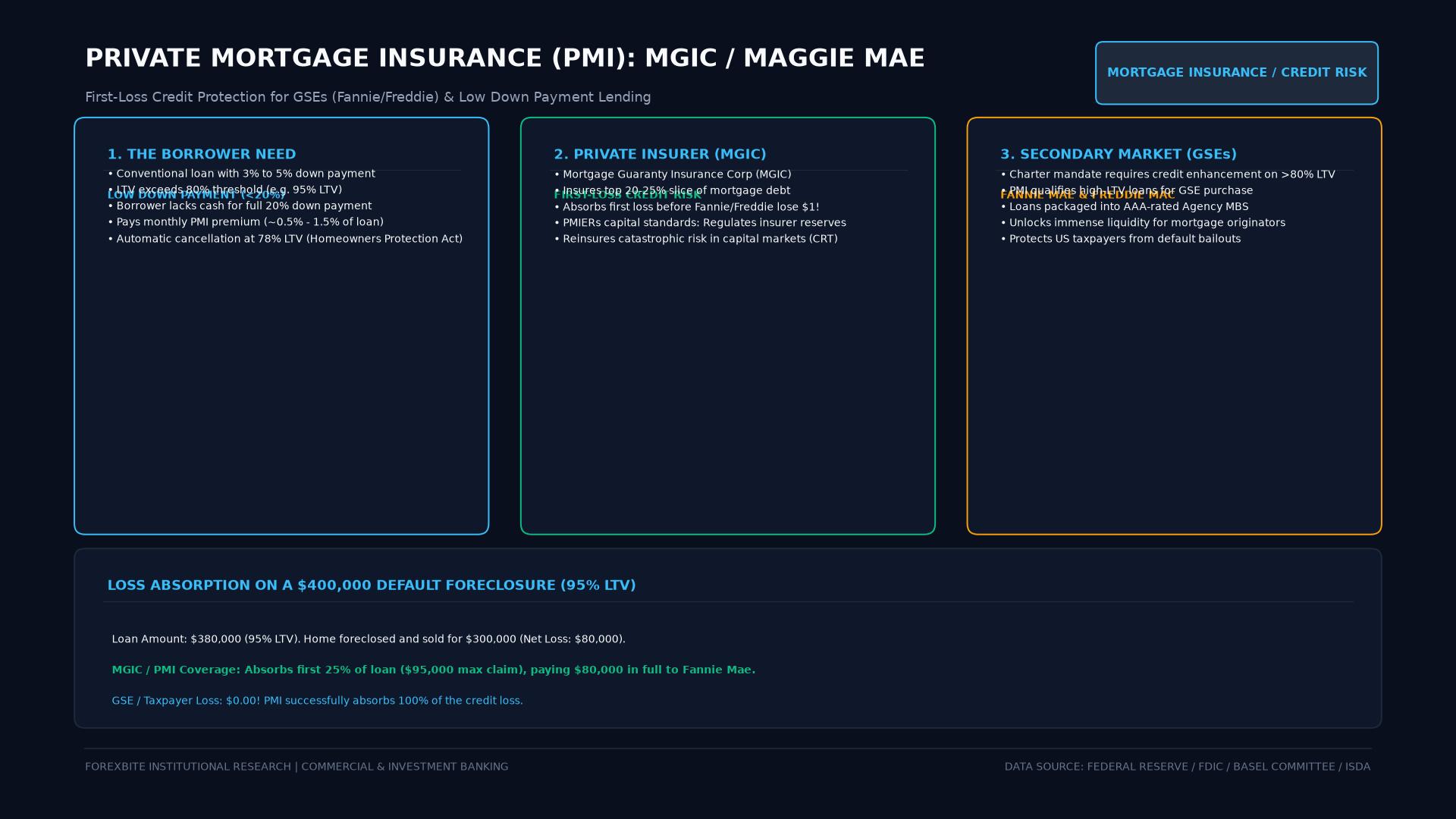 Figure: Private mortgage insurance structure: first-loss credit risk protection for high-LTV residential mortgages, facilitating secondary agency sales.
Historical Origins and the Birth of Private Mortgage Insurance
Prior to 1957, the American residential mortgage market was bifurcated:
- Government-Insured Lending: The Federal Housing Administration (FHA), established under the National Housing Act of 1934, and the Veterans Administration (VA) insured high loan-to-value (LTV) mortgages. However, FHA loans were constrained by rigid statutory loan limits, complex bureaucratic approval procedures, and restrictive interest rate caps.
- Conventional Uninsured Lending: Commercial banks and savings and loan associations (S&Ls) demanded mandatory 20% to 33% cash down payments (maximum 66% to 80% LTV) to protect their balance sheets against borrower default.
In 1957, Max H. Karl recognized that creditworthy homebuyers were locked out of homeownership solely due to the lack of upfront liquid cash for a 20% down payment. He established MGIC to insure the top portion of conventional mortgages against default risk. By charging borrowers a monthly insurance premium, MGIC provided commercial lenders with third-party credit enhancement, allowing banks to issue conventional mortgages with down payments as low as 5% to 10% (90% to 95% LTV).
Creation of the Maggie Mae Securitization Conduit
In the early 1970s, as interest rate volatility disrupted the deposit bases of savings and loan associations, MGIC formed the MGIC Mortgage Corporation. This entity acted as an aggregator conduit:
- It bought conventional insured mortgages from independent mortgage originators.
- It packaged these mortgages into diversified pools.
- It issued pass-through certificates nicknamed “Maggie Maes” to institutional investors, including pension funds and life insurance companies.
MGIC provided a 5% top-layer pool insurance policy on the entire securitization package, complementing the primary mortgage insurance on individual underlying home loans. This innovation created the architectural template for the multi-trillion-dollar private-label residential mortgage-backed securities (RMBS) market.
              MAGGIE MAE SECURITIZATION FLOW

  +------------------+         +--------------------+
  | Retail Homebuyer |         | Retail Homebuyer   |
  | (90% LTV Loan)   |         | (95% LTV Loan)     |
  +------------------+         +--------------------+
           \                            /
            v                          v
  +-------------------------------------------------+
  | Primary Originating Lender (Bank / S&L)         |
  | Attaches MGIC Private Mortgage Insurance (PMI)  |
  +-------------------------------------------------+
                           |
                           v Whole Loan Purchase
  +-------------------------------------------------+
  | MGIC Mortgage Corporation (Conduit / Maggie Mae)|
  | Aggregates Pools & Adds Master Pool Insurance   |
  +-------------------------------------------------+
                           |
                           v Securitization Transfer
  +-------------------------------------------------+
  | Maggie Mae Pass-Through Trust                   |
  +-------------------------------------------------+
                           |
                           v Monthly P&I Cash Flows
  +-------------------------------------------------+
  | Institutional Investors: Pensions, Insurers     |
  +-------------------------------------------------+
Core Mechanics of Private Mortgage Insurance (PMI)
The credit mechanics of MGIC and Maggie Mae center on the contractual absorption of first-loss credit exposure. When a conventional mortgage exceeds the statutory 80% loan-to-value threshold ($LTV > 80%$), Fannie Mae and Freddie Mac charters require credit enhancement before the GSEs can purchase the loan. MGIC provides this credit enhancement through private mortgage insurance.
1. Primary Coverage Tranches
PMI does not insure 100% of the mortgage balance. Instead, it insures a defined top percentage of the loan: typically between 12% and 35% of the unpaid principal balance (UPB), depending on the initial loan-to-value ratio:
- 85% LTV: 12% primary insurance coverage.
- 90% LTV: 25% primary insurance coverage.
- 95% LTV: 30% primary insurance coverage.
- 97% LTV: 35% primary insurance coverage.
This coverage structure ensures that if a borrower defaults and the property is foreclosed and liquidated at a discount, the lender or secondary market investor is protected down to an effective 65% to 75% LTV level.
2. Mathematical Loss Severity Calculation
When a borrower defaults and the property enters judicial or statutory foreclosure, the claim settlement under MGIC coverage follows an explicit mathematical formula:
$$\text{Claim Amount} = \text{UPB} + \text{Accrued Delinquent Interest} + \text{Allowable Legal & Property Preservation Expenses}$$
$$\text{PMI Claim Payout} = \text{Claim Amount} \times \text{Coverage Percentage}$$
The net loss severity incurred by the mortgage investor is expressed as:
$$\text{Net Investor Loss} = \max\Big(0, \text{Claim Amount} - \text{Net Realized Property Liquidation Value} - \text{PMI Claim Payout}\Big)$$
Consider an example of a defaulted mortgage:
- Original Purchase Price: $400,000.
- Unpaid Principal Balance (UPB) at Default: $360,000 (initial 90% LTV).
- Contracted MGIC PMI Coverage: 25%.
- Accrued Delinquent Interest: $15,000.
- Foreclosure, Legal, and Broker Fees: $25,000.
- Total Gross Claim Amount: $$360,000 + $15,000 + $25,000 = $400,000$.
$$\text{MGIC Cash Payout} = $400,000 \times 25% = $100,000$$
If the foreclosed property is auctioned in a distressed housing market for $310,000:
- Total Cash Recovered by Investor: $$310,000 \text{ (Property Sale)} + $100,000 \text{ (MGIC Payout)} = $410,000$.
- Because total proceeds ($410,000) exceed the claim amount ($400,000), the investor suffers $0 credit loss.
MGIC absorbed the entire economic shock, insulating the secondary pass-through investor from loss.
       PMI FIRST-LOSS CREDIT ABSORPTION BUFFER

$400,000 Total Default Exposure
+-------------------------------------------------------+
| Top Layer Absorbed by MGIC PMI (25% = $100,000)       | <- First Loss
+-------------------------------------------------------+
| Secondary Recovery via Property Liquidation ($310,000)| <- Core Collateral
+-------------------------------------------------------+
| Residual Investor Capital ($0 Impairment)             | <- Senior Position
+-------------------------------------------------------+
The Homeowners Protection Act of 1998 (HPA)
For retail mortgage borrowers, private mortgage insurance represented an added monthly expense. To prevent lenders from collecting PMI premiums indefinitely after the underlying collateral equity had appreciated, the US Congress enacted the Homeowners Protection Act of 1998 (HPA), known as the “PMI Cancellation Act”:
- Borrower-Requested Cancellation: A borrower with an established record of on-time payments has the legal right to submit a written request to cancel PMI once the principal balance of the mortgage reaches 80% of the original property value, or if a certified appraisal confirms that home price appreciation has driven current LTV below 75-80%.
- Automatic Termination: The loan servicer is legally mandated to automatically terminate PMI cancellation on the date the principal balance is scheduled to reach 78% of the original value based on the initial amortization schedule, provided the loan is current.
- Final Statutory Sunset: If PMI has not been canceled earlier, it must legally terminate at the midpoint of the amortization period (e.g., at month 180 of a 30-year fixed-rate mortgage), regardless of the outstanding loan-to-value ratio.
Real-World Case Study: The 2008 Financial Crisis and PMIERs Reform
The 2007-2008 subprime mortgage crisis presented an existential stress test for MGIC, Maggie Mae conduits, and the entire private mortgage insurance industry.
+--------------------------------------------------------------------+
|               THE 2008 SUBPRIME CONTROVERSY & MGIC                 |
+--------------------------------------------------------------------+
| 1. Market Distortions: Proliferation of "piggyback" 80-20 loans     |
|    designed specifically to circumvent PMI requirements.           |
| 2. Lax Underwriting: Introduction of Alt-A, low-doc, and no-doc    |
|    mortgage pools carrying private insurance.                      |
| 3. Nationwide Home Price Collapse: Case-Shiller index fell >30%.   |
| 4. Claim Surge: Foreclosure volumes overwhelmed legacy reserves;   |
|    MGIC incurred billions in cumulative underwriting losses.        |
| 5. Regulatory Response (2015): FHFA established PMIERs (Private    |
|    Mortgage Insurer Eligibility Requirements) to mandate capital.  |
+--------------------------------------------------------------------+
Between 2007 and 2011, several legacy mortgage insurers (such as PMI Group, Triad, and Republic Mortgage Insurance) entered receivership as claims eclipsed capital reserves. While MGIC survived, it was forced to dilute equity, execute massive reinsurance treaties, and draw down capital buffers to honor claims.
Post-Crisis PMIERs Framework
In 2015, the Federal Housing Finance Agency (FHFA), acting as conservator for Fannie Mae and Freddie Mac, established the Private Mortgage Insurer Eligibility Requirements (PMIERs):
- Risk-Based Required Assets: Private mortgage insurers must maintain a minimum level of liquid, high-quality assets calibrated to the risk profile of each insured loan (factoring in FICO credit score, LTV, debt-to-income ratio, and vintage).
- Available Assets Requirement: Insurers must continuously maintain Available Assets that equal or exceed Required Assets:
$$\text{PMIERs Sufficiency Ratio} = \frac{\text{Available Assets}}{\text{Required Assets}} \ge 100%$$
- Credit Risk Transfers (CRT): To satisfy PMIERs while expanding insurance volume, MGIC and its peers institutionalized Insurance-Linked Notes (ILNs). Under program names such as Home Re, MGIC transfers catastrophic credit layers directly to capital market reinsurance investors, ensuring private insurers maintain solvent liquidity buffers through deep economic contractions.
Comparison: Maggie Mae vs GSEs
| Attribute | Maggie Mae / MGIC | Fannie Mae (FNMA) | Freddie Mac (FHLMC) | Ginnie Mae (GNMA) |
|---|---|---|---|---|
| Legal Structure | Private Corporation | GSE (Under Conservatorship) | GSE (Under Conservatorship) | Wholly Owned US Gov Corp |
| Federal Guarantee | None | Implicit (FHFA Backstop) | Implicit (FHFA Backstop) | Full Faith and Credit |
| Underlying Loans | Conventional Insured | Conventional Conforming | Conventional Conforming | FHA, VA, USDA, PIH |
| Primary Risk | Insurer Balance Sheet | Systematic Housing Default | Systematic Housing Default | Prepayment / Sovereign |
| Capital Standard | PMIERs / State Insurance | FHFA Regulatory Capital | FHFA Regulatory Capital | US Treasury Direct |
Frequently Asked Questions
Is Maggie Mae an active US government agency?
No. Maggie Mae is an informal financial market nickname referring to the mortgage pass-through securities and conduit programs developed by the Mortgage Guaranty Insurance Corporation (MGIC). MGIC is an independent, publicly traded private financial corporation (NYSE: MTG) and is not a government agency, government-sponsored enterprise (GSE), or public entity.
How does private mortgage insurance differ from federal FHA mortgage insurance?
FHA mortgages are backed by the federal government and charge both an upfront mortgage insurance premium (UFMIP) and an annual monthly premium (MIP) that typically remains in place for the entire 30-year life of the loan. Private mortgage insurance (PMI) on conventional loans requires zero upfront federal fees, can be canceled under the Homeowners Protection Act once home equity reaches 20%, and generally costs less for borrowers with strong FICO credit scores.
Why did Wall Street give MGIC securities the nickname Maggie Mae?
When the modern secondary mortgage market was established in the late 1960s and early 1970s, traders used personified nicknames to differentiate securities issuers: FNMA became “Fannie Mae”, GNMA became “Ginnie Mae”, and FHLMC became “Freddie Mac”. When MGIC Mortgage Corporation began issuing its own private-label pass-through certificates, institutional traders adopted “Maggie Mae” to simplify verbal execution across dealing desks.
Ready to trade forex?
Open a free demo account with a regulated broker. Practice with virtual funds before risking real money.