Default
Default is the failure of a borrower or debt issuer to fulfill legal contractual obligations of a debt agreement, encompassing missed interest coupon payments, non-repayment of principal, or covenant breaches.
What Is a Financial Default?
In debt markets and credit risk management, a default occurs when a debtor—whether an individual borrower, a multinational corporation, a municipal authority, or a sovereign national government—fails to satisfy the legally binding terms and financial covenants stipulated in a credit agreement or bond indenture.
Most commonly, a default is triggered by a payment failure: the debtor fails to make a scheduled interest coupon payment or repay the full principal balance upon bond maturity beyond statutory grace periods. However, default can also be triggered by a covenant violation (technical default) or through an involuntary distressed debt restructuring where creditors are coerced into accepting significant financial losses (“haircuts”) under the threat of total non-payment.
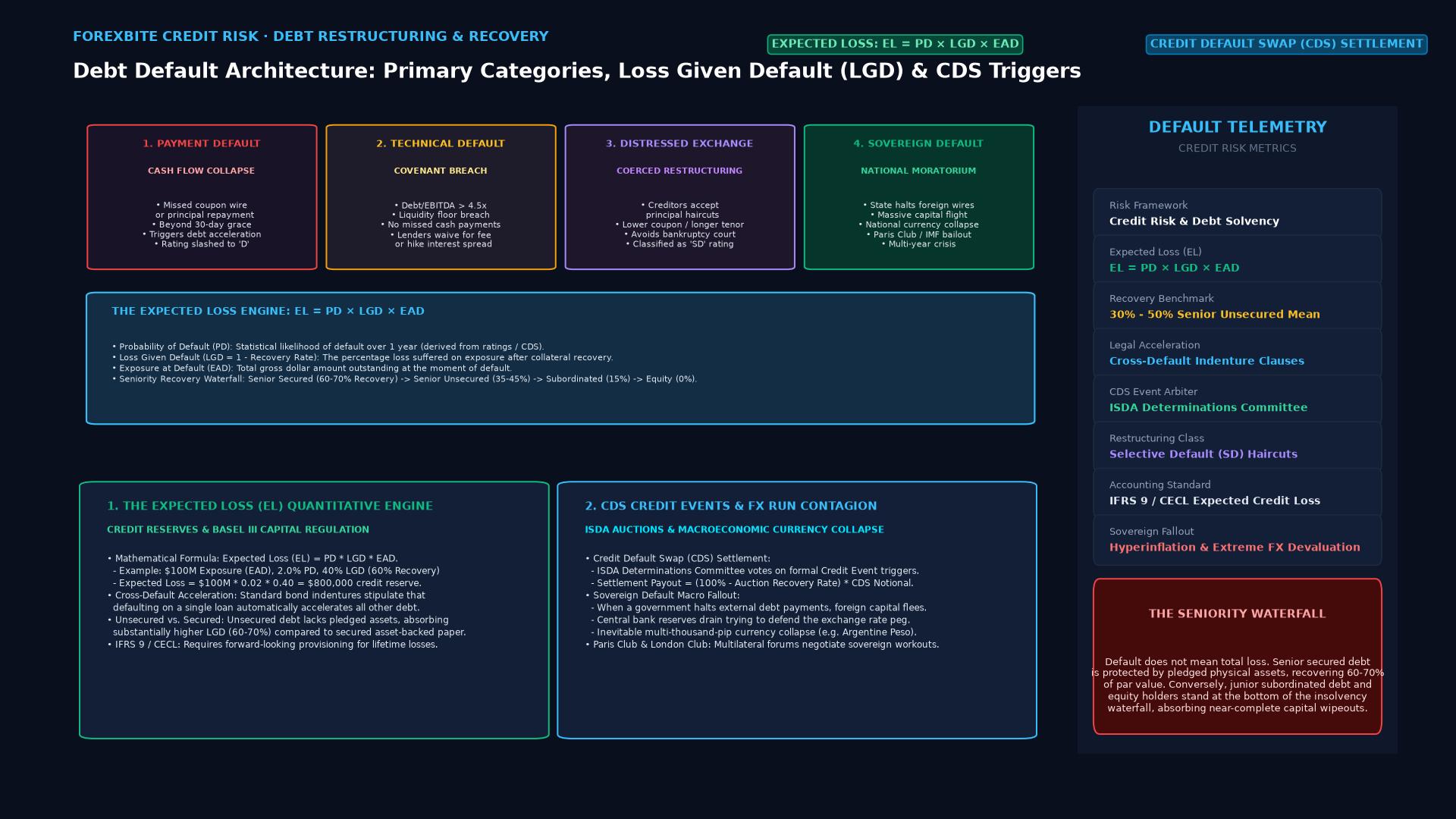 Figure: Debt default spectrum across payment, technical, distressed exchange, and sovereign categories alongside the Expected Loss (EL = PD × LGD × EAD) engine.
Key Takeaways
- Payment vs. Technical Default: A payment default involves an actual cash deficit; a technical default occurs when a solvent borrower violates structural loan covenants (such as minimum liquidity ratios or working capital thresholds).
- Cross-Default Acceleration: Standard debt indentures contain cross-default clauses, meaning that defaulting on a single loan or bond issue instantly triggers an automatic default across all of the borrower’s other outstanding debt obligations.
- The Recovery Rate Factor: Default does not necessarily mean total loss for bondholders. Post-default value is determined by the recovery rate, which historically averages between 30% and 50% for senior secured corporate debt.
- Sovereign Defaults and Currency Collapses: When a national government defaults on foreign debt, foreign capital flees the nation, interest rates skyrocket, and the domestic currency experiences violent multi-thousand-pip devaluations.
The Primary Categories of Default
Credit analysts categorize defaults based on the legal structure of the failure and the nature of the debtor:
| Default Classification | Triggering Condition | Typical Legal Consequence | Market Impact |
|---|---|---|---|
| Payment Default | Missed scheduled interest or principal wire transfer beyond grace period (e.g., 30 days) | Creditors accelerate debt; loan becomes immediately payable in full | Bond rating slashed to D; CDS triggers payout |
| Technical Default | Violation of affirmative/negative covenants (e.g., Debt/Equity ratio exceeds 4.5x) | Lenders waive breach for a fee, renegotiate covenants, or increase interest margin | Credit spread widens; share price drops on uncertainty |
| Distressed Debt Exchange | Debtor offers new bonds with lower coupons, extended maturities, or principal haircuts | Rating agencies classify as Selective Default (SD) | Bondholders accept lower value to avoid bankruptcy |
| Sovereign Default | Sovereign state declares moratorium or repudiates foreign-held external bonds | Paris Club & London Club restructuring negotiations | Sovereign CDS triggers; national currency collapses |
| Strategic Default | Solvent borrower voluntarily halts debt payments because asset value is underwater | Judicial foreclosure; seizure of pledged collateral | Asset written off; debtor’s credit rating severely impaired |
The Cross-Default Clause: Systemic Acceleration
In modern corporate and sovereign finance, debt indentures almost universally incorporate a Cross-Default Provision:
$$\text{Default on Loan A } \implies \text{Immediate Acceleration and Default on Loans B, C, and D}$$
The Mechanical Reality:
If a multinational corporation holding $5 billion in total debt misses a minor $10 million interest payment on a single bank credit line:
- The cross-default clause activates across all the company’s outstanding senior notes, commercial paper, and bilateral credit facilities.
- Every creditor gains the immediate legal right to demand 100% repayment of their principal immediately.
- Because no corporation holds sufficient idle cash to repay its entire capital structure at once, cross-default clauses force distressed companies into emergency Chapter 11 bankruptcy restructuring within days.
Debt Seniority and the Recovery Waterfall
When a corporate debtor enters formal default and bankruptcy liquidation, remaining liquidated assets are distributed strictly according to the Absolute Priority Rule:
Bankruptcy Liquidation Waterfall:
┌────────────────────────────────────────────────────────┐
│ 1. Senior Secured Creditors (Collateralized / Banks)   │ ──► Highest Recovery (~60-80%)
├────────────────────────────────────────────────────────┤
│ 2. Senior Unsecured Bondholders                        │ ──► Moderate Recovery (~30-50%)
├────────────────────────────────────────────────────────┤
│ 3. Subordinated / Mezzanine Debt Holders               │ ──► Low Recovery (~10-20%)
├────────────────────────────────────────────────────────┤
│ 4. Preferred Stockholders                              │ ──► Negligible Recovery (<5%)
├────────────────────────────────────────────────────────┤
│ 5. Common Equity Shareholders                          │ ──► 100% Total Loss ($0.00)
└────────────────────────────────────────────────────────┘
$$\text{Loss Given Default (LGD)} = 100% - \text{Recovery Rate (R)}$$
Sovereign Defaults: How National Default Destroys a Currency
Unlike corporations, sovereign nations cannot be liquidated by a bankruptcy court; a government’s foreign assets are largely protected by sovereign immunity. However, the economic consequences of a sovereign default are devastating:
- Loss of International Market Access: International bond markets immediately lock out the defaulting nation. The government can no longer borrow foreign currency to fund deficits.
- Banking System Paralysis: Domestic commercial banks—which hold large quantities of sovereign government bonds as reserves—experience catastrophic capital impairment, sparking widespread bank runs.
- Currency Hyper-Devaluation: Foreign investors liquidate domestic investments at fire-sale prices to convert proceeds into U.S. Dollars, draining central bank foreign exchange reserves and triggering rapid currency collapse.
Real-World Case Study: The 1998 Russian Sovereign Default (“GKO Crisis”)
On August 17, 1998, the Russian government stunned global markets by declaring a unilateral default on its domestic treasury debt:
The Macro Crisis:
- Facing massive budget deficits, plummeting crude oil prices ($11 per barrel), and the contagion fallout of the 1997 Asian financial crisis, Russia could no longer service its short-term ruble-denominated treasury bills (GKOs).
- The Russian government declared a 90-day moratorium on foreign commercial debt payments and unilaterally restructured GKO debt into long-term paper, inflicting massive haircuts on foreign investors.
The Financial Fallout:
- Currency Collapse: The Russian Ruble was devalued, plunging by more than 70% against the U.S. Dollar within weeks, igniting domestic hyperinflation.
- Global Contagion: The sudden default triggered a worldwide credit spread blowout. Premier quantitative hedge fund Long-Term Capital Management (LTCM), which had heavily leveraged arbitrage positions in Russian and European bonds, suffered catastrophic multi-billion-dollar losses, requiring a historic $3.6 billion Wall Street consortium bailout orchestrated by the Federal Reserve to prevent global market collapse.
Frequently Asked Questions
What is the difference between insolvency and default?
Insolvency is an economic condition where a firm’s total liabilities exceed its assets (balance sheet insolvency) or where cash flows are insufficient to pay debts as they mature (cash flow insolvency). Default is the formal, contractual event when a specific legal debt payment is missed or a covenant is breached. A company can be technically insolvent for months before an official default occurs.
What is a “Selective Default” (SD)?
A Selective Default is a credit rating designation assigned by agencies (such as S&P) when an issuer defaults on a specific bond issue or debt class, but continues to make timely scheduled payments on other senior obligations.
Can a country default on debt denominated in its own domestic currency?
Technically, a sovereign government with a fiat printing press can print infinite amounts of its own currency to service domestic-currency debt, avoiding nominal default. However, doing so triggers hyperinflation, destroying the currency’s purchasing power. Consequently, nations occasionally choose to formally default on local debt rather than destroy their entire monetary system.
Ready to trade forex?
Open a free demo account with a regulated broker. Practice with virtual funds before risking real money.