Maintenance markup
Maintenance markup is the minimum gross profit margin percentage or price floor maintained above unit cost to prevent secondary markdowns, promotions, or dealer concessions from eliminating commercial profitability.
Maintenance markup represents the baseline price premium or gross margin floor established above the acquisition cost of an asset, commodity, or retail inventory unit. Its primary function is to establish a hard boundary below which subsequent commercial discounts, seasonal markdowns, promotional sales, or dealer trading concessions are prohibited from driving transaction prices.
The concept operates across two primary domains:
- Commercial Merchandising and Inventory Management: Retail controllers establish a maintenance markup percentage to ensure that after factoring in shrinkage, employee discounts, and clearance sales, the realized gross margin satisfies fixed corporate overhead and return-on-capital targets.
- Financial Market Dealing and Over-the-Counter (OTC) Trading: Broker-dealer trading desks establish internal maintenance markup parameters when selling securities from proprietary inventory. These guidelines guarantee that principal markups cover repo financing carry costs, trade clearance expenses, and balance-sheet risk capital while complying with regulatory fair-pricing standards such as FINRA Rule 2121.
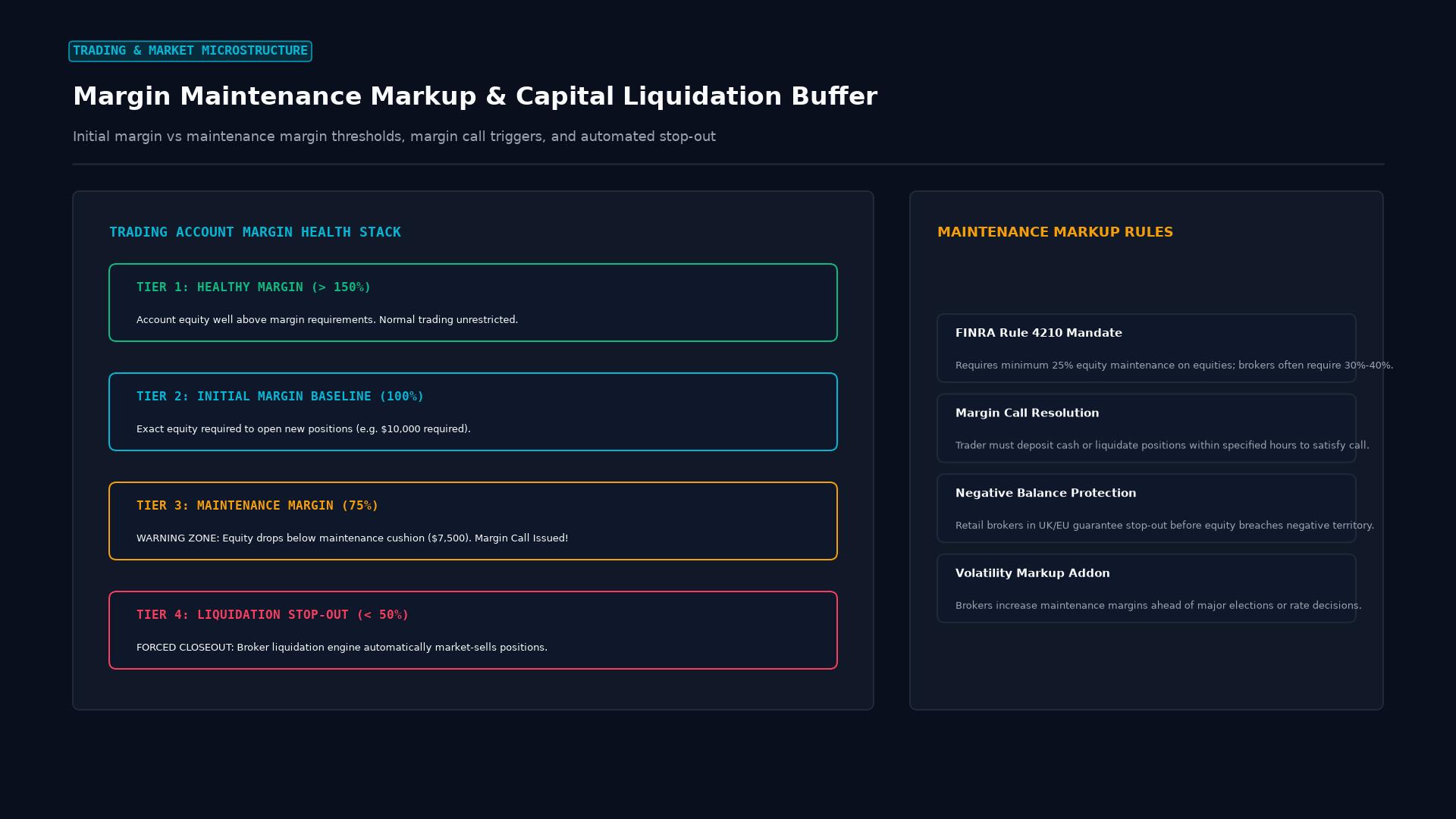 Figure: Retail broker markup framework: base interbank core spread expanded with retail spread markup and overnight financing buffer.
Theoretical Mechanics: Initial Markup vs Maintained Markup
In commercial enterprise economics, retail merchants distinguish between the theoretical target markup applied when goods enter the warehouse and the actual realized margin captured at the cash register.
1. The Initial Markup (IMU)
Initial markup represents the percentage added to the cost basis of merchandise to establish the initial retail list price:
$$\text{Initial Markup % (IMU)} = \frac{\text{Initial Retail Price} - \text{Cost}}{\text{Initial Retail Price}} \times 100$$
Alternatively, expressed on a cost-plus basis:
$$\text{Markup on Cost %} = \frac{\text{Initial Retail Price} - \text{Cost}}{\text{Cost}} \times 100$$
Merchants intentionally set the initial markup higher than their target operating margin to absorb future inventory deductions, collectively termed Retail Reductions:
- Markdowns: Price reductions necessary to clear slow-moving or seasonal inventory.
- Shrinkage: Inventory losses attributable to shoplifting, employee theft, spoilage, or administrative logistics errors.
- Employee and Corporate Discounts: Concessions granted to staff or institutional accounts.
2. The Maintained Markup (MMU)
Maintained markup measures the net gross profit margin realized on actual physical sales before factoring in operating expenses such as payroll, lease amortization, and marketing overhead:
$$\text{Maintained Markup % (MMU)} = \frac{\text{Net Realized Sales} - \text{Gross Cost of Goods Sold}}{\text{Net Realized Sales}} \times 100$$
The mathematical relationship linking Initial Markup, Retail Reductions ($R$), and Maintained Markup is defined as:
$$\text{MMU %} = \text{IMU %} - \Big[ \text{Reductions %} \times (100% - \text{IMU %}) \Big]$$
Where:
- $\text{Reductions %}$ is expressed as a percentage of net sales.
If a merchandising controller requires a minimum Maintained Markup of 45% (the maintenance markup threshold) to cover corporate fixed costs, and projects retail reductions of 15%, the required Initial Markup must be solved algebraically:
$$\text{Required IMU %} = \frac{\text{Target MMU %} + \text{Reductions %}}{100% + \text{Reductions %}} = \frac{45% + 15%}{100% + 15%} = \frac{60}{115} \approx 52.17%$$
Any seasonal promotional campaign that reduces the maintained margin below the maintenance markup floor triggers an operational freeze, requiring executive sign-off.
       MAINTAINED MARKUP DYNAMICS RELATIVE TO REDUCTIONS

Realized
Margin %
   ^
   |  * Initial Markup (IMU = 52.17%)
   |   \
   |    \   Gross Sales Realization
   |     \
   |      \---------------------------------- Maintenance Markup Floor (45%)
   |       \
   |        \  Unprofitable Operating Territory
   +--------------------------------------------->
   0         5%        10%       15%       20%
                     Retail Reductions %
Broker-Dealer Principal Trading and FINRA Rule 2121
In financial markets, maintenance markup principles govern how registered broker-dealers establish trading spreads when executing transactions as principal from proprietary accounts.
1. Principal Trading vs Agency Execution
When a broker executes as an agent, it charges a transparent commission disclosed on the trade confirmation. When acting as a dealer (principal), the firm fills client buy orders directly from its own inventory, charging a markup above the Prevailing Market Price (PMP), or buys from clients at a markdown below PMP.
               BROKER-DEALER SPREAD ARCHITECTURE

+--------------------------------------------------------------+
| Wholesale Inter-Dealer Prevailing Market Price (PMP: 100.00) |
+--------------------------------------------------------------+
                               |
            Trade Execution as Principal Counterparty
                               v
      +------------------------+------------------------+
      |                                                 |
      v Client Buy Order                                v Client Sell Order
+---------------------------+              +---------------------------+
| Dealer Sells to Client    |              | Dealer Buys from Client   |
| Price: 101.50             |              | Price: 98.50              |
| Markup: +1.50 (+1.50%)    |              | Markdown: -1.50 (-1.50%)  |
+---------------------------+              +---------------------------+
2. FINRA Rule 2121: The 5% Policy
Under Financial Industry Regulatory Authority (FINRA) Rule 2121 (commonly known as the “5% Policy”), broker-dealers are prohibited from charging unfair or excessive markups, markdowns, or commissions.
Although the 5% threshold serves as a historical regulatory guideline rather than an absolute statutory ceiling, the actual fair markup is evaluated based on:
- The type of security involved (equities vs corporate bonds vs municipal paper).
- The availability and liquidity of the security in primary and secondary markets.
- The unit price of the security (lower-priced penny stocks carry higher percentage handling costs).
- Total transaction size (institutional block trades warrant lower markups than small odd lots).
- Dealer services rendered and execution expenses incurred.
For liquid fixed-income bonds, regulatory scrutiny typically treats markups exceeding 1.5% to 2.5% as suspect or excessive.
3. Determining the Prevailing Market Price (The PMP Waterfall)
Under FINRA Regulatory Notice 17-24 and MSRB Rule G-30, dealers cannot calculate markups using their own historical acquisition cost if market conditions have shifted. Dealers must establish the PMP using a mandatory evidentiary hierarchy:
- Contemporaneous Inter-Dealer Transactions: Actual trades executed between dealers in the same security near the time of the customer transaction.
- Contemporaneous Institutional Purchases/Sales: Transactions between dealers and institutional accounts in the same security.
- Contemporaneous Quotations: Validated two-sided quotes in active, competitive inter-dealer markets.
- Economic Models and Similar Securities: Yield-curve benchmarking and spread analysis relative to comparable debt instruments.
The dealer markup percentage is formally defined as:
$$\text{Markup %} = \frac{\text{Customer Execution Price} - \text{PMP}}{\text{PMP}} \times 100$$
Trading desk software embeds automated maintenance markup bands: if a trader inputs a price that generates a markup below the firm’s cost-of-carry floor or above FINRA’s fair pricing threshold, the order management system (OMS) blocks order routing.
Real-World Case Study: Fixed-Income Inventory Carrying Costs
Consider a specialized fixed-income dealer holding a $25,000,000 inventory of BBB-rated corporate bonds. The firm finances this inventory overnight in the tri-party repo market at a repo rate of 5.30%.
+--------------------------------------------------------------------+
|               BOND DESK CARRY AND MARKUP AUDIT                     |
+--------------------------------------------------------------------+
| 1. Inventory Holding: $25,000,000 BBB Corporate Bonds (5.80% Yield)|
| 2. Overnight Financing Rate (Repo Borrowing): 5.30%               |
| 3. Gross Daily Carry Spread: 5.80% - 5.30% = +0.50% (+50 bps)     |
| 4. Operational Overhead & Clearing Cost: $450 per trade ticket     |
| 5. Regulatory Capital Charge (Basel III / FINRA Rule 4110):        |
|    Mandatory net capital deduction of 7.0% on inventory ($1.75M). |
| 6. Cost of Capital Hurdle: 12.0% annualized on allocated capital.  |
+--------------------------------------------------------------------+
To determine the maintenance markup floor for selling a $1,000,000 block of these bonds to a wealth management client, the desk quantifies:
- Allocated Capital Drag: Allocated regulatory capital requires a daily hurdle of: $$\text{Daily Capital Cost} = \frac{$1,000,000 \times 7% \times 12%}{360} = $23.33 \text{ per day}$$
- Clearing and Depository Fees: Fixed execution cost of $75 per ticket.
- Inventory Holding Duration: Average holding duration of 14 days before sale: $$\text{Carrying Cost Offset} = 14 \times \left( \frac{$1,000,000 \times (5.80% - 5.30%)}{360} \right) = +$194.44 \text{ (Positive Net Carry)}$$
Although the net carry is slightly positive, market volatility creates price risk. The desk policy sets a maintenance markup floor of 35 basis points (0.35%) above the prevailing inter-dealer bid ($PMP = 98.50$).
- Target Minimum Price: $98.50 \times (1 + 0.0035) = 98.84475$
- Dollar Markup: $0.34475 \times $10,000 = $3,447.50$ per $1,000,000 par value.
If the institutional salesperson attempts to offer the bonds to a preferred client at 98.60 (a markup of only 10 bps, or $1,000), the OMS rejects the transaction: the spread fails to cover the desk’s baseline maintenance markup floor for unhedged inventory risk.
Regulatory Disclosure: SEC Rule 10b-10 and MSRB Rule G-15
Financial regulators have expanded transparency requirements regarding dealer markups on retail transactions:
- SEC Rule 10b-10: Mandates that broker-dealers acting as principal disclose the exact dollar amount and percentage of the markup or markdown on customer trade confirmations for corporate debt and asset-backed securities if the dealer executed an offsetting trade on the same day.
- MSRB Rule G-15: Enforces identical confirmation disclosure mandates for municipal securities transactions. Confirmations must explicitly display the Prevailing Market Price (PMP) determined by the dealer and the exact markup percentage charged relative to that benchmark.
These statutory transparency rules prevent dealers from concealing excessive spreads within opaque bond prices.
Frequently Asked Questions
How does a maintenance markup differ from an initial markup?
An initial markup is the aspirational percentage added to an asset’s cost to establish its original retail list price, deliberately structured to absorb future markdowns and inventory losses. A maintenance markup is the firm non-negotiable floor below which the selling price or realized margin is not permitted to fall, protecting the seller from generating negative operating cash flows.
Does FINRA specify an exact maximum markup percentage in Rule 2121?
No. While commonly referred to as the “5% Policy”, FINRA Rule 2121 does not establish a rigid statutory ceiling of 5%. Markups must be reasonable based on the relevant circumstances of the trade. For liquid corporate or government bonds, a markup of even 2% or 3% is frequently deemed excessive by regulatory auditors, whereas for illiquid, low-priced micro-cap equities, higher percentage markups may be justified by extraordinary execution and clearing costs.
What is the relationship between maintenance markup and maintenance margin?
Although both terms share the word “maintenance”, they address different financial concepts. Maintenance markup refers to the minimum gross profit spread or pricing floor added above cost in commercial and principal sales. Maintenance margin refers to the minimum equity balance (typically 25% under FINRA Rule 4210) that an investor must maintain in a leveraged margin brokerage account to avoid an immediate margin call and forced liquidation.
Ready to trade forex?
Open a free demo account with a regulated broker. Practice with virtual funds before risking real money.