Bid-Ask Spread
The bid-ask spread (also called simply 'the spread') is the difference between the highest price a buyer is willing to pay (bid) and the lowest price a seller is willing to accept (ask). In forex, it is the primary transaction cost for retail traders — paid on every trade entry and exit. Tight spreads indicate high liquidity; wide spreads indicate low liquidity or high uncertainty.
The Hidden Tax on Every Trade
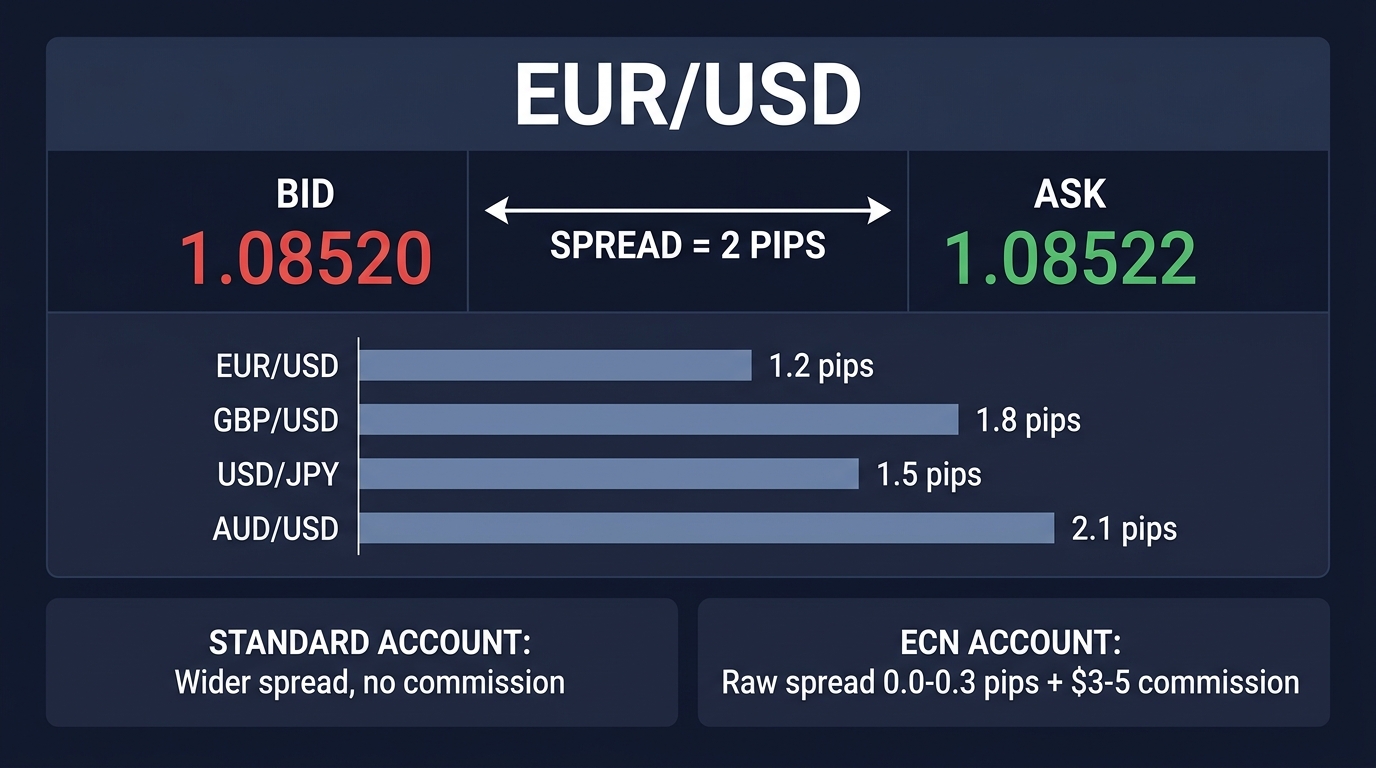
The spread is not optional, not negotiable, and not avoidable. Every single time you enter a forex trade, you immediately start with a paper loss equal to the spread. If EUR/USD is quoted 1.0851 / 1.0852, and you buy at the ask (1.0852), your position is immediately worth only 1.0851 (the current bid price). You need price to rise by at least 1 pip before you break even.
For a trader using a standard lot (100,000 units), a 1-pip spread equals $10 per trade. Two trades per day, 20 trading days per month: $400/month in spread costs alone. At a 2-pip spread: $800/month. A day trader making 15 trades/day pays $3,000-$6,000/month in spreads — before any other costs.
This is why spread comparison between brokers is not academic. It is a critical component of trading profitability.
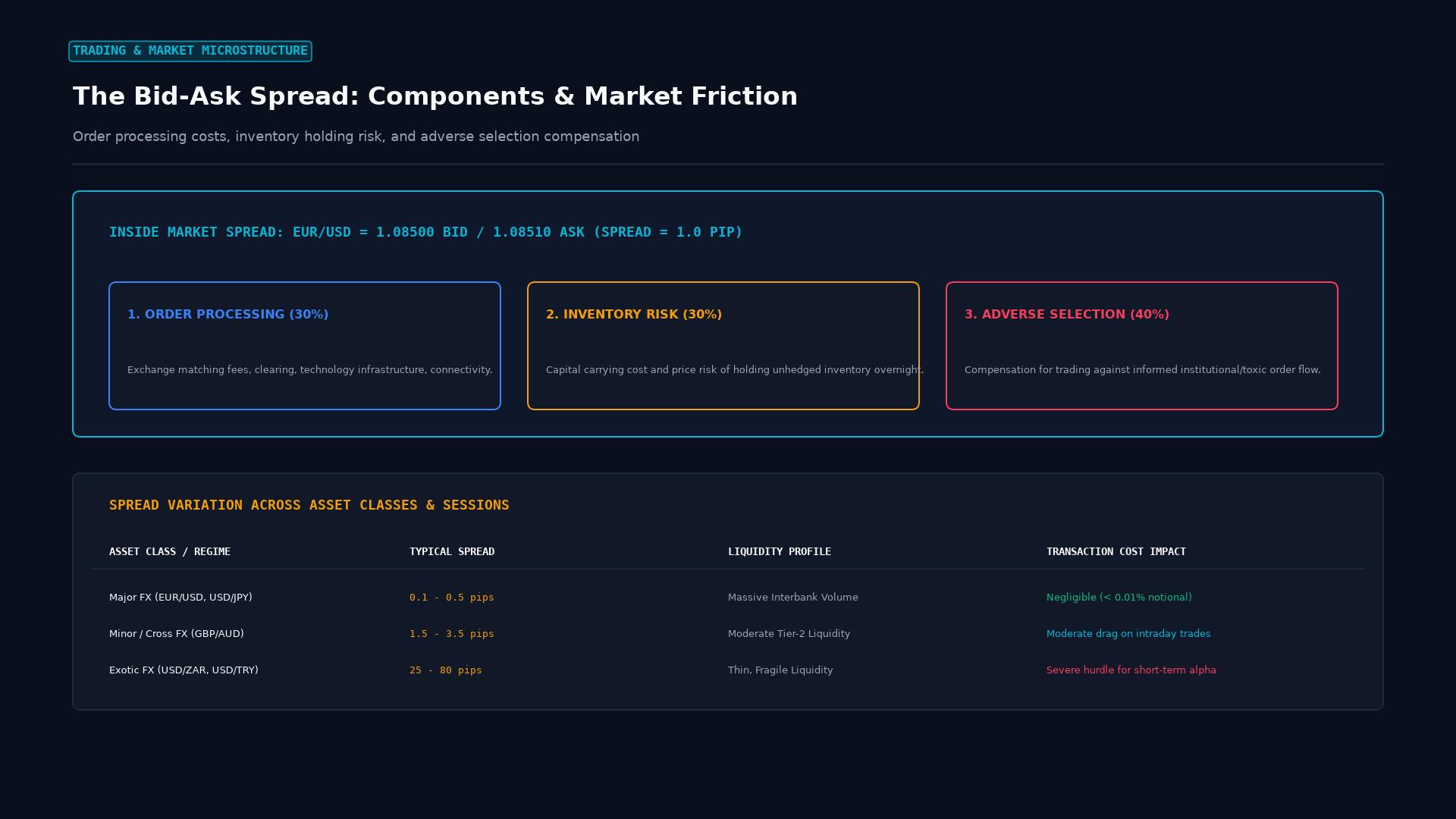 Figure: Deconstructing the bid-ask spread: order processing costs, inventory holding risk, and adverse selection compensation across liquid vs exotic market regimes.
How Spreads Are Structured
Fixed spreads: The broker quotes the same spread regardless of market conditions. Common in market maker models. EUR/USD might always show a 2-pip spread, whether it’s London session or 3 AM Sydney. The advantage: predictability. The disadvantage: during highly liquid conditions (London-New York overlap), a fixed 2-pip spread is more expensive than the interbank 0.1-pip reality.
Variable (floating) spreads: The spread fluctuates based on market liquidity and volatility. During peak trading hours on major pairs: 0.1-0.4 pips on ECN accounts. During major news events or illiquid hours: 5-30+ pips. Variable spreads reflect actual market conditions — you benefit during liquid periods but pay more during stress.
Raw spreads + commission: ECN brokers often offer near-zero raw spreads (0.0-0.2 pips) but charge a commission per standard lot ($3-7 per side, $6-14 round-turn). Total cost: raw spread + commission. This is often the most transparent and cost-effective structure for active traders.
Typical Spreads Across Pair Types
| Pair Type | Example | ECN Spread (peak) | Standard MM Spread |
|---|---|---|---|
| Major | EUR/USD | 0.0–0.3 pips | 1.5–2.5 pips |
| Major | GBP/USD | 0.2–0.5 pips | 2.0–3.5 pips |
| Cross | EUR/GBP | 0.5–1.5 pips | 3.0–5.0 pips |
| Cross | GBP/JPY | 1.0–2.5 pips | 4.0–8.0 pips |
| Exotic | USD/TRY | 10–40 pips | 30–80 pips |
| Exotic | USD/ZAR | 30–80 pips | 60–150 pips |
Exotic pairs have dramatically wider spreads due to lower liquidity and higher volatility. A $200 spread on a USD/ZAR trade is not unusual.
When Spreads Widen
News events: In the 30-60 seconds surrounding high-impact data (NFP, CPI, FOMC), spreads on EUR/USD can widen from 0.2 pips to 10-30+ pips as liquidity providers protect themselves from being immediately picked off.
Weekend gaps: Friday close to Sunday open, spreads widen briefly as liquidity is restored.
End of day (5:00 PM EST rollover): Brief period of reduced liquidity as one trading day closes and another opens. Spreads widen temporarily.
Low-volume sessions: Tokyo session for European pairs, early Sunday hours.
Spread Cost Calculator
To calculate the total spread cost for any trade:
Spread Cost = Spread in pips × Pip value per lot × Number of lots
EUR/USD trade, 2-pip spread, 2 standard lots:
2 pips × $10/pip × 2 lots = $40 round-turn spread cost
This $40 is paid whether the trade wins or loses. Factor this into your minimum profit target requirement.
Key Takeaways
- The spread is the difference between bid (sell price) and ask (buy price) — paid on every trade
- Fixed spreads offer predictability; variable spreads offer lower costs during liquid conditions
- ECN raw spread + commission is most transparent for high-volume traders
- Major pairs during peak hours: 0.0-0.5 pips (ECN); exotics: 10-150+ pips
- Spreads widen dramatically during news events — factor this into stop-loss and strategy planning
FAQ
Is a commission-based account always better than a spread-based account? It depends on trading volume. A trader making 1-2 trades per week benefits from the simplicity of a spread account. A trader making 10-15 trades per day at standard lot sizes will almost always save money on a commission-based ECN account. Calculate the total round-turn cost (spread × pip value, or commission × lots) for your typical trade to determine which structure is cheaper.
Do spreads count as slippage? No — spreads are known in advance and are a fixed component of your entry cost. Slippage is the additional difference between your expected fill price and the actual fill price, typically caused by fast-moving markets. They’re separate costs that both affect profitability but operate differently.
Ready to trade forex?
Open a free demo account with a regulated broker. Practice with virtual funds before risking real money.