Marginal Risk
Marginal risk—commonly quantified as Marginal Value at Risk (MVaR)—is the incremental change in total portfolio risk resulting from adding one additional unit of exposure to a specific financial asset, currency pair, or counterparty contract.
What Is Marginal Risk?
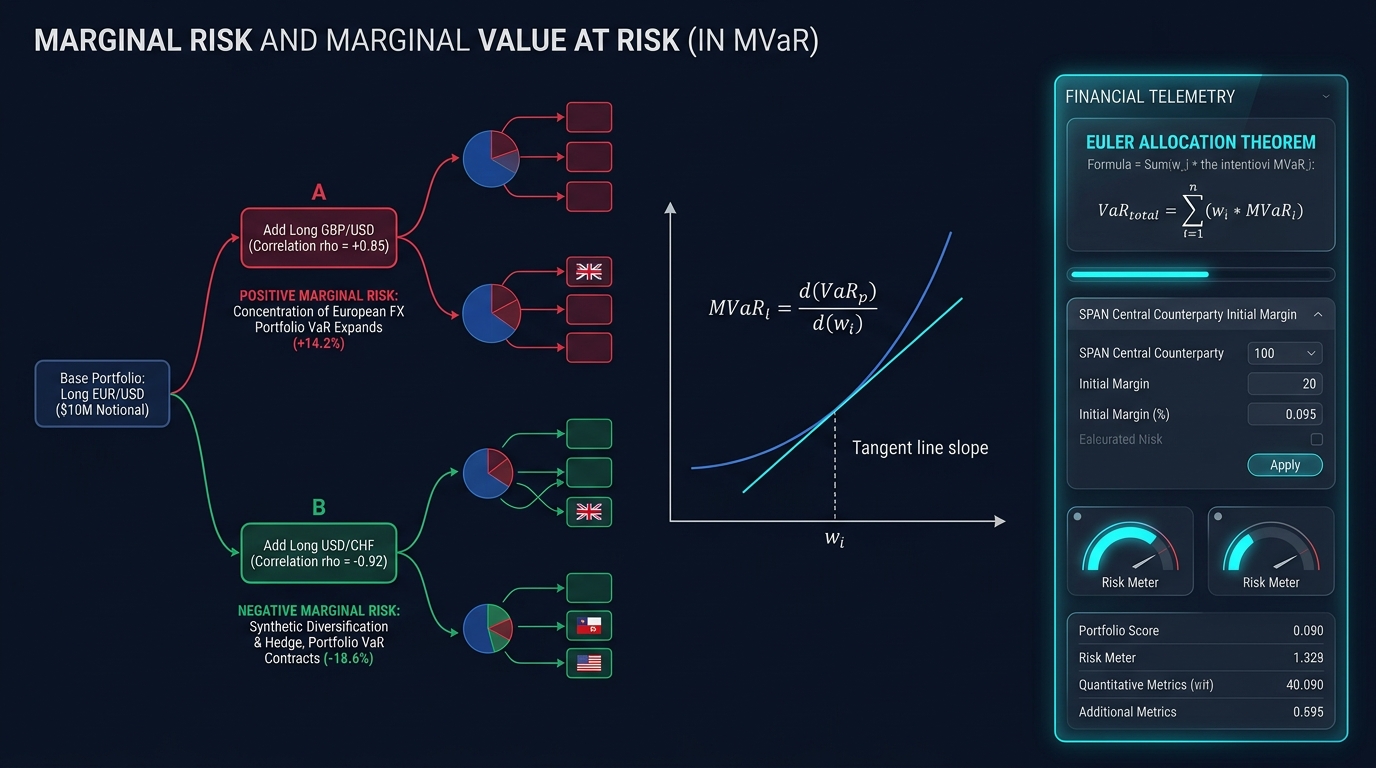
In financial risk management and portfolio theory, marginal risk quantifies the rate at which total portfolio risk changes when an investor or risk manager marginally expands or reduces the allocation to a specific asset. Most commonly operationalized as Marginal Value at Risk (MVaR), it calculates the partial derivative of total portfolio Value at Risk with respect to the weight or dollar value of an individual position:
$$\text{MVaR}_i = \frac{\partial \text{VaR}_p}{\partial w_i}$$
In derivatives clearing and interbank dealing, marginal risk also carries an operational definition: it represents the incremental credit and settlement exposure an exchange clearing house (such as CME Clearing or LCH) or prime broker assumes when a client opens a new futures or OTC contract before the daily variation margin cycle settles.
Crucially, marginal risk is not determined solely by the volatility of the asset being added; it depends profoundly on that asset’s correlation with all other existing positions within the portfolio.
Key Takeaways
- Sensitivity Metric: MVaR measures the sensitivity of total portfolio risk to a minor change in the allocation of asset $i$.
- Impact of Correlation: Adding a volatile asset with a negative correlation to existing holdings yields a negative marginal risk, meaning the new position actively reduces aggregate portfolio risk.
- Euler Allocation Principle: Under Euler’s theorem for linearly homogeneous functions, the sum of each asset’s weight multiplied by its marginal risk exactly equals the total portfolio risk: $\text{VaR}_p = \sum w_i \cdot \text{MVaR}_i$.
- Clearing House Margin Models: Central counterparty clearing houses (such as SPAN or VaR-based margin engines) use marginal risk calculations to determine the exact additional margin collateral required when a trader submits a new order.
- Superior to Standalone Risk: Evaluating a trade based on marginal risk prevents the dangerous error of assuming a low-volatility asset is inherently “safe” when it may actually compound an existing directional concentration.
Mathematical Formulation: MVaR in Matrix Notation
For a portfolio of $n$ assets with weight vector $\mathbf{w}$ and covariance matrix $\boldsymbol{\Sigma}$, the portfolio standard deviation is:
$$\sigma_p = \sqrt{\mathbf{w}^T \boldsymbol{\Sigma} \mathbf{w}}$$
Assuming normally distributed returns with critical confidence factor $Z_{\alpha}$ (e.g., $Z = 1.645$ for a 95% confidence level), the portfolio Value at Risk is:
$$\text{VaR}p = Z{\alpha} \cdot \sigma_p$$
The Marginal Value at Risk (MVaR) of asset $i$ is calculated as:
$$\text{MVaR}_i = \frac{\partial \text{VaR}p}{\partial w_i} = Z{\alpha} \cdot \frac{(\boldsymbol{\Sigma} \mathbf{w})i}{\sigma_p} = Z{\alpha} \cdot \frac{\text{Cov}(R_i, R_p)}{\sigma_p} = \text{VaR}p \cdot \frac{\beta{i,p}}{W}$$
Where:
- $\beta_{i,p}$ is the beta of asset $i$ with respect to the existing portfolio.
- $W$ is the total monetary value of the portfolio.
This elegant mathematical relationship proves that an asset’s marginal risk is directly proportional to its portfolio beta. If an asset has a beta greater than 1.0 relative to the portfolio, adding more of it increases overall portfolio risk faster than the portfolio expands.
Comparative Taxonomy: The Hierarchy of VaR Metrics
| Risk Dimension | What It Quantifies | Mathematical Definition | Primary Practical Use Case |
|---|---|---|---|
| Absolute (Standalone) VaR | Risk of an asset held completely in isolation | $\text{VaR}i = Z{\alpha} \cdot \sigma_i \cdot w_i$ | Regulatory single-asset risk reporting |
| Marginal VaR (MVaR) | Rate of change in portfolio VaR per dollar added | $\frac{\partial \text{VaR}_p}{\partial w_i}$ | Sizing new trade entries and optimizing hedges |
| Incremental VaR (IVaR) | Exact dollar difference in VaR if a position is added/removed | $\text{VaR}_{p+\text{trade}} - \text{VaR}_p$ | Assessing large block trade additions |
| Component VaR (CVaR) | Absolute dollar amount of current portfolio VaR contributed by asset $i$ | $w_i \cdot \text{MVaR}_i$ | Performance attribution and internal capital charging |
Practical Application: Multi-Currency Hedge Fund Allocation
A macro hedge fund runs a $100,000,000 USD currency portfolio with an existing 99% daily Value at Risk of $1,500,000. The portfolio is currently heavily long the Euro (EUR/USD) and the Australian Dollar (AUD/USD).
The Chief Risk Officer (CRO) evaluates two prospective $10,000,000 trade proposals:
- Proposal 1: Add Long British Pound (GBP/USD):
- GBP/USD exhibits a high positive correlation ($+0.82$) with the existing portfolio.
- The marginal VaR is calculated at +0.024 ($2.4%$).
- Adding this trade increases portfolio daily VaR by +$240,000, concentrating the fund’s vulnerability to a sudden resurgence in the U.S. Dollar.
- Proposal 2: Add Long Swiss Franc (USD/CHF Short):
- USD/CHF exhibits a strong negative correlation ($-0.90$) with EUR/USD and a negative beta relative to the portfolio.
- The marginal VaR is calculated at -0.018 ($-1.8%$).
- Adding this trade provides a synthetic hedge, reducing portfolio daily VaR by -$180,000 to $1,320,000 while maintaining targeted macro exposures.
The CRO approves Proposal 2, utilizing marginal risk analytics to enhance portfolio efficiency without sacrificing capital deployment.
Critical Pitfalls in Marginal Risk Management
- Assuming Linear Scaling: Marginal VaR is a local derivative; it is accurate only for small, incremental position changes. For massive block trades (e.g., doubling position size), managers must calculate Incremental VaR (IVaR) rather than relying on MVaR.
- Correlation Breakdown in Crises: Marginal risk calculations depend heavily on historical covariance matrices. During liquidity crunches, historical correlations often break down—assets that appeared uncorrelated suddenly correlate to 1.0, rendering standard MVaR models dangerously optimistic.
Frequently Asked Questions (FAQ)
Can marginal risk be negative?
Yes. When a financial asset has a sufficiently negative covariance with the aggregate portfolio, adding exposure to that asset reduces the overall risk of the combined portfolio. In this scenario, the asset has a negative marginal risk and acts as an effective hedge.
How do clearing houses use marginal risk to calculate margin?
Derivatives exchanges (such as CME) use portfolio-based margin systems (like SPAN or CME CORE) that calculate the marginal risk each new order adds to a member’s existing book. If a new trade offsets existing open contracts, the marginal margin required is zero or may even release excess collateral.
What is the difference between Marginal VaR and Incremental VaR?
Marginal VaR is the rate of change (the mathematical derivative) of portfolio risk with respect to an infinitesimally small trade. Incremental VaR is the actual discrete dollar difference in total portfolio risk resulting from executing a specific, finite trade size.
Ready to trade forex?
Open a free demo account with a regulated broker. Practice with virtual funds before risking real money.