MKTD
MKTD is the capital markets abbreviation for Marketed, designating a fully marketed public securities offering where underwriters conduct an extensive roadshow to build an institutional order book before pricing.
In corporate finance, investment banking syndicates, and equity capital markets (ECM), the acronym MKTD stands for Marketed (most commonly referencing a Marketed Offering or Fully Marketed Follow-On Offering). On institutional deal sheets, Bloomberg terminal syndication feeds, and equity research calendars, MKTD identifies a public equity or debt transaction where the underwriting banks conduct an active marketing campaign and institutional roadshow to generate investor demand prior to fixing the final transaction price.
Unlike an accelerated bookbuild (ABB) or an overnight bought deal (where shares are priced in hours with minimal investor marketing), a marketed (MKTD) transaction unfolds over several days or weeks. This structured process allows management to present corporate forward guidance directly to sovereign wealth funds, long-only mutual funds, and hedge funds, maximizing price discovery and broadening the institutional shareholder registry.
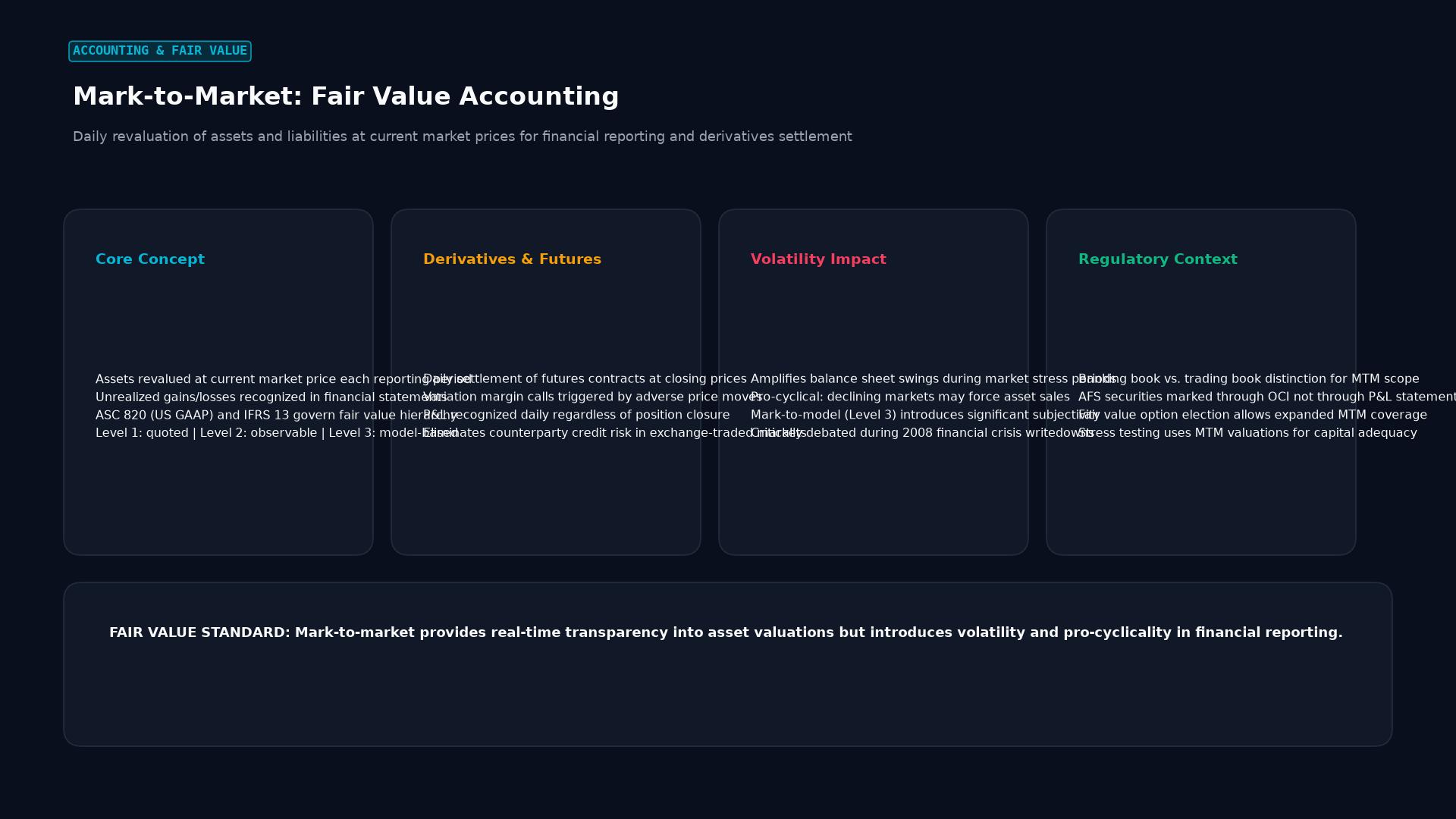 Figure: Daily revaluation of assets and liabilities at current market prices for financial reporting and derivatives settlement
Structural Taxonomy of Equity Offerings
Investment banks categorize secondary follow-on equity offerings based on the duration of the marketing process, risk allocation, and regulatory registration:
1. Fully Marketed Follow-On Offering (MKTD)
A marketed transaction involves public announcement followed by a multi-day marketing window:
- Roadshow Presentation: Executive management (CEO and CFO) conducts one-on-one virtual and in-person roadshow meetings with tier-1 institutional portfolio managers across financial centers (New York, London, Boston, San Francisco).
- Extensive Bookbuilding: The underwriting syndicate solicits non-binding Indications of Interest (IOIs) from institutional buyers across a specified price range, assembling an aggregate demand curve.
- Regulatory Registration: The transaction is filed under the Securities Act of 1933 via an SEC Form S-1 or off an existing Form S-3 shelf registration statement with an accompanying preliminary prospectus supplement (“red herring”).
2. Accelerated Bookbuild (ABB)
In an accelerated transaction, the public roadshow is eliminated:
- The offering is announced immediately after the close of public equity markets at 4:00 PM EST.
- The syndicate desk opens the electronic order book overnight, targeting existing institutional holders and pre-identified investors who have been “wall-crossed” (bound by confidentiality agreements).
- The offering is priced before the market opens at 9:30 AM EST the following morning.
3. Bought Deal (Block Trade)
The underwriting investment bank agrees to purchase the entire block of new shares directly from the issuing company as principal at a negotiated, discounted fixed price before marketing begins. The bank assumes 100% of the price and inventory risk, hoping to re-sell the shares in the secondary market at a modest profit.
       COMPARISON OF SECONDARY OFFERING STRUCTURES

Feature         Marketed (MKTD)          Accelerated (ABB)        Bought Deal
----------------------------------------------------------------------------------
Marketing Window 3 to 10 Business Days   12 to 48 Hours           Near Instant (Minutes)
Roadshow        Full Public Roadshow     No Roadshow / Calls      Zero Roadshow
Price Discovery Maximum Institutional    Moderate                 Issuer Locks Price
Pricing Discount Typically 2% to 6%      Typically 4% to 8%       Typically 6% to 12%
Market Risk     Borne by Issuing Corp    Low (Overnight window)   Borne by Underwriters
Target Investor New Long-Only Base       Existing Shareholders    Syndicate Contacts
The Institutional Bookbuilding Engine in a Marketed Offering
The defining operational characteristic of a marketed (MKTD) offering is the formal bookbuilding process managed by the Lead Left Bookrunner:
1. Indications of Interest and Demand Elasticity
During the roadshow, institutional investors submit orders specifying both desired share volume and limit price sensitivity:
- Strike Bids: Bids stating the investor will take shares at whatever final price the syndicate sets.
- Price-Sensitive Bids: Bids stating the investor will purchase 500,000 shares at $48.00, but only 200,000 shares if the price is set at $50.00.
The bookrunner synthesizes these discrete orders into an aggregate demand curve, calculating the Oversubscription Ratio:
$$\text{Oversubscription Ratio} = \frac{\text{Total Dollar Volume of Institutional Bids}}{\text{Total Capital Target of Base Offering}}$$
A marketed offering that is $3\times$ to $5\times$ oversubscribed provides the syndicate with pricing leverage, allowing the bookrunner to price the deal at or near the top of the marketed range while eliminating speculative hedge-fund flippers in favor of long-term fundamental asset managers.
2. The Offer Discount to Last Close
Because a follow-on offering increases the circulating share supply (dilution), the final offer price ($P_{\text{offer}}$) is typically priced at a discount to the prevailing market closing price ($P_{\text{close}}$) on the day of pricing:
$$\text{Offer Discount %} = \frac{P_{\text{close}} - P_{\text{offer}}}{P_{\text{close}}} \times 100$$
Because a fully marketed (MKTD) transaction allows the syndicate to generate demand across global institutional investors, the resulting offer discount is generally narrower (2% to 5%) than the steeper discounts demanded by buyers in rushed overnight block trades (6% to 12%).
       BOOKBUILDING DEMAND WATERFALL

Aggregate Demand
   ^
   |        * $52.00 (Tight Demand: $80M Subscribed)
   |       /
   |      /  * $50.00 (Target Parity: $250M Subscribed) -> 2.5x Oversubscribed
   |     /
   |    /    * $48.00 (Deep Demand: $500M Subscribed)   -> 5.0x Oversubscribed
   +---+-----+-----+-------------------------------------------------------->
   $0 $100M $200M $300M                                  Capital Committed
The Greenshoe Overallotment Option and Syndicate Stabilization
To prevent downward price pressure when newly issued shares begin trading in the secondary market, marketed offerings routinely incorporate an Overallotment Option, colloquially termed the Greenshoe Option (originating from the 1960 Green Shoe Manufacturing Company IPO):
- Statutory 15% Provision: The issuing corporation grants the underwriting syndicate the option to purchase up to an additional 15% above the base offering size at the official offer price, exercisable within 30 days of closing.
- Overselling the Syndicate Short: At pricing, the underwriters intentionally sell 115% of the offering to investors, creating a 15% “naked” syndicate short position.
- Price Stabilization under SEC Regulation M (Rule 104):
- Scenario A (Stock Drops Below Offer Price): If secondary market prices fall below the offer price, the lead underwriter does not exercise the Greenshoe option. Instead, the underwriter uses the cash collected from the extra 15% sales to buy back shares in the open market, creating continuous bid support (stabilization) and closing the syndicate short at a profit.
- Scenario B (Stock Rallies Above Offer Price): If secondary market prices surge above the offer price, buying shares in the open market would result in heavy losses. The underwriter exercises the Greenshoe option, buying the additional 15% from the issuer at the fixed offer price to cover the short position.
       GREENSHOE (OVERALLOTMENT) MECHANICS

+---------------------------------------------------------------+
| Syndicate Sells 115% of Base Offering (Creates 15% Short Pos) |
+---------------------------------------------------------------+
                               |
         Secondary Market Performance Evaluation
                               v
      +------------------------+------------------------+
      |                                                 |
      v Market Price Drops Below Offer                  v Market Price Rallies Above Offer
+---------------------------+              +---------------------------+
| Underwriter Buys Shares in|              | Underwriter Exercises     |
| Open Market (Bid Support) |              | Greenshoe Option at Fixed |
| Closes Short; Stabilizes  |              | Offer Price (No Loss)     |
+---------------------------+              +---------------------------+
Real-World Case Study: Biopharma Marketed Follow-On Offering
In 2024, a commercial-stage oncology biopharmaceutical enterprise, Celera Therapeutics (NASDAQ: CLRX), required $200,000,000 in growth capital to fund Phase 3 international clinical trials and commercial manufacturing buildouts.
+--------------------------------------------------------------------+
|               CELERA THERAPEUTICS MKTD OFFERING AUDIT              |
+--------------------------------------------------------------------+
| 1. Strategic Decision: Management evaluated an Accelerated         |
|    Bookbuild (ABB) vs a 4-Day Marketed Offering (MKTD).            |
| 2. Capital Structure Reality: CLRX had high retail ownership;      |
|    the board wanted to introduce premier institutional healthcare  |
|    endowments to stabilize its volatile trading float.             |
| 3. Execution Execution: CLRX announced a Marketed Follow-On (MKTD) |
|    offering off its S-3 shelf on Monday morning.                   |
| 4. Roadshow Campaign: Over four trading days, the executive team   |
|    conducted 28 one-on-one virtual presentations with specialist   |
|    biotech institutional funds across New York and Zurich.         |
| 5. Order Book Outcome: The book closed Thursday afternoon at $750M |
|    in total institutional demand (3.75x oversubscribed).           |
| 6. Pricing & Allocation: Base shares priced at $40.00 per share    |
|    against a last closing price of $41.50 (a tight 3.6% discount). |
| 7. Quality Allocation: 85% of shares were allocated to tier-1     |
|    long-only mutual funds; speculative short-term accounts were    |
|    strictly scaled back.                                           |
| 8. Secondary Performance: The stock opened at $40.75 the next day; |
|    underwriters exercised the full 15% Greenshoe, expanding total  |
|    gross proceeds raised to $230,000,000.                          |
+--------------------------------------------------------------------+
By choosing a marketed (MKTD) campaign over an overnight block trade, the enterprise secured $230 million with minimal dilution, tightened its pricing discount, and added high-conviction institutional shareholders to its ownership registry.
Frequently Asked Questions
What is the primary risk of executing a marketed offering compared to a bought deal?
The primary risk of a marketed (MKTD) offering is market price volatility during the multi-day marketing window. Because the offering is publicly announced days before pricing, short sellers and market participants can short the stock in anticipation of new supply, driving down the underlying share price before the final offer price is set. In a bought deal, the issuer locks in a guaranteed price immediately, transferring market risk to the underwriters.
What is a “red herring” prospectus in a marketed offering?
A “red herring” is the preliminary prospectus supplement filed with the SEC and distributed to potential investors during the roadshow. It contains comprehensive disclosures regarding the company’s financial condition, business risks, and operating performance, but deliberately omits the final offering price and total number of shares offered. It earns its colloquial name from the bold red statutory disclaimer printed on its cover stating that the registration statement is not yet final.
Can retail investors participate in a marketed institutional offering?
While secondary marketed offerings are primarily directed toward large institutional investors (mutual funds, pension funds, hedge funds), retail brokerages that operate institutional syndication partnerships (such as Charles Schwab, Fidelity, or Morgan Stanley) occasionally allocate small percentage tranches of marketed follow-on shares to qualifying retail clients through online IPO and secondary allocation portals.
Ready to trade forex?
Open a free demo account with a regulated broker. Practice with virtual funds before risking real money.