Market Order
A market order is an instruction to buy or sell a currency pair immediately at the best available price in the market. It guarantees execution but not a specific price. Market orders are the fastest way to enter or exit a position and are used when certainty of execution matters more than precision of price.
What Happens When You Click “Buy Market”
Every trader’s first trade is usually a market order. You see a price, you click buy (or sell), and the trade executes within milliseconds. The mechanics feel instantaneous — but there’s more happening under the hood than most beginners realize, and the subtleties of market order execution directly affect your profitability over time.
When you submit a market order, your trading platform routes it to a liquidity provider — either your broker’s internal desk (market maker) or external banks and ECNs. The order fills at whatever bid or ask price is available at that exact moment. The spread you pay is the immediate cost: if EUR/USD is quoted at 1.0851 / 1.0852, a long market order fills at 1.0852 (the ask). A short order fills at 1.0851 (the bid).
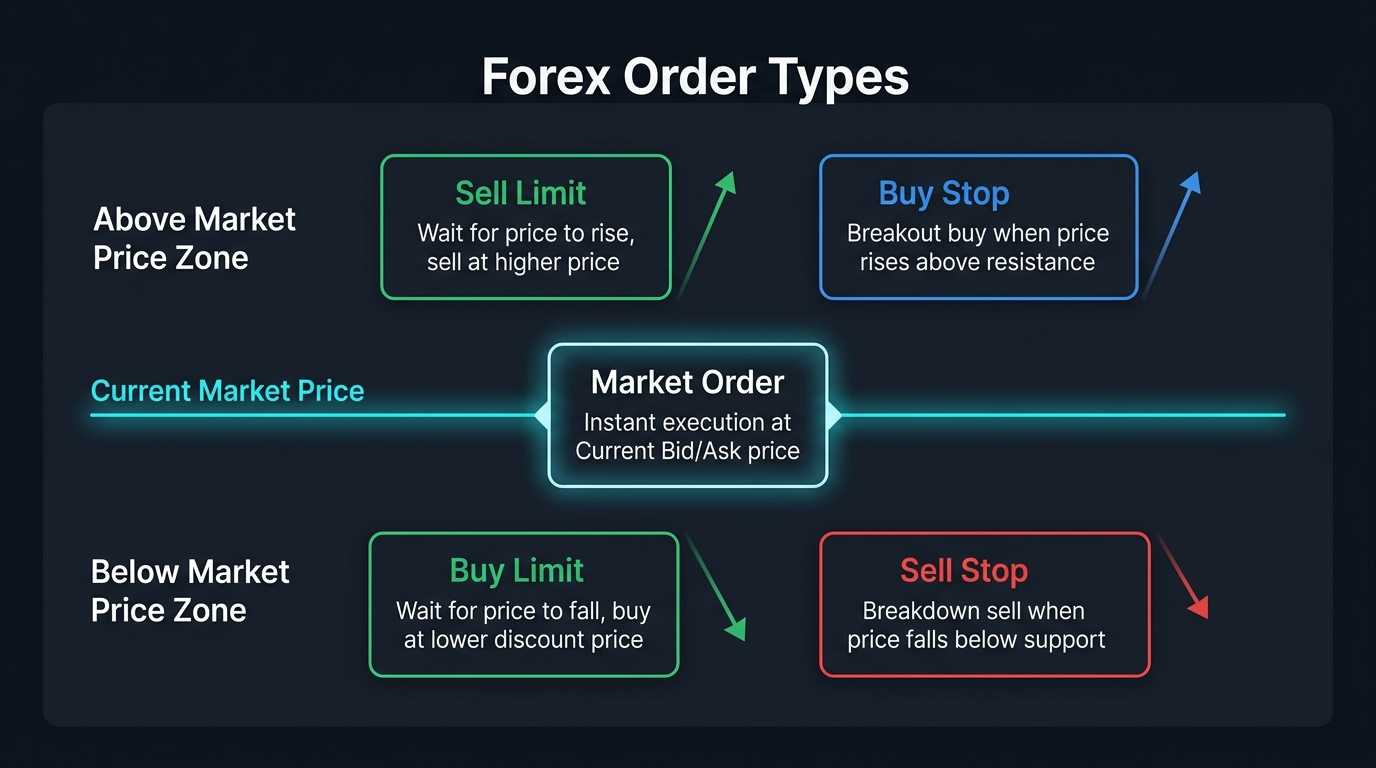
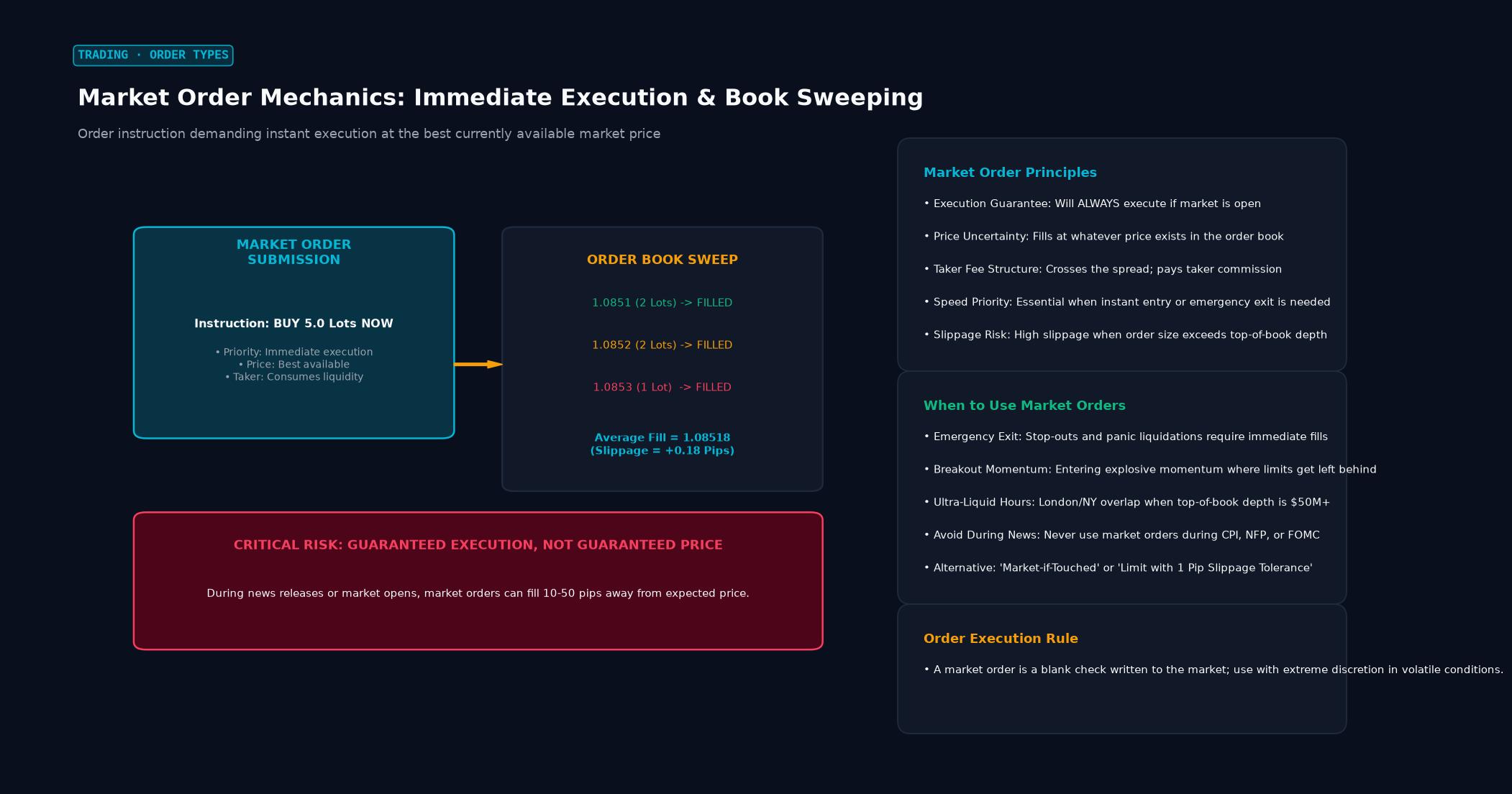 Figure: Order instruction demanding instant execution at the best currently available market price
When to Use a Market Order
Market orders are the right tool in specific situations:
Exiting a losing trade quickly: When your stop-loss level is hit and you want out, a market order guarantees the exit. A limit order to exit might not fill if price gaps through your level.
Trading around high-impact news: When a major data release (NFP, CPI, Fed decision) hits and you need to enter or exit immediately before the market moves further, speed trumps price precision. Market orders execute; pending orders might not.
Highly liquid sessions: During peak EUR/USD trading hours (London-New York overlap), the bid-ask spread is typically 0.1–0.3 pips on ECN accounts. At those spread levels, the price slippage risk of a market order is minimal.
Breaking out of consolidation: When price breaks a key technical level with momentum and you want immediate participation in the move, a market order ensures you don’t miss the entry while waiting for a limit fill.
Slippage: The Hidden Cost of Market Orders
Slippage occurs when your market order fills at a different price than the last quoted price. In a fast-moving market — during news events, at the open of illiquid sessions, or when large institutional orders move price rapidly — the available price can shift in the milliseconds between clicking and execution.
On a major pair during normal hours, slippage is typically 0–1 pip. During a major news release, it can reach 5–20 pips, occasionally more. This isn’t necessarily a broker problem — it reflects genuine market conditions where liquidity providers have widened spreads and moved their quotes.
Negative slippage (filling worse than expected) is most common. Positive slippage (filling better than expected) also occurs, particularly on ECN accounts where the order competes in a real market — sometimes prices improve between order submission and fill.
Market Orders vs. Pending Orders
The fundamental choice in execution:
| Feature | Market Order | Pending Order (Limit/Stop) |
|---|---|---|
| Execution guarantee | Yes — always fills | No — only fills if price reaches the level |
| Price precision | No — best available price | Yes — specific price or better (limit) |
| Slippage risk | Yes | Minimal for limits; gaps possible for stops |
| Speed | Immediate | Waits for trigger condition |
For most retail traders, the choice comes down to: do you need certainty of execution right now (market order), or certainty of price at a specific level (limit order)?
Market Orders and Broker Type
At market maker brokers, your market order is filled internally by the broker’s desk, which takes the other side of your trade. Execution is fast but the broker controls the fill price within certain bounds — requotes (offering you a different price than you clicked) were historically common but have become less frequent with competition and regulation.
At ECN/STP brokers, your market order is matched against real market participants. Fill quality depends on available liquidity. During liquid sessions, you often get price improvement. During illiquid times, slippage is more variable.
Key Takeaways
- Market orders guarantee execution, not price — you fill at the best available price at the moment of order
- The spread is paid immediately on entry (ask price for longs, bid price for shorts)
- Slippage can occur in fast markets — plan for this in your risk calculations
- Use market orders when speed of execution matters more than price precision
- ECN accounts generally produce better market order fill quality than market maker accounts during liquid sessions
FAQ
Can a market order be partially filled? In retail forex, most brokers fill market orders in full (you’re trading against the broker’s liquidity pool). On ECN platforms in very large sizes, partial fills are theoretically possible but rare for retail lot sizes.
Should I use market orders for all my entries? Not necessarily. Limit orders let you enter at a specific price — often after a pullback to a key level — which typically produces better risk-reward ratios than chasing price with market orders. Many experienced traders use limit orders for planned entries and market orders for emergency exits.
Ready to trade forex?
Open a free demo account with a regulated broker. Practice with virtual funds before risking real money.