MLP
MLP stands for Master Limited Partnership, a publicly traded limited partnership combining the pass-through tax benefits of a private partnership with the liquid trading of a publicly listed stock.
In corporate finance, equity capital markets, and energy infrastructure, the acronym MLP stands for Master Limited Partnership. An MLP is a specialized corporate entity that combines the pass-through tax treatment of a private limited partnership with the trading liquidity of a public equity security listed on major exchanges such as the New York Stock Exchange (NYSE) or NASDAQ.
Investors who acquire an interest in an MLP are legally designated as Limited Partners (or unitholders) holding “units” rather than corporate shares. By eliminating corporate-level income taxation under Section 7704 of the Internal Revenue Code (IRC), MLPs avoid double taxation: net operating cash flows flow directly to unitholders through quarterly cash distributions, making MLPs an attractive asset class for income-focused institutional and retail investors.
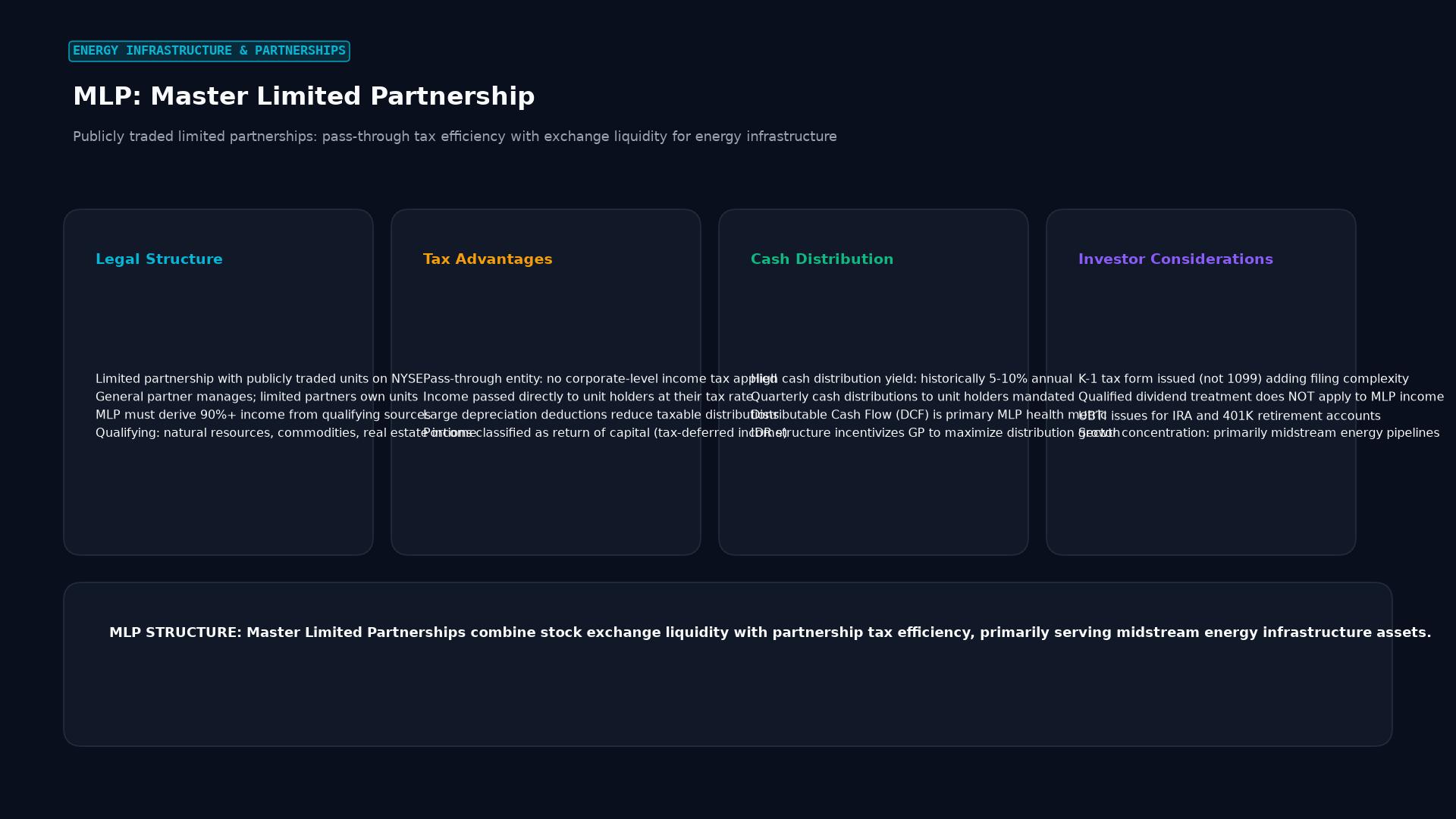 Figure: Publicly traded limited partnerships: pass-through tax efficiency with exchange liquidity for energy infrastructure
The Statutory Foundation: IRC Section 7704 and Qualifying Income
Prior to 1987, corporations across diverse retail, restaurant, and manufacturing sectors converted their corporate charters into publicly traded partnerships to avoid federal corporate income taxes.
To halt corporate tax base erosion, the US Congress enacted the Tax Reform Act of 1986 and the Revenue Act of 1987, codifying Internal Revenue Code Section 7704. Under IRC Section 7704, all publicly traded partnerships are classified as taxable corporations by default, unless they satisfy the 90% Qualifying Income Exception:
$$\text{Qualifying Income Ratio} = \frac{\text{Gross Income from Qualifying Natural Resource Activities}}{\text{Total Gross Income}} \ge 90.0%$$
What Constitutes Qualifying Income Under IRC § 7704(d)?
To preserve pass-through partnership tax status, at least 90% of an MLP’s gross annual income must be derived from:
- The exploration, development, mining, production, processing, refining, transportation (interstate pipeline transmission, marine barges, rail transport), or marketing of any mineral or natural resource.
- Natural resources are explicitly defined by statute to include crude oil, natural gas, natural gas liquids (NGLs), refined petroleum products, coal, timber, and industrial carbon dioxide ($CO_2$).
Because interstate pipeline transportation and terminal storage satisfy the qualifying income test without directly exposing the operator to speculative commodity price swings, the midstream energy sector represents over 90% of the entire MLP market capitalization.
       ENERGY VALUE CHAIN: WHERE MLPs OPERATE

Sector          Core Activity                     MLP Prevalency  Commodity Price Risk
----------------------------------------------------------------------------------
Upstream        Oil & Gas Drilling / Extraction   Low (C-Corp)    Very High (Direct Price)
Midstream       Pipelines, Storage, Terminals     Very High (MLP) Low (Fee-Based Tolls)
Downstream      Refining & Retail Gas Stations    Moderate / Low  High (Crack Spreads)
The Midstream “Tollbooth” Commercial Model
Midstream energy MLPs operate analogous to commercial toll roads. Rather than buying crude oil or natural gas to resell at a profit, the MLP charges third-party energy producers (such as ExxonMobil or Chevron) a fixed contractual transportation fee per barrel of crude oil or million cubic feet (Mcf) of natural gas shipped through its pipeline network.
Midstream contracts utilize specific risk-mitigation structures:
- Take-or-Pay Contracts: The energy producer contracts a specific pipeline capacity. Even if the producer halts drilling and ships zero barrels, it is legally bound to pay the full contractual pipeline tariff.
- Minimum Volume Commitments (MVCs): Mandates that if shipped volume falls below an agreed threshold, the customer must pay shortfall penalty fees.
- Fee-Based Tariffs Regulated by FERC: Interstate pipeline rates are regulated by the Federal Energy Regulatory Commission (FERC), indexed annually to inflation via the Producer Price Index for Finished Goods (PPI-FG).
Because over 80% to 90% of midstream MLP cash flows are secured by long-term fee-based contracts, cash flows remain stable even during periods of extreme crude oil price volatility.
       MIDSTREAM TOLLBOOTH CONTRACT ARCHITECTURE

+---------------------------------------------------------------+
| Upstream Oil & Gas Producer (Permian Basin Extraction)        |
+---------------------------------------------------------------+
                               |
                               v Ships Physical Crude
+---------------------------------------------------------------+
| MLP Interstate Pipeline Network (Take-or-Pay Contract)        |
| Producer Pays Fixed Fee: $2.50 per Barrel Shipped             |
| (Fee Due Regardless of Prevailing Crude Market Price)         |
+---------------------------------------------------------------+
                               |
                               v Delivers Physical Crude
+---------------------------------------------------------------+
| Gulf Coast Export Terminal / Refinery (Houston Ship Channel)  |
+---------------------------------------------------------------+
Governance Dynamics: General Partners and Incentive Distribution Rights (IDRs)
Historically, an MLP was structured with a dual-class equity architecture:
- General Partner (GP): Held executive operational control, appointed the board of directors, and owned a 2% managing equity interest.
- Limited Partners (LPs): Public investors holding units with zero managerial voting power.
To incentivize the General Partner to grow cash distributions paid to public unitholders, the partnership agreement incorporated Incentive Distribution Rights (IDRs). As quarterly distributions per unit ($DPU$) increased past target hurdles, the GP received an escalating share of incremental cash flows:
       HISTORICAL IDR TIER WATERFALL STRUCTURE

Distribution Tier       Quarterly Target DPU       LP Cash Share    GP IDR Share
----------------------------------------------------------------------------------
First Target Tier       Up to $0.40 per unit       98.0%            2.0%
Second Target Tier      $0.4001 to $0.45 per unit  85.0%            15.0%
Third Target Tier       $0.4501 to $0.50 per unit  75.0%            25.0%
High-Splits Tier        Above $0.50 per unit       50.0%            50.0%
The IDR Elimination Wave (2015–2020)
Once an MLP reached the “high-splits” tier, 50% of every marginal dollar generated was diverted away from public unitholders to the General Partner. This structural drag increased the MLP’s cost of capital, making new pipeline construction unfeasible.
Between 2015 and 2020, the midstream industry underwent widespread restructuring: dominant MLPs (such as Enterprise Products Partners, Magellan Midstream, and Energy Transfer) bought out their General Partners and eliminated IDRs, or converted entirely into traditional C-Corporations (such as Kinder Morgan and Oneok), adopting a single-class, unconflicted equity structure.
Tax Mechanics: Return of Capital, Basis Adjustments, and K-1s
Investing in an MLP involves specific federal tax rules that differ from traditional corporate dividend taxation:
1. Tax-Deferred Return of Capital
When an investor receives a cash distribution from an MLP, typically 80% to 90% of the distribution is treated as a tax-deferred return of capital rather than taxable income:
- The return of capital reduces the investor’s adjusted tax basis in the MLP units dollar-for-dollar.
- The investor pays $0 in capital gains taxes in the year the cash distribution is received.
- Taxes are deferred until the investor sells the units in the secondary market.
If an investor purchases 1,000 MLP units at $30.00 ($30,000 cost basis) and receives $2,400 in cash distributions in Year 1 ($2.40 per unit, 85% return of capital):
- Cash Received: $2,400 tax-free.
- Tax Basis Reduction: $2,400 \times 0.85 = $2,040$.
- Adjusted Tax Basis at Year-End: $$30,000 - $2,040 = $27,960$.
2. The IRS Schedule K-1 Requirement
Instead of receiving a standard Form 1099-DIV in January, MLP unitholders receive an IRS Schedule K-1 (Form 1065) by late March. The K-1 allocates the investor’s pro-rata share of partnership net trading income, ordinary business deductions, MACRS depreciation, and foreign taxes.
3. Depreciation Recapture (IRC Section 751)
When an investor disposes of MLP units, the accumulated basis deductions attributable to partnership accelerated depreciation are taxed as ordinary income (depreciation recapture) under IRC Section 751 (the “hot assets” rule), rather than favorable long-term capital gains rates.
4. The Retirement Account Trap: UBTI in IRAs
Holding MLPs inside tax-advantaged retirement accounts (such as a Traditional IRA, Roth IRA, or 401(k)) carries unexpected tax risks. Under IRC Section 512, partnership operating income generated through debt-financed property is classified as Unrelated Business Taxable Income (UBTI):
- If cumulative UBTI inside an IRA exceeds $1,000 in a single tax year, the IRA itself must file IRS Form 990-T and pay federal corporate income taxes on the excess, eliminating the tax-advantaged status of the account.
       TAX PROFILE: CORPORATE STOCK VS MLP UNITS

Feature                 Traditional C-Corp Stock         Master Limited Partnership
----------------------------------------------------------------------------------
Annual Tax Form         Form 1099-DIV (Simple)           IRS Schedule K-1 (Complex)
Cash Distribution Type  Taxable Dividend Income          Tax-Deferred Return of Capital
Corporate Tax Layer     Yes (21% Federal Statutory Rate) None (Pass-Through Partnership)
Sale Tax Character      Pure Capital Gain (15%-20%)      Capital Gain + Recapture (Ord Inc)
IRA Suitability         Excellent (No UBTI Risk)         Poor (UBTI Risk over $1,000)
Real-World Case Study: Evaluating Distributable Cash Flow (DCF)
Fundamental equity analysts evaluate MLPs using Distributable Cash Flow (DCF) and the Distribution Coverage Ratio (DCR) rather than GAAP Net Income.
Consider a midstream pipeline operator, Plains Energy Partners LP, reporting quarterly results:
+--------------------------------------------------------------------+
|               PLAINS ENERGY PARTNERS DCF AUDIT                     |
+--------------------------------------------------------------------+
| 1. Adjusted Operating EBITDA: $250,000,000                         |
| 2. Less: Cash Net Interest Expense: -$45,000,000                   |
| 3. Less: Cash Taxes Paid: -$5,000,000                              |
| 4. Less: Maintenance Capital Expenditures (Maintenance CAPEX):     |
|    (Capital spent to maintain existing pipeline integrity): -$30,000,000
| 5. Distributable Cash Flow (DCF):                                  |
|    $250M - $45M - $5M - $30M = $170,000,000                        |
+--------------------------------------------------------------------+
| Distribution Coverage Calculation:                                 |
| - Total Units Outstanding: 100,000,000                             |
| - Declared Distribution Per Unit (DPU): $1.25 per quarter          |
| - Total Cash Distributed: 100,000,000 * $1.25 = $125,000,000       |
|                                                                    |
| Distribution Coverage Ratio (DCR):                                 |
| DCR = DCF / Total Distributions = $170,000,000 / $125,000,000 = 1.36x
+--------------------------------------------------------------------+
| Financial Health Evaluation:                                       |
| - A DCR of 1.36x indicates exceptional distribution safety.        |
| - The partnership generates a $45,000,000 excess cash cushion to   |
|   fund growth projects or pay down debt without issuing new units. |
+--------------------------------------------------------------------+
A Distribution Coverage Ratio exceeding $1.20\times$ indicates high distribution safety, while a ratio falling below $1.00\times$ signals an imminent distribution cut.
Frequently Asked Questions
What happens if an investor holds an MLP until their tax basis reaches zero?
If an investor holds an MLP for many years, continuous quarterly distributions will eventually reduce their adjusted tax basis down to zero. Once the tax basis reaches $0.00, all subsequent cash distributions received can no longer be classified as a tax-free return of capital; future distributions are taxed immediately as capital gains in the year received.
Why do some energy companies convert from MLPs into C-Corporations?
Several major midstream operators (such as Kinder Morgan and Williams Companies) converted from MLPs into standard taxable C-Corporations to access a broader pool of institutional capital. Many institutional investors (such as sovereign wealth funds, foreign pension funds, and passive equity mutual funds tracking the S&P 500) are legally prohibited from holding partnership units or receiving Schedule K-1s. Converting to a C-Corp allows the company to join major stock indexes, expanding institutional demand.
What is the difference between Maintenance CAPEX and Growth CAPEX in an MLP?
Maintenance Capital Expenditure represents capital spent to maintain the operating capacity, safety, and integrity of existing pipelines and storage assets; it is deducted directly when calculating Distributable Cash Flow. Growth Capital Expenditure represents discretionary capital deployed to construct brand-new pipelines, storage facilities, or processing plants that expand future operating capacity; it is funded through retained cash or debt/equity issuance and is not deducted from quarterly DCF.
Ready to trade forex?
Open a free demo account with a regulated broker. Practice with virtual funds before risking real money.