Mortgage
A mortgage is a debt instrument secured by the collateral of specified real estate property, obligating the borrower to repay predetermined installments over time while granting the lender a conditional legal claim or lien upon the property until the debt is fully amortized.
A mortgage is a specialized, legally binding contract in real estate finance that pledges real property (land, residential homes, or commercial structures) as collateral for the repayment of a loan. Under the legal framework of real property law, a mortgage is composed of two distinct instruments executed simultaneously:
- The Promissory Note: The unconditional negotiable debt contract wherein the borrower (mortgagor) acknowledges personal legal indebtedness and promises to repay the principal borrowed plus interest to the lender (mortgagee) across a predetermined schedule.
- The Security Instrument (Mortgage or Deed of Trust): The legal document that encumbers the underlying real estate asset, creating a recorded security interest or conditional legal title in favor of the lender. This grants the mortgagee the statutory right to seize and liquidate the collateral via foreclosure if the borrower defaults on the promissory note.
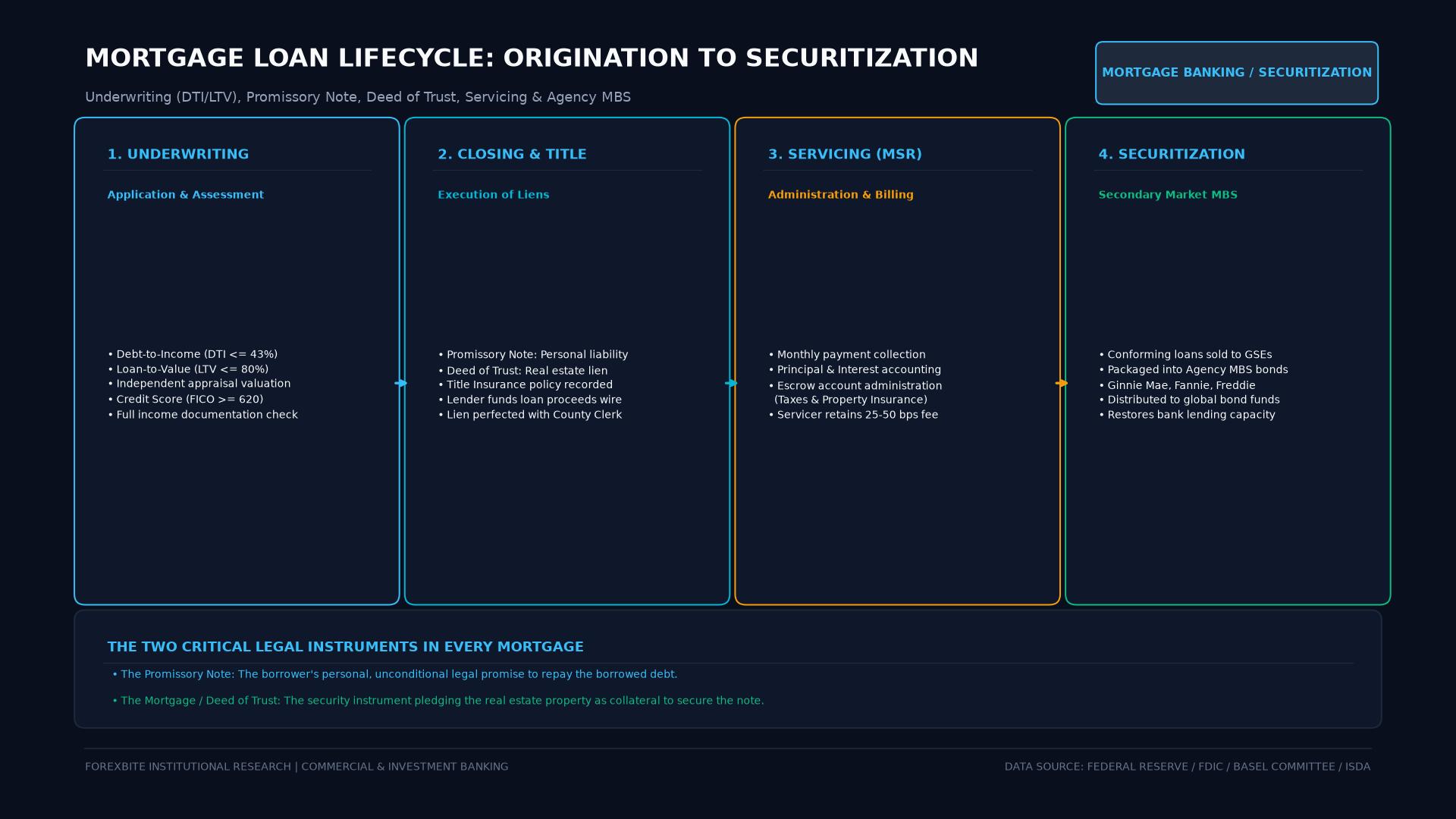 Figure: Mortgage lifecycle pipeline: borrower underwriting, property appraisal, title perfection, loan servicing, and secondary agency MBS pooling.
Legal Theories of Real Estate Mortgages
The jurisdictional execution of a mortgage depends heavily on whether state or national law adheres to Lien Theory, Title Theory, or Intermediate Theory:
+------------------------+-----------------------------+-----------------------------+
| Dimension              | Lien Theory State           | Title Theory State          |
+------------------------+-----------------------------+-----------------------------+
| Legal Title Holder     | The Mortgagor (Borrower)    | The Mortgagee (Lender) or   |
| During Repayment       | retains legal title.        | Neutral Trustee (Deed)      |
+------------------------+-----------------------------+-----------------------------+
| Security Mechanism     | Equitable lien recorded in  | Legal title transferred     |
|                        | public land registry.       | subject to defeasance.      |
+------------------------+-----------------------------+-----------------------------+
| Foreclosure Procedure  | Predominantly Judicial      | Predominantly Non-Judicial  |
|                        | (Formal court proceeding)   | (Trustee Sale / Power)      |
+------------------------+-----------------------------+-----------------------------+
| Lender Right to        | Only upon completion of     | Immediately upon statutory  |
| Possession on Default  | judicial auction.           | default notice.             |
+------------------------+-----------------------------+-----------------------------+- Lien Theory: The borrower retains both legal and equitable title to the property. The mortgage document merely serves as a financial lien encumbering the deed. In the event of borrower default, the lender must file a formal civil lawsuit (judicial foreclosure) to obtain a court order authorizing a sheriff’s sale.
- Title Theory: Legal title to the property is legally conveyed to the mortgagee (or to a neutral third-party trustee via a Deed of Trust) until the debt is fully satisfied. The borrower retains only “equitable title,” which represents the right of occupancy and the statutory power to compel re-conveyance of legal title upon final debt payment (the defeasance clause). Foreclosure is expedited through a non-judicial power-of-sale auction without judicial litigation.
- Intermediate Theory: The borrower retains legal title so long as loan payments remain current. However, upon the occurrence of a contractual event of default, legal title automatically vests in the lender, expediting repossession.
The Mathematics of Mortgage Amortization
Residential and commercial mortgages operate via structured periodic payments designed to retire principal and satisfy accrued interest over a contractual horizon (typically 15, 20, or 30 years).
Derivation of the Standard Constant Payment (PMT)
For a standard fixed-rate fully amortizing mortgage, the fixed monthly payment ($PMT$) is derived from the ordinary annuity present value equation: $$PV = PMT \times \left[ \frac{1 - (1 + r)^{-n}}{r} \right]$$
Solving for $PMT$: $$PMT = P \times \left[ \frac{r(1 + r)^n}{(1 + r)^n - 1} \right]$$
Where:
- $P$ = Original loan principal borrowed.
- $r$ = Periodic monthly interest rate ($\text{Annual Stated Rate} / 12$).
- $n$ = Total number of monthly installments ($\text{Term in Years} \times 12$).
Principal and Interest Dynamics Across Time
In a fully amortizing mortgage, the total monthly payment remains constant, but the composition of the payment shifts monotonically over time:
- Monthly Interest Charge: $$I_t = B_{t-1} \times r$$ Where $B_{t-1}$ is the outstanding principal balance at the start of period $t$.
- Monthly Principal Reduction: $$PR_t = PMT - I_t$$
- New Ending Balance: $$B_t = B_{t-1} - PR_t$$
In the early years of a 30-year mortgage, the predominant share of each monthly payment satisfies accrued interest, with negligible principal reduction. As the principal balance amortizes, the monthly interest charge declines, exponentially accelerating the rate of principal reduction during the final third of the loan lifecycle.
                    30-YEAR MORTGAGE AMORTIZATION TRAJECTORY

  Payment ($)
   ^
   | +-------------------------------------------------------------+
   | |                      TOTAL MONTHLY PAYMENT                  |
   | +-------------------------------------------------------------+
   | | \                                                         / |
   | |  \             INTEREST PORTION                          /  |
   | |   \             (Dominates early years)                 /   |
   | |    \                                                   /    |
   | |     \                                                 /     |
   | |      \                                               /      |
   | |       \                                             /       |
   | |        \               PRINCIPAL PORTION           /        |
   | |         \            (Dominates late years)       /         |
   | |          \                                       /          |
   | +-----------+-------------------------------------+-----------+
   0             Year 10                             Year 20     Year 30
Primary Mortgage Product Architectures
+--------------------+-------------------------+----------------------------+
| Mortgage Type      | Interest Rate Structure | Primary Risk Factor        |
+--------------------+-------------------------+----------------------------+
| Fixed-Rate (FRM)   | Constant coupon for the | Prepayment risk for lender;|
|                    | full term (15/30 yrs)   | lost rate cuts for borrower|
+--------------------+-------------------------+----------------------------+
| Adjustable (ARM)   | Initial fixed period,   | Payment shock for borrower;|
|                    | then resets to benchmark| default risk upon rate rise|
+--------------------+-------------------------+----------------------------+
| Interest-Only (IO) | Zero principal paid for | Massive payment reset when |
|                    | introductory period     | amortization commences     |
+--------------------+-------------------------+----------------------------+
| Balloon Mortgage   | Short maturity with     | Refinancing risk at term;  |
|                    | lump-sum balance due    | lack of principal takeout  |
+--------------------+-------------------------+----------------------------+
| Reverse Mortgage   | Negative amortization;  | Property value erosion;    |
| (HECM)             | repaid upon death/sale  | non-recourse collateral cap|
+--------------------+-------------------------+----------------------------+
1. Fixed-Rate Mortgages (FRMs)
The fixed-rate mortgage isolates the borrower completely from interest rate volatility. Regardless of whether benchmark rates rise or fall, the monthly principal and interest payment remains locked. However, in falling interest rate environments, borrowers exercise their embedded prepayment option by refinancing into lower-rate loans, causing early redemptions for institutional bondholders.
2. Adjustable-Rate Mortgages (ARMs)
ARMs feature an introductory fixed-rate period (e.g., 5, 7, or 10 years in a “5/1 ARM” or “7/6 ARM”) followed by periodic interest rate resets indexed to an institutional benchmark, predominantly the 30-Day Average SOFR (Secured Overnight Financing Rate): $$\text{Reset Rate} = \text{SOFR Benchmark} + \text{Contractual Margin}$$
To protect borrowers from unconstrained rate hikes, ARMs incorporate statutory and contractual rate caps:
- Initial Cap: Maximum permissible increase on the first reset date (e.g., 2% or 5%).
- Periodic Cap: Maximum allowable adjustment in any single subsequent period (e.g., 1% or 2%).
- Lifetime Cap: Maximum aggregate interest rate ceiling over the life of the loan (e.g., 5% above the initial rate).
The Securitization Pipeline and the Secondary Mortgage Market
Few commercial banks or non-bank originators hold 30-year fixed mortgages on their balance sheets to maturity due to severe Asset-Liability Mismatch (ALM): funding 30-year fixed-rate assets with short-term, floating-rate deposits exposes a bank to fatal duration risk (the core vulnerability that destroyed the US Savings and Loan industry in the 1980s and collapsed Silicon Valley Bank in 2023).
To mitigate this, the global mortgage market relies on secondary market securitization:
                  THE MORTGAGE SECURITIZATION PIPELINE

  Borrower
     |
     | Promissory Note & Mortgage Deed
     v
  Originator (Mortgage Broker / Retail Commercial Bank)
     |
     | Whole Loan Sale & Underwriting Verification
     v
  GSEs & Securitizers (Fannie Mae, Freddie Mac, Ginnie Mae, Wall Street)
     |
     | Pooling, Pass-Through Structuring & Credit Enhancement
     v
  Mortgage-Backed Securities (Agency & Non-Agency MBS)
     |
     | Institutional Distribution
     v
  End Investors (Pension Funds, Insurance Co, Sovereign Funds, Central Banks)
1. Conforming vs. Non-Conforming Loans
- Conforming Loans: Mortgages that satisfy the stringent underwriting parameters established by the Federal Housing Finance Agency (FHFA), including maximum loan-to-value (LTV) limits (typically 80% without private mortgage insurance), debt-to-income (DTI) ceilings (typically $\le 43%-45%$), and statutory conforming loan limits. These loans are purchased and securitized by Fannie Mae (FNMA) and Freddie Mac (FHLMC) into liquid Agency MBS.
- Jumbo Mortgages: Non-conforming loans exceeding the FHFA statutory dollar limits. Jumbo loans cannot be sold directly to Fannie or Freddie and are held in bank portfolio balance sheets or securitized via private-label residential mortgage-backed securities (RMBS).
- Government Loans: Insured or guaranteed by federal agencies:
- FHA Loans: Insured by the Federal Housing Administration, designed for low-to-moderate-income borrowers requiring as little as 3.5% down payment.
- VA Loans: Guaranteed by the Department of Veterans Affairs, offering zero-down-payment financing for eligible active-duty service members and veterans.
- Ginnie Mae (GNMA): A wholly owned US government corporation that guarantees timely payment of principal and interest on MBS backed exclusively by FHA, VA, and USDA loans, carrying the explicit full faith and credit backing of the US Government.
2. Prepayment Risk and Option-Adjusted Spread (OAS)
Mortgage investors face complex structural cash-flow uncertainty:
- Contraction Risk: When mortgage interest rates fall, borrowers refinance. Capital is returned to MBS investors prematurely, forcing them to reinvest cash at lower prevailing yields.
- Extension Risk: When interest rates spike, refinancing halts. The expected maturity of the MBS lengthens precisely when investors desire their capital returned to redeploy into higher-yielding debt.
To model this non-linear cash-flow behavior, quantitative mortgage analysts calculate the Constant Prepayment Rate (CPR), apply the Public Securities Association (PSA) Prepayment Benchmark, and price bonds using Option-Adjusted Spread (OAS) models.
Regulatory Safeguards: Dodd-Frank and Post-2008 Reforms
The catastrophic subprime mortgage collapse of 2007–2008 demonstrated how predatory lending, no-documentation “liar loans,” and collateralized debt obligation (CDO) excess could destabilize the global financial system. The subsequent Dodd-Frank Wall Street Reform and Consumer Protection Act of 2010 established systemic statutory firewalls:
- The Ability-to-Repay (ATR) Rule: Codified under Regulation Z (Truth in Lending Act), legally prohibiting creditors from originating residential mortgages without verifying and documenting the consumer’s income, assets, employment, and credit history.
- Qualified Mortgages (QM): Lenders receive statutory legal safe harbor protection against borrower lawsuits if the loan meets strict QM criteria:
- Absence of risky features: No negative amortization, interest-only payments, balloon payments, or terms exceeding 30 years.
- Points and fees cap: Total upfront origination fees cannot exceed 3% of the total loan amount for loans over $100,000.
- Underwriting standard: Fully amortizing payment calculated at the maximum interest rate permitted during the initial five years.
- TRID (TILA-RESPA Integrated Disclosures): Replaced obsolete disclosure forms with standardized, transparent consumer disclosures: the Loan Estimate (LE) delivered within three business days of application, and the Closing Disclosure (CD) provided at least three business days prior to loan consummation.
Default, Foreclosure, and Deficiency Mechanics
When a mortgagor fails to cure a contractual payment default, the mortgagee initiates legal foreclosure proceedings:
+------------------------+--------------------------------------------------+
| Stage                  | Legal and Financial Event                        |
+------------------------+--------------------------------------------------+
| 1. Notice of Default   | Recorded in public records after 90–120 days of  |
|    (NOD)               | delinquency (mandated by CFPB servicing rules).  |
+------------------------+--------------------------------------------------+
| 2. Reinstatement /     | Statutory window allowing borrower to pay past-  |
|    Equity Redemption   | due payments, late charges, and legal fees.      |
+------------------------+--------------------------------------------------+
| 3. Sheriff's Sale or   | Public auction where property is sold to the     |
|    Trustee Auction     | highest third-party cash bidder.                 |
+------------------------+--------------------------------------------------+
| 4. REO (Real Estate    | If bids fail to exceed opening bid (debt owed),  |
|    Owned)              | property reverts to lender balance sheet.        |
+------------------------+--------------------------------------------------+
| 5. Deficiency Judgment | Court ruling holding borrower personally liable  |
|                        | for unpaid balance (in recourse jurisdictions).  |
+------------------------+--------------------------------------------------+- Recourse vs. Non-Recourse: In a recourse state, if a foreclosed house sells for $300,000 against an outstanding mortgage debt of $400,000, the lender can petition the court for a $100,000 deficiency judgment to garnish wages or levy other personal assets. In non-recourse states (such as California for purchase-money residential loans), the lender’s sole legal recovery is the property itself.
Best Practices for Evaluating Mortgage Commitments
- Calculate the Total Cost via APR, Not Just the Note Rate: The nominal note rate dictates monthly interest accrual, but the Annual Percentage Rate (APR) reflects the true economic cost of credit by incorporating upfront origination fees, discount points, mortgage insurance, and processing charges.
- Analyze Break-Even on Discount Points: If paying upfront discount points to lower the permanent note rate, calculate the amortization break-even point: $$\text{Break-Even Months} = \frac{\text{Upfront Cost of Points ($) } }{\text{Monthly Payment Savings ($) } }$$ If the borrower plans to sell or refinance before reaching the break-even threshold, purchasing points represents an unrecoverable capital destruction.
- Monitor Loan-to-Value (LTV) Milestones: In conventional loans with less than 20% down, private mortgage insurance (PMI) is mandatory. Under the federal Homeowners Protection Act of 1998, borrowers possess the statutory right to request PMI cancellation once principal amortizes to 80% of the original property value, and servicers must automatically terminate PMI at 78% LTV.
Frequently Asked Questions (FAQ)
What is the practical difference between a mortgage and a promissory note?
The promissory note is the legal document establishing the borrower’s personal liability to repay a debt, detailing interest rates, payment dates, and maturity terms. In contrast, the mortgage is the security instrument that pledges the real estate as collateral for that promissory note. A lender cannot foreclose on a property without holding both the underlying promissory note and the recorded mortgage or deed of trust.
How does an escrow account function within a monthly mortgage payment?
Most residential mortgage servicers collect monthly payments structured as PITI: Principal, Interest, Taxes, and Insurance. The principal and interest portions retire the loan balance and satisfy lender interest. The real estate property taxes and homeowner hazard insurance premiums are held in an impound escrow account, from which the servicer pays municipal tax authorities and insurance carriers on the borrower’s behalf as bills mature.
Why do lenders charge Private Mortgage Insurance (PMI) on conventional loans?
Private Mortgage Insurance protects the lender (not the borrower) against financial loss if the borrower defaults on the mortgage. Under standard banking underwriting, borrowers putting down less than 20% equity present higher statistical default risk and lower collateral protection. PMI covers the difference between the delinquent loan balance and the recovered foreclosure sale proceeds, enabling lenders to safely originate loans with down payments as low as 3% to 5%.
Ready to trade forex?
Open a free demo account with a regulated broker. Practice with virtual funds before risking real money.