Odd-lot theory
Odd-lot theory is a technical analysis and behavioral finance sentiment indicator based on the contrarian premise that small, unsophisticated retail investors (historically identified by transactions of fewer than 100 shares) are systematically wrong in their market timing at major inflection points.
Odd-lot theory is a classical technical analysis and behavioral market sentiment theory originating in mid-twentieth-century equity trading. The theory operates on the contrarian premise that small, individual retail investors lack the institutional research, quantitative risk systems, and emotional discipline required to time market cycles accurately. Consequently, by tracking transactions executed in odd lots (order sizes of 1 to 99 shares, below the standard institutional round lot of 100 shares), technical analysts sought to identify market turning points by taking positions contrary to prevailing retail activity.
Under the traditional hypothesis:
- When odd-lot purchases rise to unsustainable extremes, the market is approaching a cyclical bull market top driven by late retail fear of missing out (FOMO).
- When odd-lot short sales spike dramatically, the market is experiencing capitulation at a bear market bottom, signaling an optimal institutional accumulation opportunity.
While the theory held high empirical relevance during the mid-twentieth century, modern electronic market microstructure, high-frequency algorithmic order shredding, and commission-free fractional share trading have fundamentally altered the information content of odd-lot transactions.
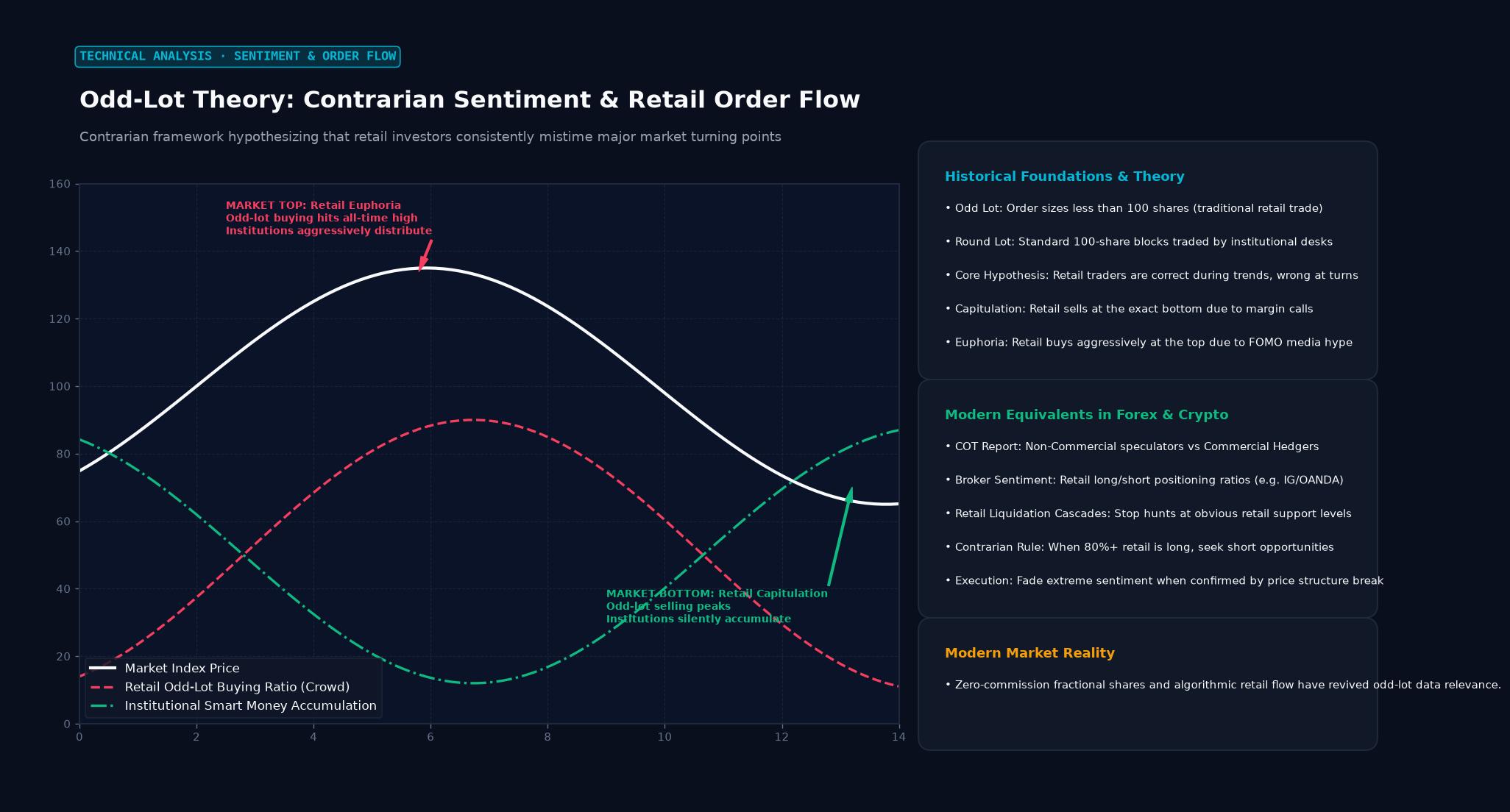 Figure: Contrarian framework hypothesizing that retail investors consistently mistime major market turning points
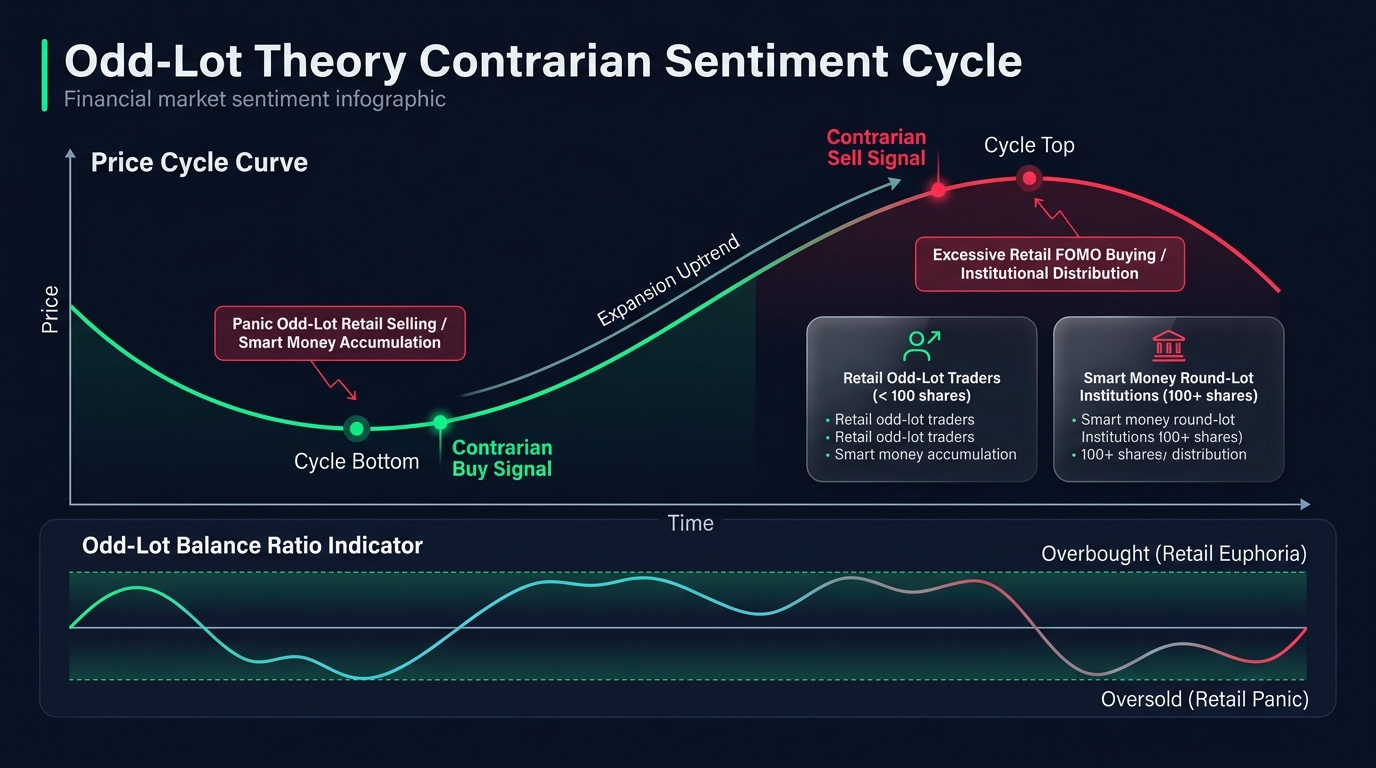
Historical Origins and Foundational Indicators
The Emergence of Contrarian Analysis
Odd-lot theory emerged during the 1930s and 1940s, formalized through the work of financial analyst Garfield Drew and popularizer Humphrey Neill (author of The Theory of Contrary Opinion).
Prior to electronic clearing and the Depository Trust Company (DTC), physical stock certificates were traded on exchange floors in standardized units of 100 shares, known as round lots. Orders for fewer than 100 shares were designated as odd lots and routed to specialized odd-lot dealer firms (such as Carlisle & Jacquelin or DeCoppet & Doremus on the New York Stock Exchange). These dealers filled odd-lot orders by breaking up round lots and charging a small clearing surcharge known as the “odd-lot differential.”
Because institutional investors, mutual funds, and wealthy family offices traded almost exclusively in multiple round lots (e.g., 500, 1,000, or 10,000 shares), the daily odd-lot reporting data published by the NYSE isolated the trading behavior of small retail investors.
Key Quantitative Odd-Lot Formulas
Technical analysts constructed several standardized metrics to quantify retail sentiment:
-
The Odd-Lot Balance Index (Odd-Lot Ratio): Measures the balance of buying versus selling sentiment among retail traders: $$\text{Odd-Lot Ratio} = \frac{\text{Odd-Lot Purchases}}{\text{Odd-Lot Sales}}$$
- A prolonged rise in the ratio above historical baselines indicated aggressive retail accumulation, warning of an impending market top.
- A drop in the ratio indicated retail pessimism, signaling potential market stabilization.
-
The Odd-Lot Short Sales Ratio: Regarded as the most potent contrarian signal within the framework: $$\text{Odd-Lot Short Ratio} = \frac{\text{Odd-Lot Short Sales}}{\text{Total Odd-Lot Sales}}$$ Retail investors rarely engage in short selling due to psychological loss aversion and margin complexity. When ordinary retail traders became bearish enough to execute odd-lot short sales, it almost invariably occurred at the absolute climax of a bear market panic. A sharp spike in the odd-lot short ratio was interpreted by institutional desks as an immediate buy signal.
The Behavioral Economics Behind Contrarian Sentiment
Odd-lot theory was an early precursor to modern behavioral finance, formalizing cognitive biases documented by Daniel Kahneman, Amos Tversky, and Richard Thaler:
+------------------------+--------------------------------------------------+
| Cognitive Bias         | Behavioral Manifestation in Odd-Lot Behavior     |
+------------------------+--------------------------------------------------+
| Herding Behavior       | Retail traders enter equity markets only after an|
|                        | extended bull run has received broad media coverage|
+------------------------+--------------------------------------------------+
| Recency Bias           | Extrapolating recent price trends indefinitely,  |
|                        | buying heavily at multi-year valuation peaks.    |
+------------------------+--------------------------------------------------+
| Disposition Effect     | Selling winning stocks prematurely while holding |
|                        | onto losing positions to avoid realizing losses. |
+------------------------+--------------------------------------------------+
| Capitulation Panic     | Dumping shares or shorting at the bottom of steep|
|                        | drawdowns due to intolerable emotional pain.     |
+------------------------+--------------------------------------------------+
Contrarian institutional investors utilized odd-lot metrics not because small investors are unintelligent, but because unorganized retail market participants lack institutional information channels, trade with high leverage, and are driven by emotional headlines.
The Modern Breakdown: Algorithmic Order Shredding
In contemporary electronic equity markets, the historical assumption of odd-lot theory (that an odd-lot trade represents an individual retail trader) has completely broken down.
                   THE SHREDDING OF INSTITUTIONAL ORDER FLOW

  Historical Structure (Pre-2000)                Modern Algorithmic Reality
  +-------------------------------------+        +-----------------------------------+
  | - Round Lot (100 shares) = Pros     |        | - Institutional Meta-Order (50,000)|
  | - Odd Lot (1-99 shares) = Retail    |        | - Smart Order Router (SOR / TWAP) |
  | - Clear separation of trader types  |        | - Shredded into 15, 23, 40 shares |
  | - Odd-lot data = Retail sentiment   |        | - >60% of all NYSE trades are odd |
  +-------------------------------------+        +-----------------------------------+
1. Algorithmic Child-Order Slicing
With the advent of Reg NMS, high-frequency trading (HFT), and dark pools, institutional asset managers executing large parent orders (e.g., purchasing 50,000 shares of Microsoft or Apple) no longer send single large round-lot blocks to exchange floors.
Instead, algorithmic Smart Order Routers (SORs) utilizing TWAP (Time-Weighted Average Price) and VWAP (Volume-Weighted Average Price) slicing engines shred parent orders into thousands of tiny child orders:
- An institutional algorithm might buy 17 shares on Nasdaq, 22 shares on BATS, and 14 shares on the NYSE within milliseconds to minimize price impact and avoid tipping off predatory algorithms.
- Consequently, modern market data reveals that over 50% to 65% of all executed trades on major US equity exchanges are odd lots. The overwhelming majority of modern odd-lot volume represents high-frequency institutional algorithms rather than retail investors.
2. The Impact of High Nominal Share Prices
Before the mid-2010s, publicly traded corporations routinely executed stock splits (such as 2-for-1 or 3-for-1 splits) to keep their nominal share price between $20 and $80, ensuring that a 100-share round lot remained affordable for retail investors ($2,000 to $8,000).
In recent decades, mega-cap technology corporations (such as Berkshire Hathaway Class A, and historically Alphabet, Amazon, and Booking Holdings) permitted their share prices to rise into the thousands of dollars per share. At a share price of $3,000:
- A standard 100-share round lot requires $300,000 of capital.
- Even affluent individual investors and small registered investment advisors (RIAs) are mathematically forced to trade in odd lots (e.g., 5 or 10 shares) simply to manage portfolio diversification.
Evolution into Modern Retail Sentiment Tracking
While tracking exchange-reported odd lots is no longer a viable proxy for retail sentiment, the core philosophical premise of odd-lot theory (contrarian sentiment analysis) remains fundamental to quantitative trading. Institutional desks have replaced legacy odd-lot metrics with advanced alternative datasets:
+------------------------+--------------------------------------------------+
| Modern Indicator       | Quantitative Metric & Contrarian Logic           |
+------------------------+--------------------------------------------------+
| Retail Call Option     | Tracking small-lot single-stock call option      |
| Volume (Small Traders) | purchases (<10 contracts). Hyper-bullish retail  |
|                        | call surges frequently mark speculative tops.    |
+------------------------+--------------------------------------------------+
| Social Media Sentiment | Natural Language Processing (NLP) sentiment on   |
| Tracking (NLP)         | Reddit (r/wallstreetbets), StockTwits, and X.    |
+------------------------+--------------------------------------------------+
| AAII Retail Sentiment  | American Association of Individual Investors     |
| Survey                 | weekly survey; extreme bullishness signals tops, |
|                        | while extreme bearishness (>50%) signals bottoms.|
+------------------------+--------------------------------------------------+
| FINRA Margin Debt      | Total debit balances in customer broker margin   |
| Acceleration           | accounts; parabolic margin growth marks late-    |
|                        | stage retail leverage and impending liquidation. |
+------------------------+--------------------------------------------------+
| Internalizer Order     | PFOF wholesale market makers (Citadel, Virtu)    |
| Flow Data (PFOF)       | track segmented retail buying/selling directly.  |
+------------------------+--------------------------------------------------+
The Meme Stock Phenomenon: When Contrarian Logic Failed
The classical odd-lot theory assumes that institutional capital will always overwhelm and crush uncoordinated retail traders. However, the rise of commission-free trading platforms (such as Robinhood) and social media coordination in early 2021 (the Meme Stock Squeeze in Gamestop, AMC, and BlackBerry) proved that coordinated retail options buying could trigger catastrophic gamma squeezes and short squeezes, forcing multi-billion-dollar hedge funds into emergency liquidation. Modern quantitative models therefore treat retail momentum not merely as a contrarian indicator, but as a potent directional force over short-term horizons.
Regulatory Modernization: SEC Round-Lot Reform
Historically, under SEC Rule 611 of Regulation NMS (the Order Protection Rule), exchange quotation feeds protected only round lots (100 shares). Odd-lot limit orders placed between the national best bid and offer (NBBO) were invisible on the public Securities Information Processor (SIP) consolidated tape.
To resolve this informational distortion:
- In December 2020, the SEC approved Market Data Infrastructure Rules (MDIR), redefining round lots into dynamic tiers based on share price:
- $250.00 or less: 100 shares.
- $250.01 to $1,000.00: 40 shares.
- $1,000.01 to $10,000.00: 10 shares.
- $10,000.01 or more: 1 share.
- Under these modernized rules, high-priced odd lots are incorporated into the protected SIP best bid and offer, formalizing the end of the traditional round-lot/odd-lot boundary.
Best Practices for Applying Contrarian Sentiment
- Never Rely on Legacy Odd-Lot Trade Counts: Do not attempt to utilize raw exchange-traded odd-lot volume data as a measure of retail sentiment in modern algorithmic markets, as more than half of that data represents institutional execution slicing.
- Combine Sentiment with Structural Price Action: A sentiment indicator alone does not provide a trade trigger. Even if retail traders are excessively bullish, markets can remain irrational and overbought for extended periods. A contrarian short trade should only be initiated after price confirms a structural breakdown (such as a loss of key moving averages or a lower low in market structure).
- Analyze Options Open Interest Skew: Examine the ratio of retail put purchases to call purchases across short-dated tenors. When the CBOE Equity Put/Call ratio drops to historic lows, it indicates excessive market complacency, signaling an optimal environment to purchase portfolio downside protection.
Frequently Asked Questions (FAQ)
What is the difference between a round lot and an odd lot?
A round lot is the standard trading unit established by equity exchanges, historically standardized at 100 shares of stock (or multiples of 100). An odd lot is any order or transaction involving between 1 and 99 shares. Historically, odd lots were subject to higher transaction fees and handled by specialized dealers, whereas round lots enjoyed standard exchange execution.
Why is odd-lot theory largely obsolete in modern stock markets?
Odd-lot theory is obsolete in its original form because odd-lot transactions no longer represent retail investors. In modern electronic markets, institutional algorithms (such as VWAP and smart order routers) routinely shred massive institutional orders into small odd-lot child trades (e.g., 15 or 25 shares) to execute across fragmented venues without moving market prices. Because the majority of modern odd-lot volume is generated by sophisticated institutions, odd-lot volume can no longer be used as a proxy for uninformed retail trading.
What indicators do modern traders use instead of odd-lot statistics?
Modern traders track contemporary retail sentiment through alternative datasets. These include retail call-versus-put option volume in small-lot sizes, the American Association of Individual Investors (AAII) sentiment survey, customer debit margin balances reported by FINRA, natural language processing (NLP) tracking of retail discussion forums like Reddit’s WallStreetBets, and proprietary retail order flow statistics published by wholesale market makers.
Ready to trade forex?
Open a free demo account with a regulated broker. Practice with virtual funds before risking real money.