Round Lot
A standardized trading unit of a financial asset, traditionally established as 100 shares in equity markets and 100,000 units of the base currency (one standard lot) in foreign exchange markets.
What Is a Round Lot?
A round lot is the normal, standardized trading increment accepted by financial exchanges and institutional liquidity networks to facilitate orderly market making, quote dissemination, and clearing. Historically established to eliminate the operational frictions of trading arbitrary, irregular quantities, round lots ensure that bids, offers, and clearing confirmations occur in uniform blocks.
In modern financial markets, the definition of a round lot varies across asset classes:
- Foreign Exchange (FX): A round lot (referred to universally as a standard lot) represents 100,000 units of the base currency.
- Equity Markets: A traditional round lot consists of 100 shares of stock.
- Options Markets: A standard exchange-traded equity option contract covers a round lot of 100 underlying shares.
- Commodities & Futures: Standardized contract specifications (e.g., 1,000 barrels of crude oil or 100 troy ounces of gold).
Orders placed in exact round lots historically received priority matching, narrower bid-ask spreads, and direct inclusion in the consolidated public tape (such as the National Best Bid and Offer, or NBBO, in the United States). Conversely, transactions smaller than a round lot are classified as odd lots, which were historically subject to broker markups and delayed execution.
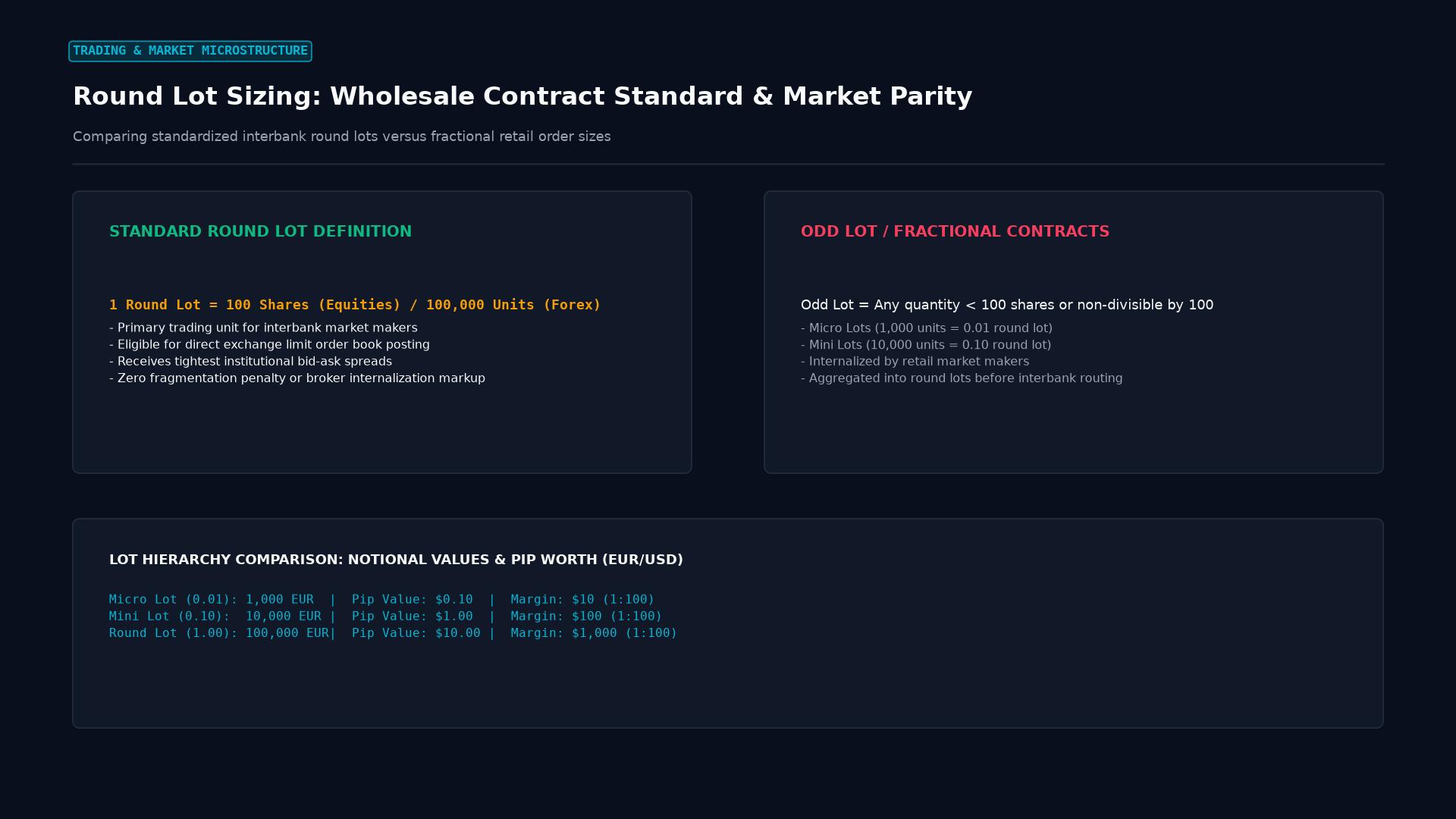 Figure: Institutional wholesale standards: 100,000 currency units (1 round lot) vs odd-lot retail orders internalized by market makers.
Round Lot vs. Odd Lot vs. Mixed Lot
The trading environment categorizes order sizes based on their conformity to standard units:
| Dimension | Round Lot | Odd Lot | Mixed Lot |
|---|---|---|---|
| Size Definition | Exact multiple of the standard unit (e.g., 100 shares or 100k FX units) | Fewer than the standard unit (e.g., 1 to 99 shares, or fractional FX lots) | A combination of a round lot and an odd lot (e.g., 145 shares, or 1.45 FX lots) |
| Price Feed Reporting | Historically reported immediately on consolidated tape / Level 2 | Frequently internalized off-exchange; historically omitted from NBBO | Broken into round-lot and odd-lot components by matching engines |
| Market Maker Quoting | Core interbank and exchange liquidity is quoted in round lots | Handled via retail aggregators, fractional share brokers, or sub-penny desks | Executed through algorithmic routing to minimize execution slippage |
| Execution Cost | Narrowest institutional bid-ask spread | May incur fractional-share spreads or retail dealer markups | Standard blended commission structure |
The Mathematics of a Forex Round Lot: Notional Value, Margin, and Pip Value
In currency trading, executing a round lot (1.00 lot) fundamentally dictates capital commitment, risk exposure, and margin consumption.
1. Notional Exposure
The notional value of a round lot is calculated by multiplying the standard unit size by the spot exchange rate:
$$\text{Notional Exposure} = 100,000 \times \text{Spot Rate}$$
For example, buying 1 round lot of GBP/USD when the pair trades at 1.3000 represents an institutional capital commitment of $130,000.
2. Pip Value Calculation
For pairs where the U.S. Dollar is the quote currency (EUR/USD, GBP/USD, AUD/USD), one pip (0.0001) in a round lot is mathematically fixed:
$$\text{Pip Value} = 100,000 \times 0.0001 = $10.00 \text{ per pip}$$
For cross pairs where the quote currency is not USD (e.g., USD/JPY), the pip value fluctuates with the underlying exchange rate:
$$\text{Pip Value} = \frac{100,000 \times 0.01}{\text{USD/JPY Rate}} = \frac{1,000}{155.00} = $6.45 \text{ per pip}$$
3. Required Margin
Brokers require traders to post a fraction of the round lot’s notional value based on approved regulatory leverage:
$$\text{Required Margin} = \frac{\text{Base Currency Notional Value}}{\text{Leverage Ratio}}$$
At 1:30 leverage (the European ESMA retail cap), opening a 1.00 round lot of EUR/USD requires:
$$\text{Margin} = \frac{€100,000}{30} = €3,333.33 \approx $3,666.66$$
At 1:100 leverage (offshore/institutional), the required margin drops to €1,000 ($1,100).
Real-World Case Study: The SEC Market Structure Reform and Odd-Lot Revolution
For over a century on the New York Stock Exchange (NYSE), orders under 100 shares were disregarded by the Consolidated Tape Association. Because odd lots did not set the national best price (NBBO), high-priced institutional equities (such as Berkshire Hathaway Class A trading at $500,000+ or Amazon and Alphabet before their 2022 20-for-1 stock splits) suffered from fragmented pricing.
          HISTORICAL TAPE DISPARITY (PRE-SEC RULE ADJUSTMENT)

 Exchange Book:
   Bid: 100 shares @ $150.00 (Round Lot - Sets National Best Bid)
   Bid: 10 shares  @ $150.15 (Odd Lot   - INVISIBLE to National Tape)

 Result: Institutional high-frequency traders capitalized on price opacity
         between hidden odd-lot bids and displayed round lots.
In 2020, the U.S. Securities and Exchange Commission (SEC) adopted the Market Data Infrastructure Rule, modernizing the definition of round lots for high-priced stocks:
- Stocks priced $0.00 to $250.00: 100-share round lot.
- Stocks priced $250.01 to $1,000.00: 40-share round lot.
- Stocks priced $1,000.01 to $10,000.00: 10-share round lot.
- Stocks priced above $10,000.00: 1-share round lot.
This landmark structural change mirrored what the forex market accomplished years earlier through fractional lotting (micro and mini lots). Institutional matching engines were forced to recognize smaller liquidity increments, narrowing spreads for retail participants and eliminating the unfair speed and visibility advantages historically enjoyed by institutional round-lot desks.
Practical Risk Management Guidelines When Trading Round Lots
For independent and institutional traders alike, managing round lots requires strict adherence to risk management parameters:
-
Avoid Over-Leveraging Accounts: Because each pip in a round lot equals $10.00, an adverse 50-pip market movement inflicts a $500.00 cash drawdown. Under a strict 1% risk rule, an account must have at least $50,000 in equity to withstand a 50-pip stop-loss on a 1.00 round lot.
-
Utilize Fractional Lot Sizing: Rather than constraining orders to binary round lots (1.00, 2.00, 3.00), traders should calculate precise position sizes (e.g., 0.37 lots or 1.24 lots) based on stop-loss distance:
$$\text{Lots to Trade} = \frac{\text{Account Equity} \times \text{Risk %}}{\text{Stop Loss in Pips} \times \text{Pip Value per Lot}}$$
-
Monitor Execution Routing: When executing large orders (multiple round lots, such as 20.00 to 50.00 lots), utilizing Time-Weighted Average Price (TWAP) or Volume-Weighted Average Price (VWAP) algorithmic orders prevents market impact and slippage across liquidity tiers.
Frequently Asked Questions
Can a beginner trader trade round lots safely?
Generally no, unless the account is capitalized with at least $25,000 to $50,000. Because a 1.00 round lot subjects the account to $10.00 per pip of price movement, small market swings of 100 to 200 pips can trigger margin calls on undercapitalized accounts ($1,000 to $5,000). Beginners should master risk parameters using micro lots (0.01 lots / 1,000 units) where each pip equals $0.10.
Are institutional bank quotes in forex limited to 1 round lot?
No. In the interbank Tier-1 market (EBS, Refinitiv Dealing), institutional quotes are traded in minimum increments of 10 to 50 round lots (typically $1 million to $5 million notional). A single round lot of $100,000 is considered a retail or small commercial corporate transaction by major money-center banks.
Why did exchanges create the 100-share round lot standard in equities?
The 100-share standard originated in the 19th and early 20th centuries on physical trading floors. Floor brokers and clearinghouses used physical paper certificates. Standardizing deliveries in 100-share certificates minimized clerical paperwork, reduced vault storage requirements, and enabled rapid hand-signaling and verbal matching in crowded trading pits.
Ready to trade forex?
Open a free demo account with a regulated broker. Practice with virtual funds before risking real money.