OEX
OEX is the ticker symbol for the S&P 100 Index Options traded on the Chicago Board Options Exchange (CBOE). Introduced in 1983 as the world's first exchange-traded equity index option, OEX is distinctive for featuring American-style exercise with cash settlement.
The OEX is the proprietary ticker symbol for S&P 100 Index Options, listed and traded on the Chicago Board Options Exchange (CBOE). Launched on March 11, 1983, OEX holds a legendary position in modern derivatives history as the world’s first exchange-traded equity index option contract. By allowing institutional asset managers and retail speculators to trade broad market exposure in a single standardized instrument rather than executing dozens of individual stock orders, the introduction of OEX revolutionized equity portfolio hedging, market making, and quantitative risk management.
A defining structural characteristic of the OEX contract is its American-style exercise convention combined with cash settlement. Unlike modern benchmark index options (such as the S&P 500 index options, SPX), which are European-style contracts exercisable only at expiration, OEX options can be exercised by the contract holder on any business day prior to expiration, creating unique mathematical pricing dynamics, early exercise arbitrage opportunities, and short assignment risks.
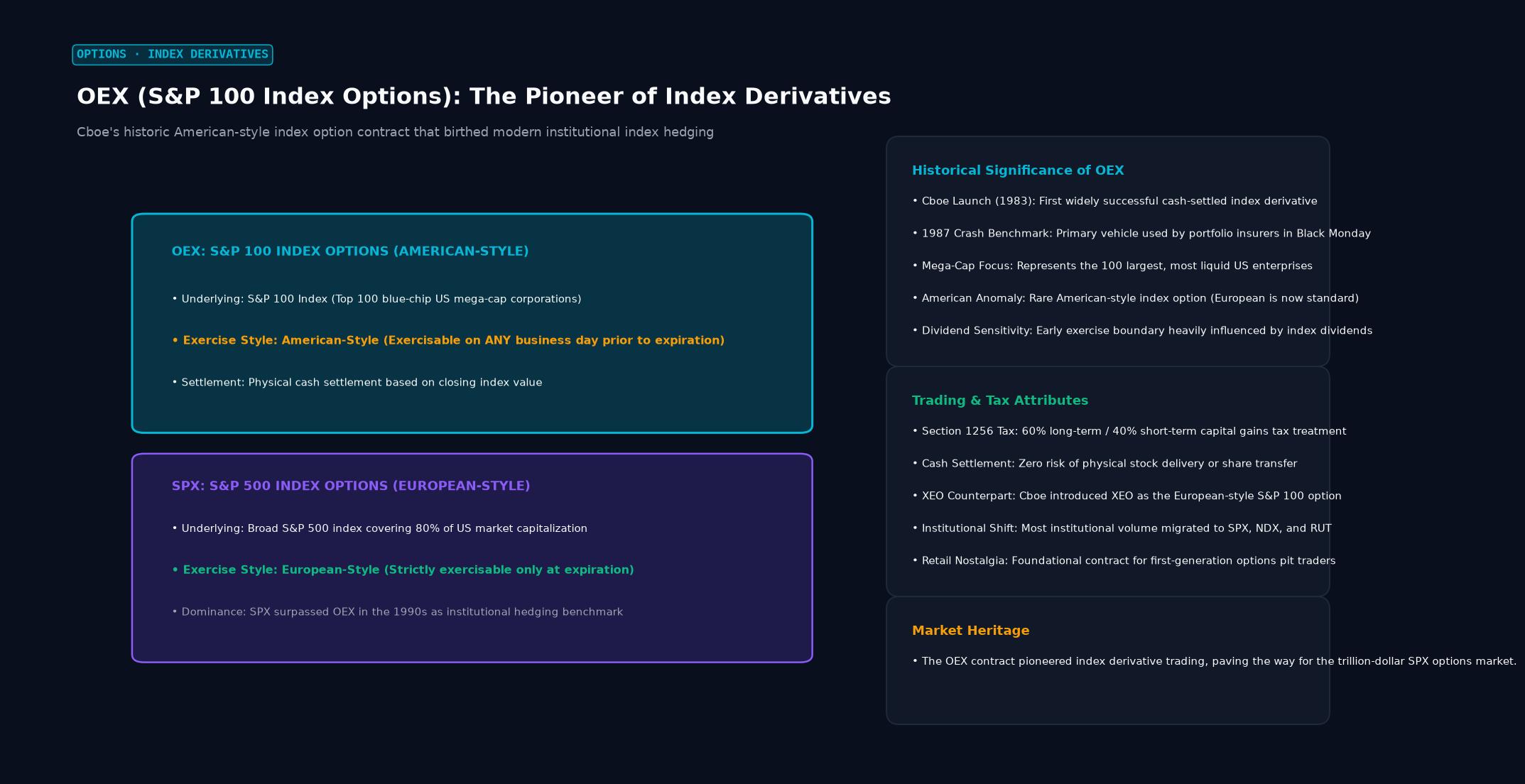 Figure: Cboe’s historic American-style index option contract that birthed modern institutional index hedging
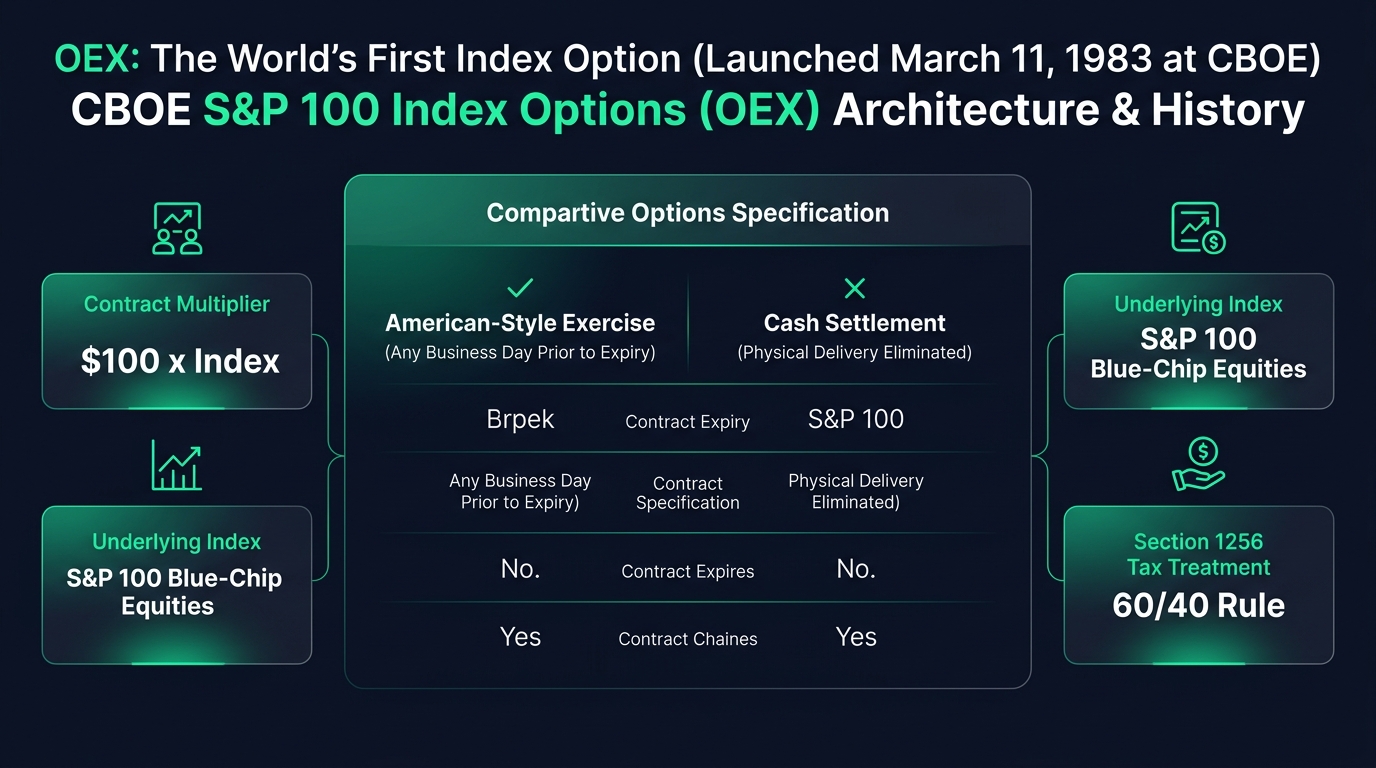
Historical Origins and the Derivatives Revolution
The Birth of Index Options (March 11, 1983)
Prior to 1983, equity option trading was confined strictly to single-stock equity options (introduced by the CBOE upon its founding in 1973). Institutional investors seeking to hedge diversified stock portfolios against broad macroeconomic drawdowns faced severe structural frictions:
- Hedging required executing individual put option contracts across dozens of separate corporate equities.
- Single-stock options carried severe idiosyncratic corporate earnings risk, dividend adjustments, and prohibitive transaction costs.
To solve this friction, the CBOE engineered the CBOE 100 Index, a market-capitalization-weighted index composed of 100 leading US blue-chip corporations with listed options on the exchange. On March 11, 1983, trading commenced on the CBOE 100 option contract under the ticker OEX.
The product was an immediate, runaway commercial triumph. Within months, daily trading volume in OEX exploded, establishing the OEX trading pit at the CBOE as the largest, most crowded, and most liquid derivatives trading floor in the world throughout the 1980s and early 1990s. Recognizing its systemic importance, Standard & Poor’s partnered with the CBOE in July 1983, officially rebranding the underlying index as the S&P 100 Index.
                    MILESTONES IN INDEX OPTION TRADING

  1973                     March 1983                  July 1983              2001+
  +------------------+     +--------------------+      +---------------+      +-------------------+
  | CBOE Founded     | ==> | OEX Launched       | ===> | S&P 100 Brand | ===> | XEO Introduced    |
  | Single-Stock     |     | World's First      |      | SPX Launched  |      | SPX Overtakes OEX |
  | Equity Options   |     | Index Option       |      | (S&P 500 Pool)|      | Electronic Screen |
  +------------------+     +--------------------+      +---------------+      +-------------------+
The Underlying Asset: The S&P 100 Index
The S&P 100 Index represents a concentrated subset of the broader S&P 500 Index:
- Constituent Selection: Maintained by the S&P Dow Jones Index Committee, the index selects 100 industry-leading US corporations with liquid balance sheets and active listed options.
- Market Capitalization Coverage: Because the constituent firms are mega-cap enterprises (such as Apple, Microsoft, Amazon, Nvidia, Alphabet, Berkshire Hathaway, and JPMorgan Chase), the S&P 100 accounts for approximately 65% to 70% of the total market capitalization of the entire S&P 500.
- Index Calculation: Like the S&P 500, the S&P 100 is a float-adjusted market-capitalization-weighted index: $$\text{Index Level} = \frac{\sum_{i=1}^{100} P_i \times Q_i^{\text{float}}}{\text{Index Divisor}}$$ Where $P_i$ is the share price of constituent $i$, and $Q_i^{\text{float}}$ is the publicly available float shares.
Contract Mechanics: The Critical American vs. European Distinction
The structural hallmark that distinguishes OEX from virtually all other modern index options is its American-style exercise convention:
+------------------------+-------------------+------------------+-------------------+
| Specification          | OEX (S&P 100)     | XEO (S&P 100)    | SPX (S&P 500)     |
+------------------------+-------------------+------------------+-------------------+
| Exercise Style         | American-Style    | European-Style   | European-Style    |
|                        | (Any Business Day)| (Expiration Only)| (Expiration Only) |
+------------------------+-------------------+------------------+-------------------+
| Settlement Type        | Cash Settlement   | Cash Settlement  | Cash Settlement   |
|                        | ($100 Multiplier) | ($100 Multiplier)| ($100 Multiplier) |
+------------------------+-------------------+------------------+-------------------+
| Underlying Index       | S&P 100 Index     | S&P 100 Index    | S&P 500 Index     |
+------------------------+-------------------+------------------+-------------------+
| Early Exercise Risk    | YES (High risk    | NO (Zero early   | NO (Zero early    |
| for Option Writers     | on short options) | assignment risk) | assignment risk)  |
+------------------------+-------------------+------------------+-------------------+
| Valuation Model        | Binomial / Bjerks-| Black-Scholes-   | Black-Scholes-    |
|                        | und-Stensland     | Merton (BSM)     | Merton (BSM)      |
+------------------------+-------------------+------------------+-------------------+
1. Cash Settlement Mechanics
When an investor exercises a standard single-stock American option (e.g., an Apple call option), physical shares of Apple stock are transferred.
In contrast, OEX is cash-settled:
- Exercising an OEX option does not involve the transfer of shares of 100 separate corporations.
- Upon exercise, the Options Clearing Corporation (OCC) calculates the cash difference between the option strike price and the closing settlement level of the S&P 100 Index.
- The writer’s account is debited, and the exerciser’s account is credited with the cash settlement amount: $$\text{Cash Settlement Value (Call)} = (\text{Settlement Index Level} - \text{Strike Price}) \times $100$$ $$\text{Cash Settlement Value (Put)} = (\text{Strike Price} - \text{Settlement Index Level}) \times $100$$
2. The Early Exercise Dilemma and Dividend Drag
Because OEX is an American-style contract, contract holders possess the legal right to exercise their options prior to the expiration date. This introduces distinct mathematical boundaries:
- Deep In-The-Money (ITM) Calls: Constituent companies in the S&P 100 pay regular quarterly cash dividends. When a cluster of mega-cap constituents approaches their ex-dividend dates, the intrinsic value of an ITM call may exceed its market price if the remaining extrinsic time value is less than the expected dividend drop. In such cases, rational option holders exercise their calls early to capture the cash dividend equivalent.
- Deep In-The-Money (ITM) Puts: When interest rates are elevated, deep ITM puts exhibit early exercise incentive. By exercising the put early, the holder receives the cash settlement value immediately, which can then be reinvested in risk-free Treasury bills to earn prevailing money market yields.
- Assignment Risk for Option Writers: Traders who write short OEX options (or execute vertical credit spreads, iron condors, or calendar spreads) face unpredictable overnight early assignment. If assigned, the trader’s account is immediately debited cash, disrupting multi-leg spread delta neutrality.
To provide institutional investors with an identical index exposure free from early exercise assignment risk, the CBOE introduced XEO in 2001, which tracks the S&P 100 under a strict European-style exercise convention.
Tax Advantages: IRC Section 1256 Treatment
In the United States, OEX index options qualify for specialized, preferential tax treatment under Section 1256 of the Internal Revenue Code (IRC § 1256):
                  THE SECTION 1256 TAX ADVANTAGE

  Standard Single-Stock Equity Option           OEX Index Option (Section 1256)
  +-------------------------------------+       +-------------------------------------+
  | - Held < 1 year: 100% Short-Term    |       | - Blended Statutory 60/40 Rule:     |
  |   Capital Gains Rate (up to 37%)    | =====>|   60% Long-Term (Max 20% Base)      |
  | - Subject to Wash-Sale Disallowance |       |   40% Short-Term (Max 37% Base)     |
  | - Complex Schedule D tracking       |       | - Exempt from IRS Wash-Sale Rules   |
  +-------------------------------------+       +-------------------------------------+
The 60/40 Capital Gains Rule
Under Section 1256:
- Any capital gain or loss realized on an OEX contract is automatically taxed at a statutory blended rate of 60% long-term capital gains and 40% short-term capital gains, regardless of how long the contract was held.
- Even if a day trader opens and closes an OEX position within 45 seconds, 60% of the resulting profit qualifies for lower long-term capital gains tax rates.
- Mark-to-Market Accounting: At calendar year-end, open OEX positions are deemed sold at fair market value, simplifying tax compliance via IRS Form 6781 and completely bypassing IRS wash-sale rules.
Trading Floor History: The Legend of the OEX Pit
The OEX pit at the Chicago Board Options Exchange is legendary in the folklore of American financial capitalism:
+------------------------+--------------------------------------------------+
| Historical Dimension   | The OEX Floor Culture (1980s–1990s)              |
+------------------------+--------------------------------------------------+
| Physical Venue         | The CBOE trading floor at 400 S. LaSalle Street, |
|                        | Chicago; a tiered amphitheater pit.              |
+------------------------+--------------------------------------------------+
| Pit Population         | Often packed with over 500 market makers, floor  |
|                        | brokers, and clerks shouting in open-outcry.     |
+------------------------+--------------------------------------------------+
| Market Makers          | Individual risk-takers (locals) quoting two-sided|
|                        | markets, hedging via S&P 500 futures at the CME. |
+------------------------+--------------------------------------------------+
| The 1987 Crash         | On October 19, 1987 (Black Monday), OEX put      |
|                        | premiums exploded, testing exchange solvency.    |
+------------------------+--------------------------------------------------+
The Migration from OEX to SPX
During the 1980s, OEX was the undisputed king of index options. However, as quantitative finance, financial engineering, and institutional portfolio management matured in the 1990s and 2000s:
- The Broad Benchmark Shift: Institutional pension funds and mutual funds measured performance against the S&P 500, not the S&P 100.
- Preference for European Exercise: Institutional risk managers preferred the SPX contract because European-style exercise eliminated early assignment risk, simplifying dynamic delta-hedging algorithms.
- Electronic Execution: As trading transitioned from physical floor pits to the CBOE Command electronic platform, liquidity steadily shifted from OEX to SPX, making SPX the dominant equity index derivative in the modern era. Nonetheless, OEX remains an actively utilized contract, particularly for traders executing specialized American-style volatility strategies.
Best Practices for Trading OEX Options
- Model Prices Using American Binomial Trees: Never utilize the standard Black-Scholes-Merton (BSM) formula to price OEX options, as BSM assumes European exercise and systematically underprices American early exercise premiums. Quantitative traders should utilize the Cox-Ross-Rubinstein (CRR) Binomial Tree or the Bjerksund-Stensland (2002) analytical approximation.
- Monitor Ex-Dividend Schedules of Top Holdings: When holding short ITM call positions in OEX, track the upcoming ex-dividend dates of top-weighted index components (such as Apple, Microsoft, and ExxonMobil). If the cumulative dividend exceeds the call’s remaining time value, close or roll the position to prevent unexpected early exercise assignment.
- Select XEO When Executing Complex Spreads: If your strategy involves multi-leg structures (such as iron condors, calendar spreads, or diagonal spreads) on the S&P 100, execute via the XEO European-style contract to eliminate the risk of one leg being assigned early and leaving the remaining position unhedged.
Frequently Asked Questions (FAQ)
What does the acronym OEX stand for?
OEX is the ticker symbol for the S&P 100 Index Options traded on the Chicago Board Options Exchange (CBOE). The letter “O” originally represented Options, and “EX” derived from the Exchange or the historical CBOE 100 index identifier. Today, OEX universally identifies the American-style S&P 100 index option contract.
How does an OEX option differ from an SPX option?
While both trade on the CBOE and are cash-settled, they differ in two major structural ways:
- Underlying Index: OEX tracks the S&P 100 Index (100 mega-cap companies), whereas SPX tracks the broader S&P 500 Index (500 companies).
- Exercise Style: OEX is an American-style option, meaning it can be exercised by the contract holder on any business day prior to expiration. SPX is a European-style option, which can only be exercised on the final expiration date, eliminating early assignment risk for option writers.
What happens if my short OEX option is assigned early?
If you write an OEX option and the counterparty exercises it prior to expiration, the Options Clearing Corporation (OCC) assigns the exercise notice to your brokerage account overnight. Because OEX is cash-settled, you do not deliver or receive physical stock shares. Instead, your account is immediately debited the cash difference between the option strike price and the closing index level multiplied by $100.
Ready to trade forex?
Open a free demo account with a regulated broker. Practice with virtual funds before risking real money.