PAC tranche
A PAC tranche (Planned Amortization Class tranche) is a structured bond class within a Collateralized Mortgage Obligation (CMO) structured to receive scheduled principal repayments within a designated prepayment collar, protected by companion support tranches.
A PAC tranche (Planned Amortization Class tranche) is an engineered debt security class within a Collateralized Mortgage Obligation (CMO) structure. In mortgage-backed securitization, cash flows generated by an underlying pool of residential mortgages (consisting of monthly interest, scheduled principal amortization, and unscheduled principal prepayments) are not distributed to investors pro-rata. Instead, quantitative financial engineers slice the cash flows into distinct structural layers or tranches, each carrying unique maturity, yield, and risk characteristics.
The PAC tranche is engineered to occupy the most secure, predictable position within the CMO capital structure. By establishing a legally binding sinking fund schedule backed by subordinated companion tranches (support tranches), the PAC tranche provides fixed income investors with a stable Weighted Average Life (WAL) and insulates them from the two primary hazards of mortgage investing: contraction risk (accelerated principal return during falling interest rate environments) and extension risk (delayed principal return during rising interest rate environments).
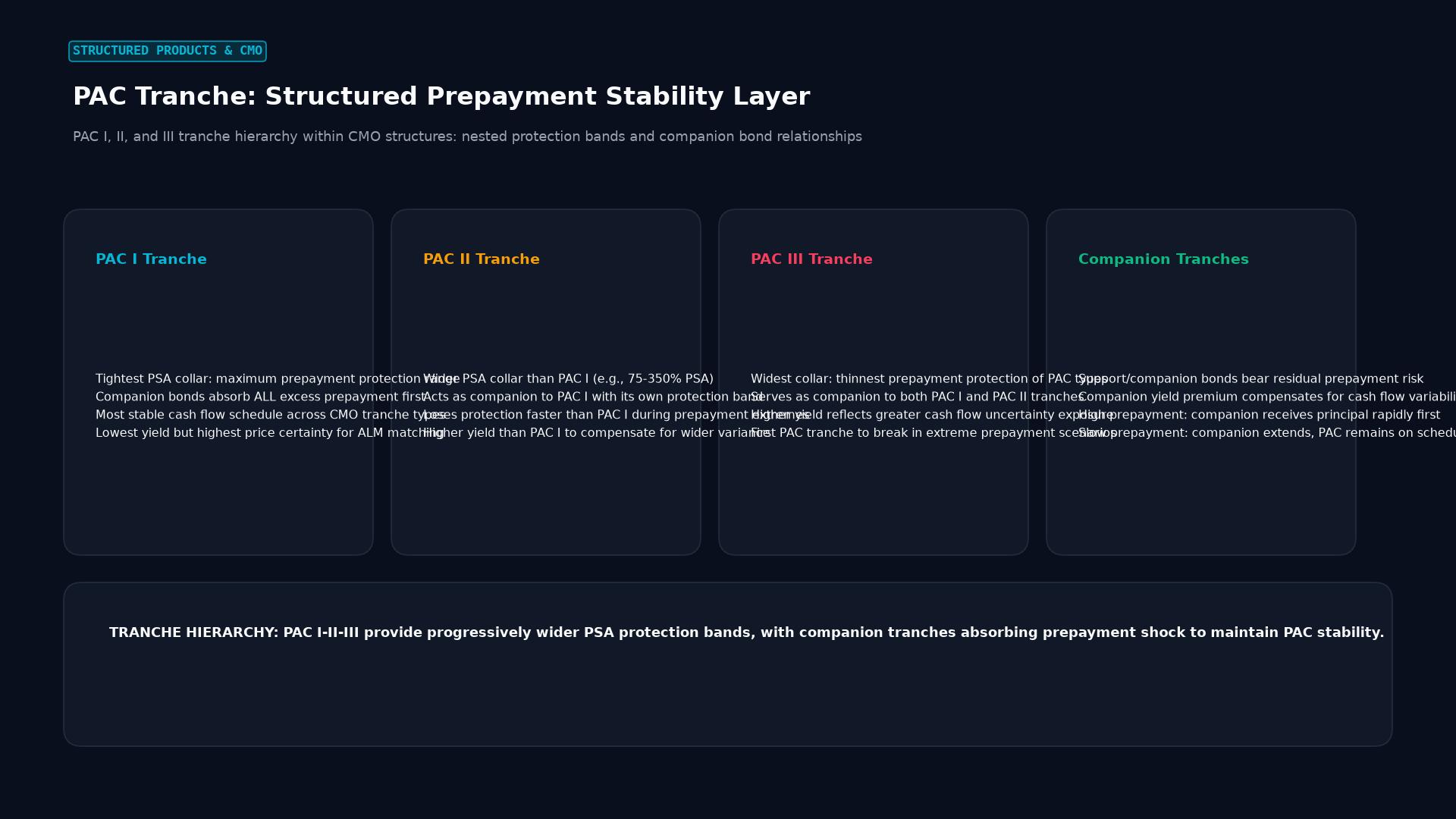 Figure: PAC I, II, and III tranche hierarchy within CMO structures: nested protection bands and companion bond relationships
The Mathematics of Tranche Structuring: The PSA Prepayment Collar
The creation of a PAC tranche begins with the definition of the prepayment collar, expressed in percentages of the Public Securities Association (PSA) benchmark model.
1. The Standard PSA Benchmark Curve
The PSA model represents an empirical industry standard for residential mortgage prepayments:
- At 100% PSA, the prepayment rate is assumed to begin at a Single Monthly Mortality (SMM) of 0.2% per annum in month 1, increasing by 0.2% each month until reaching a constant annualized Conditional Prepayment Rate (CPR) of 6.0% at month 30: $$\text{CPR}_t = \begin{cases} 6.0% \times \left( \frac{t}{30} \right), & \text{for } 1 \le t \le 30 \ 6.0%, & \text{for } t > 30 \end{cases}$$
- A speed of 200% PSA indicates prepayments occurring at twice the baseline rate (reaching 12% CPR at month 30).
- A speed of 50% PSA represents half the baseline rate (reaching 3% CPR).
2. Deriving the Protected Cash Flow Envelope
To engineer a PAC tranche, the structurer establishes a lower collar boundary ($L$) and an upper collar boundary ($U$), such as 100% PSA and 300% PSA:
- The structurer models the total mortgage pool principal cash flows generated at speed $L$ across all $N$ monthly payment periods: ${P_{L,1}, P_{L,2}, \dots, P_{L,N}}$.
- The structurer models the principal cash flows generated at speed $U$: ${P_{U,1}, P_{U,2}, \dots, P_{U,N}}$.
- The scheduled principal payment for the PAC tranche at month $t$ is calculated as the minimum of the two boundaries: $$\text{PAC Schedule}t = \min \left[ P{L,t}, P_{U,t} \right]$$
This mathematical derivation guarantees that as long as actual historical prepayments remain between $L$ and $U$, the collateral pool will always produce sufficient principal to meet the PAC tranche’s contractual payment schedule.
                    THE PAC COLLAR CASH FLOW ENVELOPE

  Monthly Principal ($)
   ^
   |        / \  (High Prepayments: 300% PSA Profile)
   |       /   \
   |      /     \--------------------------------
   |     /       \                              |
   |    /         \      PAC TRANCHE            |
   |   /           \     SCHEDULED CASH FLOWS   |
   |  /             \    (Guaranteed Envelope)  |
   | /               \                          |
   |/                 \                         |
   |-------------------+------------------------+ (Low Prepayments: 100% PSA Profile)
   +------------------------------------------------------------------------> Months
Cash Flow Waterfall Mechanics: Priorities and Reallocation
On each monthly payment distribution date, the CMO trustee applies the contractual cash flow waterfall:
+------------------------+--------------------------------------------------+
| Priority Order         | Structural Cash Flow Allocation Action           |
+------------------------+--------------------------------------------------+
| 1. Interest Payments   | All tranches (PAC I, PAC II, Companion) receive  |
|                        | accrued monthly coupon interest based on their   |
|                        | current outstanding principal balance.           |
+------------------------+--------------------------------------------------+
| 2. PAC I Principal     | Principal cash flows are directed first to the   |
|    Scheduled Amount    | PAC I tranche up to its exact contractual        |
|                        | sinking fund schedule for that month.            |
+------------------------+--------------------------------------------------+
| 3. PAC II Principal    | If surplus principal remains, it is applied to   |
|    Scheduled Amount    | satisfy the PAC II sinking fund schedule.        |
+------------------------+--------------------------------------------------+
| 4. Companion Tranche   | ALL residual principal cash flows (surplus       |
|    Absorption          | prepayments) are routed to pay down the          |
|                        | principal balance of the Companion tranche.      |
+------------------------+--------------------------------------------------+
1. In a Decreasing Interest Rate Environment (Prepayment Acceleration)
When mortgage rates fall from 7% to 5%, homeowners refinance in volume, driving prepayment speeds from 100% PSA up to 280% PSA:
- The PAC tranche receives its planned scheduled payment, retaining its original maturity profile.
- The companion tranche receives massive lump-sum prepayments, paying down companion bondholders years ahead of schedule.
- The PAC tranche avoids the reinvestment rate penalty, allowing investors to continue earning attractive yields.
2. In an Increasing Interest Rate Environment (Prepayment Deceleration)
When mortgage rates climb from 5% to 8%, refinancing collapses, slowing prepayment speeds to 110% PSA:
- The diminished principal cash flows entering the CMO trust are allocated first to the PAC tranche.
- The companion tranche receives zero principal distributions, bearing the complete burden of the cash flow drought.
- The PAC tranche avoids maturity extension, amortizing as scheduled.
Weighted Average Life (WAL) Sensitivity Analysis
The defining quantitative advantage of a PAC tranche is the stability of its Weighted Average Life (WAL) across varying prepayment environments:
$$\text{WAL} = \sum_{t=1}^N \frac{t \times \text{Principal Distributed}_t}{12 \times \text{Total Initial Principal}}$$
+------------------+-----------------------------+-----------------------------+
| Prepayment Speed | PAC I Tranche WAL           | Companion Tranche WAL       |
| (PSA Benchmark)  | (Target: 5.0 Years)         | (Residual Support)          |
+------------------+-----------------------------+-----------------------------+
| 50% PSA          | 6.4 Years (Slight Extension)| 18.2 Years (Severe Extens.) |
+------------------+-----------------------------+-----------------------------+
| 100% PSA (Collar)| 5.0 Years (On Schedule)     | 12.5 Years                  |
+------------------+-----------------------------+-----------------------------+
| 150% PSA (Center)| 5.0 Years (On Schedule)     | 7.2 Years                   |
+------------------+-----------------------------+-----------------------------+
| 250% PSA (Collar)| 5.0 Years (On Schedule)     | 2.8 Years (Rapid Contraction|
+------------------+-----------------------------+-----------------------------+
| 400% PSA (Bust)  | 3.6 Years (Contraction)     | 0.9 Years (Paid Off Fully)  |
+------------------+-----------------------------+-----------------------------+
Within the 100% to 250% PSA band, the PAC tranche’s WAL remains constant at exactly 5.0 years. In contrast, the companion tranche’s WAL experiences extreme volatility, collapsing from 12.5 years down to 2.8 years, illustrating the transfer of prepayment risk from the PAC to the companion.
Structural Breakdown: “Effective Collar Drift” and Collar Busts
Fixed income analysts must track two structural vulnerabilities inherent in PAC tranches:
                    THE DRIFT OF THE EFFECTIVE COLLAR

  Collar Width (PSA)
   ^
   |  ==================================  Initial Upper Collar (300% PSA)
   |   \
   |    \-------------------------------  Effective Upper Collar Drifts DOWN
   |                                      (As companion balances deplete)
   |         REMAINING PAC SHIELD
   |                                      Effective Lower Collar Drifts UP
   |    /-------------------------------  (If early prepayments were fast)
   |   /
   |  ==================================  Initial Lower Collar (100% PSA)
   +------------------------------------------------------------------------> Deal Seasoning
1. Effective Collar Drift
The prepayment collar established at the inception of a CMO is not static:
- As the mortgage pool seasons and interest rate cycles unfold, the supporting companion tranches amortize.
- If actual prepayments were persistently fast during the deal’s early years, a substantial portion of the companion tranches is permanently retired.
- With fewer companion bonds remaining to absorb future prepayments, the effective upper collar drifts downward (e.g., from 300% PSA down to 210% PSA), making the PAC tranche significantly more vulnerable to future refinancing waves.
2. A Collar Bust (The “Busted PAC”)
If actual prepayments break out above the upper collar for a sustained period, all companion tranches are retired down to a zero balance.
Once companion support is eliminated:
- The PAC tranche loses its prepayment shield.
- It transforms into an ordinary sequential-pay mortgage bond.
- Subsequent prepayment surges flow directly into the PAC tranche, causing unwanted contraction and early redemption.
Institutional Deployment in Asset-Liability Management (ALM)
PAC tranches are widely utilized across conservative institutional balance sheets:
+------------------------+--------------------------------------------------+
| Institutional Entity   | Balance Sheet Application and Rationale          |
+------------------------+--------------------------------------------------+
| Commercial Bank ALCO   | High-Quality Liquid Asset (HQLA) portfolios;     |
| Committees             | provides predictable monthly cash flow without   |
|                        | violating interest rate risk stress tests.       |
+------------------------+--------------------------------------------------+
| Life Insurance Cos.    | Matching guaranteed payout liabilities under    |
|                        | fixed annuities and life insurance endowments.   |
+------------------------+--------------------------------------------------+
| Sovereign Wealth Funds | Generating yield spreads over US Treasuries with |
|                        | AAA Agency credit quality and low duration drift.|
+------------------------+--------------------------------------------------+
Best Practices for Analyzing PAC Tranches
- Calculate the Ratio of Companion Support: Before investing in a seasoned PAC tranche, divide the outstanding dollar balance of all companion tranches by the remaining balance of the PAC tranche. A ratio above 0.50 indicates strong protective cushion; a ratio below 0.15 indicates imminent collar bust risk.
- Stress-Test Beyond the Collar Bands: Quantitative analysts should evaluate PAC pricing using Monte Carlo interest rate paths that simulate extreme shocks ($\pm 300$ basis points). Evaluating how the tranche behaves when the collar is breached reveals its tail-risk exposure.
- Verify Seniority (PAC I vs. PAC II): Confirm whether the tranche is a primary PAC I or a secondary PAC II. While PAC II tranches offer higher yields, their protection is subordinated, and their sinking fund schedules are sacrificed if the underlying collateral suffers stress.
Frequently Asked Questions (FAQ)
What is the difference between a PAC bond and a PAC tranche?
The terms are often used interchangeably, but “PAC bond” refers to the general debt instrument, while “PAC tranche” specifically describes the structural slice within a multi-tiered Collateralized Mortgage Obligation (CMO). A single CMO deal may contain multiple PAC tranches (such as PAC I, PAC II, and PAC III), each possessing different priority claims and maturity horizons.
Why do investors accept lower yields on PAC tranches than on sequential tranches?
Investors accept lower yields on PAC tranches because they provide superior cash flow predictability. In sequential mortgage tranches, investors bear unhedged prepayment volatility, risking premature return of capital during rate drops or prolonged lockups during rate spikes. The structural protection provided by companion tranches lowers the PAC’s risk premium, resulting in tighter yield spreads.
Can a PAC tranche experience credit default risk?
Most PAC tranches issued in the United States are Agency CMOs, backed by mortgage collateral guaranteed by Fannie Mae (FNMA), Freddie Mac (FHLMC), or Ginnie Mae (GNMA). Consequently, they carry negligible credit default risk (carrying the explicit or implicit backing of the US Government). However, in non-agency private-label CMOs, PAC tranches can face credit risk if homeowner mortgage defaults exceed the subordination protections of junior credit-support tranches.
Ready to trade forex?
Open a free demo account with a regulated broker. Practice with virtual funds before risking real money.