Pacific Exchange
The Pacific Exchange (PCX) was a historic regional securities and options exchange operating in San Francisco and Los Angeles from 1882 until its acquisition by Archipelago Holdings in 2005, subsequently becoming the foundation for NYSE Arca.
The Pacific Exchange (PCX) was a premier regional securities and options exchange operating on the West Coast of the United States. Tracing its lineage back to the founding of the San Francisco Stock and Bond Exchange in 1882, the exchange played a vital role in American capital formation, financing the rapid industrialization of the American West, the California oil booms, and the emergence of Silicon Valley technology giants.
Throughout its operational history, the Pacific Exchange was distinguished by its dual-floor trading architecture spanning San Francisco and Los Angeles, its high-volume equity options franchise, and its role as an aggressive technological disruptor. In 1999, the PCX became the first US securities exchange to demutualize, transforming from a member-owned club into a for-profit corporation. In 2001, the PCX executed a historic partnership with electronic communications network (ECN) Archipelago to create ArcaEx, fully retiring its traditional physical equities floor in favor of an electronic limit order book that now operates as NYSE Arca.
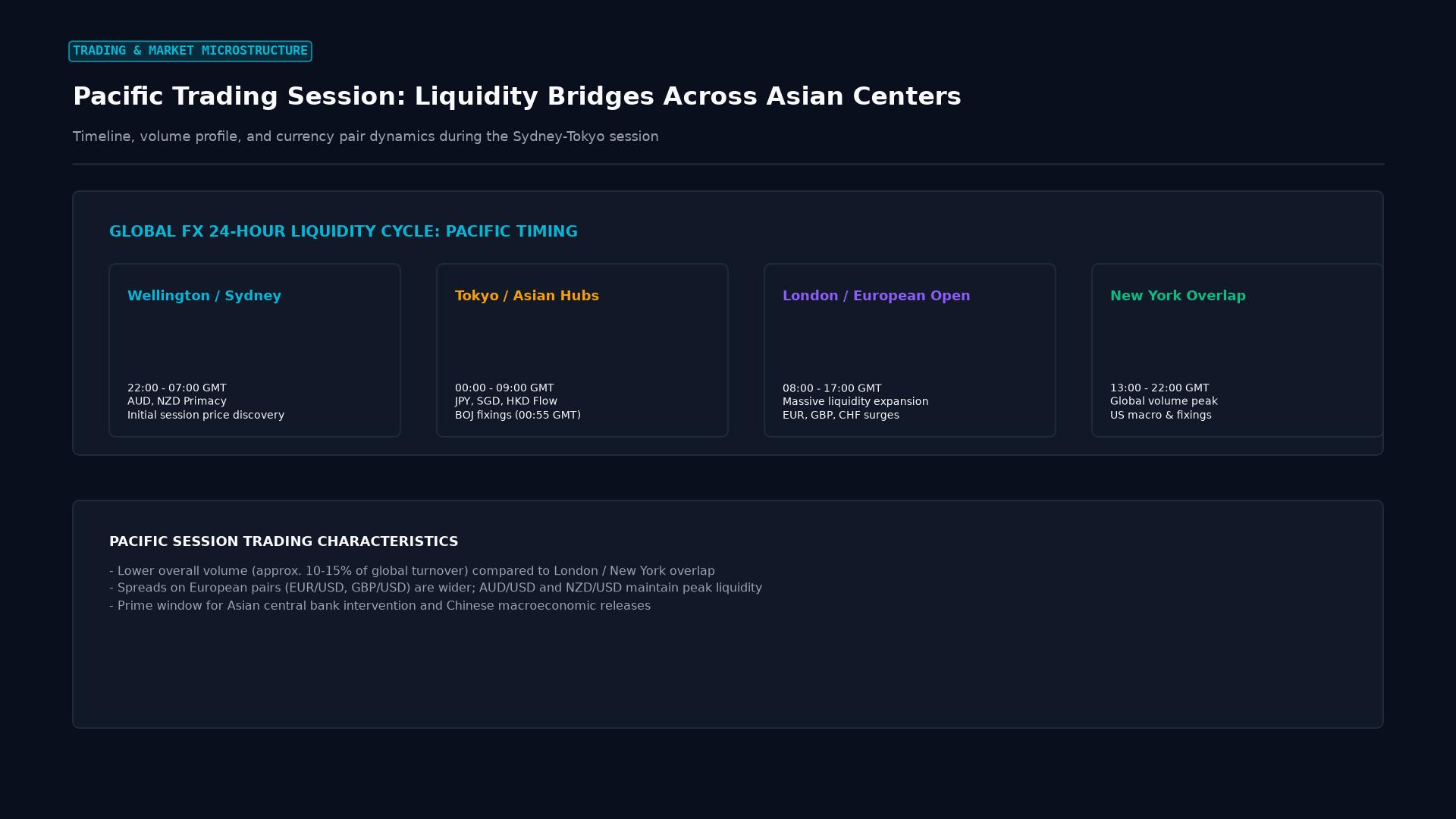 Figure: Global 24-hour session cycle: Wellington/Sydney opening, Asian financial center overlap, volume distribution, and currency pair characteristics.
Historical Origins: The Comstock Lode and California Oil
The 1882 Gold and Silver Mining Heritage
The Pacific Exchange emerged from the intense wealth generated by the California Gold Rush and the discovery of the Comstock Lode in Nevada (the greatest silver strike in American history):
- In the 1860s and 1870s, wild speculation in mining shares in San Francisco was conducted on informal street corners and in the unregulated San Francisco Stock Exchange Board.
- On September 18, 1882, nineteen prominent local brokers gathered to establish a formal, disciplined marketplace: the San Francisco Stock and Bond Exchange.
- The exchange instituted strict membership standards, physical clearing procedures, and standardized quotation sheets, trading shares of mining operations, regional railroads (such as the Central Pacific), and municipal utility bonds.
The Los Angeles Oil Exchange (1899)
Concurrently, the discovery of massive petroleum reserves in the Los Angeles Basin in the 1890s triggered speculative oil company formations in Southern California. On February 1, 1899, regional oil barons and brokers founded the Los Angeles Oil Exchange (later renamed the Los Angeles Stock Exchange) to trade local energy exploration stocks.
                    THE 1957 CONSOLIDATION OF CALIFORNIA TRADING

  San Francisco Stock & Bond Exchange            Los Angeles Stock Exchange
  (Founded 1882 - Banking & Mining)              (Founded 1899 - Petroleum & Utilities)
                 \                                     /
                  \                                   /
                   v                                 v
          +---------------------------------------------------+
          |         PACIFIC COAST STOCK EXCHANGE (1957)       |
          | - Dual trading floors linked by voice intercom    |
          | - San Francisco: 301 Pine Street                  |
          | - Los Angeles: 618 South Spring Street            |
          +---------------------------------------------------+
The Landmark 1957 Merger
For six decades, San Francisco and Los Angeles competed intensely for regional order flow. However, the post-World War II expansion of national brokerage networks and telecommunications rendered dual fragmented California exchanges inefficient.
In January 1957, the two exchanges executed a historic consolidation, establishing the Pacific Coast Stock Exchange (PCSE):
- Maintained physical trading floors in both cities simultaneously.
- Connected the two trading floors across 400 miles via high-speed, direct open-microphone voice intercom systems, private pneumatic tube lines, and synchronized automated quotation tickers.
- In 1973, the institution simplified its name to the Pacific Stock Exchange (PSE), and in 1997 rebranded formally as the Pacific Exchange (PCX).
The Options Revolution: Launch of the PCX Options Floor (1976)
Following the Chicago Board Options Exchange’s (CBOE) groundbreaking introduction of listed equity options in 1973, the Pacific Stock Exchange sought to expand into derivatives:
+------------------------+--------------------------------------------------+
| Milestone Date         | Derivatives Transformation                       |
+------------------------+--------------------------------------------------+
| April 9, 1976          | The Pacific Stock Exchange officially launched   |
|                        | trading in listed equity options on the San      |
|                        | Francisco floor with 16 underlying stocks.       |
+------------------------+--------------------------------------------------+
| 1980s Tech Boom        | PCX secured exclusive option listing licenses on |
|                        | emerging Silicon Valley tech giants, including   |
|                        | Microsoft, Intel, Compaq, and Micron.            |
+------------------------+--------------------------------------------------+
| POETS Platform (1990)  | Launched the Pacific Options Exchange Trading    |
|                        | System (POETS), pioneering automated electronic  |
|                        | options quoting and retail limit order routing.  |
+------------------------+--------------------------------------------------+
1. The Silicon Valley Option Magnet
Because of its geographic proximity to Silicon Valley, the Pacific Exchange attracted market makers and proprietary trading firms specializing in technology equities.
Throughout the 1980s and 1990s:
- The PCX options pit in San Francisco was one of the most volatile derivatives arenas in the world, quoting hyper-liquid options on Apple, Sun Microsystems, Oracle, and Hewlett-Packard.
- Market makers operated under the Lead Market Maker (LMM) system, combining specialist obligations (mandatory continuous quoting) with competitive floor market-maker crowds.
2. Time Zone Arbitrage: The “After-Hours” Advantage
A major competitive advantage of the Pacific Exchange was its West Coast time zone:
- When the New York Stock Exchange and American Stock Exchange closed at 16:00 Eastern Time (13:00 Pacific Time), the Pacific Exchange remained open for an additional thirty minutes of official equity trading (closing at 13:30 Pacific / 16:30 Eastern).
- This extra window made the PCX the exclusive venue where national institutional desks and corporate treasurers could trade earnings releases, late economic news, or emergency corporate developments before the following morning.
Demutualization and the Electronic Transformation (1999–2005)
By the late 1990s, traditional floor-based exchanges faced extinction due to the rise of off-exchange electronic communications networks (ECNs) such as Island, Instinet, and Archipelago, which matched equity trades in fractions of a second with zero floor commissions.
                    THE ARCAEX ELECTRONIC REVOLUTION

  Pacific Exchange (PCX)                           Archipelago (Arca ECN)
  +-------------------------------------+          +-----------------------------------+
  | - Self-Regulatory Organization (SRO)|          | - Cutting-edge electronic engine  |
  | - SEC regulatory license            |          | - Low latency, zero floor overhead|
  | - Struggling physical floor         |          | - Lacked official exchange status |
  +-------------------------------------+          +-----------------------------------+
                     \                                /
                      \                              /
                       v                            v
  +-------------------------------------------------------------------------+
  |              THE ARCHIPELAGO EXCHANGE (ArcaEx - July 2000)              |
  | - First all-electronic national stock exchange in US financial history  |
  | - Physical equity floors in SF and LA closed permanently (2001-2002)    |
  | - Full migration of all PCX equity listings to Arca electronic book     |
  +-------------------------------------------------------------------------+
1. The Historic 1999 Demutualization
Under Chairman and CEO Philip DeFeo, the Pacific Exchange recognized that its member-owned structure, where conservative floor seat holders could veto technological modernization, prevented rapid innovation.
In 1999, the PCX became the first US securities exchange to complete formal demutualization:
- Floor seat memberships were converted into common corporate equity shares.
- The exchange reorganized into PCX Holdings, Inc., separating regulatory governance from commercial business operations.
2. The Alliance with Archipelago (ArcaEx)
In July 2000, PCX Holdings executed a bold corporate alliance with Archipelago Holdings, the operator of the fast-growing Arca ECN:
- Rather than spending hundreds of millions of dollars attempting to build a proprietary electronic matching engine, the PCX made Archipelago its exclusive equities trading facility.
- In October 2001, the SEC formally approved the transaction, creating the Archipelago Exchange (ArcaEx) as the first fully electronic national securities exchange in the United States.
- The physical equity trading floor in Los Angeles was closed in 2001, followed by the permanent closure of the historic San Francisco equity floor in 2002. All trading migrated to electronic server racks.
The Acquisition by NYSE: The Birth of NYSE Arca
The success of the PCX-Archipelago alliance triggered the consolidation wave that reshaped global exchange architecture:
+------------------------+--------------------------------------------------+
| Date / Transaction     | Structural Exchange Realignment                  |
+------------------------+--------------------------------------------------+
| September 2005         | Archipelago Holdings completed the outright      |
|                        | acquisition of PCX Holdings for $90 million,     |
|                        | acquiring the PCX Options franchise and SRO rule.|
+------------------------+--------------------------------------------------+
| March 2006             | The New York Stock Exchange (NYSE) merged with   |
|                        | Archipelago in a $9 billion transaction to form  |
|                        | NYSE Group, Inc. (later NYSE Euronext).          |
+------------------------+--------------------------------------------------+
| Modern Era             | The former Pacific Exchange equities and options |
|                        | infrastructure operates today as NYSE Arca and   |
|                        | NYSE Arca Options, the world's leading ETF venue.|
+------------------------+--------------------------------------------------+
When the New York Stock Exchange merged with Archipelago in March 2006, the primary strategic prize was the Pacific Exchange’s underlying infrastructure:
- NYSE Arca: The electronic equities platform became the NYSE’s flagship electronic exchange, dominating global trading and listings for Exchange-Traded Funds (ETFs).
- NYSE Arca Options: The historic PCX options franchise in San Francisco was integrated into the NYSE’s multi-exchange options group, remaining one of the premier derivatives execution venues in the world.
Comparative Matrix: Pacific Exchange vs. Historical Regional Peers
+------------------------+-----------------------------+-----------------------------+-----------------------------+
| Feature                | Pacific Exchange (PCX)      | Boston Stock Exchange (BSE) | Philadelphia Exchange (PHLX)|
+------------------------+-----------------------------+-----------------------------+-----------------------------+
| Headquarters           | San Francisco & Los Angeles | Boston, Massachusetts       | Philadelphia, Pennsylvania  |
+------------------------+-----------------------------+-----------------------------+-----------------------------+
| Founding Heritage      | 1882 (Mining & Comstock)    | 1834 (New England Railroads)| 1790 (Oldest US Exchange)   |
+------------------------+-----------------------------+-----------------------------+-----------------------------+
| Core Claim to Fame     | First demutualized exchange;| Created BOX Options         | Pioneer of foreign currency |
|                        | created ArcaEx with Arca    | Exchange with Bourse de MTL | options (1982); currency hub|
+------------------------+-----------------------------+-----------------------------+-----------------------------+
| Final Modern Acquirer  | Acquired by Archipelago /   | Acquired by Nasdaq in 2007  | Acquired by Nasdaq in 2007  |
|                        | NYSE (Now NYSE Arca)        | (Now Nasdaq BX)             | (Now Nasdaq PHLX)           |
+------------------------+-----------------------------+-----------------------------+-----------------------------+
Best Practices for Researching PCX Legacy Records
- Verify Exchange Identifier Codes in Historical Datasets: When analyzing historical tick datasets or options transaction histories from the 1980s and 1990s, the Pacific Exchange is typically identified by the single-letter code “P” on consolidated tape feeds (Tape B), distinguishing it from the American Stock Exchange (“A”) and the NYSE (“N”).
- Account for Rule Continuity in NYSE Arca: Practitioners navigating NYSE Arca rulebooks should note that many operational trading rules and market-maker obligations directly descend from the original PCX and PCSE SRO rule filings approved by the SEC.
- Trace Corporate Action Precedents: For legal researchers examining early dot-com IPOs and tech listings from 1990 to 2000, review the archives of the Pacific Exchange, which served as the primary regional listing venue for numerous Silicon Valley innovators prior to their migration to Nasdaq.
Frequently Asked Questions (FAQ)
What happened to the Pacific Exchange?
The Pacific Exchange ceased operating as an independent entity through a two-step acquisition. In 2005, Archipelago Holdings (operator of the Arca ECN) acquired PCX Holdings for approximately $90 million. In 2006, the New York Stock Exchange merged with Archipelago in a historic $9 billion transaction, integrating the Pacific Exchange’s electronic equities and options infrastructure directly into the NYSE, where it operates today under the name NYSE Arca.
Why did the Pacific Exchange have two trading floors in different cities?
The Pacific Exchange operated two trading floors because it was formed in 1957 through the merger of two rival regional exchanges: the San Francisco Stock and Bond Exchange (founded 1882) and the Los Angeles Stock Exchange (founded 1899). Rather than closing one location, the exchange maintained floors in both San Francisco (financial and banking hub) and Los Angeles (oil and manufacturing center), connecting them through open voice intercom networks.
What was the historic significance of the Pacific Exchange’s demutualization in 1999?
The Pacific Exchange’s demutualization in 1999 was a landmark milestone in modern financial history, as it was the first US securities exchange to abandon the traditional member-owned utility structure. By converting into a shareholder-owned, for-profit corporation, the exchange eliminated the ability of traditional floor seat brokers to block automation, enabling the historic partnership with Archipelago that created ArcaEx and launched the modern electronic exchange era.
Ready to trade forex?
Open a free demo account with a regulated broker. Practice with virtual funds before risking real money.