Pacific Stock Exchange
The Pacific Stock Exchange (PSE) was a major American regional stock exchange operating physical trading floors in San Francisco and Los Angeles from 1957 until its transformation into an electronic marketplace and subsequent integration into NYSE Arca.
The Pacific Stock Exchange (PSE) was a major American regional securities exchange operating simultaneously across two physical trading floors in San Francisco and Los Angeles. Formed in 1957 through the consolidation of the San Francisco Stock and Bond Exchange (founded 1882) and the Los Angeles Stock Exchange (founded 1899), the institution was officially chartered as the Pacific Coast Stock Exchange (PCSE) before formally adopting the title Pacific Stock Exchange in 1973.
Throughout the second half of the twentieth century, the PSE was the largest and most active regional stock exchange in the United States outside of New York City. The exchange was renowned for its unique dual-city floor operations, its role as a regional incubator for West Coast industrial and mining capital, its dominance in cross-listing New York Stock Exchange (NYSE) equities for extended-hours trading, and its pioneering deployment of automated floor execution systems.
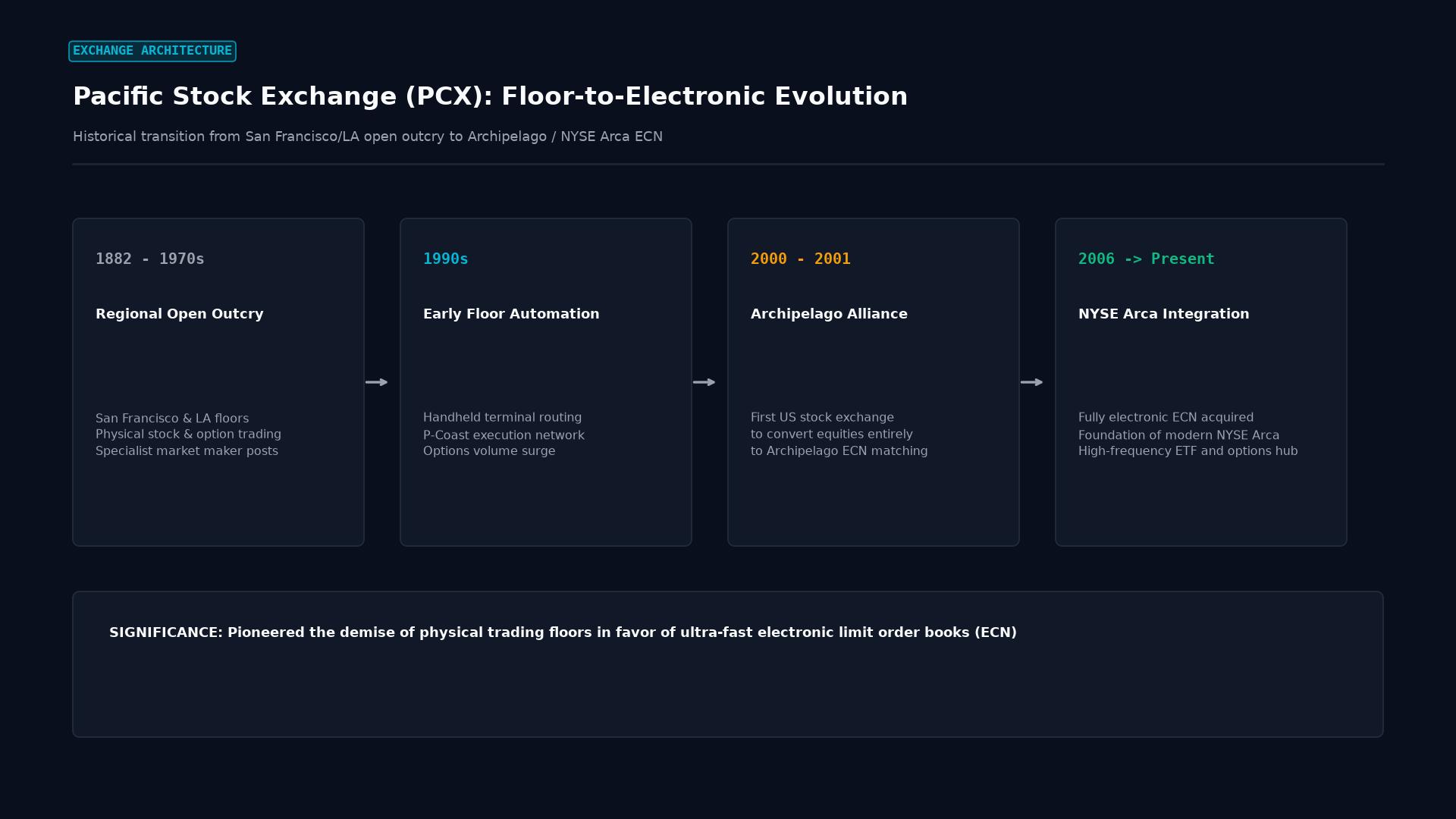 Figure: Historical exchange transformation: regional open-outcry trading floor evolution into the Archipelago electronic ECN and NYSE Arca platform.
Architectural and Operational Marvel: The Dual-Floor System
The most distinctive characteristic of the Pacific Stock Exchange was its dual-city operational model. Unlike other American bourses that operated from a single centralized trading hall, the PSE maintained two fully functional trading floors separated by more than 350 miles:
+------------------------+-----------------------------+-----------------------------+
| Feature                | San Francisco Trading Floor | Los Angeles Trading Floor   |
+------------------------+-----------------------------+-----------------------------+
| Physical Address       | 301 Pine Street, Financial  | 618 South Spring Street,    |
|                        | District, San Francisco, CA | Historic Core, Downtown LA  |
+------------------------+-----------------------------+-----------------------------+
| Architectural Heritage | Classical temple-facade by  | Classical Moderne landmark; |
|                        | Miller & Pflueger; famous   | Spring Street termed the    |
|                        | Ralph Stackpole sculptures  | "Wall Street of the West"   |
+------------------------+-----------------------------+-----------------------------+
| Primary Specialization | Banking, Utilities, Mining, | Petroleum, Aerospace, Real  |
|                        | and high-tech Silicon Valley| Estate, Entertainment       |
+------------------------+-----------------------------+-----------------------------+
The Telecommunications Pipeline
Operating two trading floors in different cities for the exact same securities created an immediate risk of price discrepancies and arbitrage fragmentation. To maintain a unified, synchronized National Market, the PSE deployed an advanced private telecommunications infrastructure:
                    THE DUAL-FLOOR REAL-TIME INTERCOM LINK

  SAN FRANCISCO FLOOR (Pine Street)            LOS ANGELES FLOOR (Spring Street)
  +-----------------------------------+        +-----------------------------------+
  | Specialist Post: Chevron Stock    |        | Specialist Post: Chevron Stock    |
  | Quoting: $45.125 Bid / $45.250 Ask|        | Quoting: $45.125 Bid / $45.250 Ask|
  +-----------------------------------+        +-----------------------------------+
                   ^                                      ^
                   |                                      |
                   +==== Dedicated Open Audio Intercom ===+
                   |     High-Speed Pneumatic Tubes       |
+==== Synchronized Ticker Lines =======+- Open-Microphone Voice Intercom: Open audio circuits ran continuously between the specialist posts in San Francisco and Los Angeles. When a floor broker in Los Angeles shouted a bid to the specialist, the specialist in San Francisco heard the bid in real time through overhead loudspeakers, ensuring identical pricing across both floors.
- Pneumatic Tubes and Tele-Printers: Order tickets, execution confirmations, and physical clearing slips were routed across the floor via high-pressure pneumatic tube networks, while high-speed tele-printers synchronized order books between the two cities.
The Core Business Model: Dual-Listing and Time-Zone Arbitrage
While the Pacific Stock Exchange maintained primary listings for hundreds of West Coast corporations, the vast majority of its daily equity trading volume derived from dual-listed securities:
+------------------------+--------------------------------------------------+
| Trading Advantage      | Institutional Mechanism and Value Proposition    |
+------------------------+--------------------------------------------------+
| The 30-Minute Window   | When the New York exchanges closed at 16:00 EST  |
| (Late-Day Liquidity)   | (13:00 PST), the PSE remained open until 13:30   |
|                        | PST (16:30 EST). This made the PSE the sole      |
|                        | venue to trade late corporate earnings news.     |
+------------------------+--------------------------------------------------+
| Specialist Competition | PSE specialists competed with NYSE specialists   |
|                        | by offering price improvement, lower transaction |
|                        | fees, and tighter bid-ask spreads for odd lots.  |
+------------------------+--------------------------------------------------+
| Primary Tech Listings  | Before Nasdaq became the dominant tech exchange, |
|                        | growing Silicon Valley corporations floated on   |
|                        | the PSE to access early regional public capital. |
+------------------------+--------------------------------------------------+
The Legendary Late-Day Trading Session
The thirty minutes between 16:00 and 16:30 Eastern Time (13:00 to 13:30 Pacific Time) was the most intense trading window on the PSE floors:
- Major American public corporations routinely waited until after the 16:00 close of the New York Stock Exchange to release quarterly corporate earnings, dividend announcements, executive resignations, or merger bids to prevent midday panic on Wall Street.
- Because the Pacific Stock Exchange remained open, all institutional block order flow from Wall Street banks (such as Morgan Stanley, Salomon Brothers, and Goldman Sachs) surged onto the San Francisco and Los Angeles floors via direct telegraph and telephone lines.
- PSE specialists absorbed these massive institutional orders, capturing significant market share and establishing the PSE as a critical shock absorber for national equity markets.
The 1976 Options Expansion and Technology Automation
In April 1976, seeking to diversify beyond traditional equities, the Pacific Stock Exchange launched the Pacific Options Exchange:
1. The Silicon Valley Options Trading Crowds
The options floor, established in San Francisco at 301 Pine Street, expanded rapidly:
- The PSE secured trading rights for listed options on emerging California technology pioneers, including Microsoft, Intel, Apple, Hewlett-Packard, and National Semiconductor.
- The physical options floor developed an intense, high-energy open-outcry trading culture. Hundreds of independent market makers, known as “locals,” crowded into tiered trading pits, utilizing intricate hand signals to flash bids, offers, strike prices, and expiration months across the room.
2. The POETS Electronic Automation System (1990)
In 1990, the Pacific Stock Exchange launched POETS (Pacific Options Exchange Trading System), an innovative automated trading infrastructure:
- Automated the routing of public retail limit orders directly to specialist posts.
- Provided real-time electronic trade execution for standard option orders (up to 20 contracts) without requiring manual paper handling by floor clerks.
- Introduced automated quotes that continuously updated option theoretical values based on changes in underlying stock prices, paving the way for modern algorithmic market making.
The Transition from Floor to Screen: The Rebranding and Sunset
By the late 1990s, structural changes in global finance made physical regional trading floors economically unsustainable:
                  CHRONOLOGY OF THE PSE TRANSFORMATION

  1973: Rebranded as Pacific Stock Exchange (PSE)
                           |
                           v
  1997: Renamed "The Pacific Exchange" (PCX); visual brand modernization
                           |
                           v
  1999: Landmark Demutualization (First US exchange to abandon member club model)
                           |
                           v
  2001: Closure of the Los Angeles Equity Floor (September 2001)
                           |
                           v
  2002: Closure of the San Francisco Equity Floor (May 2002; migrated to ArcaEx)
                           |
                           v
  2005: Archipelago Holdings acquires PCX Holdings for $90 Million
                           |
                           v
  2006: NYSE merges with Archipelago; former PSE assets become NYSE Arca
1. The Rebranding to Pacific Exchange (1997)
In 1997, the institution dropped the word “Stock” from its title, officially becoming The Pacific Exchange (PCX). This rebrand reflected the reality that options trading had surpassed equity trading as the exchange’s primary revenue generator.
2. The Demutualization and ArcaEx Integration
In 1999, the exchange demutualized under CEO Philip DeFeo, allowing outside capital investment. In 2000, the exchange partnered with electronic communications network Archipelago to create ArcaEx:
- In September 2001, the Los Angeles equities trading floor was permanently shuttered.
- In May 2002, the historic San Francisco equities floor at 301 Pine Street closed its doors, ending 120 years of continuous open-outcry equity trading in Northern California.
- Equities were completely migrated to Archipelago’s electronic servers, while the San Francisco options floor continued operating until its full integration into the modern NYSE Arca Options network following the 2006 NYSE-Archipelago merger.
Cultural and Architectural Legacy
The physical landmarks of the Pacific Stock Exchange remain prominent architectural icons of American financial history:
- San Francisco (301 Pine Street): The grand granite building, constructed during the Great Depression and featuring monumental classical colonnades, is internationally famous for the monumental statues carved into its facade by sculptor Ralph Stackpole. The heroic sculptures, titled Earth’s Fruitfulness and Man’s Inventive Genius, symbolize the agricultural and industrial labor that founded West Coast prosperity. The former trading floor was subsequently converted into luxury fitness and private social club facilities, preserving its historic wood-paneled walls.
- Los Angeles (618 South Spring Street): The historic building in downtown Los Angeles, with its hand-carved stone reliefs and soaring ceilings, stands as an enduring monument to the “Wall Street of the West,” frequently used as a filming location for classic Hollywood cinema.
Best Practices for Historical Securities Research
- Interpret Regional Exchange Tickers Correctly: In archival microfiche records, historical newspapers, and legacy CRSP stock databases from 1957 to 2002, trades executed on the Pacific Stock Exchange are designated with the regional exchange symbol “P” or “PCSE”.
- Account for Extended-Session Price Extremes: When analyzing historical volatility in dual-listed NYSE stocks prior to 2000, be aware that high and low price prints often occurred on the Pacific Stock Exchange during its post-4:00 PM EST session, capturing corporate news releases that did not trade on the primary New York tape until the next morning.
- Trace Corporate Lineage in Silicon Valley Studies: Economic historians tracking the early capitalization of semiconductor and personal computing companies should review PSE listing prospectuses from the late 1970s and 1980s, which document early venture capital exits and public offerings before the dominance of Nasdaq.
Frequently Asked Questions (FAQ)
What was the Pacific Stock Exchange?
The Pacific Stock Exchange (PSE) was a major American regional securities exchange founded in 1957 through the merger of the San Francisco Stock and Bond Exchange (1882) and the Los Angeles Stock Exchange (1899). It was the primary stock and options exchange on the West Coast of the United States until its operations were automated and acquired by Archipelago and the New York Stock Exchange in the mid-2000s.
Why did the Pacific Stock Exchange remain open later than the New York Stock Exchange?
Due to time zone differences, the Pacific Stock Exchange took advantage of its West Coast location by staying open for trading until 13:30 Pacific Time (16:30 Eastern Time), precisely thirty minutes after the 16:00 Eastern close of the New York exchanges. This 30-minute window allowed national institutional investors and corporate traders to execute transactions based on late-breaking corporate earnings releases and news announcements before the following trading day.
Does the Pacific Stock Exchange still exist today?
The Pacific Stock Exchange no longer exists as an independent entity with physical trading floors. However, its institutional infrastructure, regulatory exchange license, and technology live on as a central pillar of global finance: the equities platform evolved into NYSE Arca (the premier exchange for Exchange-Traded Funds, ETFs), while its derivatives operations became NYSE Arca Options, both owned and operated by the Intercontinental Exchange (ICE) and the New York Stock Exchange.
Ready to trade forex?
Open a free demo account with a regulated broker. Practice with virtual funds before risking real money.