Pacific Rim
The Pacific Rim refers to the geographic and economic region encompassing the nations, territories, and sovereign economies bordering the perimeter of the Pacific Ocean, serving as the dominant engine of global trade, manufacturing, and capital flows.
The Pacific Rim is a geographic, geopolitical, and macroeconomic term designating the landmasses, sovereign nations, and maritime territories bordering the perimeter of the Pacific Ocean. Geologically aligned with the volcanic and seismic “Ring of Fire,” the Pacific Rim encompasses four distinct continents: North America, South America, Asia, and Oceania.
In international macroeconomics, global trade theory, and foreign exchange markets, the Pacific Rim represents the most powerful economic corridor on earth. Generating more than 60% of global Gross Domestic Product (GDP) and conducting approximately 50% of total world merchandise trade, the region connects the massive consumer demand of the Americas with the advanced manufacturing powerhouses of East Asia, the extractive natural resource giants of Australasia, and the high-growth emerging economies of Southeast Asia.
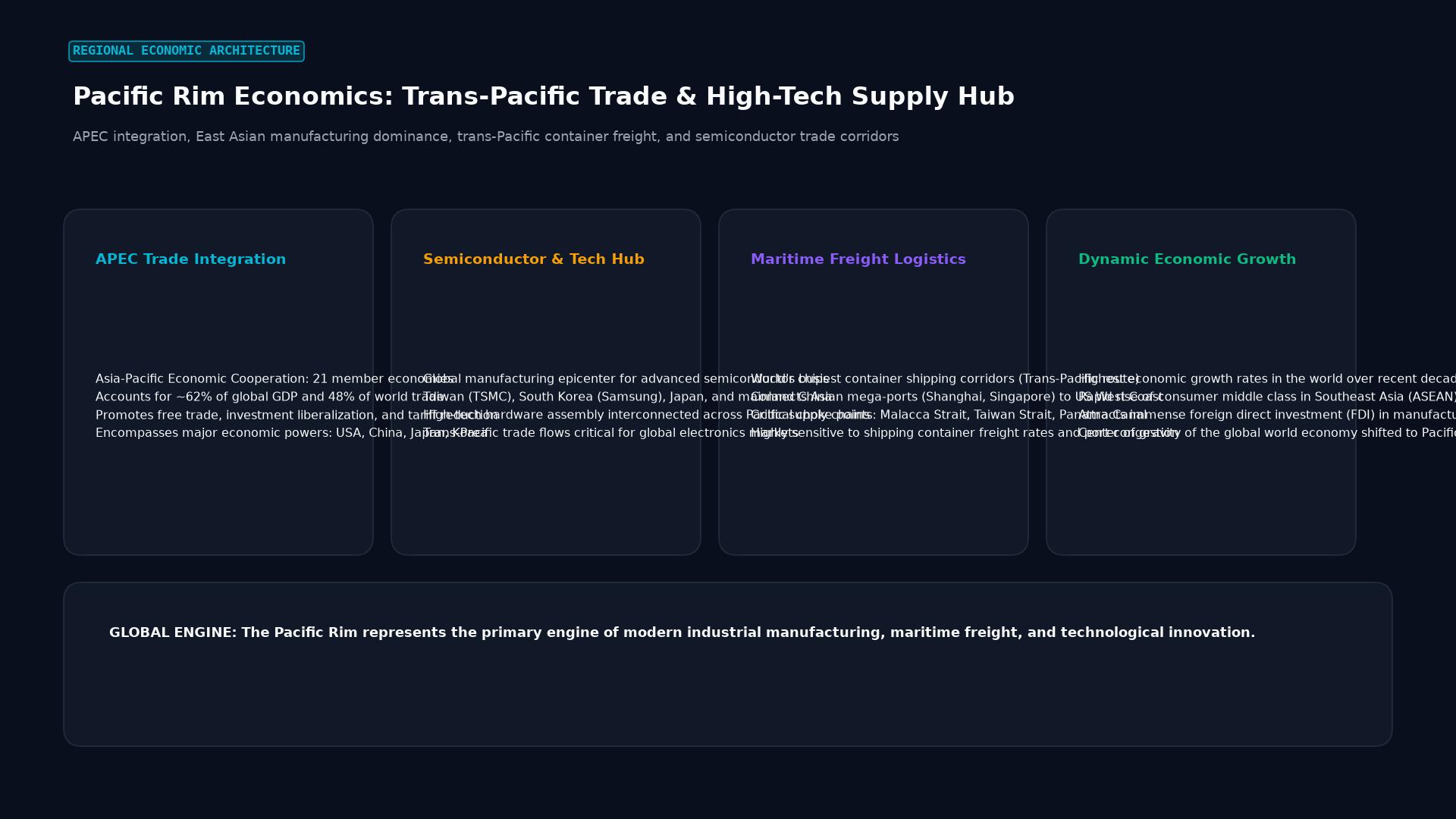 Figure: APEC integration, East Asian manufacturing dominance, trans-Pacific container freight, and semiconductor trade corridors
The Macroeconomic Architecture: The Trans-Pacific Triangular Flow
The global financial system of the late twentieth and early twenty-first centuries has been defined by the Trans-Pacific Macroeconomic Loop, an interconnected circuit of goods, capital, and foreign exchange reserves:
                  THE TRANS-PACIFIC CAPITAL & TRADE CYCLE

  East Asian Exporters (China, Japan, Korea, Taiwan)
  - Manufacture consumer electronics, machinery, autos, chips
                           |
                           | Outbound Merchandise Exports ($ Trillions)
                           v
  North American Consumer Markets (United States, Canada)
  - Absorbs manufactured goods; runs massive Current Account Deficit
                           |
                           | US Dollars Paid to Asian Exporters
                           v
  Asian Central Banks (PBOC, Bank of Japan, HKMA, MAS)
  - Accumulate US Dollar FX Reserves to prevent domestic currency appreciation
                           |
                           | Recycled via US Treasury Bond Purchases
                           v
  US Capital Markets (Treasury Market / Wall Street)
  - Lowers US interest rates; finances US federal deficits and domestic consumer credit
1. The Global Savings Glut and US Treasury Recycling
In 2005, then-Federal Reserve Governor Ben Bernanke formulated the Global Savings Glut hypothesis to explain why long-term US interest rates remained low despite Federal Reserve rate hikes:
- Following the traumatic 1997 Asian Financial Crisis, Pacific Rim developing nations abandoned reliance on emergency IMF assistance.
- Asian economies (led by China, Taiwan, South Korea, and Singapore) systematically engineered persistent current account surpluses, intentionally holding down their domestic currencies to maximize export competitiveness.
- Asian central banks accumulated massive foreign exchange reserves, which were automatically recycled into US Treasury bonds and Agency debt.
- This circular flow subsidized American borrowing costs, kept mortgage rates low, and financed the structural trade deficits between the western and eastern shores of the Pacific.
2. The Trans-Pacific Container Corridor
The physical backbone of the Pacific Rim is the maritime shipping container pipeline spanning the northern Pacific:
- Mega-container vessels transport millions of twenty-foot equivalent units (TEUs) from Chinese ports (Shanghai, Ningbo-Zhoushan, Shenzhen) and East Asian hubs to the San Pedro Bay Ports of Los Angeles and Long Beach.
- Critical maritime choke points, most notably the Strait of Malacca (connecting the Indian Ocean with the South China Sea), accommodate more than one-quarter of global petroleum transit and one-third of all global maritime trade.
Regional Multilateral Treaties and Trade Frameworks
To facilitate frictionless capital investment and tariff reduction, Pacific Rim economies have constructed specialized multilateral institutions:
+------------------------+--------------------------------------------------+
| Multilateral Entity    | Structural Mandate and Geographic Footprint      |
+------------------------+--------------------------------------------------+
| APEC (Asia-Pacific     | 21 Member Economies established in 1989; operates|
| Economic Cooperation)  | as a non-binding consensus forum promoting free  |
|                        | trade, investment facilitation, and tech cooperation|
+------------------------+--------------------------------------------------+
| CPTPP (Comprehensive & | Mega-regional free trade agreement encompassing  |
| Progressive Trans-Pac) | 11 nations (including Japan, Canada, Australia,  |
|                        | Vietnam, Singapore, Chile, Mexico, and the UK).  |
+------------------------+--------------------------------------------------+
| RCEP (Regional Compre- | The world's largest free trade agreement by      |
| hensive Economic Part.)| population and GDP (15 nations), anchoring ASEAN |
|                        | alongside China, Japan, South Korea, and Austral.|
+------------------------+--------------------------------------------------+
| The Pacific Alliance   | Latin American trade bloc (Chile, Colombia,      |
| (Alianza del Pacífico) | Mexico, Peru) integrating stock exchanges and    |
|                        | outward trade toward Asian Pacific Rim markets.  |
+------------------------+--------------------------------------------------+
1. Asia-Pacific Economic Cooperation (APEC)
Founded in Canberra in 1989, APEC is distinctive because its members are designated as “Member Economies” rather than sovereign states, permitting the simultaneous participation of the People’s Republic of China, Hong Kong (China), and Chinese Taipei (Taiwan). APEC was the foundational diplomatic engine that reduced average tariffs across the region from over 17% in 1989 to below 5% by the late 2010s.
2. CPTPP vs. RCEP: Competing Visions of Integration
- CPTPP (Trans-Pacific Partnership Heritage): Focuses on high-standard regulatory integration: complete elimination of tariffs across 99% of tariff lines, strict enforcement of cross-border intellectual property rules, mandatory labor standards, environmental protections, and prohibitions against preferential subsidies for State-Owned Enterprises (SOEs).
- RCEP (Regional Comprehensive Economic Partnership): Enacted in January 2022, RCEP covers 2.3 billion people and approximately 30% of global GDP. Designed with high flexibility for developing members, RCEP prioritizes standardized Rules of Origin (ROO) across East Asia, allowing intermediate parts manufactured across multiple ASEAN nations to qualify for single-country tariff exemptions.
Supply Chain Realignment: From “Factory Asia” to “China Plus One”
The industrial landscape of the Pacific Rim is currently undergoing its most profound structural transformation since the opening of China in 1978:
                    THE "CHINA PLUS ONE" SUPPLY CHAIN SHIFT

                 High-Tech Design & Capital (USA / Japan / Taiwan)
                                        |
                 +----------------------+----------------------+
                 |                                             |
                 v                                             v
     TRADITIONAL CONDUIT                             DIVERSIFIED RESHORING
  +-----------------------+                        +-----------------------+
  | China (Mainland)      |                        | Vietnam, Malaysia,    |
  | - Massive scale       | ======= Rebalancing ==>| Thailand, Indonesia,  |
  | - Complete supplier   |   (Tariffs & Risk)     | India, Mexico (Near)  |
  |   ecosystem           |                        +-----------------------+
  +-----------------------+                                    |
                 \                                            /
                  +---------------------+--------------------+
                                        |
                                        v
                       Finished Consumer Exports to US & EU
1. The Semiconductor Choke Point
The Pacific Rim produces the overwhelming majority of the world’s semiconductor logic chips:
- Taiwan (TSMC): Manufactures over 90% of the world’s most advanced sub-5-nanometer microprocessors, utilized in smartphones, cloud data centers, and artificial intelligence hardware.
- South Korea (Samsung, SK Hynix): Commands the global market for dynamic random-access memory (DRAM) and NAND flash memory chips.
- Japan: Provides foundational semiconductor manufacturing equipment (Tokyo Electron) and specialized chemical photoresists.
- The Geopolitical Bottleneck: The concentration of global microelectronics fabrication across the narrow Taiwan Strait represents one of the most acute systemic risk nodes in international economics.
2. The Rise of Nearshoring and Friendshoring
Due to rising geopolitical tensions, trans-Pacific tariff impositions, and supply chain fragility exposed during the pandemic, multinational corporations are actively executing “China Plus One” and nearshoring strategies:
- Component assembly is diversifying from coastal China into Southeast Asia (Vietnam, Malaysia, Thailand, and Indonesia).
- North American corporations are executing nearshoring into Mexico, utilizing the tariff-free provisions of the USMCA to build advanced manufacturing clusters along the US-Mexico border, reducing shipping transit times from forty days across the Pacific to two days by truck.
Foreign Exchange Microstructure in the Pacific Rim
The Pacific Rim encompasses several of the most liquid currency pairs in global foreign exchange:
+------------------------+--------------------------------------------------+
| Currency Pair          | Market Profile and Economic Driver               |
+------------------------+--------------------------------------------------+
| USD/JPY                | Core G10 benchmark; tracks US-Japan sovereign    |
|                        | 10-year Treasury yield differentials.            |
+------------------------+--------------------------------------------------+
| AUD/USD                | Premier hard commodity proxy (iron ore, coal,    |
|                        | lithium); sensitive to Chinese industrial PMI.   |
+------------------------+--------------------------------------------------+
| USD/CNH                | Offshore Chinese Renminbi; primary barometer of  |
|                        | Sino-American trade tensions and PBOC fixings.   |
+------------------------+--------------------------------------------------+
| NZD/USD                | Agricultural soft commodity bellwether; driven   |
|                        | by Global Dairy Trade (GDT) auction data.        |
+------------------------+--------------------------------------------------+
| USD/KRW & USD/TWD      | High-beta technology export barometers; driven   |
|                        | by global consumer semiconductor cycle demand.   |
+------------------------+--------------------------------------------------+
Best Practices for Navigating Pacific Rim Investment Exposure
- Monitor Chinese Macroeconomic Indicators for Regional Currency Bets: When trading commodity currencies within the Pacific Rim (such as AUD, NZD, CLP, or PEN), treat Chinese industrial data (Caixin Manufacturing PMI, blast furnace operating rates, and property investment metrics) as primary leading indicators.
- Audit Rules of Origin in Cross-Border Trade Contracts: Corporate procurement officers operating across the Pacific Rim must examine the distinct Rules of Origin under CPTPP, RCEP, and USMCA. Misclassifying regional value content can invalidate preferential tariff treatments, triggering substantial customs penalties.
- Account for Extended Maritime Freight Volatility: Trans-Pacific shipping container spot rates (tracked by the Shanghai Containerized Freight Index, SCFI, and Freightos Baltic Index) directly dictate landed inventory costs for North American retail importers. Incorporate shipping rate hedges during peak pre-holiday booking seasons (August through October).
Frequently Asked Questions (FAQ)
What countries are considered part of the Pacific Rim?
The Pacific Rim includes all sovereign nations and territories that border the Pacific Ocean. Major economies include the United States, Canada, Mexico, Chile, and Peru in the Americas; China, Japan, South Korea, Taiwan, Hong Kong, and the ASEAN nations (such as Vietnam, Singapore, Malaysia, Indonesia, Thailand, and the Philippines) in Asia; and Australia and New Zealand in Oceania.
Why is the Pacific Rim so important to the global economy?
The Pacific Rim is the dominant engine of global economic activity, generating over 60% of world GDP and roughly half of international trade. It encompasses the world’s largest consumer market (the United States), the world’s premier manufacturing center (East and Southeast Asia), and major extractive commodity exporters (Australia, Canada, Chile). The region drives global technological innovation, electronics manufacturing, and maritime trade.
What is the difference between APEC, CPTPP, and RCEP?
APEC (Asia-Pacific Economic Cooperation) is a non-binding economic forum of 21 Pacific Rim economies that promotes trade liberalization and regulatory dialogue. In contrast, CPTPP and RCEP are formal, legally binding free trade agreements. CPTPP is a high-standard agreement among 11 nations requiring deep regulatory harmonization, labor protections, and intellectual property enforcement. RCEP is a broader 15-nation agreement anchored by ASEAN and China, focusing primarily on progressive tariff reduction and unified regional rules of origin.
Ready to trade forex?
Open a free demo account with a regulated broker. Practice with virtual funds before risking real money.