Balance of Payments
The Balance of Payments (BoP) is a comprehensive accounting record of all economic transactions between a country's residents and the rest of the world over a specific period. It tracks every dollar, euro, or yen that flows into or out of a country — for goods, services, investments, and financial transfers. Persistent imbalances in the BoP create structural pressure on exchange rates over months and years.
The Architecture of the Balance of Payments
Think of the Balance of Payments as a country’s financial diary — it records every transaction that crosses its borders. By construction, the BoP always sums to zero (every transaction has two sides), but the individual components within it reveal important structural dynamics about a country’s currency position.
The BoP has three main accounts:
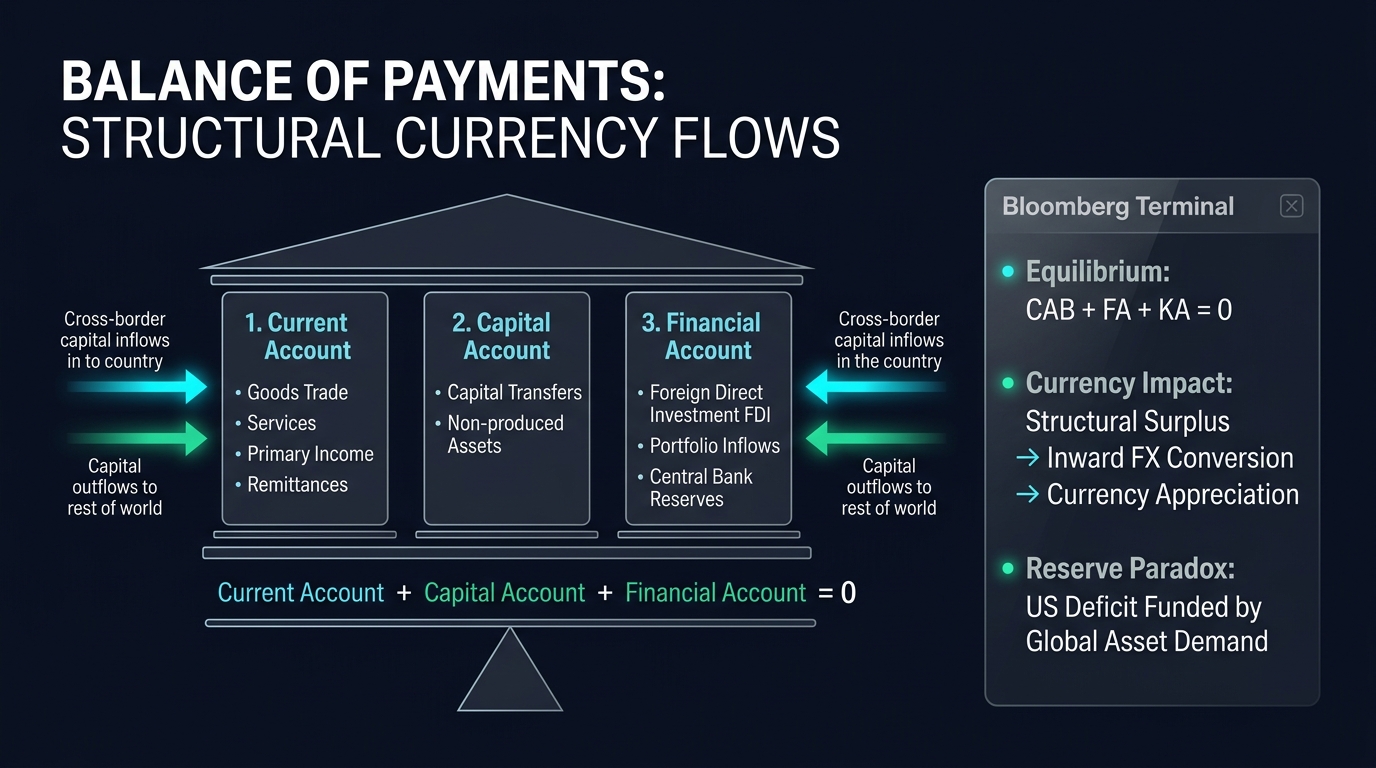
The Current Account
The most closely watched component. It records:
Trade in goods (merchandise trade): Exports minus imports of physical goods. A surplus means the country exports more than it imports (net earner of foreign currency). A deficit means it imports more (net spender of foreign currency).
Trade in services: Tourism, financial services, technology licensing, shipping. The UK runs a goods trade deficit but a services trade surplus, primarily through financial services in the City of London.
Primary income: Investment income flowing in and out — dividends from foreign equity holdings, interest on bonds held abroad, repatriated profits. Countries with large overseas investment portfolios (Japan, US) earn significant primary income.
Secondary income: Transfers without economic exchange — foreign aid, remittances, international organization contributions. Countries like India, Mexico, and the Philippines receive large remittance inflows from workers abroad.
Current account surplus: The country is a net lender to the rest of the world. Historically positive for the currency (structural demand as foreign currencies are converted). China, Germany, and Japan have been persistent surplus countries.
Current account deficit: The country borrows from the rest of the world to fund excess consumption or investment. The US runs a persistent current account deficit — financed because the dollar is the global reserve currency, creating ongoing demand for dollar-denominated assets.
The Capital Account
A smaller and less-discussed account recording capital transfers (debt forgiveness, assets of migrants moving countries) and acquisition/disposal of non-produced, non-financial assets (natural resource rights, trademarks). Typically a minor item for developed economies.
The Financial Account
Records investment flows:
Foreign Direct Investment (FDI): Long-term investment in productive assets — a German company building a factory in Vietnam, a Chinese company acquiring a US technology firm. FDI represents confidence in the host country’s long-run growth prospects.
Portfolio investment: Purchases of foreign stocks and bonds. More volatile than FDI because portfolio flows can reverse quickly when sentiment changes. The “sudden stop” phenomenon — when foreign portfolio investment abruptly reverses — has caused currency crises in multiple emerging markets.
Reserve assets: Changes in a country’s foreign exchange reserves, gold, and IMF special drawing rights. When a central bank buys or sells foreign currency to influence its exchange rate (intervention), this shows up here.
BoP and Currency Pressure
The BoP exerts pressure on exchange rates through the supply and demand it creates for a currency:
Structural surplus country: Persistent current account surpluses mean the country is continuously selling foreign currency and buying domestic currency to convert export earnings. This creates persistent underlying demand for the domestic currency.
Structural deficit country: Persistent deficits mean the country is continuously selling domestic currency to buy foreign currencies for imports. This creates persistent supply pressure on the domestic currency.
However, financial account flows can dominate and overwhelm current account effects in the short to medium term. A country with a current account deficit can have a strong currency if it attracts enough capital flows (portfolio investment, FDI) to more than offset the trade deficit outflow. The US is the most dramatic example — its dollar remains strong despite perpetual current account deficits because global demand for dollar-denominated assets generates massive financial account inflows.
Key Takeaways
- The BoP records all economic transactions between a country and the world; by definition it always sums to zero
- Current account = trade in goods + services + income transfers; the most-watched component
- Financial account = FDI + portfolio investment + reserve changes; can dominate short-term currency flows
- Persistent current account surpluses create structural currency demand; persistent deficits create structural supply pressure
- Financial account flows (portfolio investment) can override current account effects, explaining why deficit countries can still have strong currencies
FAQ
How often is BoP data published? Quarterly in most countries, with monthly trade data (goods trade balance) published more frequently. The IMF compiles internationally comparable BoP data across countries.
Does a current account deficit always weaken a currency? Not necessarily — particularly for reserve currency countries like the US. The dollar benefits from being the world’s reserve currency, meaning global demand for dollar assets perpetually generates financial account inflows that offset the current account deficit. For smaller economies without reserve currency status, persistent current account deficits are much more likely to create sustained downward currency pressure.
Ready to trade forex?
Open a free demo account with a regulated broker. Practice with virtual funds before risking real money.