PIO
PIO stands for Public Information Officer in regulatory communications, Payment In Order in banking settlements, or Public Interest Organization in non-profit finance.
What Does PIO Stand For?
In financial markets, regulatory compliance, and cross-border banking, the acronym PIO represents several distinct terms depending on the operational context:
- Public Information Officer (PIO): The designated communications and disclosure executive within regulatory agencies (such as the SEC, CFTC, or Federal Reserve), sovereign treasury departments, and publicly traded corporations responsible for managing news dissemination and ensuring compliance with market disclosure laws.
- Payment In Order (PIO): A banking and cash management designation indicating that a payment instruction, letter of credit, or wire transfer has satisfied all documentary, compliance, and fund verification protocols and is cleared for execution.
- Public Interest Organization (PIO) / Public Interest Entity (PIE): An institutional designation in financial reporting and auditing for entities whose size, regulatory status, or economic significance warrants heightened public reporting standards.
- Person of Indian Origin (PIO): An administrative and banking status in cross-border wealth management denoting individuals of Indian ancestry eligible for specialized non-resident rupee bank accounts (NRE/NRO accounts).
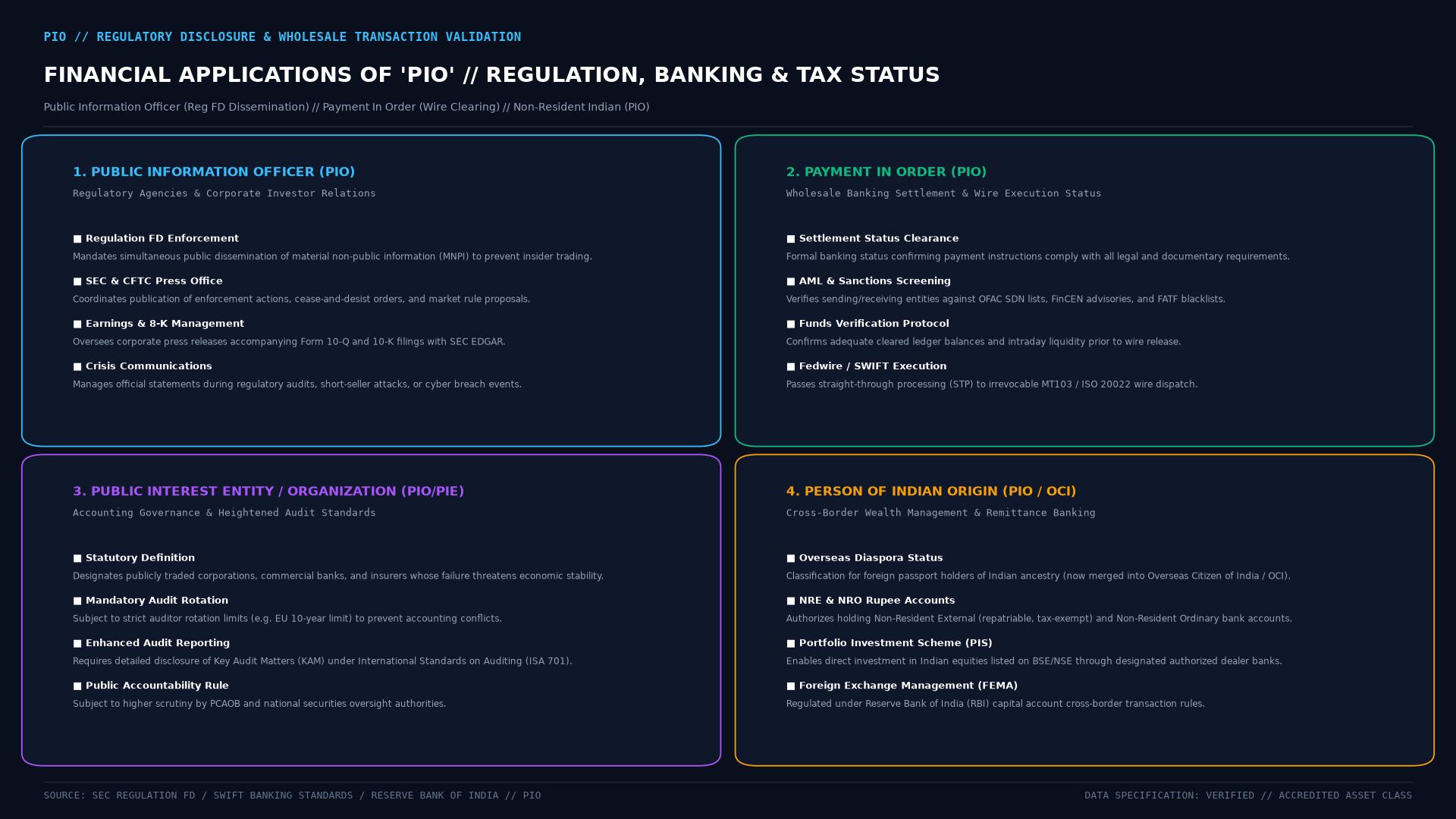 Figure: The four key institutional applications of ‘PIO’ in financial operations: Public Information Officer under Regulation FD, Payment In Order in wholesale banking settlements, Public Interest Entity (PIE/PIO) accounting governance, and Person of Indian Origin non-resident remittance banking.
1. Public Information Officer (PIO) in Financial Regulation
In capital markets governance, a Public Information Officer (PIO) acts as the authorized intermediary between government financial regulators and the global investment public.
Regulatory Agency Governance (SEC, CFTC, FinCEN)
Government market watchdogs, including the United States Securities and Exchange Commission (SEC), the Commodity Futures Trading Commission (CFTC), and the Financial Conduct Authority (FCA) in the United Kingdom, maintain dedicated PIO offices.
The responsibilities of a regulatory PIO include:
- Disseminating Market Rulings: Releasing administrative law judge decisions, no-action letters, and proposed rule amendments to financial media and market participants simultaneously.
- Enforcement Disclosures: Coordinating public releases regarding asset freezes, insider trading indictments, and civil settlements to prevent selective information leaking.
- Handling Crisis Inquiries: Formulating official institutional commentary during high-volatility flash crashes, broker insolvency events, or systemic market dislocations.
       Regulatory Commission Reaches Enforcement Settlement
                               │
                               ▼
       Office of the Public Information Officer (PIO)
       Drafts Standardized Press Release & Legal Findings
                               │
                               ▼
       Simultaneous Embargo Lift via Public Wire Feeds
       (EDGAR, Major News Services, Agency Web Portal)
                               │
                               ▼
       Ensures Equal Access; Eliminates Information Asymmetry
Corporate Investor Relations and Regulation Fair Disclosure (Reg FD)
For publicly traded corporations, the communications officer works in tandem with the Investor Relations (IR) desk and legal counsel. Under the SEC’s Regulation Fair Disclosure (Regulation FD), public corporations are strictly prohibited from selectively disclosing material non-public information (MNPI) to preferred Wall Street analysts, hedge funds, or institutional investors before releasing it to the broad public.
When a public corporation experiences an unexpected material event, such as a CEO resignation, a material supply chain disruption, or an unsolicited takeover proposal:
- The company’s legal team drafts a Form 8-K.
- The communications team and PIO prepare public statements and manage questions from financial journalists.
- Information is broadcast across broad distribution channels to ensure that retail and institutional traders receive access at the exact same second.
2. Payment In Order (PIO) in Banking Settlements
In treasury management, corporate cash operations, and wholesale commercial banking, Payment In Order describes a verified state in transaction clearing.
Payment Initiated by Corporate Treasurer
                │
                ▼
1. Liquidity & Credit Check (Available Balance Verified)
                │
                ▼
2. Sanction & AML Screening (OFAC, PEP, FinCEN Watchlists)
                │
                ▼
3. Format & Authentication (BIC, IBAN, Dual Authorizations)
                │
                ▼
ALL CONTROLS PASSED ──► Status: "Payment In Order" (PIO)
                │
                ▼
Release to Clearing Rail (Fedwire, CHIPS, Target2, SWIFT)
The Transaction Clearing Lifecycle
When an institutional customer initiates an international payment:
- Receipt and Validation: The core banking engine validates formatting requirements, ensuring accurate SWIFT MT103 or ISO 20022 message fields (e.g., matching BIC/SWIFT codes and IBAN accounts).
- Compliance Screening: The transaction passes through automated filtering systems checking the remitter and beneficiary against international sanctions lists (OFAC, UN, EU), politically exposed person (PEP) registries, and anti-money laundering (AML) databases.
- Credit Verification: The bank verifies that the originating account holds sufficient ledger and collected funds, or that an adequate intraday overdraft facility is active.
- Transition to PIO: Once all algorithmic and operational checks clear, the payment message updates to Payment In Order. This informs the treasury clearing desk that the wire can be submitted to clearing rails (such as Fedwire, CHIPS, or TARGET2) without manual compliance intervention.
+------------------------------------------------------------------------------------+
|                      PAYMENT SETTLEMENT STATUS TAXONOMY                            |
+-----------------------------------+------------------------------------------------+
| STATUS CODE                       | OPERATIONAL MEANING                            |
+-----------------------------------+------------------------------------------------+
| Pending Submission                | Payment drafted; awaiting internal approvals.  |
| Compliance Hold / Review          | Flagged for potential sanctions or AML check.  |
| Payment In Order (PIO)            | All compliance and balance criteria verified;  |
|                                   | ready for immediate clearing release.          |
| In Flight / Settling              | Dispatched into interbank rail (SWIFT/Fedwire).|
| Reconciled / Final                | Beneficiary bank acknowledged irrevocable credit|
+-----------------------------------+------------------------------------------------+
3. Public Interest Organization (PIO) and Entities in Accounting
In international auditing, accounting standards, and securities oversight, institutions are often classified as Public Interest Organizations or Public Interest Entities (PIEs).
Under frameworks established by the International Auditing and Assurance Standards Board (IAASB) and European Union audit legislation:
- Scope of Coverage: Includes exchange-listed enterprises, commercial banks, licensed insurance companies, and pension funds.
- Stringent Audit Requirements: Because the financial collapse of these institutions poses systemic economic risks, PIEs face mandatory external audit firm rotation (typically every 7 to 10 years), strict caps on non-audit consulting fees provided by audit firms, and expanded disclosure in Independent Auditor Reports.
- Audit Committee Oversight: PIEs must maintain independent audit committees with proven financial and accounting expertise to oversee internal risk management and external reporting integrity.
4. Person of Indian Origin (PIO) in Cross-Border Wealth Management
In retail banking, non-resident foreign exchange, and wealth management, PIO historically designated an individual who held foreign citizenship (other than Pakistan or Bangladesh) but could prove Indian ancestral lineage.
+-----------------------------------------------------------------------------------+
|                        DIASPORA BANKING CLASSIFICATIONS                           |
+-----------------------------------+-----------------------------------------------+
| CATEGORY                          | DEFINITION & REGULATORY RIGHTS                |
+-----------------------------------+-----------------------------------------------+
| NRI (Non-Resident Indian)         | Indian citizen residing outside India.        |
| PIO (Person of Indian Origin)     | Foreign passport holder of Indian lineage.     |
| OCI (Overseas Citizen of India)   | Lifelong visa status that superseded the PIO  |
|                                   | card scheme under 2015 statutory reforms.     |
+-----------------------------------+-----------------------------------------------+
Financial Implications for Banking and Property
Under regulations administered by the Reserve Bank of India (RBI) and the Foreign Exchange Management Act (FEMA):
- Specialized Rupee Accounts: Individuals with PIO/OCI status can open Non-Resident External (NRE) accounts (fully repatriable, tax-free interest in India) and Non-Resident Ordinary (NRO) accounts (for income originating in India, such as rent, pensions, or local dividends).
- Capital Markets Access: Eligible individuals can trade Indian equities, mutual funds, and government securities via the Portfolio Investment Scheme (PIS) through designated authorized dealer banks.
- Real Estate Investments: Individuals holding this status may purchase residential and commercial real estate across India without prior central bank approval, although investment in agricultural land, farmhouses, and plantation properties remains prohibited.
Key Takeaways
- Multiple Operational Contexts: Depending on the sector, PIO stands for Public Information Officer, Payment In Order, Public Interest Organization, or Person of Indian Origin.
- Regulatory Communications: As a Public Information Officer, the role ensures that market-moving news and enforcement penalties are released fairly under Regulation FD without creating information asymmetries.
- Banking Settlement Integrity: In treasury operations, a “Payment In Order” status confirms that a wire transfer has cleared all compliance, AML, sanctions, and ledger balance checks, allowing straight-through processing.
- Governance Standards: Public Interest Organizations (or Entities) face heightened auditing scrutiny, mandatory auditor rotation, and enhanced financial reporting due to their systemic economic footprint.
- Diaspora Wealth Management: In emerging market banking, historical PIO status granted specialized access to rupee bank accounts (NRE/NRO) and local investment securities under Reserve Bank of India oversight.
Frequently Asked Questions (FAQ)
What role does a Public Information Officer play during a financial market crisis?
During a financial market crisis, such as a major broker default or an unexpected trading halt, the Public Information Officer of a regulatory body or exchange serves as the single authorized voice for official updates. The PIO coordinates with economists, legal counsel, and market surveillance personnel to draft factual press notices. By issuing transparent, timely statements across public channels, the PIO helps prevent panic caused by unverified market rumors and ensures all participants have equal access to essential operational data.
How does a “Payment In Order” designation affect straight-through processing (STP)?
Straight-through processing (STP) refers to the automated, electronic execution of financial transactions from initiation to final settlement without manual human intervention. When an automated banking platform marks a transaction as “Payment In Order,” it confirms that all algorithmic validation gates, including account number syntax, sanctions database screening, and liquidity availability, have completed successfully. This status triggers the core banking engine to release the payment message directly into interbank clearing rails like SWIFT or Fedwire without human delay.
What is the difference between PIO and OCI in Indian foreign exchange banking?
Historically, a Person of Indian Origin (PIO) card and an Overseas Citizen of India (OCI) card were separate administrative schemes offering different travel and property rights. In 2015, the Indian government merged the two programs, phasing out PIO cards and granting OCI status to all eligible diaspora members. For banking and foreign exchange purposes under the Reserve Bank of India, holders of this status enjoy equivalent privileges, allowing them to open rupee-denominated NRE and NRO bank accounts, invest in domestic stock portfolios, and repatriate funds subject to FEMA regulatory guidelines.
Ready to trade forex?
Open a free demo account with a regulated broker. Practice with virtual funds before risking real money.