Wire Transfer
A wire transfer is an electronic method of transferring funds directly between financial institutions through secure payment networks like Fedwire, CHIPS, and SWIFT, providing irrevocable same-day gross settlement.
What Is a Wire Transfer?
A wire transfer is a direct, electronic transfer of funds from one financial institution to another, settling on an immediate, gross, or real-time basis without the multi-day clearing delays associated with traditional paper checks or batch automated clearing house (ACH) transfers.
In wholesale banking and foreign exchange operations, wire transfers are the primary mechanism through which institutional participants fund trading accounts, settle spot and derivative contracts, and execute cross-border treasury operations. Once processed through central bank settlement systems, wire transfers are irrevocable and final, meaning the receiving bank holds good central bank funds that cannot be recalled by the sender.
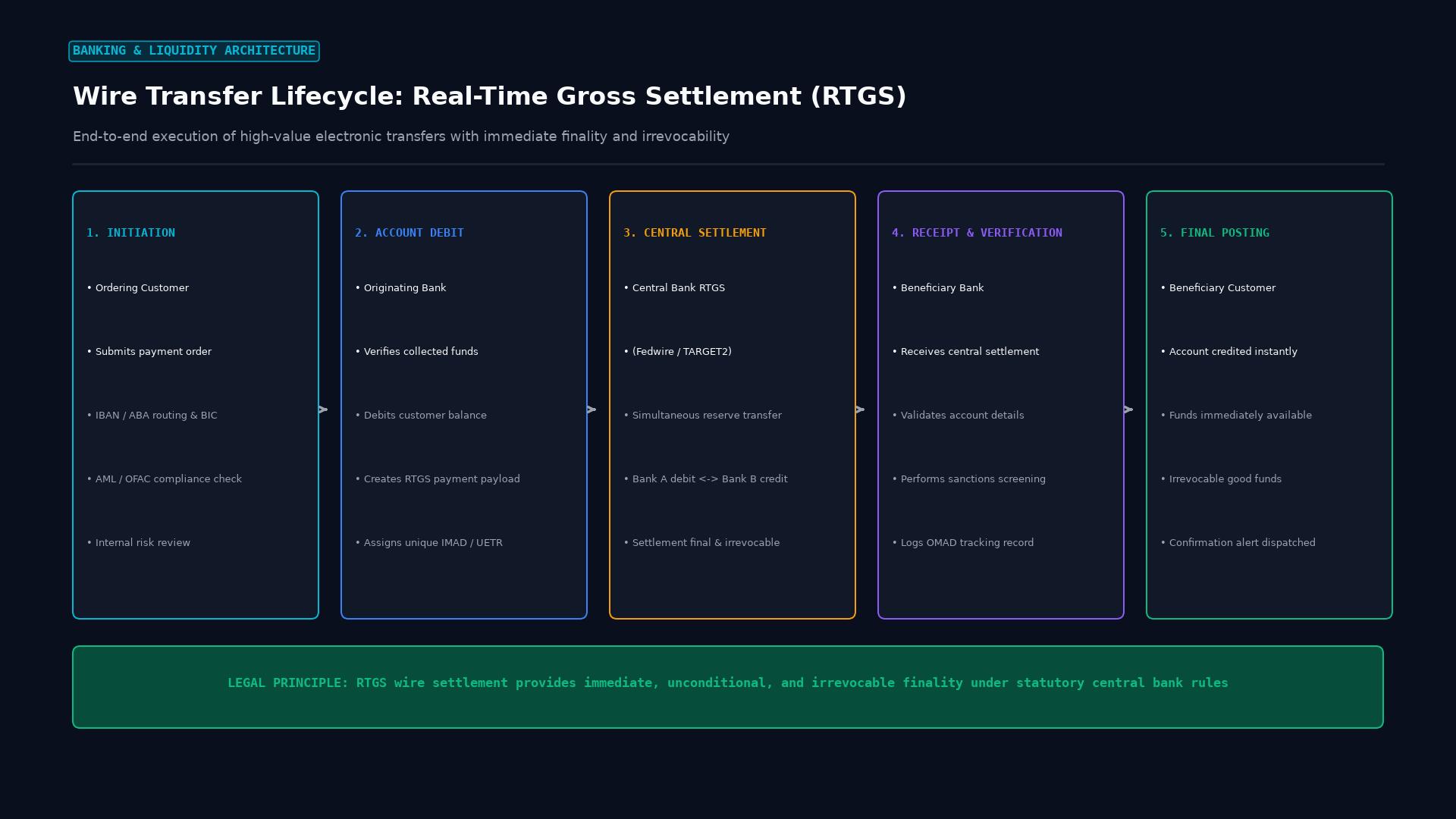 Figure: End-to-end execution of high-value electronic wire transfers via central bank RTGS rails, ensuring immediate, final, and irrevocable settlement.
Technical Architecture: Payment Networks and Settlement Systems
Global wire transfers rely on specialized clearing houses and telecommunication networks, each serving distinct institutional roles:
1. Fedwire Funds Service (Real-Time Gross Settlement - RTGS)
Operated directly by the Federal Reserve Banks, Fedwire processes domestic US dollar transfers on a continuous, transaction-by-transaction (gross) basis. As soon as the Federal Reserve processes the entry, the transfer represents an unconditional legal obligation of the Federal Reserve Bank to the receiving institution.
2. Clearing House Interbank Payments System (CHIPS)
A private-sector US dollar netting system operated by The Clearing House. CHIPS uses a continuous multilateral netting algorithm:
$$\text{Net Obligation}i = \sum{j=1}^{n} \text{Payments Outward}{i \to j} - \sum{j=1}^{n} \text{Payments Inward}_{j \to i}$$
By netting offsetting payments continuously, CHIPS allows commercial banks to settle trillions of dollars in transactions using only a tiny fraction of the liquidity required by pure gross settlement systems.
3. SWIFT (The Telecommunication Messaging Layer)
The Society for Worldwide Interbank Financial Telecommunication (SWIFT) does not hold funds or clear transactions directly; it transmits authenticated, encrypted messages (such as the standard MT103 customer transfer or newer ISO 20022 pacs.008 format) instructing correspondent banks to debit and credit internal Nostro/Vostro accounts.
Comparative Matrix: Wire Transfers vs. Alternative Payment Rails
| Feature | Domestic Wire (Fedwire) | Cross-Border Wire (SWIFT) | ACH Transfer | Retail Debit / Credit Card |
|---|---|---|---|---|
| Settlement Speed | Immediate / Real-time | 1 to 3 business days | 1 to 3 business days | 2 to 3 days (batch clearing) |
| Settlement Type | Real-Time Gross (RTGS) | Correspondent Vostro sweep | Multilateral Batch Netting | Card network batch netting |
| Revocability | Irrevocable upon debit | Irrevocable once posted | Revocable (up to 60 days) | Revocable via chargebacks |
| Typical Value | $50,000 to $100,000,000+ | $10,000 to $500,000,000+ | $10 to $25,000 | $5 to $5,000 |
| Transaction Cost | $15 to $35 flat | $25 to $65 + FX markup | Negligible ($0.10 - $0.50) | 1.5% to 3.5% interchange |
Real-World Case Study: The Bangladesh Bank Cyber Heist (2016)
The systemic vulnerabilities of cross-border wire messaging were exposed in February 2016 during the historic cyber theft at the Bangladesh Bank (the central bank of Bangladesh).
Anatomy of the 2016 SWIFT Heist:
1. Malicious actors compromised Bangladesh Bank's internal IT systems and obtained valid SWIFT operator credentials.
2. The attackers issued 35 fraudulent SWIFT MT103 wire transfer requests totaling $951 million to the Federal Reserve Bank of New York, instructing it to debit Bangladesh's sovereign foreign reserve account.
3. The Fed's automated systems processed five wire instructions totaling $101 million before suspicious routing terms (including a typographical error in a non-governmental organization's name) triggered human intervention.
4. While $20 million was recovered in Sri Lanka, $81 million successfully cleared into fictitious accounts at Rizal Commercial Banking Corporation (RCBC) in the Philippines, where it was immediately laundered through local casinos and vanished.
The incident forced the global banking community to introduce SWIFT’s Customer Security Programme (CSP) and accelerate the migration toward ISO 20022 messaging standards with integrated cryptographic validation.
Frequently Asked Questions (FAQ)
Why are wire transfers legally irrevocable once completed?
Wire transfers operate under sovereign commercial codes (such as Article 4A of the Uniform Commercial Code in the US) that guarantee payment finality. Once the central bank debits the sending bank’s reserve account and credits the receiving bank, ownership of the funds transfers irrevocably. This legal finality prevents systemic gridlock in wholesale financial markets, ensuring that commercial entities can immediately re-deploy incoming capital without fear of retrospective recall.
What is the difference between a wire transfer routing number and a SWIFT/BIC code?
In domestic US banking, an ABA routing transit number (a 9-digit numerical sequence) directs funds through the domestic Automated Clearing House or Fedwire system. For international transfers, banks utilize a Business Identifier Code (BIC) or SWIFT code (an 8- or 11-character alphanumeric string) that uniquely identifies the institution, country, city, and individual branch within the global SWIFT directory.
How does the migration to ISO 20022 improve wire transfers?
Historically, SWIFT MT messages relied on legacy, unformatted text blocks that frequently caused automated compliance screening failures and required manual intervention. The ISO 20022 standard introduces structured XML-based messaging (pacs.008 and pacs.009), allowing rich, granular metadata—such as the true beneficial owner, ultimate debtor, invoice details, and tax identifiers—to accompany the payment. This significantly reduces false-positive AML flags and speeds up straight-through processing (STP).
Ready to trade forex?
Open a free demo account with a regulated broker. Practice with virtual funds before risking real money.