PYG
PYG (Paraguayan Guaraní) is the official currency of Paraguay, subdivided into 100 céntimos and issued by the Banco Central del Paraguay (BCP).
What is the Paraguayan Guaraní (PYG)?
The Paraguayan Guaraní (ISO code: PYG, symbol: ₲) is the official currency of the Republic of Paraguay. Administered and issued by the nation’s central monetary authority, the Banco Central del Paraguay (BCP), the guaraní is historically subdivided into 100 céntimos. Due to cumulative inflation over decades of economic development, céntimo coins have ceased to circulate, and cash commerce is conducted exclusively in whole guaraní denominations.
The currency takes its name from the indigenous Guaraní people, their language, and their heritage, which remain a foundational pillar of modern Paraguayan culture and national identity.
In Latin American monetary history, the Guaraní holds a notable distinction: it is one of the longest-surviving currency units in South America. While neighboring economies such as Argentina and Brazil underwent repeated hyperinflationary collapses, devaluations, and currency redenominations that wiped out multiple zeros, the Paraguayan Guaraní has remained continuously in circulation since its creation in 1943 without ever having zeros dropped from its face value.
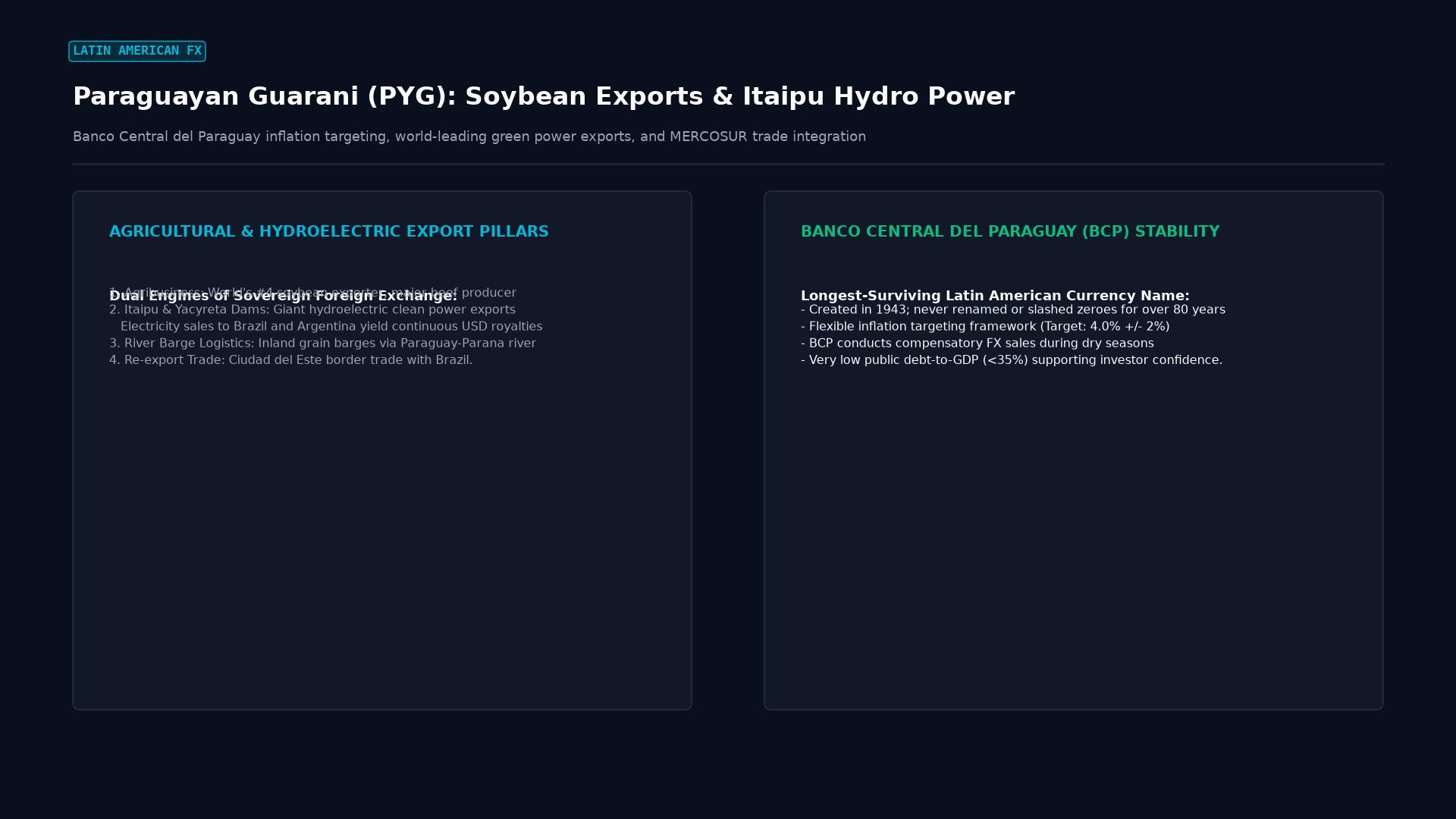 Figure: Banco Central del Paraguay inflation targeting, world-leading green power exports, and MERCOSUR trade integration
Historical Origins and Longevity
Understanding the modern Paraguayan Guaraní requires examining the economic restructuring that occurred in the mid-20th century following decades of regional conflict and monetary instability.
The Replacement of the Paraguayan Peso (1943)
Following the devastating Chaco War (1932 to 1935) against Bolivia, Paraguay suffered severe currency depreciation and banking disarray under the old Paraguayan Peso (Peso Paraguayo).
On October 5, 1943, under the leadership of President Higinio Morínigo and monetary reformer Carlos A. Pedretti, the government enacted Decree Law No. 655, establishing a comprehensive monetary overhaul:
- Created the Guaraní as the nation’s sole monetary standard.
- Converted old pesos to guaraníes at an exchange ratio of:
$$\text{1 Guaraní} = 100 \text{ Paraguayan Pesos}$$
- Established strict foreign exchange regulations to restore confidence in local pricing.
- In 1952, Decree Law No. 18 officially created the modern Banco Central del Paraguay (BCP), separating central bank monetary surveillance from commercial state banking.
1870-1943: Post-War Instability & Paraguayan Peso
Severe gold drain; dependency on Argentine Peso exchange
                      │
                      ▼
October 5, 1943: Decree Law No. 655
Introduction of the Guaraní (₲)
Conversion: 1 Guaraní = 100 Old Pesos
                      │
                      ▼
March 1952: Creation of the Banco Central del Paraguay (BCP)
Monetary autonomy granted to manage credit and currency issue
                      │
                      ▼
1970s-1980s: Itaipu Hydroelectric Boom
Massive foreign direct investment; sustained economic expansion
                      │
                      ▼
2011: Modernization and Inflation-Targeting Framework
Transition to 4.0% inflation target; managed floating FX regime;
Rejection of redenomination proposals preserves 1943 continuity
Eight Decades of Monetary Continuity
While Brazil cycled through the Cruzeiro, Cruzeiro Novo, Cruzado, Cruzado Novo, Cruzeiro Real, and finally the Real, and Argentina replaced the Peso Moneda Nacional, Peso Ley, Peso Argentino, Austral, and modern convertible Peso, Paraguay never redenominated the Guaraní.
In 2011, the BCP proposed a project to redenominate the currency by dropping three zeros (introducing a temporary “Nuevo Guaraní”), but the legislative initiative was shelved. Policymakers and businesses opted to preserve the historical currency unit while upgrading security features and issuing high-value polymer banknotes (such as the 2,000 and 5,000 guaraníes notes).
Macroeconomic Drivers of the Guaraní
The value of the Paraguayan Guaraní against the United States dollar (USD/PYG) is determined by agricultural commodity prices, regional trade, clean energy exports, and central bank intervention.
1. The Agricultural Powerhouse: Soybeans and Beef
Paraguay is an agrarian export economy, ranking among the world’s top exporters of soybeans, soybean oil, soybean meal, corn, and frozen beef. Agricultural and agribusiness products account for more than 60% of total merchandise export receipts.
+------------------------------------------------------------------------------------+
|                         PARAGUAYAN COMMODITY EXPORT PROFILE                        |
+-------------------+----------------------------------------------------------------+
| COMMODITY         | ECONOMIC SCALE & IMPACT                                        |
+-------------------+----------------------------------------------------------------+
| Soy Complex       | Top-4 global exporter; accounts for over $3B-$4B in annual     |
| (Beans, Meal, Oil)| foreign exchange earnings.                                     |
+-------------------+----------------------------------------------------------------+
| Beef Cattle       | Major supplier to international markets (Chile, Taiwan, US);   |
| (Carne Vacuna)    | generates over $1.5B in foreign revenue.                       |
+-------------------+----------------------------------------------------------------+
| Climate Cyclicity | Droughts driven by La Niña weather patterns reduce river barge |
| & River Logistics | navigability on the Paraguay-Paraná waterway, cutting exports. |
+-------------------+----------------------------------------------------------------+
When global grain and meat prices rise, agribusiness conglomerates repatriate US dollars into Asunción to settle local land leases, labor costs, and tax liabilities, appreciating the guaraní.
Conversely, climate shocks, such as severe droughts that dry up the Paraguay-Paraná Waterway (Hidrovía) and strand grain barges, constrain export volumes and place downward pressure on the PYG.
Global Soybean Harvest & Export Season (Q1-Q2)
                       │
                       ▼
Surge in Foreign Currency Revenues Flowing to Local Banks
                       │
                       ▼
Exporters Sell USD to Purchase Guaraníes for Local Operations
                       │
                       ▼
Appreciation Pressure on Guaraní (USD/PYG Drops)
2. Hydroelectric Energy Exports: Itaipu and Yacyretá
Paraguay is one of the world’s largest net exporters of clean electrical energy. The country co-owns two binational hydroelectric dams:
- Itaipu Binational: Operated jointly with Brazil on the Paraná River, it was historically the world’s largest hydroelectric facility by annual energy output.
- Yacyretá Binational: Operated jointly with Argentina.
Because Paraguay’s domestic electrical grid consumes only a fraction of its 50% treaty share of Itaipu’s power, the country sells its surplus electricity to Brazil under long-term bilateral treaty arrangements.
These energy sales provide the Paraguayan Treasury with dependable, multi-hundred-million-dollar royalties (royalties y compensaciones) paid in hard currency. These funds bolster official international reserves and support external fiscal balances.
3. Re-Export Border Trade (Ciudad del Este)
A unique pillar of the Paraguayan economy is the cross-border triangular re-export trade centered in Ciudad del Este on the Triple Frontier with Brazil and Argentina.
Paraguay imports consumer electronics, luxury perfumes, computer hardware, and high-end goods from the United States, China, and Europe at low tariff rates, then re-sells them to Brazilian and Argentine cross-border shoppers. This retail ecosystem generates significant foreign cash flows, contributing to liquidity across domestic commercial banks.
BCP Monetary Policy and the Inflation-Targeting Framework
The Banco Central del Paraguay governs the currency under a modernized Inflation-Targeting Regime adopted in May 2011.
+------------------------------------------------------------------------------------+
|                         BCP MONETARY POLICY STRUCTURE                              |
+-------------------+----------------------------------------------------------------+
| TARGET VARIABLE   | CPI Consumer Price Inflation                                   |
| NUMERICAL TARGET  | 4.0% per annum                                                 |
| TOLERANCE BAND    | ± 2.0 percentage points (2.0% to 6.0%)                         |
| OPERATIONAL TOOL  | Monetary Policy Rate (Tasa de Política Monetaria - TPM)        |
| LIQUIDITY DESK    | Instrumentos de Regulación Monetaria (IRM)                     |
+-------------------+----------------------------------------------------------------+
The Policy Rate (TPM) and Liquidity Regulation
The BCP’s Monetary Policy Committee (Comité de Política Monetaria - CPM) adjusts the Tasa de Política Monetaria (TPM) to steer interbank liquidity.
To absorb excess cash injected into the banking system by agricultural export windfalls, the BCP issues short-term debt instruments known as Instrumentos de Regulación Monetaria (IRM). By managing liquidity in this manner, the central bank maintains positive real interest rates, anchoring inflation expectations and discouraging capital flight.
BCP Foreign Exchange Interventions
The Paraguayan Guaraní operates under a managed floating exchange rate regime (flotación administrada).
+------------------------------------------------------------------------------------+
|                         BCP INTERVENTION MODALITIES                                |
+-------------------+----------------------------------------------------------------+
| INTERVENTION TYPE | OPERATIONAL TRIGGER & OBJECTIVE                                |
+-------------------+----------------------------------------------------------------+
| Compensatory      | Daily sales of foreign currency executed on behalf of the      |
| Operations        | Ministry of Economy and Finance to sterilize fiscal spending.  |
+-------------------+----------------------------------------------------------------+
| Discretionary     | Targeted market interventions to counteract excessive          |
| Volatility Sales  | speculative swings or liquidity squeezes in the interbank spot.|
+-------------------+----------------------------------------------------------------+
The BCP does not peg the guaraní to the US dollar at a fixed rate, allowing the exchange rate to reflect fundamental shifts in terms of trade. However, the BCP frequently conducts:
- Compensatory Sales: The Ministry of Economy and Finance receives US dollars from Itaipu hydroelectric royalties and foreign sovereign bond issuances. To fund domestic budget items denominated in guaraníes, the BCP executes planned, pre-announced foreign exchange sales on the interbank market.
- Discretionary Smoothing: During periods of emerging market risk aversion or local political shocks, the BCP sells US dollars from its international reserves to smooth out volatility and prevent disorderly intraday jumps in the exchange rate.
Trading the PYG: Market Microstructure
In domestic and international banking, the exchange rate is quoted directly against the US dollar as USD/PYG, representing the number of guaraníes needed to purchase one US dollar.
Direct Quotation:
USD/PYG = 7,550

Interpretation:
1 US Dollar = 7,550 Paraguayan Guaraníes
A movement to 7,700 indicates Guaraní depreciation.
A movement to 7,400 indicates Guaraní appreciation.
+------------------------------------------------------------------------------------+
| PYG MARKET CHARACTERISTICS |
+-------------------+----------------------------------------------------------------+
| Interbank Market | Electronic wholesale foreign exchange system operated through |
| | the BCP's SIEN (Sistema de Interconexión Entre Entidades). |
| Cash Settlement | Real-Time Gross Settlement via SIPAP (Sistema de Pagos |
| | del Paraguay) on a standard T+2 interbank convention. |
| Exchange Bureaus | Active parallel network of authorized Casas de Cambio handling |
| (Casas de Cambio) | physical dollar cash transactions for cross-border commerce. |
| Offshore Trading | Limited offshore liquidity; managed primarily via specialized |
| | Non-Deliverable Forwards (NDFs) for corporate hedging. |
+-------------------+----------------------------------------------------------------+Key Takeaways
- Historical Longevity: The Paraguayan Guaraní (PYG, symbol: ₲) was created in October 1943, making it one of South America’s longest-surviving national currencies without a zero-dropping redenomination.
- Agrarian Anchor: The economy depends on agribusiness exports, particularly soybeans, soybean meal, and beef, making the currency sensitive to global commodity cycles and rainfall patterns.
- Clean Energy Royalty Cash Flows: Paraguay’s joint ownership of the Itaipu and Yacyretá hydroelectric dams generates consistent, multi-hundred-million-dollar hard currency royalty payments that support fiscal balances.
- Inflation-Targeting Framework: The Banco Central del Paraguay (BCP) manages domestic price stability around an explicit 4.0% annual inflation target using its benchmark policy rate (TPM).
- Managed Floating System: The BCP uses compensatory and discretionary foreign currency interventions to dampen currency volatility while allowing long-term market trends to adjust.
- Frontier Currency Access: Physical spot transactions settle through domestic banking rails (SIPAP), while international institutional investors manage currency exposures via offshore Non-Deliverable Forwards (NDFs).
Frequently Asked Questions (FAQ)
Why has Paraguay never dropped zeros from the Guaraní like other Latin American nations?
Unlike Argentina, Brazil, and Bolivia, which experienced bouts of extreme hyperinflation reaching thousands of percent per year in the 1970s and 1980s, Paraguay maintained fiscal and monetary discipline. Through moderate fiscal deficits, conservative central bank balance sheet management, and consistent foreign exchange earnings from agriculture and the Itaipu dam, annual inflation rarely broke into uncontrollable triple digits. Consequently, while the currency experienced steady long-term depreciation, the government never faced an emergency requiring a complete monetary replacement or the deletion of zeros.
How does the Itaipu hydroelectric dam affect the value of the Guaraní?
The Itaipu Dam is a joint enterprise between Paraguay and Brazil. Because Paraguay uses only a portion of its 50% entitlement of electricity, it exports the surplus to Brazil. Brazil pays Paraguay in hard currency (US dollars) for this energy. These payments provide the Paraguayan government with foreign exchange revenue that flows into central bank reserves. The BCP converts these dollars into guaraníes through structured market operations to fund domestic spending, providing structural support to the national currency.
What is the role of Ciudad del Este in the Paraguayan currency market?
Ciudad del Este is a major commercial duty-free hub situated on the border with Brazil and Argentina. The city’s retail economy relies on importing consumer goods, electronics, and cosmetics and selling them to shoppers from neighboring countries. This border trade creates substantial cash flows in US dollars, Brazilian reais, and Argentine pesos. Commercial exchange houses (casas de cambio) in Ciudad del Este trade hundreds of millions of dollars in cash each month, making the border city an important driver of physical foreign exchange liquidity in Paraguay.
Ready to trade forex?
Open a free demo account with a regulated broker. Practice with virtual funds before risking real money.