Qualified distribution
A qualified distribution is a tax-free withdrawal of earnings and principal from a tax-advantaged account, such as a Roth IRA, 529 plan, or HSA, meeting statutory criteria.
What is a Qualified Distribution?
In tax law, retirement planning, and wealth management, a qualified distribution is a withdrawal of funds from a tax-advantaged account that satisfies all statutory requirements established by the Internal Revenue Code (IRC).
When a withdrawal meets the legal definition of a qualified distribution, the account holder is entitled to receive both their original contributions and all accumulated investment earnings, dividends, and capital gains 100% free of federal, state, and local income taxes, as well as exempt from statutory early withdrawal penalties.
Conversely, a withdrawal that fails to satisfy statutory requirements is classified as a non-qualified distribution. Non-qualified distributions generally result in investment earnings being taxed at ordinary income tax rates, frequently compounded by an additional early withdrawal excise penalty (typically 10% to 20%).
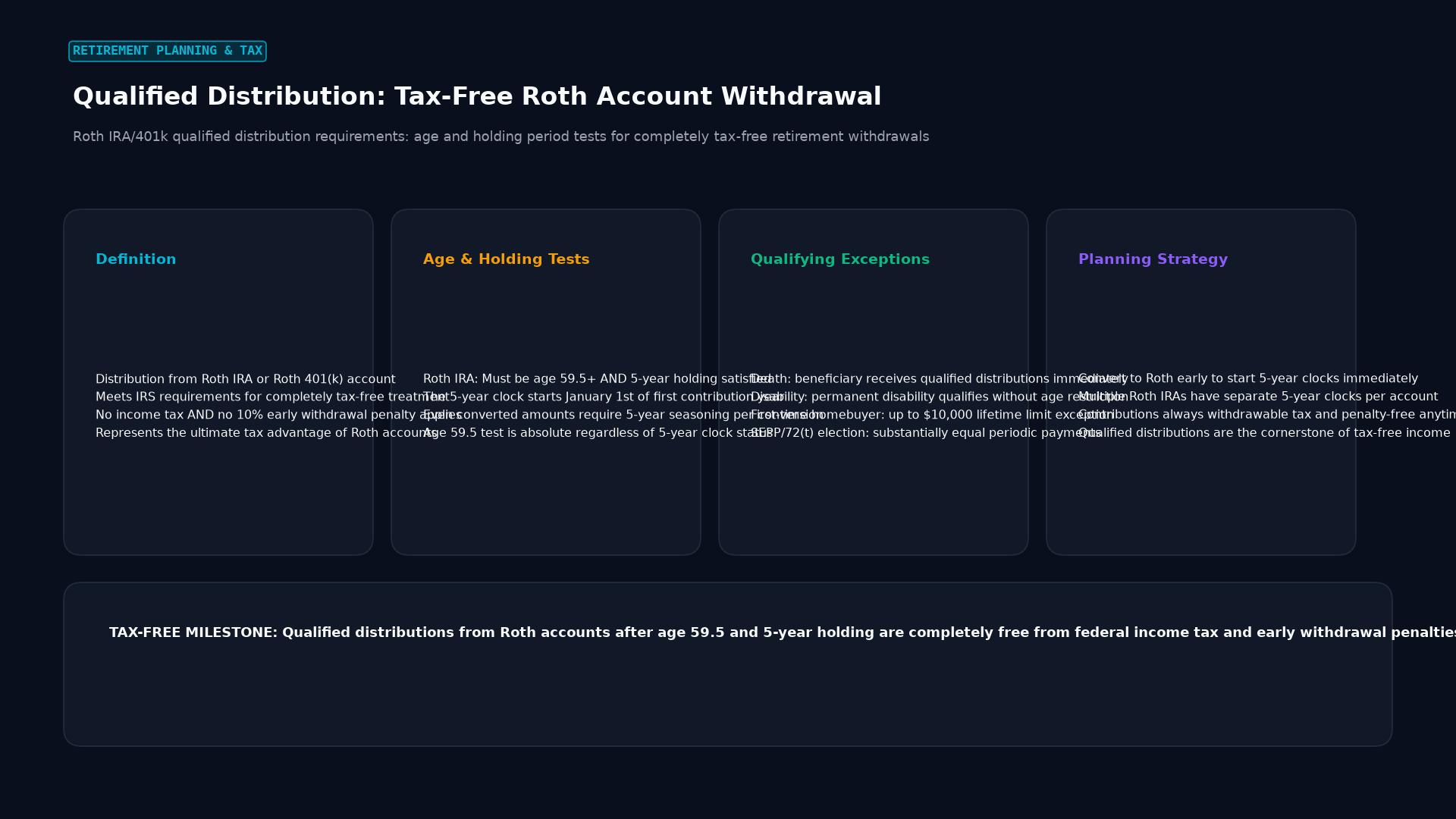 Figure: Roth IRA/401k qualified distribution requirements: age and holding period tests for completely tax-free retirement withdrawals
Qualified Distributions from Roth IRAs (IRC § 408A)
The Roth Individual Retirement Arrangement (Roth IRA) is one of the most widely used wealth-building vehicles in the United States. To achieve qualified distribution status on Roth IRA investment earnings, a withdrawal must satisfy a strict two-prong statutory test:
                         ROTH IRA QUALIFIED DISTRIBUTION TEST

                    Prong 1: The 5-Taxable-Year Holding Rule
           Has it been ≥ 5 full tax years since the first contribution?
                                      │
                         ┌────────────┴────────────┐
                        YES                        NO
                         │                         │
                         ▼                         ▼
            Prong 2: The Qualifying Trigger    FAIL: Non-Qualified
           Does the distribution satisfy at     (Earnings subject
           least ONE of the following hurdles?   to ordinary income
           - Reached Age 59½                     tax + 10% penalty)
           - Permanent Disability
           - Beneficiary after Death
           - First-Time Homebuyer ($10K limit)
                         │
             ┌───────────┴───────────┐
            YES                      NO
             │                       │
             ▼                       ▼
      SUCCESS: 100% TAX-FREE    FAIL: Non-Qualified
1. The 5-Year Rule for Roth IRAs
The clock for the 5-year holding period begins on January 1 of the tax year for which the account holder made their very first annual contribution to any Roth IRA.
- For example, if an investor opens their first Roth IRA on April 14, 2024, and designates it as a contribution for tax year 2023, the 5-year clock begins retroactively on January 1, 2023.
- The 5-year period ends on December 31, 2027. Any distribution of earnings made on or after January 1, 2028, satisfies the 5-year rule.
2. The Four Qualifying Triggers
In addition to satisfying the 5-year holding rule, the distribution must be made under at least one of four qualifying circumstances:
- Age 59½: The account owner has attained age 59½ on or before the date of the distribution.
- Disability: The account owner is deemed totally and permanently disabled under IRC Section 72(m)(7).
- Death: The distribution is made to a designated beneficiary or the account owner’s estate following the owner’s death.
- First-Time Home Purchase: Used to acquire a principal residence for a first-time homebuyer (subject to a strict $10,000 lifetime cap per individual).
Roth IRA Non-Qualified Distribution Ordering Rules
Even if a distribution fails the qualified test, an investor may not owe taxes. Under Treasury Regulation § 1.408A-6, distributions from a Roth IRA are governed by favorable ordering rules:
$$\text{Tier 1: Regular Contributions} \longrightarrow \text{Tier 2: Conversion Principal} \longrightarrow \text{Tier 3: Investment Earnings}$$
- Regular Contributions (Tier 1): Withdrawn first. Because contributions were made with post-tax dollars, they can be withdrawn at any age, at any time, for any reason, with zero tax and zero penalty.
- Conversion and Rollover Principal (Tier 2): Withdrawn second on a first-in, first-out (FIFO) basis. Principal converted from a Traditional IRA is withdrawn tax-free, but may trigger a 10% early withdrawal penalty if taken within 5 years of the conversion date (unless the owner is over 59½).
- Investment Earnings (Tier 3): Withdrawn last. Earnings become taxable at ordinary income rates and incur a 10% penalty unless the withdrawal qualifies under the full qualified distribution test.
Health Savings Accounts (HSA - IRC § 223)
Health Savings Accounts represent a powerful savings vehicle in the US tax code because of their triple-tax advantage:
- Contributions are tax-deductible (or pre-tax via payroll deductions).
- Investment growth and interest accumulate 100% tax-free.
- Withdrawals are completely tax-free when classified as qualified distributions.
+------------------------------------------------------------------------------------+
|                         HEALTH SAVINGS ACCOUNT (HSA) RULES                         |
+---------------------+-------------------------------+------------------------------+
| DISTRIBUTION TYPE   | CRITERIA REQUIRED             | TAX & PENALTY CONSEQUENCES   |
+---------------------+-------------------------------+------------------------------+
| Qualified           | Used exclusively for qualified| 100% Federal, State, and     |
| Medical Expense     | medical expenses under IRC    | FICA Tax-Free.               |
|                     | Section 213(d).               | Zero Penalties.              |
+---------------------+-------------------------------+------------------------------+
| Non-Qualified       | Non-medical withdrawal made   | Taxed as Ordinary Income     |
| (Under Age 65)      | prior to turning age 65.      | PLUS 20% IRS Excise Penalty. |
+---------------------+-------------------------------+------------------------------+
| Non-Qualified       | Non-medical withdrawal made   | Taxed as Ordinary Income.    |
| (Age 65 and Older)  | after turning age 65.         | 20% Penalty is waived        |
|                     |                               | (Functions like Trad. IRA).  |
+---------------------+-------------------------------+------------------------------+
The “Shoebox Strategy” for Long-Term Growth
Under IRC Section 223, there is no statutory deadline requiring an HSA account holder to reimburse themselves in the same calendar year that a medical expense occurred.
Wealth managers leverage this provision via the shoebox strategy:
- An investor incurs a qualified medical expense (e.g., $5,000 for dental or surgical work) and pays out-of-pocket using everyday cash or a credit card.
- The investor saves the receipt and proof of payment electronically in a digital “shoebox.”
- The $5,000 inside the HSA remains invested in global equities and index funds, compounding tax-free over 20 or 30 years.
- Decades later in retirement, the investor withdraws $5,000 from the HSA tax-free by matching it against the archived medical receipt, while leaving decades of compound investment growth inside the account.
529 College Savings Plans (IRC § 529)
A 529 plan is an education investment vehicle that provides tax-exempt growth and tax-free distributions when used for Qualified Higher Education Expenses (QHEE).
       529 Plan Assets Invested & Compounded
                         │
                         ▼
       Distribution Taken to Cover Eligible Expenses:
       - Higher Education Tuition, Fees, Books, Supplies
       - Room & Board (Enrolled at least half-time)
       - Special Needs Services & Equipment
       - Up to $10,000/yr for K-12 Elementary/Secondary Tuition
       - Up to $10,000 Lifetime for Student Loan Debt Principal
                         │
                         ▼
       100% Tax-Free & Penalty-Free Qualified Distribution
Non-Qualified 529 Penalties and Pro-Rata Taxation
Unlike Roth IRAs, 529 plan distributions do not follow favorable ordering rules. Every distribution consists of a pro-rata blend of principal basis and investment earnings:
$$\text{Earnings Ratio} = \frac{\text{Total Account Earnings}}{\text{Total Account Value}}$$
If an account holder takes a non-qualified distribution of $10,000 from a 529 plan where earnings represent 40% of the balance:
- $6,000 is considered return of principal basis (tax-free).
- $4,000 is taxable earnings, subject to the investor’s ordinary income tax rate.
- An additional 10% IRS penalty is levied against the $4,000 earnings portion ($400 penalty).
SECURE 2.0 Act: 529-to-Roth IRA Rollovers
Under the SECURE 2.0 Act, unused 529 assets can be rolled over directly into a Roth IRA for the beneficiary without triggering taxes or penalties:
- The 529 account must have been open for at least 15 years.
- Rollovers are subject to annual Roth IRA contribution limits and carry a lifetime maximum cap of $35,000 per beneficiary.
- Contributions and earnings made within the preceding 5 years are ineligible for rollover.
Comparison Across Tax-Advantaged Accounts
+------------------------------------------------------------------------------------+
|                   QUALIFIED DISTRIBUTION MECHANICS COMPARISON                      |
+---------------------+-------------------+---------------------+--------------------+
| PLAN TYPE           | QUALIFYING EVENT  | PENALTY ON NON-     | DISTRIBUTION BASIS |
|                     | FOR TAX-FREE GAIN | QUALIFIED EARNINGS  | ORDERING RULE      |
+---------------------+-------------------+---------------------+--------------------+
| Roth IRA            | 5-Year Rule AND   | 10% Federal Excise  | Favorable Ordering |
|                     | Age 59½ / Disab.  | Tax                 | (Basis out first)  |
+---------------------+-------------------+---------------------+--------------------+
| Health Savings      | Qualified Medical | 20% Penalty (Waived | Dollar-for-dollar  |
| Account (HSA)       | Expenses § 213(d) | at age 65)          | match of expenses  |
+---------------------+-------------------+---------------------+--------------------+
| 529 Education       | Qualified Higher  | 10% Federal Excise  | Pro-Rata Blend of  |
| Plan                | Education Costs   | Tax                 | Principal & Gain   |
+---------------------+-------------------+---------------------+--------------------+
| Designated Roth     | 5-Year Rule AND   | 10% Federal Excise  | Pro-Rata Blend     |
| 401(k) / 403(b)     | Age 59½ / Disab.  | Tax                 | (Until Rollover)   |
+---------------------+-------------------+---------------------+--------------------+
Key Takeaways
- Tax-Free Exemption: A qualified distribution allows account owners to withdraw both principal contributions and accumulated investment returns 100% free of income taxes and IRS penalties.
- Roth IRA Two-Prong Rule: To qualify for tax-free earnings from a Roth IRA, the account must satisfy the 5-taxable-year rule and the owner must have reached age 59½, become disabled, passed away, or used up to $10,000 for a first-time home purchase.
- Roth IRA Ordering Shield: Regular contributions to a Roth IRA can be withdrawn at any time and age without taxes or penalties because contributions follow favorable ordering rules.
- HSA Triple Advantage: Health Savings Accounts provide tax-free growth and tax-free withdrawals when matched with qualified medical expenses, with the 20% non-qualified penalty waived after age 65.
- Pro-Rata Calculations: 529 college savings plans and designated Roth 401(k)s allocate non-qualified distributions proportionally across basis and earnings, unlike the tiered ordering rules of Roth IRAs.
- SECURE 2.0 Flexibility: Unused 529 education funds can be transitioned into a beneficiary’s Roth IRA up to a $35,000 lifetime cap, avoiding non-qualified taxes if holding periods are satisfied.
Frequently Asked Questions (FAQ)
Can I withdraw money from my Roth IRA before age 59½ without paying taxes?
Yes. Under the IRS ordering rules for Roth IRAs, your original contributions are always returned first. Because contributions are made with money that has already been taxed, you can withdraw your original principal contributions at any age, at any time, and for any reason with zero taxes and zero penalties. Only when you have withdrawn all of your cumulative contributions (and any qualified rollover funds) do you begin touching investment earnings, which are subject to taxes and a 10% early withdrawal penalty unless an exception applies.
What qualifies as an eligible expense for a 529 plan qualified distribution?
Eligible expenses for a 529 plan include tuition, mandatory enrollment fees, textbooks, required course supplies, and computer equipment for a student attending an accredited college, university, or vocational school. For students enrolled at least half-time, reasonable room and board costs are also eligible. In addition, federal tax law permits up to $10,000 per year per student to be withdrawn for K-12 private school tuition, and a lifetime maximum of up to $10,000 can be used to pay down qualified student loan principal for the beneficiary or their siblings.
What happens if I use HSA funds for non-medical expenses after age 65?
If you withdraw funds from an HSA for non-medical expenses after turning age 65, you will not owe the standard 20% IRS excise penalty. However, the withdrawn amount will be treated as ordinary income and subject to standard income tax rates. In this manner, an HSA functions identically to a Traditional IRA or 401(k) after age 65, while preserving the added benefit of completely tax-free withdrawals at any age if the money is used to pay for qualified out-of-pocket healthcare expenses.
Ready to trade forex?
Open a free demo account with a regulated broker. Practice with virtual funds before risking real money.