Qualified dividend
A qualified dividend is an ordinary dividend meeting specific IRS holding-period criteria to be taxed at preferential long-term capital gains rates (0%, 15%, or 20%) rather than higher ordinary income rates.
What is a Qualified Dividend?
In federal taxation and investment finance, a qualified dividend is a corporate distribution of earnings that satisfies specific Internal Revenue Service (IRS) statutory criteria, entitling the recipient to be taxed at preferential long-term capital gains tax rates (0%, 15%, or 20%) rather than higher ordinary income tax rates.
Prior to 2003, all corporate dividends received by individual shareholders in the United States were taxed as ordinary income, reaching marginal federal tax brackets as high as 38.6% to 39.6%. This treatment resulted in severe economic double taxation: corporate profits were taxed first at the corporate level via the corporate income tax, and taxed a second time at ordinary individual income tax rates when distributed to shareholders.
To stimulate capital investment, reduce dividend tax penalties, and align equity payouts with long-term capital appreciation, Congress passed the Jobs and Growth Tax Relief Reconciliation Act of 2003 (JGTRRA), codifying the qualified dividend framework under Internal Revenue Code (IRC) Section 1(h)(11).
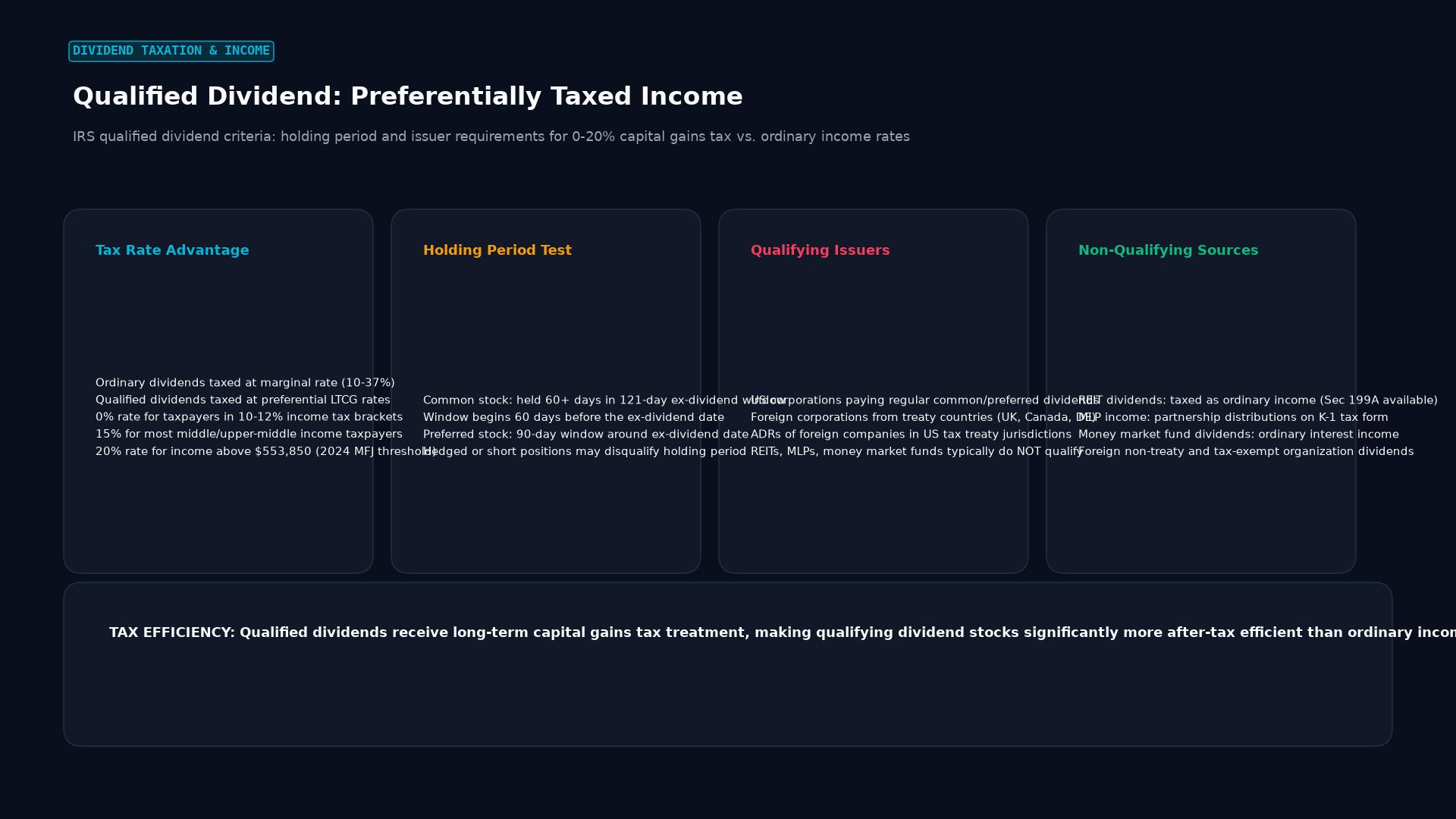 Figure: IRS qualified dividend criteria: holding period and issuer requirements for 0-20% capital gains tax vs. ordinary income rates
Preferential Tax Rates on Qualified Dividends
Qualified dividends are taxed using the progressive capital gains tax brackets rather than ordinary wage tax brackets:
+------------------------------------------------------------------------------------+
|                  QUALIFIED DIVIDEND FEDERAL TAX BRACKETS                           |
+-----------+----------------------------+-------------------------------------------+
| TAX RATE  | SINGLE FILERS (INCOME)     | MARRIED FILING JOINTLY (INCOME)           |
+-----------+----------------------------+-------------------------------------------+
| 0.0%      | Up to $47,025              | Up to $94,050                             |
+-----------+----------------------------+-------------------------------------------+
| 15.0%     | $47,026 to $518,900        | $94,051 to $583,750                       |
+-----------+----------------------------+-------------------------------------------+
| 20.0%     | Exceeding $518,900         | Exceeding $583,750                        |
+-----------+----------------------------+-------------------------------------------+
(Thresholds indexed annually for inflation under the Tax Cuts and Jobs Act).
The 3.8% Net Investment Income Tax (NIIT)
For high-income investors whose Modified Adjusted Gross Income (MAGI) exceeds statutory thresholds ($200,000 for single filers, $250,000 for married couples filing jointly), qualified dividends are also subject to the 3.8% Net Investment Income Tax (NIIT) under IRC Section 1411.
Consequently, the top effective federal tax rate on qualified dividends is:
$$\text{Top Marginal Rate} = 20.0% + 3.8% (\text{NIIT}) = 23.8%$$
Even at this maximum rate, qualified dividends provide a significant tax advantage compared to the top ordinary income bracket of 37.0% (or 40.8% including NIIT).
The Three-Part Statutory Test for Qualified Status
To achieve qualified status, a dividend distribution must pass three distinct legal tests established by the Internal Revenue Code:
                         THE QUALIFIED DIVIDEND THREE-PART TEST

                               1. THE ISSUER TEST
                Is the dividend paid by a US domestic C-Corp or a
                Qualified Foreign Corporation (QFC)?
                                       │
                         ┌─────────────┴─────────────┐
                        YES                          NO
                         │                           │
                         ▼                           ▼
                           2. THE HOLDING PERIOD TEST    FAIL: Taxed as
                Did the investor hold the stock unhedged  Ordinary Income
                for > 60 days in the 121-day window?
                                       │
                         ┌─────────────┴─────────────┐
                        YES                          NO
                         │                           │
                         ▼                           ▼
                             3. THE HEDGING TEST         FAIL: Taxed as
                Was the investor free from short hedges   Ordinary Income
                or deep ITM short calls during the 60 days?
                                       │
             ┌───────────┴───────────┐
            YES                      NO
             │                       │
             ▼                       ▼
      SUCCESS: 100% QUALIFIED    FAIL: Taxed as Ordinary Income
1. The Issuer Test
The dividend must be paid by:
- A domestic United States corporation incorporated under state law.
- A Qualified Foreign Corporation (QFC) that satisfies at least one of the following requirements:
- Incorporated in a possession of the United States (such as Puerto Rico, Guam, or the US Virgin Islands).
- Eligible for the benefits of a comprehensive bilateral income tax treaty with the United States that includes an exchange of information program.
- The foreign stock or American Depositary Receipt (ADR) on which the dividend is paid is readily tradable on an established securities market in the United States (e.g., listed on the NYSE or Nasdaq).
Disqualification Exception: Dividends paid by a foreign corporation that is classified as a Passive Foreign Investment Company (PFIC) under IRC Section 1297 in the taxable year of distribution or the preceding taxable year can never qualify.
2. The Holding Period Test (IRC § 246(c))
To prevent market participants from purchasing a stock immediately before its dividend distribution and selling it immediately after, the tax code enforces strict holding periods:
                 THE 121-DAY STATUTORY HOLDING PERIOD WINDOW

    60 Days Before Ex-Dividend Date           60 Days After Ex-Dividend Date
◄──────────────────────────────────────┬──────────────────────────────────────►
                                       │
                                Ex-Dividend Date

Rule: Investor must hold the shares for MORE THAN 60 DAYS within this 121-day span.
(Minimum required holding: 61 full days).- Common Stock: The investor must hold the stock for more than 60 days during the 121-day holding period that begins 60 days before the stock’s ex-dividend date and ends 60 days after the ex-dividend date.
- Preferred Stock: If the dividend is on preferred stock attributable to a period exceeding 366 days, the holding period expands: the investor must hold the preferred shares for more than 90 days during a 181-day window beginning 90 days before the ex-dividend date.
Counting the Days:
When calculating the 60-day holding period:
- The day of acquisition is not counted.
- The day of disposition is counted.
- The ex-dividend date itself is counted if the stock is held on that day.
Numerical Example:
- Ex-Dividend Date: Thursday, July 10.
- 121-Day Window: Begins May 11 and ends September 8.
- If an investor buys shares on July 8 (two days before the ex-dividend date) and holds them until September 10, the total holding period exceeds 60 days, and the dividend qualifies for preferential tax rates.
- If the investor sells the shares on August 15 (only 38 days of holding), the holding period test fails, and the dividend is taxed at ordinary income rates.
3. The Hedging and Diminished Risk Rule
Under IRC Section 246(c)(4), days do not count toward the 60-day holding period if the investor’s risk of loss is substantially diminished because the investor:
- Holds an option to sell, is under a contractual obligation to sell, or has entered into a short sale of substantially identical stock or securities.
- Is the grantor of an option to purchase substantially identical property (such as selling a deep in-the-money covered call option).
- Holds an offsetting position through a total return equity swap or short futures contract.
Distributions That Never Qualify
Not all distributions labeled as “dividends” qualify for preferential capital gains treatment under federal tax law.
+------------------------------------------------------------------------------------+
|                         NON-QUALIFIED CORPORATE PAYOUTS                            |
+-------------------+----------------------------------------------------------------+
| DISTRIBUTION TYPE | REASON FOR DISQUALIFICATION                                    |
+-------------------+----------------------------------------------------------------+
| REIT Dividends    | Real Estate Investment Trusts pay no corporate income tax      |
|                   | because they deduct dividends. To prevent zero taxation,       |
|                   | REIT payouts are taxed at ordinary income rates (eligible for   |
|                   | 20% Section 199A QBI deduction).                               |
+-------------------+----------------------------------------------------------------+
| Master Limited    | Payouts are partnership distributions (return of capital and   |
| Partnerships (MLP)| pass-through ordinary income reported on Schedule K-1).        |
+-------------------+----------------------------------------------------------------+
| Payments in Lieu  | When stock is loaned to short sellers via securities lending,  |
| of Dividends      | the lender receives a cash "substitute payment" that is taxed  |
|                   | as ordinary income.                                            |
+-------------------+----------------------------------------------------------------+
| Credit Union      | Legally classified as taxable deposit interest rather than     |
| "Dividends"       | corporate equity dividend payouts.                             |
+-------------------+----------------------------------------------------------------+
| Tax-Exempt Corps. | Distributions from entities exempt under IRC § 501 or § 521.   |
+-------------------+----------------------------------------------------------------+
Institutional and Wealth Planning Implications
The substantial difference between the 20% qualified dividend rate and the 37% ordinary income rate drives portfolio construction strategies:
+------------------------------------------------------------------------------------+
|                         ASSET LOCATION TAX OPTIMIZATION                            |
+---------------------+-------------------------------+------------------------------+
| ACCOUNT TYPE        | OPTIMAL ASSET ALLOCATIONS     | TAX RATIONALE                |
+---------------------+-------------------------------+------------------------------+
| Taxable Brokerage   | - High-dividend blue-chip     | - Low qualified dividend tax |
| Accounts            |   common stocks (C-Corps)     |   rates (max 23.8% vs 40.8%).|
|                     | - Broad equity index ETFs     | - Tax-loss harvesting.       |
+---------------------+-------------------------------+------------------------------+
| Tax-Deferred / Roth | - Real Estate Investment      | - Shields REITs, corporate   |
| Retirement Accounts |   Trusts (REITs)              |   debt, and high-yield bond  |
| (401k / IRA)        | - High-yield corporate bonds  |   interest from ordinary     |
|                     | - Active trading strategies   |   income tax brackets.       |
+---------------------+-------------------------------+------------------------------+
By locating blue-chip dividend growth stocks within taxable accounts and holding REITs and fixed-income debt within IRAs, wealth managers optimize after-tax cash returns across an investor’s overall balance sheet.
Key Takeaways
- Preferential Tax Treatment: Qualified dividends are taxed at long-term capital gains rates (0%, 15%, or 20% plus 3.8% NIIT) rather than ordinary income tax rates, reducing the tax penalty on corporate equity payouts.
- Statutory Foundation: Codified under IRC Section 1(h)(11) via the 2003 JGTRRA to mitigate double taxation on corporate earnings.
- The 60-Day Holding Requirement: Common stock must be held unhedged for more than 60 days during a 121-day window surrounding the ex-dividend date to achieve qualified status.
- Issuer Requirements: Dividends must be issued by a domestic US C-corporation or a Qualified Foreign Corporation (QFC) eligible under US tax treaties; PFICs are disqualified.
- Hedging Exclusions: Buying put options, executing short sales, or writing deep in-the-money call options pauses the statutory holding period day-count.
- Excluded Asset Classes: REIT distributions, credit union payouts, and substitute payments from securities lending do not qualify and are taxed at ordinary income rates.
Frequently Asked Questions (FAQ)
What is the difference between an ordinary dividend and a qualified dividend?
Every dividend paid by a corporation is classified as an ordinary dividend. However, if the dividend satisfies specific statutory requirements regarding the issuing company, the holding period of the shares, and the absence of hedging, it is classified as a “qualified dividend.” The primary difference lies in the tax rate applied: regular ordinary dividends are taxed at the investor’s personal income tax rate (up to 37%), whereas qualified dividends are taxed at lower long-term capital gains tax rates (maximum of 20% plus 3.8% NIIT).
How do I know if the dividends I received during the year are qualified?
At the end of each tax year, your brokerage firm issues an IRS Form 1099-DIV.
- Box 1a displays Total Ordinary Dividends (the entire sum of all dividends received across your holdings).
- Box 1b displays Qualified Dividends (the specific dollar amount that met the IRS holding period and issuer rules). When filing your federal tax return, the amount listed in Box 1b is reported on Form 1040 and taxed using the Qualified Dividends and Capital Gain Tax Worksheet, ensuring you receive preferential tax rates on that portion.
Why don’t dividends paid by Real Estate Investment Trusts (REITs) count as qualified dividends?
REITs are structured under federal tax law to pass through substantially all of their taxable real estate income directly to shareholders. Unlike standard C-corporations, REITs are permitted to deduct distributed dividends from their corporate taxable income, paying zero federal corporate income tax. Because REIT earnings are not taxed at the corporate level, the IRS taxes REIT dividends at ordinary income rates when received by shareholders, preventing corporate real estate earnings from escaping standard taxation altogether.
Ready to trade forex?
Open a free demo account with a regulated broker. Practice with virtual funds before risking real money.