SGD
SGD (Singapore Dollar) is the official currency of the Republic of Singapore, subdivided into 100 cents and regulated by the Monetary Authority of Singapore (MAS).
What is the Singapore Dollar (SGD)?
The Singapore Dollar (ISO code: SGD, symbol: S$ or $) is the official currency of the Republic of Singapore. Regulated and administered by the nation’s central bank and integrated financial supervisor, the Monetary Authority of Singapore (MAS), the currency is subdivided into 100 cents.
In international finance, the Singapore Dollar is recognized as one of the world’s premier reserve currencies and a primary Asian financial haven. Supported by Singapore’s top-tier AAA sovereign credit rating, substantial net foreign asset reserves, and political stability, the currency reflects the city-state’s role as an international banking center, wealth management hub, and logistics gateway.
A major feature of the Singapore Dollar is its monetary policy framework: the MAS does not control interest rates. Instead, because Singapore’s gross trade volume exceeds 300% of its gross domestic product, the MAS conducts monetary policy through the systematic management of the external exchange rate via the Singapore Dollar Nominal Effective Exchange Rate (S$NEER).
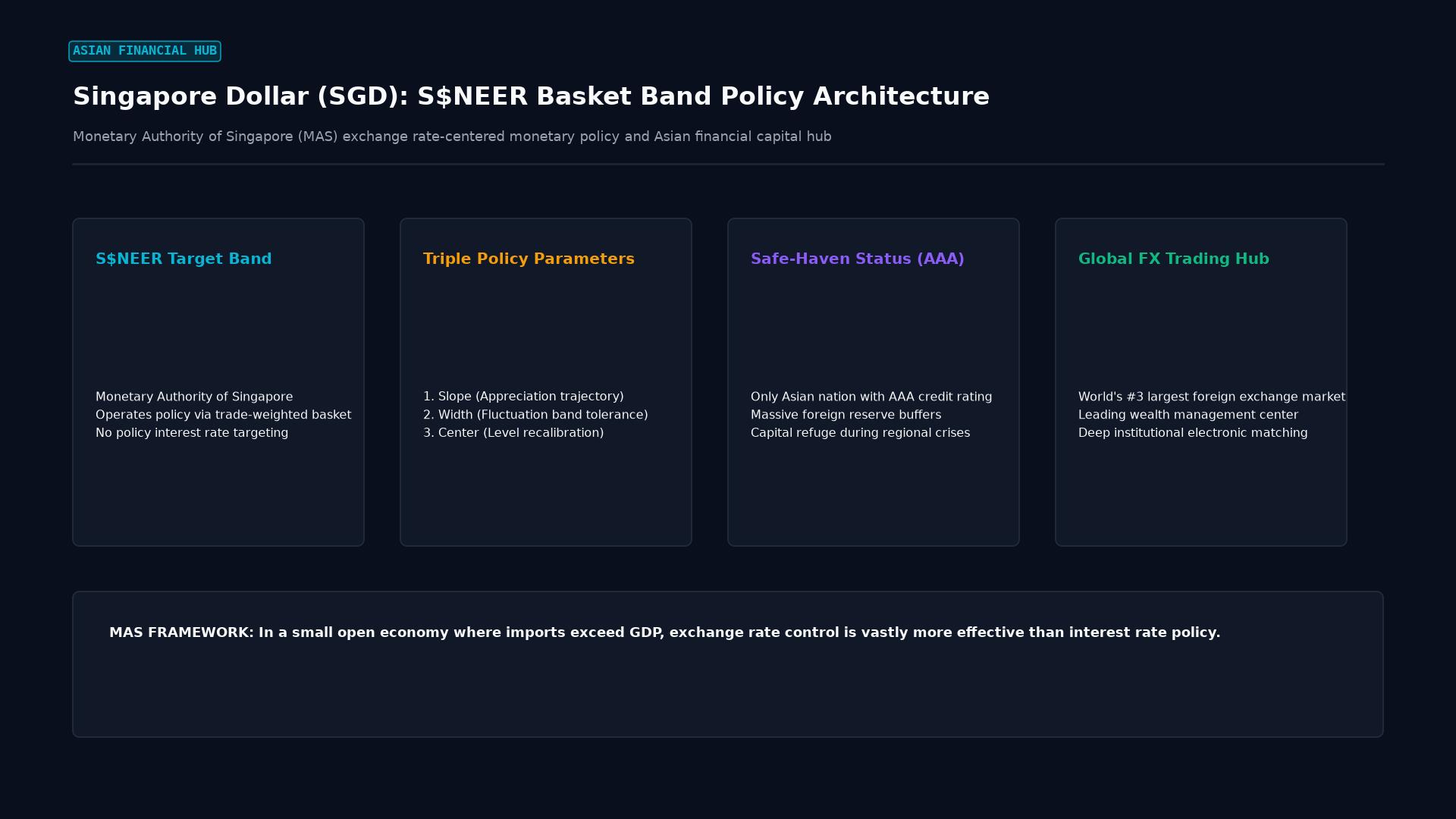 Figure: Monetary Authority of Singapore (MAS) exchange rate-centered monetary policy and Asian financial capital hub
Historical Origins and the Currency Interchangeability Agreement
The monetary evolution of the Singapore Dollar is linked to the political restructuring of Southeast Asia following decolonization.
The Dissolution of the Malayan Currency Union (1967)
Prior to 1967, Singapore, Malaysia, and Brunei shared a common currency administered by the Board of Commissioners of Currency, Malaya and British Borneo. Following Singapore’s separation from the Federation of Malaysia in August 1965, tripartite negotiations to preserve a shared currency broke down.
On June 12, 1967, Singapore established the Board of Commissioners of Currency, Singapore (BCCS) and issued its first independent sovereign banknotes (the iconic “Orchid Series”).
1953-1967: Malayan Currency Union
Shared common currency across Malaya, Singapore, and British Borneo
                      │
                      ▼
August 1965: Singapore Independence
Separation from the Federation of Malaysia
                      │
                      ▼
June 12, 1967: Issuance of Sovereign Singapore Dollar (BCCS)
Simultaneous signing of Currency Interchangeability Agreement
                      │
                      ▼
1973: Termination of Malaysian Interchangeability
Malaysia opts out; Brunei and Singapore preserve permanent 1:1 link
                      │
                      ▼
1981: Historic Shift to S$NEER Framework
MAS abandons interest rate targeting; pioneers trade-weighted FX management
                      │
                      ▼
October 2002: Merger of BCCS into MAS
Full integration of note issuance and financial sector surveillance
The 1967 Currency Interchangeability Agreement with Brunei
Simultaneously with the introduction of independent currencies in 1967, Singapore, Malaysia, and Brunei entered into the Currency Interchangeability Agreement to prevent cross-border commerce disruption:
- Malaysia terminated its participation in May 1973.
- Singapore and Brunei preserved the agreement permanently.
Under this binding bilateral treaty:
- The Singapore Dollar (SGD) and the Brunei Dollar (BND) are pegged at a fixed 1:1 ratio ($1\text{ SGD} = 1\text{ BND}$).
- Commercial banks, merchants, and government agencies in both nations accept either currency as “customary tender” at par value without exchange fees or currency conversion deductions.
The MAS Monetary Policy Framework: The S$NEER Mechanism
Unlike the US Federal Reserve, the European Central Bank, or the Bank of England, which use short-term benchmark interest rates as their primary operational lever, the Monetary Authority of Singapore uses the exchange rate.
       Hyper-Open Economy: Imports & Exports > 300% of GDP
       Domestic Prices Dominated by Global Import Costs
                             │
                             ▼
       Interest Rate Control Ineffective (Mundell-Fleming Trilemma)
       Singapore Operates Complete Capital Mobility
                             │
                             ▼
       MAS Anchors Monetary Policy to the S$NEER
       (Trade-Weighted Basket of Major Trading Partners)
                             │
                             ▼
       Monetary Policy Statement Issued Semi-Annually
       Adjusts Basket: Slope, Midpoint, or Band Width
Why Target the Exchange Rate?
Singapore is a small, hyper-open economy. Domestic consumer prices are heavily influenced by the cost of imported raw materials, food, refined oil, and capital equipment. In addition, with an open capital account, Singapore is an interest-rate taker: domestic interest rates are determined by global interest rates (primarily US dollar rates) and market expectations of the Singapore dollar’s exchange rate.
Targeting the exchange rate allows the MAS to manage imported inflation directly. When global inflationary pressures rise, the MAS guides the Singapore dollar on a gradual appreciation trajectory, making imports cheaper in local currency and keeping domestic consumer price inflation anchored.
The Three Levers of the S$NEER Policy Band
The MAS manages the S$NEER within an undisclosed, trade-weighted policy band. The central bank adjusts three specific parameters:
+------------------------------------------------------------------------------------+
|                         MAS S$NEER POLICY PARAMETERS                               |
+-------------------+----------------------------------------------------------------+
| PARAMETER         | OPERATIONAL MECHANISM & MARKET IMPACT                          |
+-------------------+----------------------------------------------------------------+
| 1. The Slope      | The rate of scheduled appreciation or depreciation over time.   |
| (Gradient)        | A steeper upward slope tightens monetary policy by guiding     |
|                   | the currency higher to combat imported inflation.              |
+-------------------+----------------------------------------------------------------+
| 2. The Midpoint   | Re-centering the entire band up or down. A re-centering upward |
| (Level)           | provides an immediate one-step appreciation to absorb shocks.  |
+-------------------+----------------------------------------------------------------+
| 3. The Width      | The spread between upper and lower boundaries (typically       |
| (Corridor)        | estimated by analysts at ±1.5% to ±2.0% around the midpoint).  |
|                   | Widening the band accommodates extreme global market volatility.|
+-------------------+----------------------------------------------------------------+
When the S$NEER approaches the upper boundary of the band, the MAS intervenes in the interbank market by selling Singapore dollars and buying US dollars. When the S$NEER tests the lower boundary, the MAS buys Singapore dollars from its reserves, defending the policy corridor.
Macroeconomic Profile and Safe-Haven Dynamics
The valuation of the Singapore dollar reflects exceptional sovereign credit fundamentals and a diversified economic structure.
1. The Sovereign Fortress Balance Sheet
Singapore is one of the few nations worldwide to maintain a pristine AAA credit rating from S&P, Moody’s, and Fitch.
This credit strength is supported by:
- Zero net sovereign debt (statutory provisions prohibit the government from borrowing to fund operational budget expenditures).
- Enormous sovereign wealth buffers managed across three institutions: the Monetary Authority of Singapore (MAS) (official foreign reserves), GIC Private Limited (sovereign wealth fund investing globally), and Temasek Holdings (state investment holding company).
- Official international foreign exchange reserves regularly exceed $350 billion to $380 billion USD, representing more than 70% of gross domestic product.
+------------------------------------------------------------------------------------+
|                         SINGAPORE RESERVES MANAGEMENT TRIAD                        |
+-------------------+----------------------------------------------------------------+
| INSTITUTION       | MANDATE & CAPITAL ALLOCATION                                   |
+-------------------+----------------------------------------------------------------+
| MAS               | Manages official foreign exchange reserves to defend the       |
|                   | S$NEER policy corridor and provide emergency bank liquidity.   |
+-------------------+----------------------------------------------------------------+
| GIC Private Ltd.  | Invests national reserves in global diversified equities, fixed|
|                   | income, private equity, and real estate for long-term returns. |
+-------------------+----------------------------------------------------------------+
| Temasek Holdings  | Owns and manages an active portfolio of strategic commercial   |
|                   | enterprises and disruptive technology investments worldwide.   |
+-------------------+----------------------------------------------------------------+
2. High-Value Advanced Manufacturing and Logistics
Singapore’s economy extends far beyond trade transshipment through the Port of Singapore:
- Advanced Semiconductor Fabrication: Produces high-complexity wafer manufacturing and microchip equipment.
- Biomedical Sciences: Regional hub for pharmaceutical manufacturing and clinical therapeutics.
- Commodity Refining & Bunkering: Houses one of the world’s largest oil refining and petrochemical complexes on Jurong Island, serving as Asia’s primary physical price discovery center for bunker fuel and middle distillates.
The Benchmark Interest Rate Transition: SORA
In domestic capital markets, the benchmark interest rate for commercial loans, residential mortgages, and derivative contracts is the Singapore Overnight Rate Average (SORA).
+------------------------------------------------------------------------------------+
|                         SORA BENCHMARK SPECIFICATIONS                              |
+-------------------+----------------------------------------------------------------+
| ADMINISTRATOR     | Monetary Authority of Singapore (MAS)                          |
| METHODOLOGY       | Volume-weighted average rate of unsecured overnight interbank   |
|                   | SGD cash transactions brokered in Singapore between 8am & 6pm. |
| REPLACED RATES    | Replaced legacy SOR (Swap Offer Rate) and SIBOR (Singapore      |
|                   | Interbank Offered Rate) during global IBOR reform.             |
| FINANCIAL ROLE    | Risk-free reference rate anchoring bonds, swaps, and mortgages.|
+-------------------+----------------------------------------------------------------+
Administered by the MAS, SORA provides a transparent, transaction-backed benchmark derived directly from actual overnight interbank lending, eliminating the manipulation vulnerabilities associated with older subjective survey benchmarks.
Trading the SGD: Foreign Exchange Microstructure
In global foreign exchange trading, the primary pair is USD/SGD, representing how many Singapore dollars are required to buy one US dollar.
Direct Quotation:
USD/SGD = 1.3450

Meaning:
1 US Dollar = 1.3450 Singapore Dollars
A move to 1.3600 represents SGD depreciation.
A move to 1.3200 represents SGD appreciation.- Continuous Linked Settlement (CLS): The Singapore Dollar is a founding CLS currency. Cross-border wholesale trades settle on a Payment-versus-Payment (PvP) basis, eliminating counterparty Herstatt settlement risk.
- Liquidity Profile: USD/SGD is actively traded during Asian, European, and North American market sessions, offering deep liquidity and tight interbank spreads (typically 0.5 to 1.5 pips).
- Macro Proxy: Global asset managers use USD/SGD as an institutional proxy for broader Asian economic health, given Singapore’s sensitivity to global trade and Chinese industrial activity.
Key Takeaways
- Official Currency of Singapore: The Singapore Dollar (SGD, symbol: S$) is regulated by the Monetary Authority of Singapore (MAS).
- Unique Exchange-Rate Policy: The MAS does not target interest rates; it manages the currency’s external value against a trade-weighted basket (S$NEER) within a crawling policy band.
- Permanent Brunei Parity: Under the 1967 Currency Interchangeability Agreement, the Singapore Dollar and Brunei Dollar circulate interchangeably at a fixed 1:1 parity.
- AAA Sovereign Foundation: Backed by substantial foreign exchange reserves, zero net debt, and sovereign capital pools managed by MAS, GIC, and Temasek.
- Trade and Logistics Pillar: Reflects an economy characterized by advanced semiconductor fabrication, biomedical engineering, and global logistics.
- SORA Benchmark Standard: Domestic borrowing and interest rate derivatives anchor to SORA, an overnight transaction-backed rate calculated by the MAS.
- CLS Settlement Security: Settles via Continuous Linked Settlement, providing deep institutional liquidity and safe cross-border execution.
Frequently Asked Questions (FAQ)
Why doesn’t the Monetary Authority of Singapore (MAS) set benchmark interest rates like the US Federal Reserve?
The MAS does not set interest rates because Singapore is an open economy with free capital mobility and international trade exceeding three times its GDP. Under the Mundell-Fleming “Impossible Trinity,” a nation cannot simultaneously maintain a fixed or managed exchange rate, free capital mobility, and an independent interest rate policy. Because Singapore’s domestic price levels are driven by the cost of imported goods, controlling the exchange rate is a far more effective tool for managing inflation than attempting to set domestic interest rates, which would simply be overwhelmed by international capital flows.
Can I spend Singapore Dollars in Brunei, and vice versa?
Yes. Under the Currency Interchangeability Agreement signed in 1967, the Monetary Authority of Singapore and the Autoriti Monetari Brunei Darussalam agree to accept each other’s currencies at a 1:1 parity without exchange fees. While Singapore Dollars are accepted in shops, hotels, and businesses across Brunei, Brunei Dollars are accepted by commercial banks and retailers across Singapore, representing one of the world’s longest-standing bilateral currency arrangements.
What is the S$NEER, and how does the MAS use it to control inflation?
The S$NEER (Singapore Dollar Nominal Effective Exchange Rate) is an index tracking the value of the Singapore Dollar against a trade-weighted basket of currencies representing Singapore’s major international trading partners. The MAS manages the S$NEER inside an undisclosed policy corridor. When inflation rises, the MAS increases the upward slope of the corridor, guiding the Singapore dollar to appreciate. A stronger currency lowers the cost of imported food, energy, and raw materials, subduing consumer price inflation.
Ready to trade forex?
Open a free demo account with a regulated broker. Practice with virtual funds before risking real money.