Stocky
Traders' institutional slang for the Swedish Krona (ISO currency code: SEK), derived from Sweden's financial and political capital, Stockholm.
What Is “Stocky”?
In the colorful vernacular of interbank foreign exchange dealing desks, “Stocky” is the traditional shorthand slang for the Swedish Krona (currency code: SEK, symbol: kr). The nickname is directly derived from Stockholm, the capital city of Sweden and the primary financial hub of the Nordic region.
Much like “Cable” denotes the British Pound, “Loonie” represents the Canadian Dollar, and “Swissy” refers to the Swiss Franc, “Stocky” belongs to a specialized vocabulary adopted by global macro traders, liquidity aggregators, and institutional spot brokers to accelerate verbal communication on high-volume trading floors.
Together with its regional neighbor—the Norwegian Krone (slang: “Nokkie”)—Stocky is classified within the “Scandies” currency basket, an elite group of open, export-driven Northern European economies characterized by strong sovereign credit ratings, sophisticated financial systems, and floating exchange rate regimes.
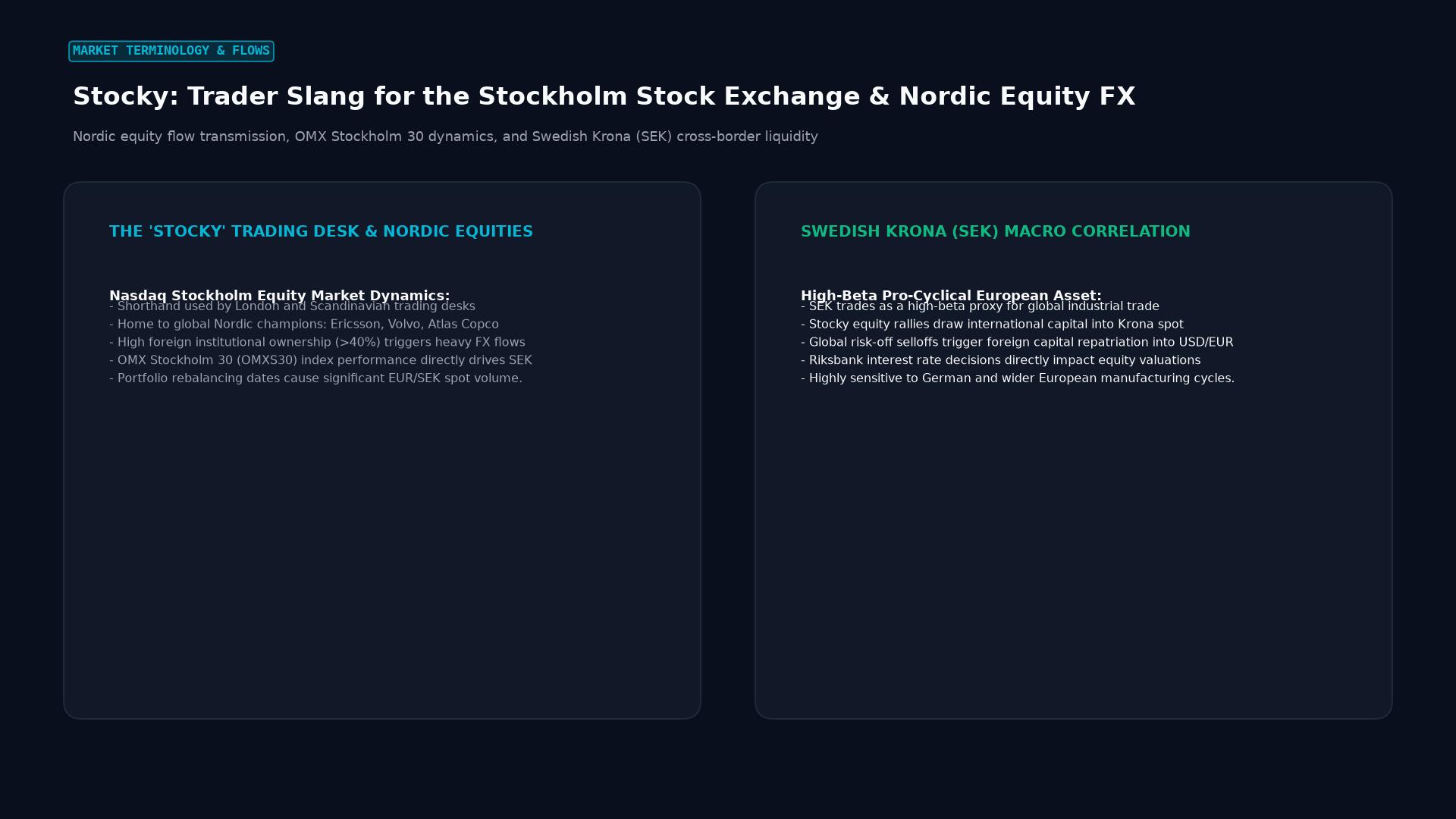 Figure: Nordic equity flow transmission, OMX Stockholm 30 dynamics, and Swedish Krona (SEK) cross-border liquidity
Macroeconomic Profile of the Swedish Krona
The Swedish Krona is issued and managed by Sveriges Riksbank, founded in 1668 and universally recognized as the oldest central bank in the world.
The valuation of Stocky is governed by four foundational economic pillars:
- High-Beta Export Sensitivity: Sweden possesses a relatively small domestic consumer base but hosts some of the world’s most competitive multinational industrial exporters (e.g., Volvo, Atlas Copco, Ericsson, Electrolux, and AstraZeneca). Because exports account for over 45% of Swedish GDP, Stocky acts as a high-beta proxy for global manufacturing demand and European economic growth.
- Pro-Cyclical Risk Sentiment: Stocky is intensely sensitive to global risk appetite. In “risk-on” environments characterized by synchronous global economic expansion, foreign capital floods into Swedish industrial equities, causing Stocky to appreciate sharply. In “risk-off” crises or geopolitical flare-ups, international investors flee Stocky in favor of liquid safe havens (USD, CHF, Gold).
- The Eurozone Orbit: The European Union is Sweden’s dominant trading partner. Consequently, the currency cross EUR/SEK is the most heavily traded Stocky instrument in wholesale markets, with the pair closely tracking interest rate differentials between the Riksbank and the European Central Bank (ECB).
- Domestic Real Estate and Household Debt: Swedish households maintain high levels of variable-rate mortgage debt. When the Riksbank raises policy rates, the transmission into domestic consumption is exceptionally rapid, creating acute structural sensitivity in macroeconomic forecasting.
Stocky vs. Nokkie vs. Swissy: The European Crosses
| Currency Nickname | Sovereign Currency | Central Bank | Dominant Macroeconomic Driver | Safe-Haven Status |
|---|---|---|---|---|
| “Stocky” | Swedish Krona (SEK) | Sveriges Riksbank | Global manufacturing cycles, European industrial demand | No (High-beta pro-cyclical risk asset) |
| “Nokkie” | Norwegian Krone (NOK) | Norges Bank | Brent crude oil and natural gas prices, Sovereign Wealth Fund | No (Petrocurrency; commodity dependent) |
| “Swissy” | Swiss Franc (CHF) | Swiss National Bank (SNB) | Current account surplus, geopolitical neutrality, banking stability | Yes (Premier global safe haven) |
Real-World Institutional Case Study: The Riksbank’s Negative Interest Rate Era (2015–2019)
In February 2015, facing persistent sub-zero inflation and aggressive quantitative easing by the neighboring European Central Bank, the Riksbank shocked international markets by cutting its benchmark repo rate below zero to -0.10%, eventually deepening to -0.50%.
       EUR/SEK SURGE DURING RIKSBANK NEGATIVE RATE POLICY

 11.00 ──┐                                         ┌─── EUR/SEK Hits 10.90 (2019)
         │                                        /│
 10.50 ──┼                                _..-''`/ │
         │                         _.-''`          │
 10.00 ──┼                  _.-''`                 │
         │           _..-''`                       │
  9.10 ──┼─-.._.-''` (2015: Negative Rate Onset)   │
         └─────────────────────────────────────────┴───────────────────
2015 2016 2017 2018 2019 2020- The Objective: Riksbank Governor Stefan Ingves deliberately engineered a weaker exchange rate (“cheap Stocky”) to import inflation and maintain Swedish export competitiveness.
- The Carry Drain: With Swedish sovereign bond yields submerged in deep negative territory, international macro hedge funds aggressively used Stocky as a funding currency for global carry trades, borrowing cheap Krona to invest in high-yielding U.S. Dollars and emerging market debt.
- The Depreciation: Stocky experienced prolonged structural depreciation, with EUR/SEK skyrocketing from 9.10 to nearly 11.00, while USD/SEK surged from 6.80 to above 10.00.
- The Exit: In December 2019, after concluding that prolonged negative rates distorted the housing market and damaged commercial bank profitability, the Riksbank became the first global central bank to end its negative interest rate experiment, raising the repo rate back to 0.00%.
Institutional Trading Nuances: Liquidity and Spreads
While Stocky ranks within the top 10 to 15 most traded currencies globally, professional market participants approach it with specialized execution rules:
- Wider Bid-Ask Spreads: In interbank EBS and Refinitiv books, USD/SEK and EUR/SEK typically trade with spreads of 1.5 to 3.0 pips, noticeably wider than the 0.1 to 0.3 pip spreads seen in EUR/USD.
- Session Liquidity Drop-Off: Liquidity in Stocky peaks during European trading hours (08:00 to 16:00 GMT). In late New York and Asian trading sessions, market depth thins dramatically, rendering Stocky prone to erratic, outsized price swings during sudden headline events.
- Nordic Cross Hedging: Multinational corporations operating across Scandinavia frequently trade the NOK/SEK cross, hedging the macroeconomic divergence between Norwegian energy revenues and Swedish industrial manufacturing.
Frequently Asked Questions
Does Sweden use the Euro as its official currency?
No. Although Sweden joined the European Union in 1995, it held a national referendum in September 2003 in which Swedish citizens voted decisively (55.9% to 42.0%) to reject adopting the Euro. Sweden continues to preserve full monetary sovereignty through the Swedish Krona and the Riksbank.
Why does Stocky suffer during global stock market downturns?
Stocky is a “risk-on, high-beta” currency. Because Sweden is heavily dependent on global trade and industrial equipment sales, any slowdown in global commerce directly damages Swedish corporate profits. When global equities sell off, institutional investors systematically liquidate high-beta currencies like SEK and reallocate into safe havens.
What is the standard lot size when trading USD/SEK?
Like all standard foreign exchange pairs, one standard lot of USD/SEK represents 100,000 units of the base currency ($100,000 USD). Because the exchange rate trades around 10.00 to 11.00 Krona per Dollar, one pip (0.0001) in USD/SEK is equivalent to approximately $1.00 USD per standard lot, compared to $10.00 per pip in EUR/USD.
Ready to trade forex?
Open a free demo account with a regulated broker. Practice with virtual funds before risking real money.