Hard Currency
A hard currency is a globally recognized, highly liquid national currency issued by a politically stable and economically sound nation, widely accepted as a store of value, medium of international commerce, and official foreign exchange reserve asset.
What Is a Hard Currency?
A hard currency—frequently termed a strong or convertible currency—is any national currency that commands widespread global confidence. Issued by governments with established track records of political stability, rigorous institutional legal protections, and transparent financial systems, hard currencies serve as reliable stores of purchasing power in international commerce.
In foreign exchange markets, a hard currency trades with deep institutional liquidity and minimal bid-ask spreads. Crucially, hard currencies are universally accepted for global debt settlement, commodity invoicing (such as crude oil, precious metals, and agricultural foodstuffs), and sovereign central bank reserve allocations.
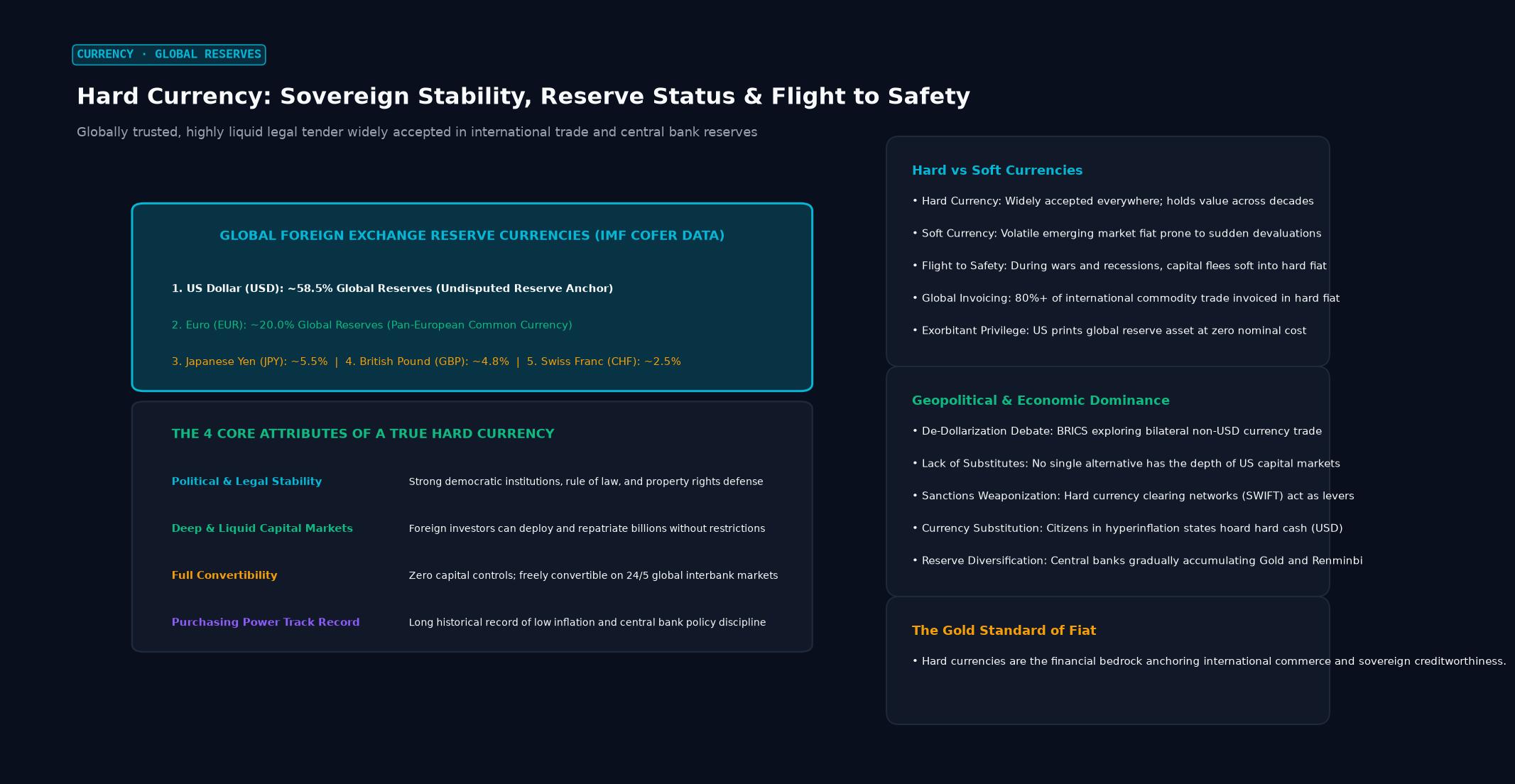 Figure: Globally trusted, highly liquid legal tender widely accepted in international trade and central bank reserves

The World’s Primary Hard Currencies
While hundreds of sovereign currencies circulate globally, only an elite tier qualifies as true international hard currencies:
| Currency | Code | Primary Global Role | Key Institutional Strength |
|---|---|---|---|
| US Dollar | USD | Dominant global reserve and trade invoice currency (~58% of global FX reserves). | World’s deepest, most liquid sovereign bond market (US Treasuries). |
| Euro | EUR | Second-largest reserve currency (~20% of global FX reserves). | Multi-nation economic union with massive export balance. |
| Japanese Yen | JPY | Premier Asian funding and global carry trade vehicle. | Massive net foreign asset creditor status and ultra-deep government debt market. |
| British Pound | GBP | Historic international commercial banking and settlement currency. | Global financial hub status centered around the City of London. |
| Swiss Franc | CHF | Ultimate global safe-haven capital refuge. | Strict monetary discipline, neutral geopolitical stance, and zero historical defaults. |
| Canadian Dollar | CAD | Major commodity-backed hard currency. | Stable democracy, extensive natural resource exports, and AAA credit rating. |
| Australian Dollar | AUD | Primary liquidity proxy for Asia-Pacific trade and commodity growth. | Proximity to Asian supply chains and transparent floating exchange rate. |
Hard Currency vs. Soft Currency
The opposing counterpart to a hard currency is a soft currency (or weak currency). Soft currencies are issued by developing or politically volatile nations whose currencies suffer from chronic inflation, sudden devaluations, and limited international liquidity:
| Dimension | Hard Currency | Soft Currency |
|---|---|---|
| Global Convertibility | Unrestricted; exchanged globally 24 hours a day | Heavily restricted by government exchange controls |
| Store of Value | High; preserves purchasing power across decades | Low; rapidly degraded by domestic price inflation |
| International Usage | Invoiced in cross-border trade and sovereign debt | Exclusively circulated within domestic borders |
| Exchange Rate Behavior | Market-determined float; orderly price discovery | Susceptible to sudden, catastrophic devaluations |
| Central Bank Holding | Held extensively in global foreign exchange reserves | Virtually absent from foreign reserve portfolios |
The “Original Sin” of Emerging Markets
In international macroeconomics, economists Barry Eichengreen and Ricardo Hausmann coined the term “Original Sin” to describe a structural vulnerability faced by developing nations: the inability of emerging market governments and corporations to borrow abroad in their own domestic currencies.
Because international lenders distrust soft currencies due to inflation and devaluation risks, developing countries are forced to issue sovereign debt denominated in hard currencies (predominantly US Dollars or Euros).
The Original Sin Trap
------------------------------------------------------------------------
1. Emerging market government issues $10B in USD-denominated sovereign bonds.
2. Tax revenues are collected entirely in the domestic soft currency.
3. Global risk-off panic causes the domestic soft currency to crash by 40%.
4. The local cost of servicing the dollar debt inflates by 40% overnight.
5. National fiscal crisis unfolds, culminating in default or IMF bailout.
This structural mismatch explains why emerging economies are hyper-sensitive to Federal Reserve rate hikes: higher US interest rates strengthen the US Dollar, immediately escalating external debt-servicing burdens across developing nations.
Key Takeaways
- A hard currency is a globally respected, highly liquid national currency issued by an economically and politically stable country.
- The US Dollar, Euro, Japanese Yen, British Pound, and Swiss Franc form the core group of international hard currencies.
- Hard currencies are characterized by full convertibility, absence of capital controls, and transparent legal structures.
- Soft currencies suffer from high domestic inflation, illiquidity, and periodic central bank devaluations.
- Due to “Original Sin,” developing nations must borrow in hard currencies, exposing them to devastating currency mismatches during global downturns.
Frequently Asked Questions
Is the Chinese Renminbi (Yuan) considered a hard currency?
The Chinese Yuan (CNY) is an IMF Special Drawing Rights (SDR) basket component, but it is not universally considered a full hard currency. China enforces strict capital controls, limits cross-border capital repatriation, and maintains a managed float rather than a freely convertible market pricing mechanism.
Why is the Swiss Franc viewed as the hardest currency in the world?
The Swiss Franc (CHF) has historically been backed by high national gold reserves, near-zero national debt, extreme political neutrality, and an independent central bank (SNB) that prioritizes price stability above all other mandates, making it the premier global safe-haven currency during international crises.
What happens when a country with a soft currency dollarizes?
When a nation’s soft currency collapses into hyperinflation (as occurred in Ecuador in 2000 or Zimbabwe in 2009), the government may abandon its domestic currency entirely and adopt a foreign hard currency (such as the US Dollar) as official legal tender, immediately restoring price stability at the expense of forfeiting domestic monetary policy.
Ready to trade forex?
Open a free demo account with a regulated broker. Practice with virtual funds before risking real money.