Systematic Risk
The fundamental, non-diversifiable risk inherent to the entire financial system or aggregate market, driven by broad macroeconomic forces such as interest rate shocks, inflation, currency crises, and geopolitical events; quantified by Beta.
What Is Systematic Risk?
Systematic risk (universally referred to in finance as market risk, un-diversifiable risk, or aggregate risk) is the vulnerability inherent to the entire financial system or broad market economy. It stems from external macroeconomic and geopolitical catalysts that affect all asset classes, corporations, and securities simultaneously.
Under Modern Portfolio Theory (MPT) developed by Nobel laureate Harry Markowitz, total portfolio risk is divided into two distinct components:
- Unsystematic Risk (Idiosyncratic Risk): Company- or industry-specific risks (e.g., an executive fraud scandal, a product recall, or a localized factory strike). Unsystematic risk can be completely diversified away by holding a broad basket of 30 to 50 uncorrelated assets.
- Systematic Risk (Market Risk): Pervasive macroeconomic factors (e.g., a global pandemic, sudden central bank monetary tightening, runaway inflation, or systemic war). Systematic risk cannot be eliminated through diversification alone, establishing an irreducible baseline of volatility for every market participant.
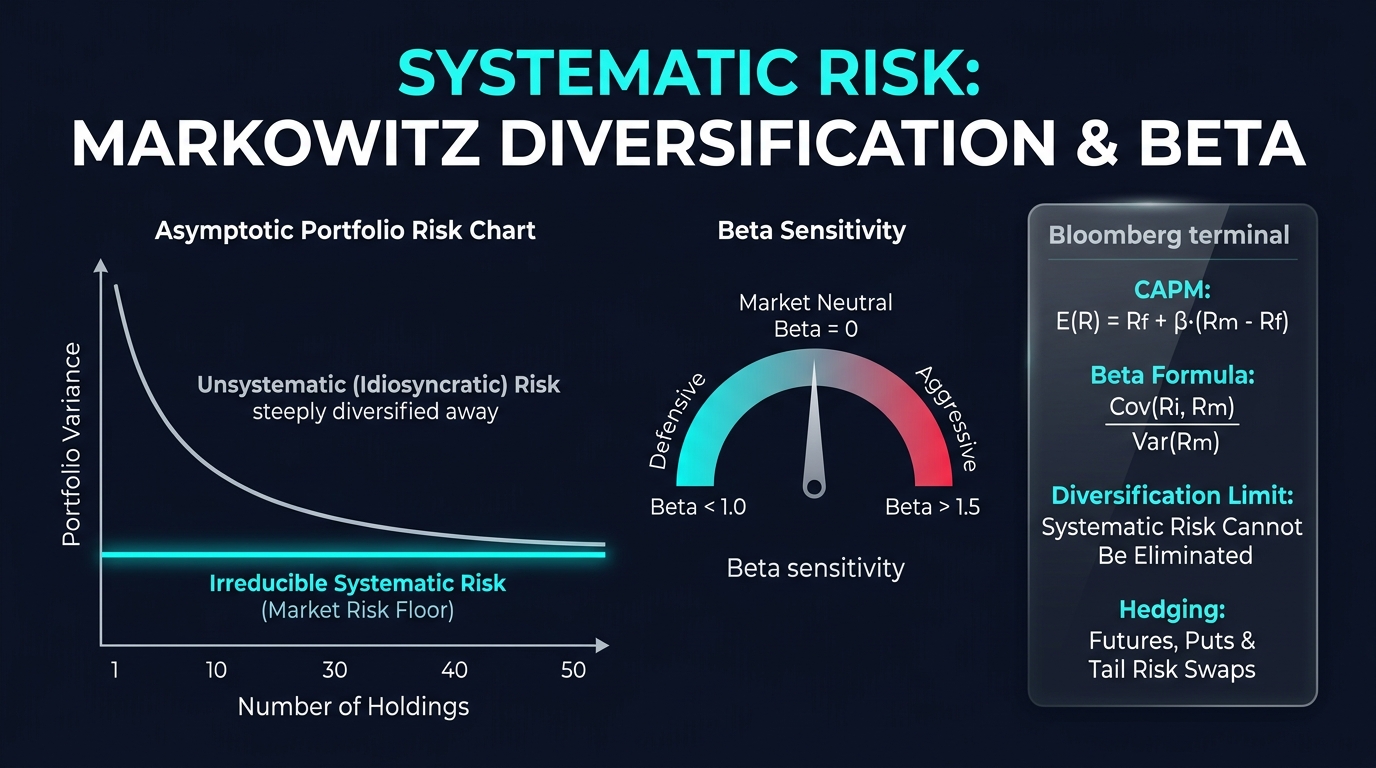
                  TOTAL RISK DIVERSIFICATION DECOMPOSITION

 Portfolio Variance (Risk)
   │
   │  \
   │   \  UNSYSTEMATIC RISK (Idiosyncratic / Specific)
   │    \  [ Diversified away as portfolio expands ]
   │     \
   │      '--...__
   │              `''---._____________________________________________________
   │  ═════════════════════════════════════════════════════════════════════════
   │  SYSTEMATIC RISK (Market Risk / Beta)
   │  [ IRREDUCIBLE BASELINE: Cannot be eliminated by adding more stocks ]
   │  ═════════════════════════════════════════════════════════════════════════
   └────────────────────────────────────────────────────────────────────────►
     1       5       10       20       30       40       50+ (Number of Holdings)
The Mathematical Quantification of Systematic Risk: Beta ($\beta$)
In quantitative finance and the Capital Asset Pricing Model (CAPM), an individual asset’s or portfolio’s sensitivity to systematic market shocks is measured by Beta ($\beta$).
Beta calculates the covariance of an asset’s returns relative to the variance of the overall market benchmark:
$$\beta_i = \frac{\text{Cov}(R_i, ; R_m)}{\text{Var}(R_m)} = \rho_{i, m} \cdot \frac{\sigma_i}{\sigma_m}$$
Where:
- $R_i$: Return of the individual asset or portfolio.
- $R_m$: Return of the broad market index (e.g., S&P 500 or MSCI World).
- $\rho_{i, m}$: Correlation coefficient between the asset and the market.
- $\sigma_i / \sigma_m$: Standard deviations (volatility) of the asset and market.
Interpreting Beta Values
- $\beta = 1.0$: The asset mirrors market volatility precisely (e.g., an S&P 500 index fund).
- $\beta > 1.0$ (High-Beta Asset): Amplifies systematic market movements. A tech stock or high-beta currency (such as the Australian Dollar) with $\beta = 1.5$ is expected to rise by 15% in a 10% bull market, but plunge by 15% when the market drops 10%.
- $\beta < 1.0$ (Low-Beta Defensive Asset): Dampens market shocks (e.g., healthcare utilities or consumer staples with $\beta = 0.5$).
- $\beta \le 0$ (Negative Beta): Moves inversely to the broad market (e.g., Gold or long volatility instruments).
Systematic Risk vs. Systemic Risk vs. Unsystematic Risk
| Risk Category | Scope of Impact | Can It Be Diversified Away? | Primary Measurement | Core Examples |
|---|---|---|---|---|
| Systematic Risk | The entire broad financial market or macro economy | No (Present across all financial assets) | Beta ($\beta$) | Aggressive interest rate hikes, global inflation shocks, stagflation |
| Unsystematic Risk | A single company, industry, or specific issuer | Yes (Eliminated by multi-asset diversification) | R-squared ($R^2$), Tracking Error | Boeing manufacturing defects, regional airline pilot strike |
| Systemic Risk | The collapse of the financial plumbing and institutional clearing | No (Causes domino collapse of counterparty networks) | CoVaR, Financial Stress Index | 2008 Lehman Brothers failure, 1974 Herstatt collapse |
Real-World Institutional Case Study: The March 2020 Global Liquidity Shock
The textbook manifestation of pure systematic risk unfolded across global capital markets in March 2020 during the initial outbreak of the COVID-19 pandemic:
       MARCH 2020 LIQUIDITY CRUNCH: CORRELATIONS CONVERGE TO 1.0

 Asset Performance (March 9 - March 23, 2020):
 - S&P 500 Equities:            Plunged -34% in 22 trading sessions
 - WTI Crude Oil:               Collapsed from $45 to below $20/barrel
 - High-Yield Corporate Debt:   Plunged -20% as credit spreads exploded
 - Traditional Safe Havens:     Gold (XAU) temporarily plunged -12%
                                30-Year U.S. Treasuries sold off sharply
 ─────────────────────────────────────────────────────────────────────────────
 Systemic Reality:
 In severe systematic panics, standard diversification fails completely.
 All asset correlations mathematically converge toward 1.0 as institutional
 market participants are hit with margin calls and liquidate everything for Cash.
During this two-week window, conventional multi-asset portfolios (including traditional 60/40 stock-bond models and risk-parity funds) suffered catastrophic, synchronized drawdowns. The crisis was halted only when the Federal Reserve stepped in with unprecedented emergency monetary facilities, demonstrating that systematic crises can only be arrested by macro sovereign interventions.
How Institutional Desks Hedge Systematic Risk
Because systematic risk cannot be resolved by merely holding more assets, institutional asset managers deploy specialized structural hedging mechanisms:
- Shorting Equity Index and Interest Rate Futures: A portfolio manager holding a $100 million equity portfolio sells E-mini S&P 500 futures contracts. If a systematic macro crisis hits, the cash gains on the short futures exactly offset the mark-to-market losses on the equity holdings.
- Options Collars and Tail-Risk Puts: Buying out-of-the-money put options on broad market indices (e.g., SPX or VIX call options) establishes an absolute floor on portfolio value.
- Macro Cross-Currency Hedges: Holding high-carry emerging market investments while simultaneously buying long Swiss Franc (CHF) or U.S. Dollar (USD) hedges protects against global risk-off contagion.
- Dynamic Cash Allocation: In periods where macroeconomic quantitative models detect surging systematic stress, institutional risk officers raise cash allocations to 30% to 50%, stepping aside until stability returns.
Frequently Asked Questions
Can an investor completely avoid systematic risk?
No investor participating in public capital markets can completely avoid systematic risk. Even if an investor shifts 100% of their capital into cash or Treasury bills, they remain exposed to systematic purchasing power risk (inflation risk) and sovereign currency debasement. Systematic risk is the permanent price of participating in the global financial economy.
Why does Modern Portfolio Theory argue that investors are only rewarded for bearing systematic risk?
Under MPT, financial markets will not pay a risk premium for unsystematic risk because any intelligent investor can eliminate it for free through basic portfolio diversification. Therefore, the expected return of an asset above the risk-free rate is determined solely by its exposure to systematic risk (Beta).
What is the difference between systematic risk and systemic risk?
- Systematic Risk: The normal, continuous macro risk inherent to market cycles, interest rate changes, and economic recessions that affects all assets.
- Systemic Risk: The catastrophic risk that a failure within a major financial institution or payment infrastructure (e.g., a Lehman Brothers bankruptcy or interbank clearing gridlock) will trigger a chain-reaction collapse of the entire international banking system.
Ready to trade forex?
Open a free demo account with a regulated broker. Practice with virtual funds before risking real money.