Market Risk
Market risk—also known as systematic or undiversifiable risk—is the risk of financial loss resulting from adverse fluctuations in broad market prices, including foreign exchange rates, interest rates, equity indices, and commodity valuations.
What Is Market Risk?
In financial economics and banking supervision, market risk represents the potential for an investor, financial institution, or corporate enterprise to incur balance sheet losses caused by changes in the aggregate market prices of financial assets. Unlike idiosyncratic or firm-specific risk—which can be neutralized through basic asset diversification—market risk affects entire asset classes simultaneously and is inherent to participating in open capital markets.
Under international regulatory frameworks established by the Basel Committee on Banking Supervision (Basel III / Fundamental Review of the Trading Book - FRTB), market risk is partitioned into four primary risk classes:
- Foreign Exchange Risk: Losses caused by adverse currency rate swings.
- Interest Rate Risk: Losses caused by changes in benchmark yield curves and bond prices.
- Equity Risk: Losses caused by broad declines in stock market indices.
- Commodity Risk: Losses caused by price volatility in energy, metals, and agricultural goods.
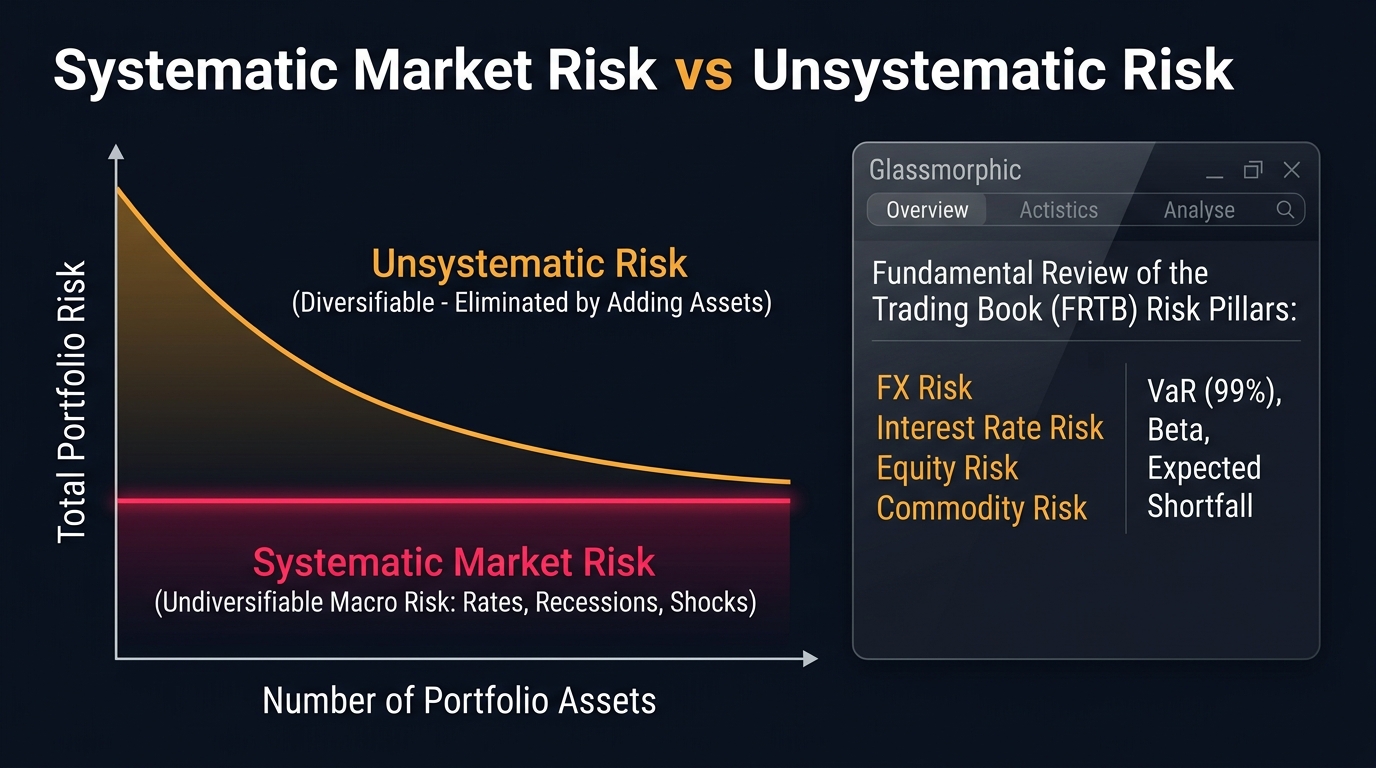
+-------------------------------------------------------------------------+
|                  SYSTEMATIC MARKET RISK VS. DIVERSIFIABLE RISK          |
+-------------------------------------------------------------------------+
|   Portfolio Risk                                                        |
|                                                                         |
|   | \                                                                   |
|   |  \   UNSYSTEMATIC RISK (Idiosyncratic / Company-Specific)           |
|   |   \  (Eliminated by adding diverse assets to portfolio)             |
|   |    \                                                                |
|   |-----\-----------------------------------------------------------    |
|   |      \                                                              |
|   |       +=========================================================    |
|   |                 SYSTEMATIC MARKET RISK (Undiversifiable)            |
|   |       (Macro factors, interest rates, global recessions, wars)      |
|   |       (Can ONLY be hedged via derivatives or cash allocation)       |
|   +-----------------------------------------------------------------    |
|   0                        Number of Assets In Portfolio                |
+-------------------------------------------------------------------------+
Key Takeaways
- Undiversifiable Nature: Market risk represents the inescapable volatility of the financial system; spreading capital across 500 stocks still leaves you exposed to a general market crash.
- The FRTB Regulatory Standard: Under the Fundamental Review of the Trading Book (FRTB), global banks must hold dedicated regulatory capital buffers against both Expected Shortfall (ES) and default risk in their trading books.
- Parametric Measurement via VaR: Market risk is predominantly quantified using Value at Risk (VaR) and Expected Shortfall (CVaR) to project maximum expected losses within specific statistical confidence intervals (e.g., 99% 10-day VaR).
- Hedging Requirement: Because market risk cannot be eliminated through diversification alone, institutions mitigate it using derivative overlays—such as interest rate swaps, currency forwards, index put options, and futures contracts.
- Asset Sensitivity Metrics: Market risk exposure is measured using specialized sensitivity coefficients: Beta ($\beta$) for equities, Duration and DV01 for interest rates, and Delta ($\Delta$) for currency and options books.
Comparative Taxonomy: The Core Financial Risk Pillars
Financial risk managers partition institutional exposure into four distinct risk classifications.
| Risk Category | Primary Cause | Primary Mitigation Technique | Key Regulatory Metric |
|---|---|---|---|
| Market Risk | Broad market price changes (FX, yields, equities) | Derivatives hedging, VaR limits, cash buffers | Expected Shortfall (ES) / VaR |
| Credit Risk | Counterparty default or credit rating downgrade | Collateral (CSAs), netting, credit default swaps | Expected Credit Loss (IFRS 9) |
| Liquidity Risk | Inability to sell assets without massive price concessions | Liquidity Coverage Ratio (LCR), cash reserves | Net Stable Funding Ratio (NSFR) |
| Operational Risk | Internal system failures, fraud, human errors, cyberattacks | Internal controls, disaster recovery, redundancy | Advanced Measurement Approach |
Quantitative Measurement: VaR and Expected Shortfall
Institutional banks utilize mathematical models to monitor trading book market risk continuously:
1. Value at Risk (VaR)
VaR answers the question: “What is the maximum dollar amount we could lose over a time horizon $T$ at a confidence level $\alpha$ under normal market conditions?”
$$\text{VaR}_{\alpha} = - \inf { l \in \mathbb{R} : P(L > l) \le 1 - \alpha }$$
Under the parametric normal assumption:
$$\text{VaR} = Z_{\alpha} \cdot \sigma_p \cdot W$$
Where $Z_{\alpha}$ is the normal distribution critical value, $\sigma_p$ is portfolio standard deviation, and $W$ is total portfolio value.
2. Expected Shortfall (ES / Conditional VaR)
Because VaR fails to capture “tail risk” (the magnitude of losses beyond the VaR threshold), modern Basel regulations mandate Expected Shortfall, which calculates the expected loss given that the VaR threshold has been breached:
$$\text{ES}{\alpha} = \mathbb{E}[L \mid L > \text{VaR}{\alpha}]$$
Real-World Case Study: The 2022 Transatlantic Inflation and Rate Shock
In 2022, global capital markets suffered one of the most violent combined market risk events in modern financial history.
- The Catalyst: Surging post-pandemic demand and the Ukraine conflict drove global inflation past 9% to 10% in the U.S., UK, and Europe.
- The Interest Rate Shock: To fight inflation, the Federal Reserve hiked interest rates by 425 basis points in nine months—its fastest tightening cycle since the 1980s.
- The Correlation Breakdown: Historically, traditional multi-asset portfolios relied on the 60/40 Equity/Bond allocation, assuming sovereign bonds would rise when equities fell. In 2022, surging interest rates crashed both stock valuations and long-duration bond prices simultaneously.
- Forex Market Turmoil: S&P 500 equities collapsed by nearly 20%, while long-term U.S. Treasuries suffered a historic 30% drawdown. Concurrently, the U.S. Dollar surged to 20-year highs, inflicting severe currency market risk on international multinationals holding foreign-currency receivables.
- Outcome: Firms that managed market risk solely through naive multi-asset diversification suffered devastating double-digit losses, while institutions utilizing dynamic derivative hedges (interest rate swaps and currency forwards) preserved capital.
Market Risk Mitigation Strategies
- Portfolio Hedging with Derivatives: Executing short index futures or purchasing out-of-the-money put options to establish a hard floor under portfolio valuations.
- Asset-Liability Matching (ALM): Ensuring corporate debt maturities and currency denominations match the duration and currency profile of incoming operational cash flows.
- Dynamic Stress Testing: Running severe hypothetical historical simulations—such as the 1987 Black Monday crash, the 2008 Lehman collapse, and the 2020 pandemic freeze—to uncover hidden portfolio correlations before real-world crises occur.
Frequently Asked Questions (FAQ)
Can an individual retail trader eliminate market risk?
No. Every market participant is exposed to market risk whenever they hold an open position. However, retail traders can control their exposure to market risk by enforcing strict position sizing (e.g., risking no more than 1% of capital per trade), utilizing protective stop-losses, and holding a portion of their net worth in risk-free cash.
What is the difference between systematic risk and unsystematic risk?
Unsystematic risk is company-specific (such as a factory fire or CEO resignation) and can be completely eliminated by holding a diversified portfolio of 30 or more uncorrelated assets. Systematic (market) risk is macroeconomic (such as interest rate hikes, war, or global recessions) and affects all assets across the entire market simultaneously.
How does the Federal Reserve affect market risk?
The Federal Reserve governs the benchmark cost of borrowing in the world’s primary reserve currency (USD). When the Fed alters interest rates or conducts Quantitative Easing / Tightening, it shifts global discount rates, directly impacting the valuations of all global equities, bonds, commodities, and currency pairs.
Ready to trade forex?
Open a free demo account with a regulated broker. Practice with virtual funds before risking real money.