UAH
The ISO 4217 currency code for the Ukrainian Hryvnia, the official legal tender of Ukraine, issued and managed by the National Bank of Ukraine.
UAH (Ukrainian Hryvnia)
The Ukrainian Hryvnia (ISO code: UAH, symbol: ₴) is the official sovereign currency of Ukraine. Subdivided into 100 kopiikas, the hryvnia was formally introduced on September 2, 1996, replacing the transitional post-Soviet karbovanets at an exchange ratio of 1 hryvnia = 100,000 karbovantsiv. The currency takes its historic name from the medieval Kievan Rus’ silver bullion ingots (grivna). It is issued, regulated, and defended by the National Bank of Ukraine (NBU, or Natsionalnyi Bank Ukrainy).
In global macroeconomics and foreign exchange analysis, the Ukrainian hryvnia presents a compelling study of a post-Soviet transition currency transformed by geopolitical conflict and emergency wartime economic administration. Following the full-scale Russian invasion in February 2022, the NBU transitioned from its pre-war inflation-targeting float to an emergency fixed peg, backed by stringent capital controls and multi-billion-dollar international financial assistance, before methodically shifting to a “managed exchange rate flexibility” regime in October 2023.
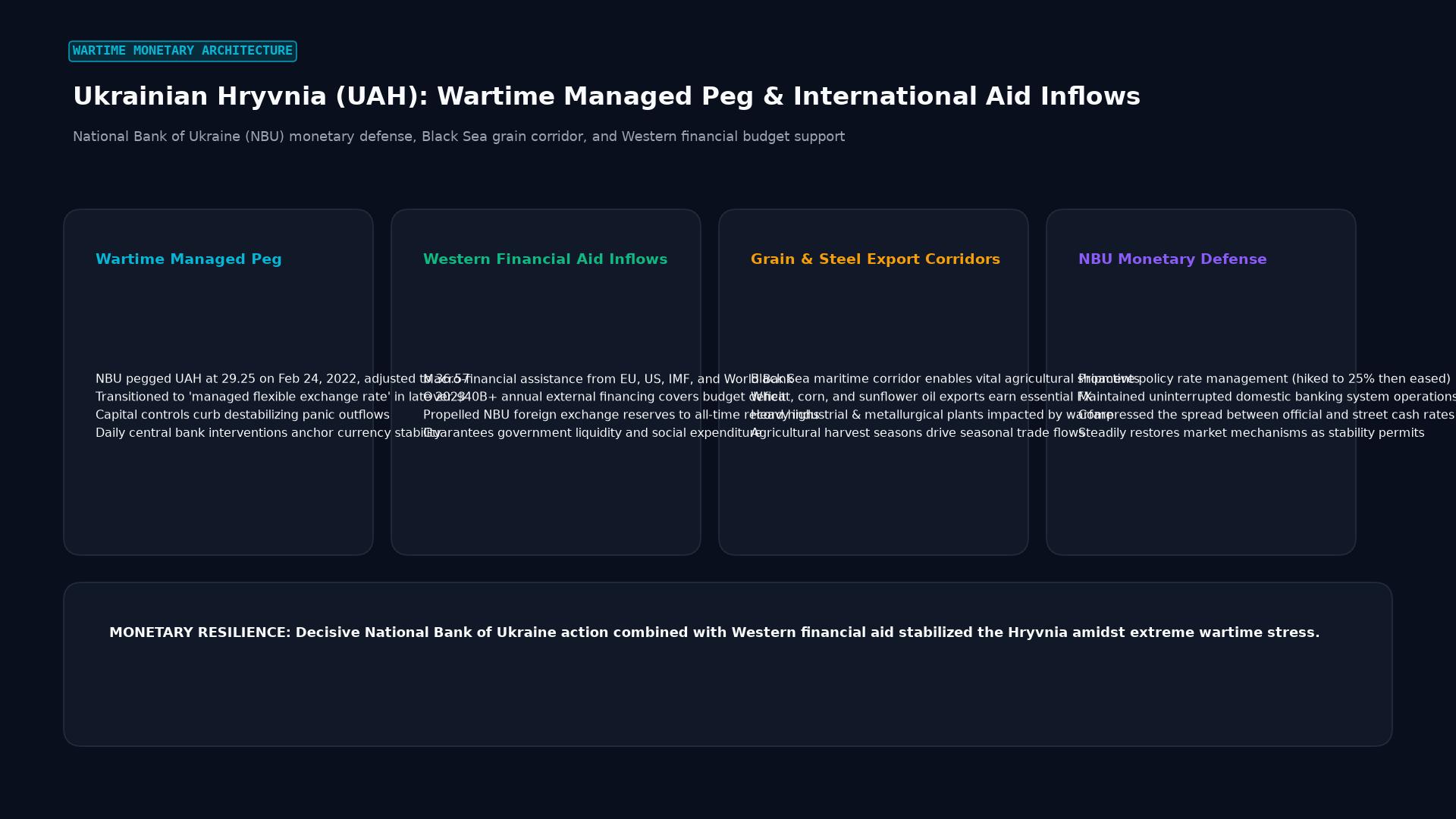 Figure: National Bank of Ukraine (NBU) monetary defense, Black Sea grain corridor, and Western financial budget support
Historical Context and Currency Evolution
The modern monetary trajectory of Ukraine encompasses several distinct historical phases:
- The Post-Soviet Hyperinflation Era (1992–1996): Following the collapse of the USSR, Ukraine introduced the temporary karbovanets (also called kupon-karbovanets). Rampant fiscal deficits, monetary expansion, and deep economic restructuring caused hyperinflation, with price increases peaking at over 10,000% annually in 1993.
- The 1996 Monetary Reform: On September 2, 1996, under President Leonid Kuchma and NBU Governor Viktor Yushchenko, the state executed monetary reform. The hryvnia was introduced at 1 UAH = 100,000 karbovantsiv. The reform restored price stability and anchored the young market economy.
- The Era of Fixed Pegs and Devaluations (1998–2014):
- 1998 Russian Crisis: The hryvnia was devalued from roughly 2.0 to 5.0 UAH/USD.
- 2008 Global Financial Crisis: The peg shifted from 5.05 to approximately 8.00 UAH/USD.
- 2014 Revolution of Dignity and War: Following the annexation of Crimea and conflict in Donbas, the NBU abandoned the unsustainable 8.00 peg. The currency adjusted to roughly 25–28 UAH/USD by 2015.
- Inflation Targeting and Floating Exchange Rate (2015–2021): The NBU modernized its institutional framework, adopting an orthodox inflation-targeting regime, floating exchange rate, and a transparent key policy interest rate (oblikova stavka), fostering a thriving domestic government bond (OVDP) market.
The Wartime Monetary Framework (2022–Present)
The full-scale invasion on February 24, 2022, required immediate, decisive central banking interventions to prevent banking system collapse, hyperinflation, and capital flight:
1. Emergency Fixed Peg (February 2022 – October 2023)
On the morning of February 24, 2022, the NBU suspended its floating regime and froze the official exchange rate at 29.25 UAH per 1 USD. This action anchored prices for military procurement, essential fuel, and medicine.
- Devaluation Adjustment (July 21, 2022): As trade balances widened and foreign inflation escalated, the NBU reset the official fixed peg by 25% to 36.57 UAH per 1 USD to enhance competitiveness and protect central bank reserves.
2. Transition to “Managed Exchange Rate Flexibility” (October 3, 2023)
Having rebuilt foreign currency reserves to historic highs exceeding $40 billion, the NBU ended the rigid 36.57 peg. It introduced managed flexibility:
- The official exchange rate is determined by transactions in the interbank foreign exchange market.
- The NBU acts as the primary market maker, selling foreign currency from official reserves to meet structural commercial deficits while absorbing volatility.
- The regime is designed to ensure the exchange rate acts as a shock absorber without allowing sharp swings that would destabilize public confidence.
+------------------------------------------------------------------------+
|             Chronology of Modern Ukrainian Exchange Regimes            |
+------------------------------------------------------------------------+
| Period          | Regime Type               | Benchmark Exchange Level |
| 1996 - 1998     | Semi-fixed crawling band  | ~1.80 to 2.20 UAH/USD    |
| 2000 - 2008     | De facto fixed dollar peg | Fixed at ~5.05 UAH/USD   |
| 2008 - 2014     | De facto fixed dollar peg | Fixed at ~8.00 UAH/USD   |
| 2015 - Feb 2022 | Floating / Inflation Target| Market: 24.00 - 28.50    |
| Feb - Jul 2022  | Emergency Wartime Peg     | Fixed at 29.25 UAH/USD   |
| Jul 2022 - Oct 23| Wartime Devalued Peg     | Fixed at 36.57 UAH/USD   |
| Oct 2023 - Pres.| Managed Flexibility       | NBU-smoothed interbank   |
+------------------------------------------------------------------------+
Macroeconomic Drivers and External Support Architecture
1. International Donor Financing
Ukraine’s wartime balance of payments is stabilized by international financial assistance from the European Union (Ukraine Facility), the United States, the International Monetary Fund (Extended Fund Facility, EFF), the World Bank, and G7 nations:
- Concessional budgetary grants and soft loans inject billions of dollars and euros directly into the NBU’s reserve accounts.
- These inflows offset massive civilian and defense imports, enabling the NBU to finance domestic foreign exchange market deficits.
2. Agricultural Exports and the Maritime Black Sea Corridor
Ukraine is traditionally known as the “breadbasket of Europe,” exporting vast quantities of corn, wheat, sunflower oil, and barley:
- The successful operation of the autonomous maritime Black Sea export corridor from ports in Odesa, Chornomorsk, and Pivdennyi has been vital for sustaining private sector export earnings and generating organic foreign currency inflows.
3. Damage to Heavy Metallurgy and Industrial Assets
Prior to 2022, iron ore and steel manufacturing (dominated by plants such as Azovstal and Illich Steel in Mariupol) provided over 25% of merchandise export revenues. The destruction and occupation of these facilities permanently altered Ukraine’s balance of payments, increasing reliance on agricultural and IT service exports.
       Wartime Balance of Payments Identity:

       CAB + FAB + External_Aid = Delta FX_Reserves

       Where:
       CAB = (Exports_Agri + Exports_IT) - (Imports_Defense + Imports_Energy + Imports_Consumer)
       FAB = Net Private Capital Inflows / Debt Service
       External_Aid = Sovereign G7 Grants, IMF Tranches, EU Concessional Loans
Capital Controls and Regulatory Infrastructure
The NBU maintains comprehensive foreign exchange restrictions under Resolution No. 18 (adopted February 24, 2022) to prevent unauthorized capital outflows:
- Cross-Border Transfer Bans: Cross-border capital transfers out of Ukraine by residents and businesses are prohibited, with exemptions strictly limited to state defense procurement, medical treatments abroad, international debt servicing to multilateral lenders, and vital commercial imports.
- Card Spending Limits: Ukrainian payment cards used abroad by refugees and displaced citizens are subject to monthly expenditure caps for merchant purchases and cash ATM withdrawals to restrict speculative currency arbitrage.
- Surrender and Repatriation Windows: Exporters must repatriate foreign currency revenues back into the Ukrainian banking system within legally mandated windows (e.g., 90 to 180 days) under penalty of daily fines.
Practical Case Study: Agricultural Conglomerate Currency Management
Consider Podillia Agro Holdings (PAH), an agricultural enterprise operating grain elevators and farming operations in Vinnytsia and Khmelnytskyi oblasts.
Scenario Parameters
- PAH ships 50,000 metric tons of milling wheat via the Odesa port terminal to a buyer in Egypt.
- Contract value: USD 11,000,000, payable via documentary letter of credit upon presentation of shipping bills of lading.
- Production costs (local labor, domestic grain transport, land lease fees to smallholders) are denominated entirely in UAH.
NBU Regulatory Compliance and Execution
- Repatriation Deadline: Under NBU wartime directives, PAH must ensure the $11,000,000 enters an authorized Ukrainian commercial bank account within 180 days of customs clearance.
- Interbank Conversion: PAH sells $8,000,000 on the Ukrainian interbank foreign exchange market (UAM) to settle local operating debts and pay land rents:
- On the transaction date, the market clearing rate under managed flexibility is 41.20 UAH/USD.
- Converted domestic liquidity: $$\text{Domestic Revenue} = $8,000,000 \times 41.20 = \text{UAH } 329,600,000$$
- Retained FX for Critical Inputs: PAH utilizes regulatory exemptions to retain the remaining $3,000,000 in a corporate foreign currency account to pay foreign European suppliers for imported seeds, plant protection chemicals, and diesel fuel, eliminating double conversion costs.
Frequently Asked Questions
What does the symbol ₴ signify?
The symbol ₴ is the official sign for the Ukrainian hryvnia, officially adopted by the National Bank of Ukraine in 2004. It features a cursive Ukrainian Cyrillic letter “г” (representing the initial sound of hryvnia), crossed by two horizontal parallel lines symbolizing stability, similar to the euro (€) and yen (¥) signs.
How does the National Bank of Ukraine defend the hryvnia during wartime?
The NBU defends the hryvnia through managed exchange rate flexibility supported by international financial aid. The central bank acts as the principal net seller of foreign exchange in the interbank market, meeting commercial import demand while enforcing strict capital controls on speculative outflows and cross-border dividend transfers.
Can international investors trade UAH on global retail forex brokers?
No. Deliverable Ukrainian hryvnia is not traded on international retail forex brokers. The offshore non-deliverable forward (NDF) market for USD/UAH in London and New York has very limited liquidity, utilized almost exclusively by specialized frontier debt funds and international development finance institutions.
Ready to trade forex?
Open a free demo account with a regulated broker. Practice with virtual funds before risking real money.