USD
The ISO 4217 currency code for the United States Dollar, the official legal tender of the United States of America and the preeminent global reserve and trade currency, issued by the Federal Reserve System.
USD (United States Dollar)
The United States Dollar (ISO code: USD, symbol: $), frequently referred to as the greenback, is the official national currency of the United States of America, its overseas territories, and several sovereign nations that have officially dollarized (including Ecuador, El Salvador, Panama, and the Federated States of Micronesia). Subdivided into 100 cents, the dollar is issued, regulated, and defended by the central monetary authority of the United States, the Federal Reserve System (the Fed), created under the Federal Reserve Act of 1913.
In global finance, international trade, and macroeconomics, the US dollar occupies an unrivaled position as the world’s primary anchor currency. According to the Bank for International Settlements (BIS) Triennial Central Bank Survey, the dollar is involved in roughly 88% of all foreign exchange transactions worldwide. In parallel, data from the International Monetary Fund (IMF) Currency Composition of Official Foreign Exchange Reserves (COFER) confirms that the dollar accounts for approximately 58% of allocated global foreign exchange reserves, making it the indispensable foundation of global capital clearing, cross-border debt issuance, commodity pricing, and central bank reserve management.
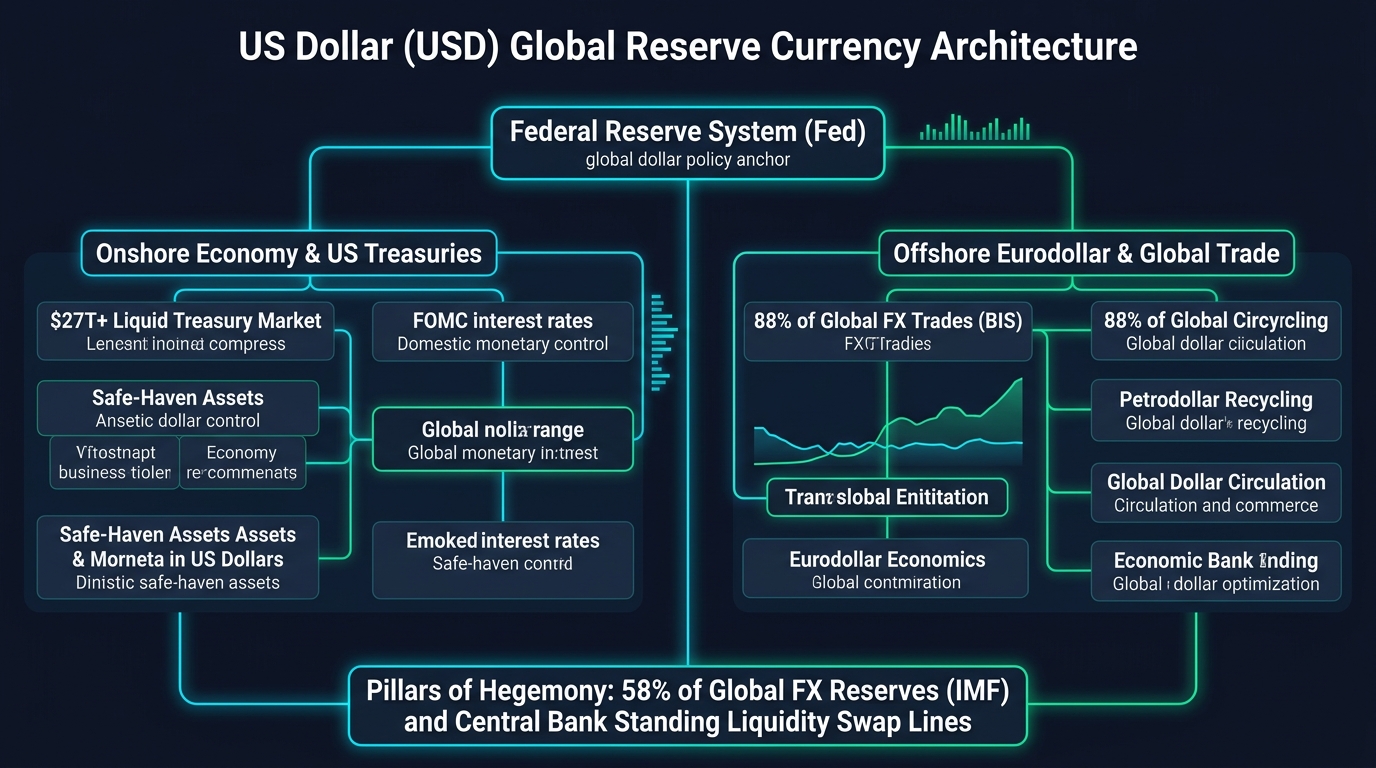
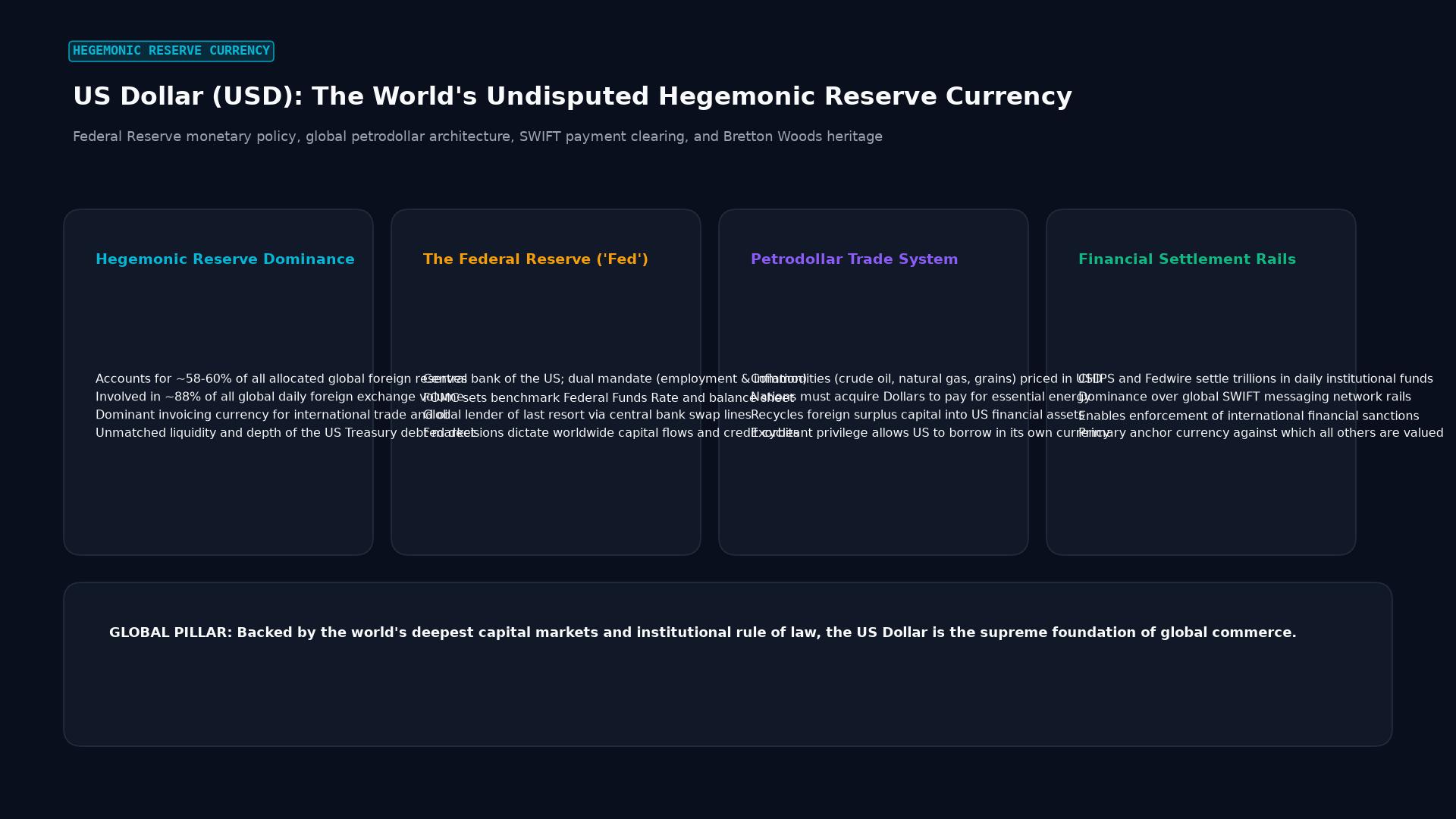 Figure: Federal Reserve monetary policy, global petrodollar architecture, SWIFT payment clearing, and Bretton Woods heritage
Historical Genesis: From Bretton Woods to Fiat Floating
The evolution of the US dollar into the supreme global reserve currency encompasses several defining monetary transitions:
1. The Coinage Act of 1792 and Early Bimetallism
The Coinage Act of April 2, 1792, established the United States Mint and created the US dollar, defining its value in terms of 371.25 grains of pure silver or 24.75 grains of pure gold (a fixed bimetallic ratio of 15 to 1). Following decades of regional banking and Civil War Greenback issuance, the Gold Standard Act of 1900 formally tied the dollar exclusively to gold.
2. The Bretton Woods Agreement (1944)
In July 1944, delegates from 44 Allied nations convened in Bretton Woods, New Hampshire, to structure the post-war international monetary architecture:
- The US dollar was established as the primary global reserve currency, formally pegged to physical gold at $35 per troy ounce.
- All other participant national currencies (including the British pound, French franc, and Deutsche Mark) were pegged to the US dollar within narrow 1% fluctuation bands.
- The International Monetary Fund (IMF) and the International Bank for Reconstruction and Development (World Bank) were established to oversee global balance-of-payments adjustments and post-war reconstruction.
3. The Triffin Dilemma and the Nixon Shock (1971)
Belgian-American economist Robert Triffin identified a fatal structural contradiction in the Bretton Woods architecture: to satisfy global trade expansion, the United States was forced to run persistent current account deficits, flooding the world with dollars. However, as foreign central bank dollar claims expanded, they inevitably surpassed the physical gold reserves stored at Fort Knox, making gold redemption impossible.
On August 15, 1971, facing heavy gold redemption requests from France and the United Kingdom, President Richard Nixon announced the suspension of dollar convertibility into gold. This event, known as the Nixon Shock, collapsed the Bretton Woods system and inaugurated the modern era of free-floating fiat currencies.
4. Petrodollar Recycling and the Plaza Accord (1970s–1980s)
In the mid-1970s, the US secured an agreement with Saudi Arabia and other OPEC nations to price crude oil exports exclusively in US dollars in exchange for military protection and security guarantees. Global oil importers were forced to maintain structural dollar reserves, cementing the petrodollar mechanism.
In September 1985, finance ministers and central bank governors of the G5 nations (US, Japan, West Germany, France, UK) signed the Plaza Accord at the Plaza Hotel in New York, executing coordinated central bank currency interventions to devalue an overvalued US dollar and reduce the expanding US trade deficit.
+------------------------------------------------------------------------+
|             Milestones in the US Dollar Global Monetary Role           |
+------------------------------------------------------------------------+
| Date / Period   | Historic Event            | Structural Outcome       |
| 1792            | Coinage Act of 1792       | Decimal dollar created   |
| 1913            | Federal Reserve Act       | Central bank established |
| July 1944       | Bretton Woods Conference  | Dollar pegged to Gold $35|
| August 1971     | Nixon Shock               | End of Gold Standard     |
| 1974 - 1975     | US-Saudi Petrodollar Pact | Crude priced strictly USD|
| September 1985  | Plaza Accord              | Coordinated USD deval.   |
| 2008 & 2020     | Global Financial Crises   | Fed FX Swap Lines opened |
+------------------------------------------------------------------------+
Monetary Policy Framework of the Federal Reserve
The Federal Reserve conducts monetary policy under a statutory dual mandate established by Congress: to pursue maximum employment and stable prices (defined as a 2.0% average inflation target over the long run).
Core Policy Instruments
- Federal Funds Target Rate: The primary policy benchmark. The Federal Open Market Committee (FOMC) sets an interest rate target range (e.g., 5.25% to 5.50%) within which commercial banks lend uncollateralized overnight reserves to one another.
- Interest on Reserve Balances (IORB): The interest rate paid by the Fed to depository institutions on eligible reserve balances, acting as the primary administrative tool to set a floor under short-term interbank money rates.
- Overnight Reverse Repo Facility (ON RRP): Provides a sub-floor for money market funds and government-sponsored enterprises, absorbing excess liquidity from non-bank financial intermediaries.
- Balance Sheet Expansion and Runoff (QE/QT): Quantitative Easing (purchasing US Treasuries and agency mortgage-backed securities to inject liquidity and lower long-term yields) and Quantitative Tightening (allowing maturing securities to roll off the balance sheet without reinvestment to contract systemic reserves).
Federal Reserve Floor System:

[ Upper Bound: Discount Window Lending Rate ]
                  ^
                  |
[ Middle Target: IORB Rate (Anchor Floor)   ]
                  ^
                  |  <-- Effective Federal Funds Rate (EFFR)
                  |
[ Lower Bound: Overnight Reverse Repo (ON RRP) ]
The Offshore Eurodollar Market and Fed Liquidity Swaps
A substantial portion of the global dollar ecosystem operates outside the physical borders and regulatory jurisdiction of the United States. This vast network of dollar-denominated deposits, loans, and bonds held in banks outside the US is known as the Eurodollar market (centered in London, Tokyo, Singapore, and Zurich).
The Global Dollar Shortage Risk
Because foreign corporations, sovereign governments, and multinational banks borrow heavily in US dollars, they face a structural currency mismatch:
- If a European or Japanese bank issues $10 billion in loans to Asian manufacturing conglomerates, it must continually refinance its short-term dollar borrowings in the offshore repo and FX swap markets.
- In periods of acute global crisis (such as the 2008 Lehman Brothers collapse or the March 2020 COVID-19 pandemic market liquidity freeze), global non-US banks face severe dollar shortages, causing the cross-currency basis to widen into deeply negative territory.
Central Bank Liquidity Swap Lines
To prevent global dollar funding panics from destabilizing the domestic US financial system, the Federal Reserve maintains standing and temporary bilateral currency swap lines with major foreign central banks:
- Standing Swap Line Network: Bank of England (BoE), European Central Bank (ECB), Bank of Japan (BoJ), Swiss National Bank (SNB), and Bank of Canada (BoC).
- The Fed provides US dollars to foreign central banks against their domestic currencies as collateral. The foreign central banks then auction these dollars to their domestic commercial banks, ensuring global dollar liquidity continues to circulate smoothly during global panics.
       Bilateral Central Bank Liquidity Swap Operation:

       Federal Reserve ---------------- [USD Cash] ---------------> Foreign Central Bank (e.g., ECB)
       Federal Reserve <------ [Local Collateral: EUR] <----------- Foreign Central Bank (e.g., ECB)
                                                                            |
                                                                            v Auctioned to
                                                                   Commercial European Banks
Dominance Across Global Reserve and Trade Metrics
Data from international regulatory organizations demonstrates the structural dominance of the US dollar over all competing fiat currencies:
| Global Metric | US Dollar (USD) | Euro (EUR) | Japanese Yen (JPY) | British Pound (GBP) | Chinese Renminbi (CNY) |
|---|---|---|---|---|---|
| Global FX Market Turnover (BIS 2022) | 88.5% | 30.5% | 16.7% | 12.9% | 7.0% |
| Global Allocated FX Reserves (IMF COFER) | 58.4% | 19.9% | 5.4% | 4.8% | 2.1% |
| Global Trade Invoicing (Excluding Intra-EU) | 84.0% | 16.0% | 4.0% | 2.5% | 3.5% |
| SWIFT International Payments | 47.0% | 22.5% | 3.8% | 6.8% | 4.6% |
| Global Cross-Border Bank Claims | 52.0% | 29.0% | 5.0% | 4.0% | 1.8% |
(Note: In BIS FX turnover calculations, total currency shares sum to 200% because every foreign exchange transaction involves two currencies.)
The De-Dollarization Debate: Geopolitics and Emerging Challenges
In recent years, geopolitical tensions, trade disputes, and Western sanctions (such as the freezing of over $300 billion in Russian sovereign central bank foreign exchange reserves following the 2022 invasion of Ukraine) have sparked debate regarding potential de-dollarization:
- Bilateral Local Currency Settlement: The BRICS bloc (Brazil, Russia, India, China, South Africa) and regional trading organizations have expanded bilateral trade settlements in local currencies (e.g., Russian oil sold to India in Indian rupees or UAE dirhams, and Sino-Russian bilateral trade settled in Chinese renminbi and Russian rubles).
- Structural Obstacles to Replacing the Dollar: Despite rising rhetoric, substituting the dollar as the global reserve anchor faces severe institutional hurdles:
- Depth of Capital Markets: The US Treasury market comprises over $27 trillion in ultra-liquid, transparent, legally secure debt instruments. Neither the Chinese renminbi (constrained by strict capital controls) nor the euro (lacking a single consolidated sovereign fiscal treasury bond) offers comparable liquidity and investor legal protections.
- Network Effects: The global financial plumbing (clearing systems, derivative documentation, trade invoicing contracts) possesses massive structural inertia. Switching currencies introduces significant friction and basis risk for multinational treasuries.
The US Dollar Index (DXY)
To track the general performance of the US dollar against a basket of its primary trading partners, currency traders and asset allocators rely on the US Dollar Index (DXY). Created in 1973 following the collapse of Bretton Woods, the DXY is a geometrically weighted basket composed of six currencies:
$$DXY = 50.14348112 \times (\text{EUR})^{-0.576} \times (\text{JPY})^{0.136} \times (\text{GBP})^{-0.119} \times (\text{CAD})^{0.091} \times (\text{SEK})^{0.042} \times (\text{CHF})^{0.036}$$
Because the euro represents a 57.6% weight in the calculation, the DXY functions in practical terms as an inverse proxy for EUR/USD performance.
Applied Trading Case Study: Federal Reserve Rate Cycle Transmission
To examine how US dollar macroeconomic decisions propagate through global financial markets, consider Global Alpha Macro Fund (GAMF), an institutional fund based in New York.
Macro Environment
- The FOMC initiates a tightening cycle, raising the federal funds target range by 500 basis points over a 16-month period to combat rising domestic inflation prints.
- Concurrently, the European Central Bank lags behind due to sluggish regional growth, and the Bank of Japan maintains its negative interest rate policy (NIRP) at -0.10%.
Cross-Asset Transmission Mechanism
- Widening Interest Rate Differentials: The yield on 2-year US Treasuries rises to 4.90%, while 2-year Japanese government bonds yield -0.05%. The US-Japan 2-year spread widens to nearly 500 basis points.
- Carry Trade Capital Flow: International institutional investors borrow cheaply in JPY and convert proceeds into USD to invest in risk-free US Treasury bills and commercial paper.
- FX Spot Movement: The massive demand for USD drives USD/JPY from 115.00 to over 155.00 (a dramatic appreciation of the dollar).
- Emerging Market Stress: Frontier and emerging market economies that borrowed heavily in USD-denominated sovereign Eurobonds experience severe balance-of-payments strain, as the local-currency cost of servicing dollar debt escalates rapidly.
Frequently Asked Questions
Why is the US dollar called the “greenback”?
The nickname “greenback” originated during the American Civil War in 1861–1862, when the Lincoln administration issued Legal Tender Act Demand Notes and United States Notes to finance military expenditures. Because the reverse sides of the paper notes were printed in distinctive green ink to deter counterfeiting, soldiers and citizens referred to them as “greenbacks.”
What is the difference between onshore USD and Eurodollars?
Onshore US dollars are dollar deposits held within domestic banking institutions chartered inside the United States, subject to Federal Reserve reserve requirements, regulatory examinations, and FDIC insurance. Eurodollars are US-dollar-denominated time deposits held in foreign commercial banks located outside the US (regardless of whether the bank is in London, Tokyo, Zurich, or Singapore). The Eurodollar market operates outside direct US regulatory control, forming the basis of global international interbank lending.
How does a stronger US dollar affect the global economy?
A stronger dollar creates mixed global effects:
- It benefits foreign exporters by making their goods more price-competitive when sold into the large US consumer market.
- It harms emerging market nations by increasing the cost of importing dollar-priced commodities (crude oil, wheat, industrial metals) and elevating the local-currency cost of servicing foreign dollar-denominated corporate and sovereign debts.
- It dampens global corporate earnings for US multinational corporations when converting overseas revenues back into dollars for financial reporting.
Ready to trade forex?
Open a free demo account with a regulated broker. Practice with virtual funds before risking real money.