Bretton Woods Agreement
The Bretton Woods Agreement (1944) was the international monetary framework that established a fixed exchange rate system in which all major currencies were pegged to the US dollar, and the dollar was convertible to gold at $35 per troy ounce. It created the International Monetary Fund (IMF) and World Bank. The system collapsed in 1971 when President Nixon suspended dollar-gold convertibility, ushering in the modern era of floating exchange rates.
Why Bretton Woods Shaped Today’s Forex Market
To understand the modern forex market, you need to understand what it replaced. Before July 1944, the international monetary system was in chaos — the Great Depression had shattered the gold standard, World War II had devastated global trade and capital flows, and competitive devaluations between nations had accelerated economic deterioration throughout the 1930s.
In July 1944, with World War II still ongoing but Allied victory clearly approaching, representatives from 44 Allied nations gathered at the Mount Washington Hotel in Bretton Woods, New Hampshire. Over three weeks, they designed a new global monetary order intended to prevent a return to the instability of the interwar years.
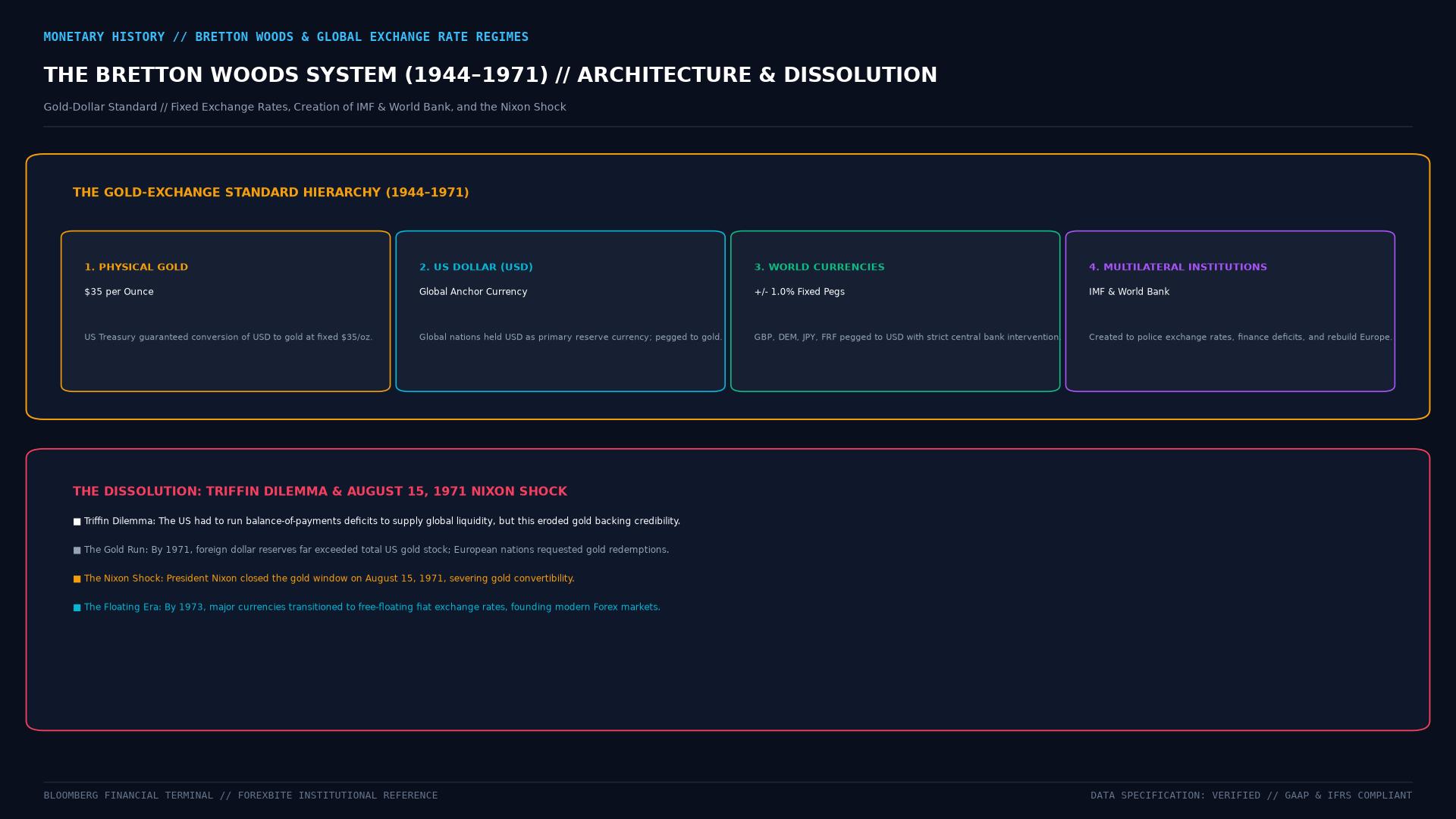 Figure: The Bretton Woods gold-exchange standard architecture (1944–1971), showing the USD fixed gold parity ($35/oz), fixed-but-adjustable allied currency pegs, IMF/World Bank roles, and the 1971 Nixon Shock collapse.
The Architecture of the System
Dollar-gold peg: The US dollar was pegged to gold at the fixed price of $35 per troy ounce. The US government committed to converting dollars to gold at this rate on demand — for foreign governments and central banks, not for private citizens.
Fixed exchange rates: All other major currencies were pegged to the US dollar at fixed rates. Countries could adjust their pegs only with IMF approval for “fundamental disequilibrium” — a rare circumstance.
IMF creation: The International Monetary Fund was established to oversee the system, provide short-term lending to countries experiencing balance of payments difficulties, and maintain exchange rate stability. It continues today as a major international financial institution.
World Bank creation: The International Bank for Reconstruction and Development (now the World Bank) was established to fund post-war reconstruction and economic development.
Why Bretton Woods Worked — and Then Didn’t
For the first 15-20 years, Bretton Woods achieved its goals. Post-war economies recovered. Trade expanded. The dollar’s dominant role — backed by the world’s largest gold reserves — provided a stable anchor.
The system’s fundamental flaw: the Triffin Dilemma, identified by economist Robert Triffin in 1960. The world needed dollars for international trade and reserves. To supply enough dollars, the US had to run balance of payments deficits. But running deficits undermined confidence in the dollar’s gold convertibility. The system required the US to simultaneously supply the world with dollars (through deficits) and maintain the appearance of gold backing — an impossible long-run combination.
By the late 1960s, US spending on the Vietnam War and Great Society domestic programs had significantly expanded dollar supply. Foreign dollar holdings far exceeded US gold reserves. Confidence eroded. France, under Charles de Gaulle, began converting its dollar reserves to gold — forcing the issue.
The Nixon Shock (1971) and the Birth of Floating Rates
On August 15, 1971, President Richard Nixon announced that the United States would unilaterally suspend dollar-gold convertibility — effectively ending the Bretton Woods system. The announcement, made on a Sunday evening to catch international markets off-guard, became known as the “Nixon Shock.”
Over the following two years (culminating in the Smithsonian Agreement and eventually the Jamaica Agreement of 1976), the world transitioned to floating exchange rates — the system that exists today, where currency values are determined by market forces of supply and demand rather than government-fixed pegs.
Bretton Woods’ Legacy for Modern Forex Traders
Several direct legacies shape the forex market you trade:
The IMF’s continued role: The IMF still monitors global financial stability, provides emergency lending, and publishes influential economic assessments — including the World Economic Outlook and Article IV consultations that can move currency markets.
Dollar dominance: Bretton Woods institutionalized the dollar as the world’s reserve currency. Despite no longer being gold-backed, the dollar retains this role through inertia, network effects, and the depth of US capital markets. This is why forex volume is dominated by dollar pairs and why dollar strength/weakness is the organizing principle of global currency markets.
The floating rate infrastructure: The vast OTC forex market — with its $7.5 trillion daily volume — exists specifically because fixed exchange rates ended in 1971-1973. In a Bretton Woods world, speculative currency trading would be both unnecessary and largely illegal.
Key Takeaways
- Bretton Woods (1944): fixed exchange rates pegged to USD, dollar pegged to gold at $35/oz
- Created the IMF and World Bank — both still operational and market-relevant
- The Triffin Dilemma: the system required the US to run deficits that ultimately undermined it
- Nixon Shock (1971): suspension of dollar-gold convertibility ended the system
- Resulted in the floating exchange rate system and the modern forex market as we know it
FAQ
Could a new Bretton Woods system be established? The idea surfaces periodically in academic and policy discussions — particularly after major currency crises. The practical obstacle: no single currency commands the trust required, and the political will to subordinate national monetary sovereignty to an international framework is limited. The SDR (Special Drawing Rights) system at the IMF is a partial multilateral alternative, but far from a new fixed-rate system.
Does Bretton Woods explain why the dollar is still dominant today? Significantly yes. The dollar’s reserve status was institutionalized by Bretton Woods. Even after the fixed rate system ended, global trade contracts, commodity prices (especially oil), and central bank reserves remained dollar-denominated through inertia. The network effects of dollar dominance are self-reinforcing: because everyone else uses dollars, you also need dollars.
Ready to trade forex?
Open a free demo account with a regulated broker. Practice with virtual funds before risking real money.