Yale School of Management - Yale SOM
The graduate business school of Yale University, renowned in institutional finance and asset management for pioneering the Endowment Model, advancing behavioral finance, and developing market valuation frameworks like the Cyclically Adjusted Price-to-Earnings (CAPE) ratio.
Yale School of Management (Yale SOM)
The Yale School of Management (commonly known as Yale SOM), established in 1976 and located on Hillhouse Avenue in New Haven, Connecticut, is the graduate business school of Yale University. While founded with a distinctive founding charter to educate leaders for business and society across both private and public sectors, Yale SOM has exerted a profound, transformative influence on modern institutional finance, portfolio theory, and capital allocation.
In the fields of asset management, quantitative equity valuation, and behavioral economics, Yale SOM is celebrated as the intellectual epicenter of two foundational paradigms: the Yale Model of Endowment Investing (pioneered by legendary Yale Chief Investment Officer David Swensen and SOM faculty) and empirical behavioral finance, anchored by Nobel Memorial Prize-winning economist and Yale SOM professor Robert Shiller (creator of the Cyclically Adjusted Price-to-Earnings / CAPE ratio and the Case-Shiller Home Price Indices).
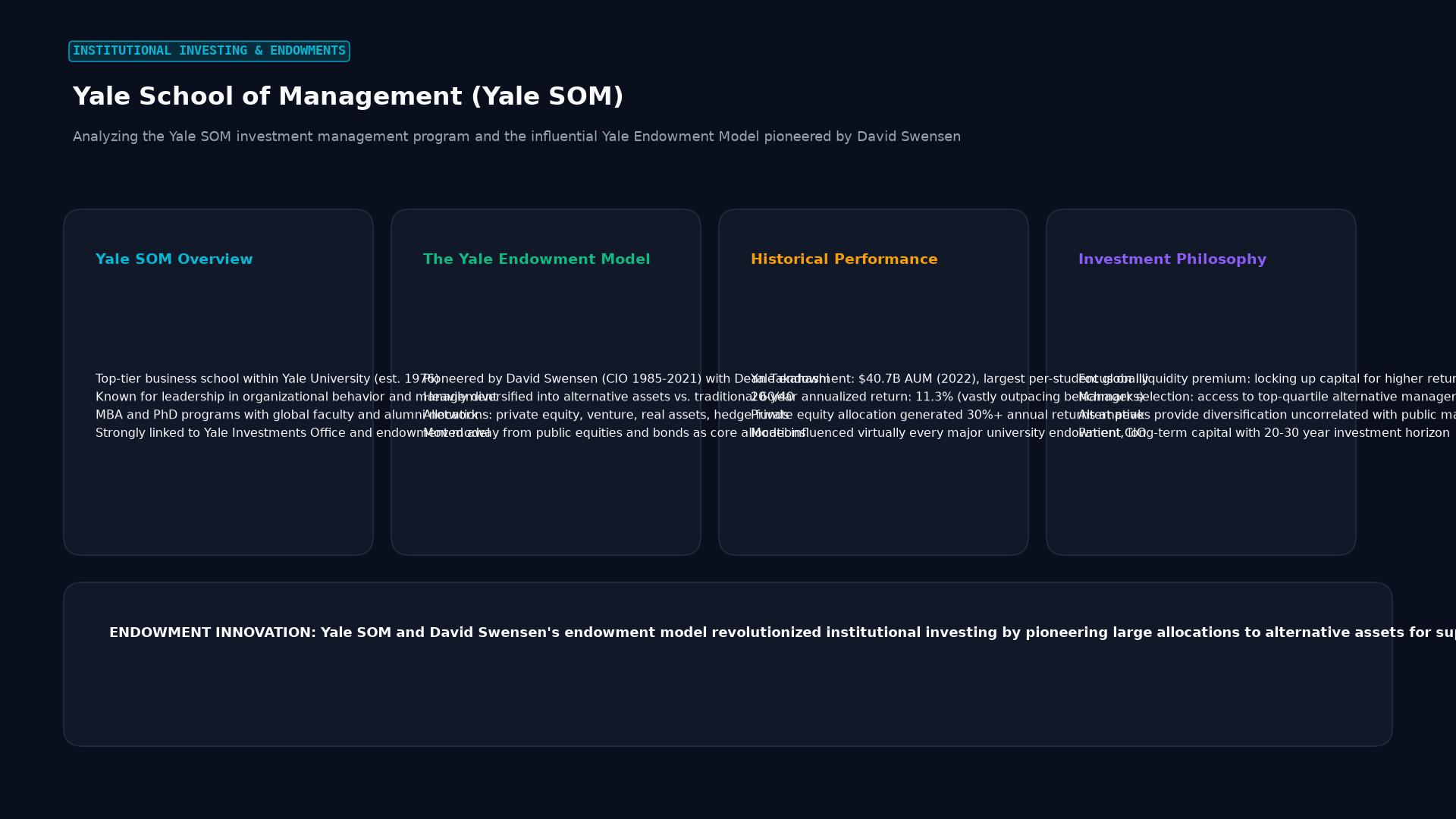 Figure: Analyzing the Yale SOM investment management program and the influential Yale Endowment Model pioneered by David Swensen
The Yale Endowment Model: Revolutionizing Institutional Asset Allocation
Prior to the mid-1980s, institutional endowments, foundations, and corporate pension funds invested under a rigid, conventional framework: the 60/40 asset allocation (60% domestic publicly traded equities, 40% domestic fixed-income government bonds).
Under the leadership of David F. Swensen (who earned his Ph.D. in economics at Yale and taught seminal asset allocation seminars at Yale SOM for over three decades until his passing in 2021) and his longtime deputy Dean Takahashi, Yale demolished this orthodoxy, introducing what is now globally recognized as the Yale Model (or the Endowment Model):
1. The Core Tenets of the Yale Model
- Exploiting the Long-Horizon Advantage: University endowments possess perpetual life horizons with zero immediate liquidity run risk. Swensen recognized that holding ultra-liquid Treasury bonds penalized long-term returns. Investors with perpetual horizons should systematically harvest the illiquidity premium offered by private assets.
- Heavy Equity Bias: Fixed income is structurally disadvantaged against inflation. Swensen mandated that portfolio assets must be overwhelmingly allocated to equity-oriented vehicles capable of generating real capital growth.
- Pioneering Alternative Assets: Rather than concentrating in public blue-chip stocks, Yale SOM scholars demonstrated that alternative asset classes offered superior risk-adjusted returns and lower correlation to the broad market cycle:
- Venture Capital (VC): Early-stage financing in transformative technology and biotech firms.
- Private Equity (Leveraged Buyouts): Value creation through operational restructuring of non-public companies.
- Absolute Return (Hedge Funds): Market-neutral, event-driven, and long/short equity strategies designed to generate alpha independent of broad market direction.
- Real Assets: Direct ownership of timberland, agriculture, energy reserves, and commercial real estate to serve as natural inflation hedges.
       The Evolution of the Yale Portfolio Allocation:

       Traditional 1980s Endowment:
       [ US Public Stocks: 60% ] [ US Bonds & Cash: 40% ]

       Modern Yale Model Architecture:
       [ Absolute Return: ~23% ] [ Venture Capital: ~22% ] [ Foreign Equity: ~15% ]
       [ Leveraged Buyouts: ~17% ] [ Real Assets: ~15% ]   [ US Equities & Bonds: <8% ]
2. Empirical Performance and Global Replication
Under the Yale Model, Yale University’s endowment expanded from roughly $1 billion in 1985 to over $40 billion, consistently outperforming peer institutional portfolios while exhibiting lower downside volatility during market drawdowns. The model was subsequently adopted by Harvard, Princeton, Stanford, sovereign wealth funds (such as Singapore’s GIC and Temasek), and modern family offices worldwide.
Behavioral Finance and the Shiller CAPE Ratio
While modern portfolio theory originated from the Efficient Market Hypothesis (EMH), Yale SOM emerged as the intellectual counterweight, demonstrating that financial markets are driven by human psychology, narrative contagion, and structural herd behavior.
Robert J. Shiller’s Landmark Contributions
Professor Robert J. Shiller, awarded the Nobel Memorial Prize in Economic Sciences in 2013, established groundbreaking empirical frameworks at Yale:
- Excess Volatility (1981): Shiller proved mathematically that stock market prices fluctuate far more dramatically than can be justified by subsequent movements in corporate dividend payments, directly disproving strict efficient market assumptions.
- The Cyclically Adjusted Price-to-Earnings (CAPE) Ratio: Developed alongside John Y. Campbell, the CAPE ratio (also called the Shiller P/E or P/E 10) adjusts standard P/E ratios by dividing current real equity prices by the 10-year moving average of real corporate earnings:
$$CAPE = \frac{P_t}{\frac{1}{10} \sum_{i=0}^{9} E_{t-i} \times \left(\frac{CPI_t}{CPI_{t-i}}\right)}$$
- By smoothing earnings over a full 10-year business cycle, the CAPE ratio eliminates short-term profit distortions caused by recessions or temporary commodity booms.
- When the CAPE ratio crosses historical statistical extremes (as in 1929 at 32x and in 2000 at 44x), it serves as a powerful predictive indicator of depressed 10-year forward equity returns.
- The S&P CoreLogic Case-Shiller Home Price Indices: Developed by Shiller and Karl Case, these indices deploy repeat-sales methodology to calculate changes in residential real estate prices across 20 major US metropolitan areas, serving as the benchmark standard for global real estate and mortgage securitization analytics.
+------------------------------------------------------------------------+
|          Historical Shiller CAPE Ratios at Iconic Market Turning Points |
+------------------------------------------------------------------------+
| Epoch / Market Event  | S&P 500 CAPE Ratio | Forward 10-Year Market Outcome |
| Historical Long-Term Mean | ~17.0x         | Benchmark long-term baseline   |
| 1929 Market Peak      | 32.6x              | The Great Crash of 1929        |
| 1982 Secular Low      | 6.6x               | Multi-decade secular bull run  |
| 2000 Dot-Com Bubble   | **44.2x (Record)** | "Lost Decade" for US equities  |
| 2009 GFC Low          | 13.3x              | Historic post-crisis recovery  |
+------------------------------------------------------------------------+
Research Centers and Institutional Innovations
Yale SOM houses dedicated research initiatives that actively shape global investment management:
1. International Center for Finance (ICF)
Founded in 1999, the ICF conducts empirical research into financial history, corporate governance, behavioral asset pricing, and market microstructure. The center maintains the Yale Stock Market Confidence Indices, surveying institutional and individual investors monthly to quantify retail crash anxiety and valuation sentiment.
2. Program on Financial Stability (YPFS)
Directed by former US Treasury Secretary Timothy Geithner and Professor Andrew Metrick, the YPFS serves as the global repository for central banking crisis management:
- Maintains the New Bagehot Project, cataloging historical central bank emergency interventions (lender-of-last-resort credit, liquidity swap lines, capital injections).
- Trains central bank governors, financial regulators, and ministry officials on systemic systemic risk containment.
Applied Portfolio Case Study: Constructing an Endowment-Style Portfolio
Consider Heritage Family Office (HFO), a private multi-generational investment entity managing $500,000,000 for a philanthropic family.
Historical Baseline Allocation (60/40 Model)
- $300,000,000 in S&P 500 Index Funds (60%).
- $200,000,000 in 10-Year US Treasury Bonds (40%).
- Weakness: In periods of stagflation (such as 2022), both stocks and bonds decline simultaneously, destroying real capital value.
Restructuring Under the Yale Model Paradigm
HFO engages Yale SOM-trained investment consultants to restructure the asset allocation:
- Private Equity & Venture Capital (30% / $150M): Committed across top-quartile funds to capture entrepreneurial growth.
- Absolute Return / Market-Neutral Hedge Funds (25% / $125M): Deployed into multi-strategy long/short arbitrage to generate uncorrelated cash yields ($LIBOR/SOFR + 4%$).
- Real Assets & Timberland (15% / $75M): Direct investment in sustainable forestry and core commercial infrastructure providing inflation-indexed contractual cash flows.
- Global Public Equities (20% / $100M): Diversified across emerging and developed international markets selected using Shiller CAPE valuation filters.
- Cash & Sovereign Treasury Buffer (10% / $50M): Retained strictly to meet annual capital calls and immediate philanthropic grant commitments.
Resulting Portfolio Dynamics
The restructured portfolio harvests higher average expected returns, reduces maximum peak-to-trough drawdowns by 35% during market panics, and immunizes family generational wealth against systemic inflation shocks.
Frequently Asked Questions
Can an individual retail investor implement the Yale Endowment Model?
While individual investors cannot easily replicate the exact Yale portfolio due to high minimum investment thresholds ($5M to $10M+) and access barriers to elite tier-1 venture capital funds, the underlying principles are widely accessible. Retail investors can implement the model’s philosophy by maintaining an equity orientation, diversifying globally, utilizing low-cost real estate investment trusts (REITs) and commodity index funds for inflation protection, and minimizing turnover to harvest long-term compounding.
What is the primary criticism of the Yale Model?
The primary criticism of the Yale Model is liquidity risk. During acute financial panics (such as the 2008 Global Financial Crisis), private equity and real estate assets cannot be sold to raise immediate cash. Endowments that over-allocated to illiquid partnerships faced capital calls from private equity managers while university operating budgets required cash, forcing some institutions to issue expensive emergency municipal bonds or sell secondary private equity stakes at deep 30% to 50% discounts.
What does the CAPE ratio tell an investor about short-term market timing?
The Shiller CAPE ratio is not a short-term market timing tool. An elevated CAPE ratio (such as 30x+) indicates that equities are historically expensive relative to long-term earnings, implying lower expected annualized returns over the subsequent 10 to 15 years. However, in the short term (1 to 3 years), valuation multiples can remain elevated or expand further due to momentum, loose monetary policy, or corporate enthusiasm.
Ready to trade forex?
Open a free demo account with a regulated broker. Practice with virtual funds before risking real money.