Asset Allocation
Asset allocation is an investment strategy that distributes capital across diverse asset classes—such as equities, fixed income, commodities, real estate, cash, and foreign exchange—to optimize the balance between risk and return based on an investor's goals, time horizon, and risk tolerance.
Understanding Asset Allocation
Asset allocation is widely recognized across academic finance and institutional wealth management as the single most critical determinant of long-term investment performance. Seminal research by Gary Brinson, Randolph Hood, and Gilbert Beebower demonstrated that more than 90% of the variability in portfolio returns over time stems from broad asset allocation decisions, rather than individual security selection or short-term market timing.
The foundational thesis of asset allocation rests on Modern Portfolio Theory (MPT), pioneered by Nobel laureate Harry Markowitz in 1952. Markowitz proved mathematically that combining assets with low or negative correlation coefficients reduces overall portfolio variance (risk) without necessarily sacrificing expected returns. In simpler terms, holding a carefully constructed mix of uncorrelated investments creates an investment whole that is more resilient than the sum of its individual parts.
Core Asset Classes
A comprehensive asset allocation framework typically segments capital across several distinct categories:
- Equities (Stocks): Offer high historical growth potential and inflation protection, but carry significant price volatility and cyclical drawdown risk.
- Fixed Income (Bonds): Provide capital preservation, predictable cash flow via coupon payments, and defensive stability during equity market downturns.
- Cash and Cash Equivalents: Treasury bills, money market funds, and commercial paper that offer maximum liquidity and capital safety, though they lose purchasing power against high inflation.
- Commodities: Physical goods such as gold, crude oil, copper, and agricultural products that act as an inflation hedge and store of value during geopolitical turbulence.
- Real Estate: Direct property or Real Estate Investment Trusts (REITs) offering income yield, capital appreciation, and low correlation to public equities.
- Foreign Exchange (Currencies): Currencies operate both as an intrinsic component of international asset holdings and as an active alpha-generating overlay strategy.
The Role of Foreign Exchange in Asset Allocation
Foreign exchange plays a dual role in portfolio construction:
1. The Passive Currency Exposure Problem
Whenever an investor buys foreign assets—such as an American investor acquiring European dividend stocks or a Japanese pension fund buying US Treasuries—they automatically inherit two distinct layers of risk:
- Asset Risk: The fluctuation in the local price of the stock or bond.
- Currency Risk: The fluctuation in the exchange rate between the domestic and foreign currency.
If a European stock rallies 10% in Euros, but the Euro depreciates 12% against the US Dollar over the same timeframe, a US-based investor actually realizes a net loss upon converting proceeds back to dollars. Institutional allocators must decide whether to leave international exposure unhedged, execute static 50% or 100% currency hedges using FX forward contracts, or implement a dynamic currency overlay.
2. The Active Currency Overlay
Sophisticated institutional funds treat foreign exchange as an independent, non-correlated asset class. Because currency pairs represent relative macroeconomic health and interest rate policy rather than corporate earnings, currency strategies (such as the carry trade, trend following, and purchasing power parity valuation models) exhibit near-zero long-term correlation to traditional equity and bond benchmarks. Adding active currency management provides valuable portfolio diversification.
Primary Asset Allocation Models
Investors deploy distinct structural models depending on their operational horizon and investment philosophy:
Strategic Asset Allocation (SAA)
This traditional approach establishes target percentage weights for each asset class based on long-term expected returns and historic risk profiles. The portfolio maintains these baseline targets regardless of short-term economic fluctuations. Periodic rebalancing occurs (quarterly or annually) by trimming outperforming assets that have grown beyond their target weight and purchasing underperforming assets, enforcing a disciplined “buy low, sell high” cycle.
Tactical Asset Allocation (TAA)
Tactical allocation introduces flexibility to deviate moderately from strategic benchmarks to capitalize on short-term macroeconomic divergences or market extremes. For instance, if an allocator observes aggressive central bank tightening, they might tactically reduce equity exposure from 60% to 50% and allocate 10% to short-duration cash equivalents or high-yielding currency carry trades.
Dynamic Asset Allocation
A proactive strategy that continuously alters asset mixes as macroeconomic regimes change. During economic expansions, capital flows heavily into equities and high-beta commodity currencies (such as the Australian and Canadian Dollars). During recessions or liquidity crises, capital shifts systematically toward defensive sovereign debt, cash, and safe-haven currencies like the US Dollar and Swiss Franc.
Practical Portfolio Allocation Example
Consider a balanced international growth portfolio managing $500,000 across global markets:
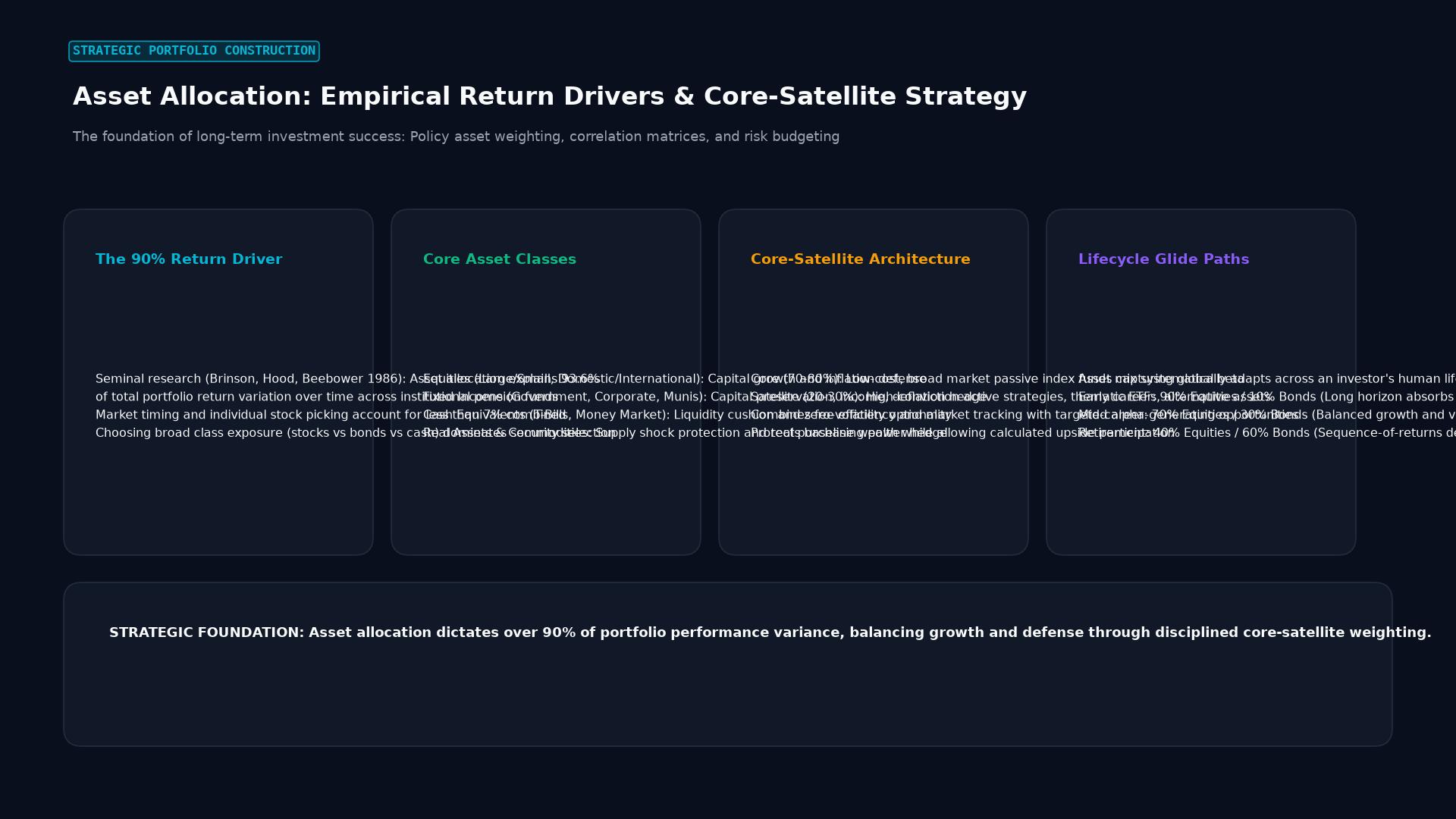 Figure: The foundation of long-term investment success: Policy asset weighting, correlation matrices, and risk budgeting
Assume the equity allocation includes $100,000 invested in export-oriented Japanese equities (Nikkei 225). If the Bank of Japan maintains ultra-loose monetary policy while the Federal Reserve holds rates high, the Japanese Yen (JPY) is prone to steady depreciation against the US Dollar.
- Without currency hedging, a 15% rally in Japanese stock prices could be entirely wiped out by a 15% decline in USD/JPY.
- By allocating 2% of the cash overlay to purchase forward currency contracts selling JPY and buying USD, the portfolio manager sterilizes the currency drag, locking in the pure equity performance of the Japanese firms.
Key Takeaways
- Asset allocation divides capital across different asset classes to optimize the risk-return trade-off based on investor objectives.
- Studies indicate that asset allocation drives over 90% of long-term portfolio return variance.
- Incorporating low-correlation assets like commodities and currencies reduces overall portfolio volatility.
- International investing creates inherent currency risk that requires strategic hedging or active overlay management.
- Systematic rebalancing enforces disciplined profit-taking and prevents portfolio drift during extended market runs.
FAQ
What is the difference between asset allocation and diversification? Asset allocation is the overarching strategy of dividing capital across major asset classes (stocks, bonds, cash, commodities). Diversification is the technique of spreading investments within each asset class (e.g., owning 40 different stocks across healthcare, technology, and energy rather than concentrating in one company).
How does age affect asset allocation? Traditional financial planning recommends higher allocations to growth-oriented equities for younger investors with multi-decade horizons, gradually shifting toward capital-preserving fixed income and cash as retirement approaches to mitigate sequence-of-returns risk.
Why should a forex trader care about asset allocation? Currency markets do not move in isolation. Cross-border capital flows driven by institutional asset allocators rebalancing multi-billion-dollar equity and bond portfolios directly create the massive trends observed on daily forex charts.
Ready to trade forex?
Open a free demo account with a regulated broker. Practice with virtual funds before risking real money.