Yupcap
A financial demographic and wealth management acronym describing a Young Urban Professional who possesses high earning potential but is constrained from acquiring residential real estate property due to elevated housing costs and structural debt burdens.
Yupcap (Young Urban Professional Cannot Afford Property)
In financial demographics, wealth management marketing, and urban macroeconomic sociology, the term Yupcap (derived from the acronym Young Urban Professional Cannot Afford Property) designates an educated, metropolitan worker, typically in their late twenties to early forties, who commands an above-average salary but remains structurally locked out of residential real estate ownership in primary economic hubs.
Closely related to the private wealth management category known as HENRY (High Earner, Not Rich Yet), Yupcaps possess substantial discretionary monthly cash flow and high human capital, but face acute structural hurdles: skyrocketing metropolitan price-to-income housing ratios, significant educational student debt obligations, and escalating down-payment requirements. Consequently, the Yupcap demographic has fundamentally transformed retail investment management, driving the rapid adoption of digital fintech platforms, commission-free fractional equity trading, robo-advisors, and alternative liquid portfolio allocations.
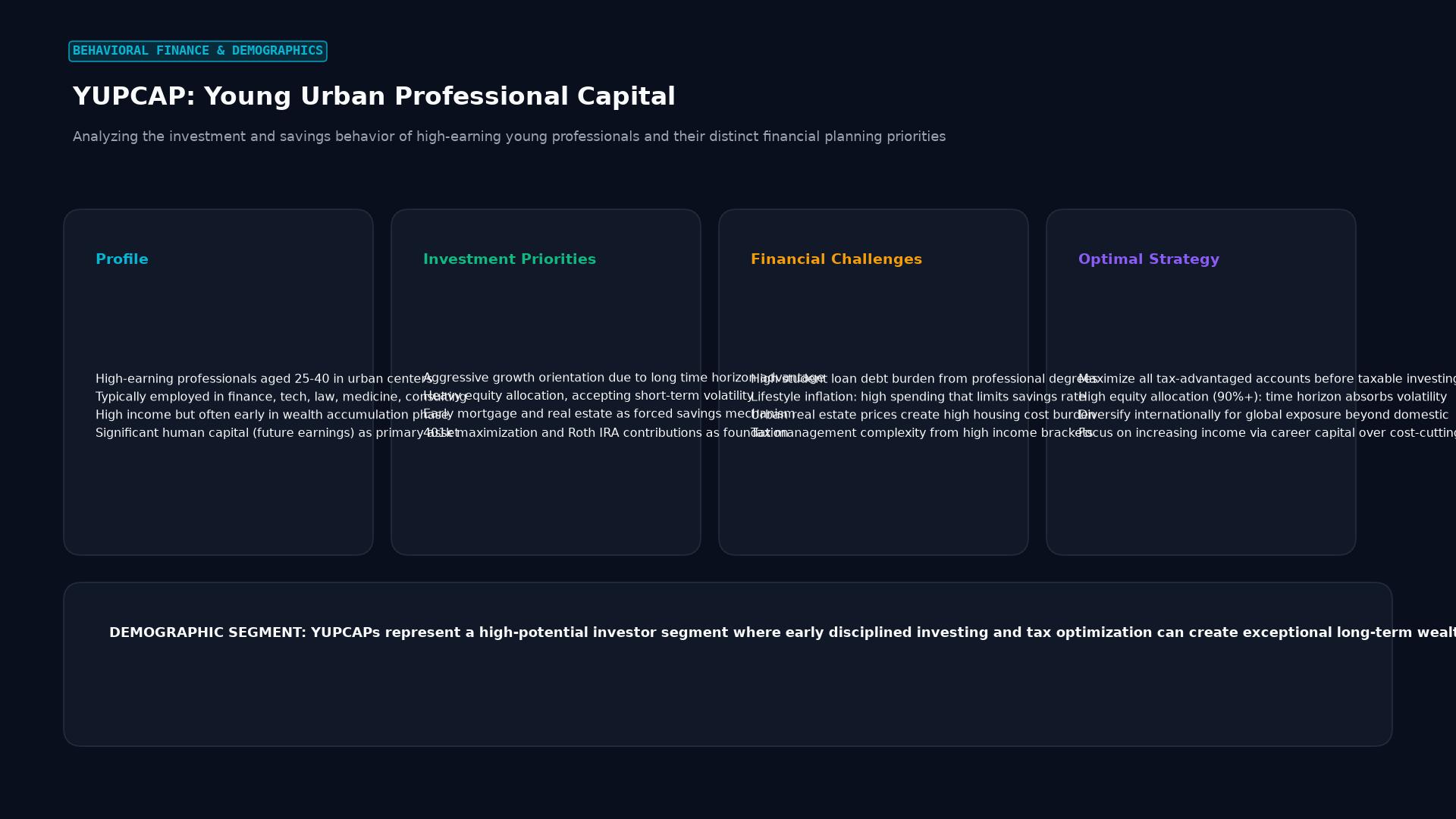 Figure: Analyzing the investment and savings behavior of high-earning young professionals and their distinct financial planning priorities
Sociological and Historical Origins: From Yuppie to Yupcap
The term represents an evolutionary shift in modern urban economic demographics over recent decades:
- The 1980s Yuppie Archetype: In the 1980s, the term Yuppie (Young Urban Professional) emerged to describe ambitious baby boomers entering investment banking, corporate law, and advertising. In that era, a moderate corporate salary allowed a 28-year-old professional to purchase residential brownstones or suburban single-family homes at historical price-to-income ratios of 3x to 4x annual earnings.
- The Post-2008 Housing Affordability Fracture: Following the 2008 Global Financial Crisis, central bank quantitative easing (QE), institutional private equity single-family home acquisitions, and stringent municipal zoning restrictions constrained urban housing supply. In tier-1 global cities (New York, London, San Francisco, Toronto, Sydney, Zurich), median home prices escalated to 10x to 15x median household income.
- Emergence of the Yupcap: By the mid-2010s, analysts coined Yupcap to differentiate these professionals from their baby-boomer predecessors: despite earning top-decile salaries ($100,000 to $250,000+), saving the $150,000 to $300,000 in liquid post-tax cash required for a 20% down payment became an insurmountable barrier without intergenerational family wealth transfers.
Macroeconomic Drivers of the Yupcap Dilemma
The financial dynamics confining the Yupcap demographic to long-term tenancy are rooted in quantifiable economic variables:
1. Extreme Price-to-Income Multiples
In classic personal finance models, residential housing is considered affordable when home prices do not exceed 3.0x to 3.5x annual gross income. In modern superstar metropolitan areas: $$\text{Price-to-Income Multiple} = \frac{\text{Median Metropolitan Home Price}}{\text{Median Professional Household Income}}$$ In cities like San Francisco, London, and Sydney, this ratio frequently hovers between 8.0x and 14.0x, forcing young professionals to take on excessive mortgage leverage or remain renters.
2. The Down Payment Liquidity Hurdle
While a professional may easily afford monthly rental payments of $3,500 from current cash flow, saving a 20% down payment (plus closing costs and reserve funds) requires accumulating hundreds of thousands of dollars in post-tax liquid savings:
- High metropolitan rents consume a large portion of gross income.
- Income taxes on high earners (federal, state, and local income taxes frequently exceeding 40% marginal brackets in New York or California) slow the velocity of liquid cash accumulation.
3. Student Debt Amortization Drag
Unlike previous generations, modern professionals frequently enter the workforce carrying $50,000 to $200,000+ in undergraduate and graduate student debt (law school, medical school, MBA programs). Monthly debt service payments directly reduce debt-to-income (DTI) underwriting ratios, disqualifying otherwise qualified buyers from prime mortgage programs.
+------------------------------------------------------------------------+
|          Comparison: 1985 Yuppie vs. Modern 2020s Yupcap               |
+------------------------------------------------------------------------+
| Metric / Characteristic | 1985 Urban Yuppie          | Modern Yupcap / HENRY    |
| Median Age Range        | 25 – 35 Years Old          | 28 – 42 Years Old        |
| Housing Price-to-Income | 3.2x Median Income         | 9.5x – 12.0x Median Inc. |
| Student Debt Burden     | Minimal to Low             | $75,000 – $180,000+      |
| Homeownership Rate      | High (>60% by age 32)      | Low (<30% by age 32)     |
| Primary Wealth Vehicle  | Home Equity (Primary Resid)| Liquid Equities, 401(k)  |
| Investment Approach     | Full-service broker / RE   | Mobile Fintech / ETFs    |
+------------------------------------------------------------------------+
Financial Planning Strategy: “Rent and Invest the Difference”
Faced with structural exclusion from primary real estate equity, wealth management advisers and fiduciary planners working with Yupcaps deploy alternative wealth-building strategies:
The Rent vs. Buy Mathematical Equivalence
The traditional cultural dogma that “renting is throwing money away” is challenged by modern portfolio mathematics. An investor who rents an apartment and systematically invests the capital that would have been absorbed by a home down payment, property taxes, HOA fees, mortgage interest, and home maintenance into a low-cost, globally diversified equity portfolio often achieves equal or superior long-term net worth:
$$\text{Net Wealth}{\text{Buyer}}(t) = \text{Home Equity}(t) - \text{Cumulative Maintenance} - \text{Property Taxes} - \text{Mortgage Interest}$$ $$\text{Net Wealth}{\text{Yupcap Renter}}(t) = \text{Down Payment Capital} \times (1 + R_{\text{equity}})^t + \sum (\Delta \text{Monthly Savings} \times (1 + R_{\text{equity}})^t)$$
Over historical 30-year horizons, broad public equity markets (such as the S&P 500 or MSCI World) have generated real annualized returns of 7.0%, outperforming the historical real capital appreciation of residential housing (which has averaged roughly 1.5% to 2.5% after accounting for physical depreciation and maintenance costs).
Wealth Management and Fintech Market Transformation
The concentration of high-earning, asset-light Yupcaps has catalyzed massive innovation across the financial services sector:
- Robo-Advisors and Automated Direct Indexing: Wealthfront, Betterment, and Schwab Intelligent Portfolios scaled by tailoring algorithmic, tax-loss harvesting portfolios specifically to tech-savvy professionals seeking passive asset allocation without paying traditional 1% AUM wealth management fees.
- Fractional Share Trading: Platforms like Robinhood and modern institutional brokerage apps eliminated round-lot share barriers, allowing young earners to allocate weekly paycheck savings into expensive mega-cap equities (such as Berkshire Hathaway Class A, Microsoft, or Nvidia).
- Alternative Private Real Estate Platforms: Because Yupcaps cannot afford to purchase a whole physical property in their home city, they allocate capital into fractional real estate crowdfunding platforms (such as Fundrise or commercial real estate syndications), capturing real estate exposure with minimal capital commitments.
Applied Financial Planning Case Study: The High-Earning Metropolitan Renter
Consider Alex and Jordan, a dual-income professional couple living in Manhattan:
- Combined Annual Gross Income: $280,000.
- Monthly Net Take-Home Pay (after 401k max and taxes): $14,500.
- Student Loan Debt Balance: $90,000 ($1,100 monthly payment).
- Liquid Savings Accumulated: $85,000.
The Housing Market Reality in Their Neighborhood
- Target 2-Bedroom Condo Purchase Price: $1,200,000.
- Minimum 20% Cash Down Payment: $240,000.
- Estimated Closing Costs & Bank Reserve Mandate: $60,000.
- Total Upfront Cash Required: $300,000.
- Gap Analysis: With only $85,000 saved, they face a $215,000 cash deficit, making home acquisition impossible without a massive family gift or high-risk private mortgage insurance loan.
The Yupcap Wealth Architecture
A fiduciary financial planner advises them to abandon homeownership anxiety and optimize their liquid balance sheet:
- Max Out Pre-Tax Vehicles: Contribute statutory maximums to corporate 401(k) plans ($46,000 combined), reducing current taxable income.
- Backdoor Roth IRAs: Execute annual Backdoor Roth IRA conversions ($14,000 combined) to secure tax-free compound growth.
- Taxable Brokerage Allocation: Allocate $4,000 per month of surplus cash flow into an automated broad-market equity index portfolio (VTI / VXUS).
- Outcome After 10 Years: Assuming 7.5% annualized equity compounding, their liquid non-housing investment portfolio expands to over $1,050,000, granting them total geographic mobility, zero property debt, and superior liquid net worth.
Frequently Asked Questions
Is being a “Yupcap” a permanent financial status?
Not necessarily. For many professionals, the Yupcap stage is a transitional phase. As student loans are paid off, career seniority increases compensation, or couples relocate from tier-1 superstar cities to secondary regional markets (such as Austin, Denver, Charlotte, or Raleigh) where price-to-income ratios are lower, many Yupcaps eventually transition into homeownership in their mid-to-late thirties.
What is the primary difference between a Yupcap and a HENRY?
The terms overlap significantly, but have different analytical origins: HENRY (High Earner, Not Rich Yet) is an affluent wealth management marketing term describing individuals with high income ($250k–$500k+) whose net worth has not yet crossed the multi-million-dollar threshold. Yupcap specifically highlights the real estate affordability barrier, emphasizing how high housing costs in urban centers prevent high-earning professionals from building traditional home equity.
How does the Yupcap demographic influence the rental property market?
The presence of thousands of high-earning professionals who cannot afford to buy homes has fueled a boom in institutional Build-to-Rent (BTR) communities and luxury multifamily apartment developments. Institutional real estate investment trusts (REITs) specifically target Yupcaps by developing amenity-rich rental properties (coworking lounges, pet spas, fitness centers, rooftop pools) that cater to affluent tenants willing to pay premium monthly rents.
Ready to trade forex?
Open a free demo account with a regulated broker. Practice with virtual funds before risking real money.