Zero-Basis-Risk Swap (ZEBRA)
A customized interest rate swap contract where a financial institution agrees to pay a municipal or corporate borrower the exact variable rate owed on its floating debt, eliminating basis risk between taxable benchmarks and tax-exempt remarketing rates.
What Is a Zero-Basis-Risk Swap (ZEBRA)?
A Zero-Basis-Risk Swap (ZEBRA) is a bespoke derivative contract developed within municipal and public finance markets to eliminate the interest rate discrepancy known as basis risk. In a standard interest rate swap, a public entity (such as a city government, university, or municipal water utility) that has issued floating-rate bonds enters an agreement to pay a fixed interest rate while receiving a floating-rate benchmark from a dealer bank.
Under conventional swap agreements, however, municipal issuers frequently encounter a structural mismatch: the floating rate they receive from the swap dealer (historically a percentage of taxable LIBOR or now the Secured Overnight Financing Rate, SOFR) does not perfectly mirror the actual interest rate they must pay to investors on their tax-exempt Variable Rate Demand Obligations (VRDOs). When credit market conditions deteriorate or tax policies shift, this gap widens, exposing the borrower to significant financial losses.
In a ZEBRA contract, the swap counterparty (typically a major global investment bank) explicitly agrees to pay the public issuer a floating rate that precisely matches the issuer’s actual floating borrowing cost, such as the exact weekly reset rate established by the bond’s remarketing agent, or 100% of the SIFMA Municipal Swap Index. In exchange for absorbing all residual basis risk onto its own trading book, the dealer charges the issuer a slightly elevated fixed interest rate.
The resulting synthetic debt structure guarantees that the issuer’s net borrowing cost remains perfectly constant, creating true zero-basis-risk synthetic fixed-rate financing.
The Basis Risk Problem in Municipal Finance
To understand the necessity of a ZEBRA structure, one must examine the mechanics of conventional municipal floating-rate debt:
                  THE CONVENTIONAL MUNICIPAL SWAP MISMATCH

      [Municipal Issuer] ─── Pays Actual VRDO Weekly Rate ───► [Bondholders]
              │
              ├─────── Pays Fixed Swap Rate (e.g., 3.85%) ───► [Swap Dealer]
              │
              └◄────── Receives 67% of SOFR/LIBOR (e.g., 3.35%) ─┘

                      Net Borrowing Cost = 3.85% + (VRDO Rate - 3.35%)
                      *If VRDO Rate spikes to 4.50%, the issuer suffers
                       an unhedged basis shortfall of 1.15% (115 bps)*
Municipalities issue VRDOs because short-term tax-exempt rates are historically lower than long-term fixed rates. To protect their budgets against rising interest rates, treasurers enter interest rate swaps to synthetically fix the cost.
However, because municipal debt is tax-exempt in the United States while swap market benchmarks are taxable, dealer banks historically paid floating rates calculated as a percentage of taxable indices (traditionally 67% or 70% of 3-month LIBOR, reflecting the highest marginal corporate tax rate).
During periods of financial crisis (such as the 2008 subprime meltdown and the collapse of municipal bond insurers like MBIA and Ambac), auction rate securities failed and VRDO remarketing agents were forced to spike weekly reset rates up to 8% or 10% to attract buyers. Meanwhile, taxable benchmark indices traded at historic lows. Public issuers paying fixed swap rates were simultaneously forced to pay massive, unexpected basis deficits to their bondholders, severely straining municipal balance sheets.
How the ZEBRA Structure Eliminates Basis Risk
A ZEBRA transaction alters the derivative contractual terms so that the swap dealer, rather than the public borrower, absorbs the risk of market dislocations:
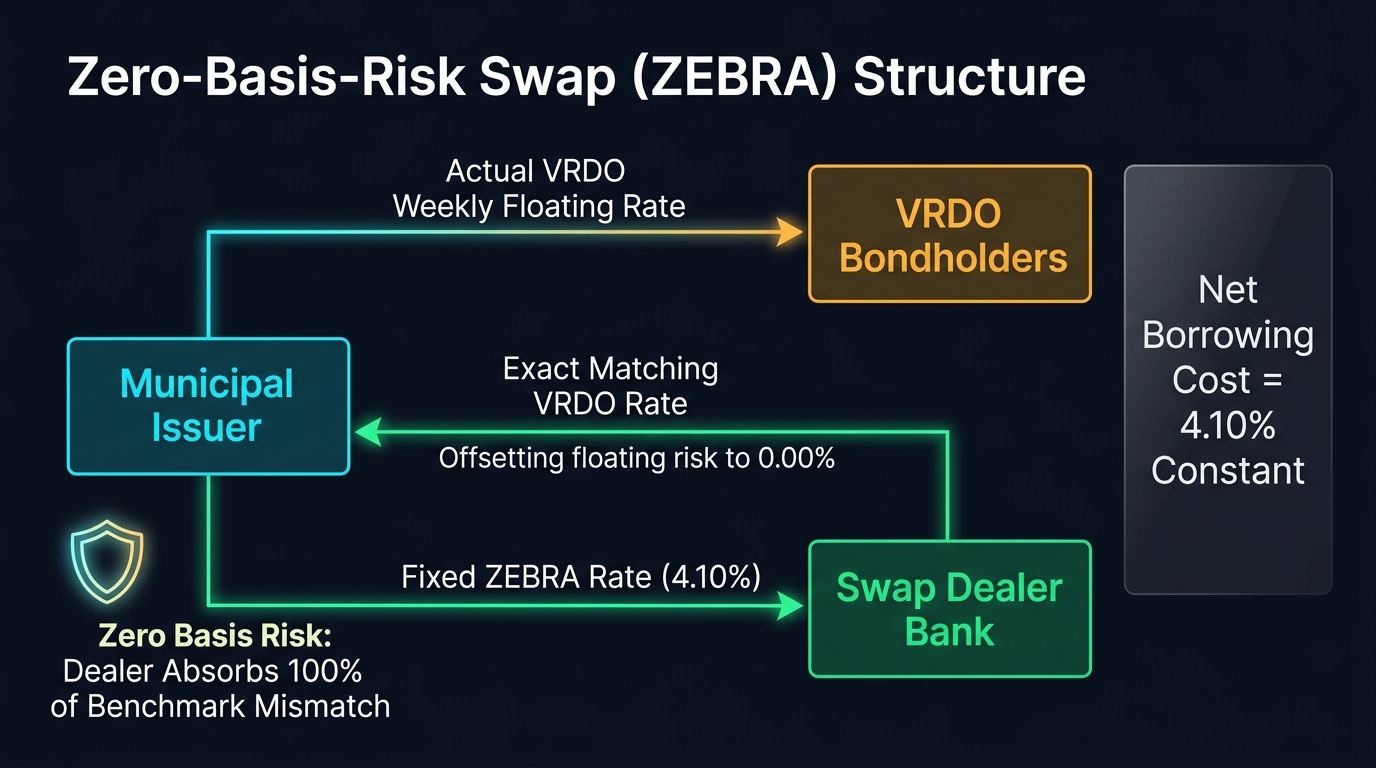
                      THE ZERO-BASIS-RISK SWAP (ZEBRA)

      [Municipal Issuer] ─── Pays Actual VRDO Weekly Rate ───► [Bondholders]
              │                                                     ▲
              │                                                     │
              ├─────── Pays Fixed ZEBRA Rate (e.g., 4.10%) ───► [Swap Dealer]
              │                                                     │
              └◄────── Receives EXACT Actual VRDO Rate ─────────────┘

                      Net Borrowing Cost = 4.10% (Completely Constant)
                      *The swap dealer bears 100% of any VRDO rate spike*
Cash Flow Mechanics:
- Bond Debt Service: The municipality pays its weekly variable rate (determined by the bond remarketing agent) directly to the VRDO bondholders.
- Swap Floating Leg: The swap dealer transfers an amount exactly equal to that weekly VRDO rate back to the municipality.
- Floating Leg Netting: The floating inflow from the dealer cancels out the floating outflow to bondholders dollar-for-dollar: $$\text{Net Floating Cost} = \text{VRDO Rate} - \text{Swap Floating Receipt} = 0.00%$$
- Swap Fixed Leg: The municipality pays a fixed rate (for example, 4.10%) to the swap dealer.
- Net Economic Result: The municipality’s total borrowing expense equals precisely 4.10%, regardless of whether market remarketing rates fluctuate between 0.50% and 12.00%.
Comparative Cash Flow Analysis: Standard Swap vs. ZEBRA
The economic divergence between a standard floating-rate swap and a ZEBRA contract is evident across varying financial stress scenarios:
| Market Environment | VRDO Weekly Reset Rate | Standard Swap Floating Receipt (67% of Benchmark) | Standard Swap Net Effective Rate | ZEBRA Floating Receipt | ZEBRA Net Effective Rate |
|---|---|---|---|---|---|
| Normal Liquid Market | 2.50% | 2.50% | 3.85% (Target met) | 2.50% | 4.10% (Guaranteed) |
| Municipal Credit Stress | 5.20% | 2.60% | 6.45% (260 bps deficit) | 5.20% | 4.10% (Protected) |
| Tax Rate Reductions | 3.80% | 2.50% | 5.15% (130 bps deficit) | 3.80% | 4.10% (Protected) |
| Market Dislocation (2008 Style) | 8.50% | 1.80% | 10.55% (670 bps deficit) | 8.50% | 4.10% (Protected) |
While the municipality pays an insurance premium of 25 basis points (paying 4.10% instead of 3.85% under normal conditions), it is completely insulated from catastrophic basis spikes.
Institutional Pricing and Dealer Risk Management
Why do Wall Street swap dealers write ZEBRA contracts, and how do they price the underlying risk?
- Premium Fixed Rate (The Basis Spread): The dealer prices a risk premium into the fixed rate paid by the issuer. If a standard benchmark swap carries a fixed rate of 3.85%, a ZEBRA contract on the same underlying municipal credit might be priced at 4.05% to 4.25%. This 20 to 40 basis point premium compensates the dealer for the volatility of the municipal-to-taxable ratio.
- Dynamic Factor Hedging: To hedge its exposure, the dealer’s quantitative trading desk constructs a cross-market dynamic hedge using SIFMA municipal swap futures, SOFR overnight index swaps (OIS), and Treasury bond futures. The desk actively rebalances these hedges based on changing credit spreads and tax legislation probabilities.
- Remarketing Agent Risk: Because the dealer agrees to pay the actual rate set by the remarketing agent, the contract often contains covenants specifying the selection of accredited remarketing agents to prevent artificially high reset rates from being set through dealer incompetence or collusion.
Regulatory and Credit Considerations
While a ZEBRA eliminates interest rate basis risk, institutional treasurers must evaluate broader counterparty and structural risks:
1. Counterparty Credit Exposure
A ZEBRA is a bilateral over-the-counter (OTC) derivative. If the swap dealer experiences credit rating downgrades or enters bankruptcy (such as Lehman Brothers in 2008), the floating cash payments owed to the municipality will cease. The issuer would suddenly be thrown back into paying unhedged floating rates on its VRDOs while facing the operational challenge of replacing the swap in a distressed market.
2. Termination Risk and Negative Mark-to-Market Values
If the public borrower seeks to unwind the financing or refinance its debt when prevailing interest rates have declined, the ZEBRA contract will possess a substantial negative mark-to-market value. The issuer must pay a significant cash termination payment to the dealer to extinguish the swap contract.
3. Regulatory Governance and Disclosure
Following the Dodd-Frank Wall Street Reform and Consumer Protection Act and Municipal Securities Rulemaking Board (MSRB) Rule G-17, municipal financial advisors must provide independent fair-value assessments of ZEBRA structures, confirming that the basis insurance premium charged by the dealer represents fair market value.
Frequently Asked Questions
Why does a municipality choose a ZEBRA over traditional fixed-rate municipal bonds?
Issuing traditional long-term fixed-rate municipal bonds can be expensive when the long end of the municipal yield curve is steep. By pairing floating-rate VRDOs with a ZEBRA contract, an issuer often achieves a synthetic fixed borrowing rate that is 30 to 75 basis points lower than issuing fixed-rate bonds directly, while enjoying complete immunity from basis risk.
What is the SIFMA Municipal Swap Index, and how does it relate to ZEBRA swaps?
The SIFMA Municipal Swap Index is a 7-day high-grade market index comprised of tax-exempt VRDOs produced by Municipal Market Data (MMD). Many ZEBRA contracts reference the SIFMA index directly as the floating leg benchmark rather than the specific issuer’s remarketing rate, ensuring an objective, transparent, and independently verified settlement rate.
What happens if the swap counterparty is downgraded?
Standard International Swaps and Derivatives Association (ISDA) master agreements accompanying ZEBRA contracts include credit support annexes (CSA) with rating trigger clauses. If the dealer bank’s credit rating drops below a designated threshold (such as A3/A-), the dealer is legally obligated to post cash or Treasury collateral to secure its obligations, or the municipality gains the legal right to terminate the contract without penalty.
Ready to trade forex?
Open a free demo account with a regulated broker. Practice with virtual funds before risking real money.