Interest Rate Swap
An interest rate swap (IRS) is a customized over-the-counter derivative contract in which two counterparties agree to exchange periodic interest rate cash flows, typically exchanging a fixed rate for a floating rate, calculated on a specified notional principal amount.
What Is an Interest Rate Swap?
An interest rate swap (IRS) is one of the largest and most liquid financial derivative instruments in the world, with hundreds of trillions of dollars in outstanding notional volume. It is a contractual agreement between two counterparties to exchange interest payment cash flows over an agreed time horizon, calculated upon an underlying notional principal amount.
Crucially, the notional principal itself never changes hands. It serves strictly as an accounting balance against which periodic interest payments are computed. The primary objective of an interest rate swap is not speculative gambling, but rather balance sheet risk management: enabling corporations, commercial banks, and institutional asset managers to manage their exposure to fluctuating interest rates by converting variable-rate debt into fixed-rate obligations, or vice versa.
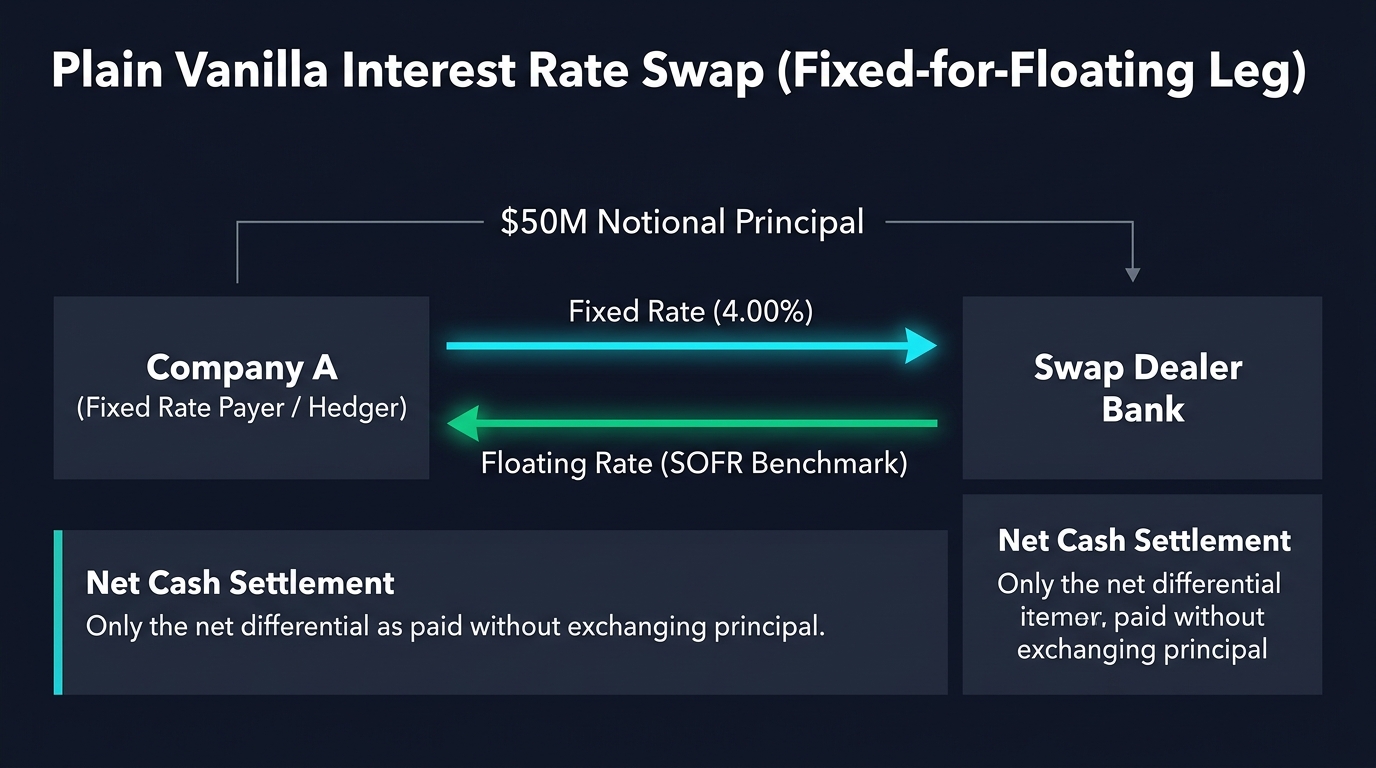
+-------------------------------------------------------------------------+
|                  PLAIN VANILLA FIXED-FOR-FLOATING SWAP                  |
|                                                                         |
|            Pays Fixed Rate (e.g., 4.20%)                                |
|  [Company A]  ------------------------->  [Bank B (Dealer)]             |
|  (Fixed-Rate   <-------------------------  (Floating-Rate               |
|   Payer)       Receives Floating (SOFR)     Payer)                      |
|                                                                         |
|  * Only the NET interest differential is exchanged on payment dates.    |
+-------------------------------------------------------------------------+
The Anatomy of a Plain Vanilla Swap
The vast majority of interest rate swaps are structured as fixed-for-floating contracts, conventionally termed “plain vanilla” swaps.
A standard contract consists of two distinct components, or “legs”:
- The Fixed Leg: One counterparty (the fixed-rate payer) agrees to pay a predetermined, unvarying interest rate (the swap rate) on specified semi-annual or annual payment dates across the life of the contract.
- The Floating Leg: The opposing counterparty (the floating-rate payer) agrees to pay a variable benchmark money-market rate that resets periodically. Following global benchmark reforms, standard floating reference rates include the Secured Overnight Financing Rate (SOFR) in the US, the Euro Short-Term Rate (€STR) in the Eurozone, and SONIA in the United Kingdom, replacing legacy LIBOR.
Concrete Institutional Hedging Example
Consider a commercial real estate development firm that secures a $50,000,000 USD loan from a syndicate of banks to construct a logistics center. The loan terms require the firm to pay a floating interest rate of SOFR + 1.50% over a 5-year term.
The firm’s Chief Financial Officer is concerned that anticipated inflation will force the Federal Reserve to raise benchmark rates, causing loan interest payments to skyrocket and making the development unprofitable.
To lock in borrowing costs, the CFO enters into a 5-year plain vanilla interest rate swap with an investment bank:
- Notional Principal: $50,000,000 USD
- Swap Terms: The firm agrees to pay a fixed swap rate of 4.00% and receive floating SOFR.
Net Cash Flow Settlement on a Semi-Annual Payment Date
Assume on the first 6-month calculation date (180 days based on 360-day money market convention), floating SOFR resets to 4.80%:
-
Fixed Leg Payment Owed by Firm: $$\text{Fixed Payment} = $50,000,000 \times 4.00% \times \frac{180}{360} = \mathbf{$1,000,000 \text{ USD}}$$
-
Floating Leg Payment Owed by Bank: $$\text{Floating Payment} = $50,000,000 \times 4.80% \times \frac{180}{360} = \mathbf{$1,200,000 \text{ USD}}$$
-
Net Settlement: Rather than exchanging two separate wires, the two legs are netted against each other: $$\text{Net Cash Transfer} = $1,200,000 - $1,000,000 = \mathbf{$200,000 \text{ USD (Paid by Bank to Firm)}}$$
-
Total Net Borrowing Cost for Firm: On the underlying loan, the firm pays the syndicate SOFR (4.80%) + 1.50% = 6.30% ($1,575,000). Receiving the $200,000 net swap payment reduces the firm’s effective interest outflow to $1,375,000, which equals exactly the budgeted 5.50% (4.00% fixed swap + 1.50% credit spread), successfully eliminating floating rate risk.
The Swap Curve: Benchmark for Global Finance
In global fixed income and macro foreign exchange markets, institutional traders track the swap curve more closely than the sovereign government bond yield curve.
The swap curve plots the fixed swap rates for various contract maturities (ranging from 1 year to 30 years). Because swap rates reflect the borrowing costs of high-grade commercial banks rather than risk-free sovereign governments, the swap curve provides a superior gauge of real interbank credit conditions and private sector funding liquidity.
The difference between the swap rate and the corresponding Treasury yield of identical maturity is known as the Swap Spread, which acts as a primary barometer of banking sector counterparty risk.
Counterparty Risk and Central Clearing
Historically, interest rate swaps were negotiated bilaterally, exposing counterparties to default risk if an institution collapsed (a primary vulnerability during the 2008 Lehman Brothers failure).
Following the Dodd-Frank Act in the United States and EMIR regulations in Europe, standardized interest rate swaps are now mandated to clear through authorized Central Counterparties (CCPs), such as LCH Clearnet. The clearinghouse enforces initial margin and daily variation margin requirements, virtually eliminating private counterparty credit defaults across the interbank swap market.
Key Takeaways
- An interest rate swap exchanges fixed and floating interest rate payments on an agreed notional principal.
- Principal amounts are never exchanged; counterparties settle only the net interest difference on payment dates.
- Major institutions use swaps to convert floating debt to fixed debt (or vice versa), neutralizing interest rate risk.
- Modern floating reference rates include SOFR (USD), €STR (EUR), and SONIA (GBP).
- Standardized swaps clear through central clearinghouses (such as LCH Clearnet), ensuring system-wide stability.
Frequently Asked Questions
What is the difference between an interest rate swap and a currency swap?
An interest rate swap is denominated in a single currency, and no principal is ever exchanged. A currency swap involves two different national currencies, where principal amounts are exchanged at inception, periodically serviced with interest, and re-exchanged at maturity.
Why do banks prefer receiving fixed rates in swaps?
Commercial banks often hold large portfolios of floating-rate loans (like commercial credit lines or variable mortgages). By entering swaps to receive fixed rates and pay floating rates, banks hedge against the risk that falling central bank interest rates will erode their interest income.
Can interest rate swaps be closed before maturity?
Yes. A counterparty can terminate a swap early by negotiating a mutual cash-settlement termination with the dealer, entering an equal and opposite offsetting swap contract, or transferring the position to a third party through an institutional novation agreement.
Ready to trade forex?
Open a free demo account with a regulated broker. Practice with virtual funds before risking real money.