Zero-Coupon Mortgage
A specialized real estate debt instrument where the borrower makes zero periodic interest or principal payments throughout the term, with the original principal and all compounded accrued interest payable as a single lump-sum balloon payment at maturity.
What Is a Zero-Coupon Mortgage?
A zero-coupon mortgage is a non-standard real estate loan structure in which the borrower is contractually exempt from making monthly or periodic debt service payments (neither principal nor interest) during the active life of the loan. Instead, contractual interest accrues continuously, capitalizing into the outstanding debt balance over time.
At the final loan maturity date (or upon the prior sale or refinancing of the property), the borrower must extinguish the debt through a single, substantial lump-sum balloon payment. This final payout comprises:
- The original principal borrowed at origination.
- The entire accumulation of compounded interest accrued over the duration of the financing term.
Because the outstanding loan balance increases rather than decreases over time, a zero-coupon mortgage is a form of planned, contractual negative amortization.
Zero-coupon mortgages are almost exclusively deployed within commercial real estate (CRE) development, institutional land acquisition, and master-planned infrastructure projects. They are virtually non-existent in consumer residential mortgage lending due to stringent consumer protection regulations, such as the Qualified Mortgage (QM) standards enforced by the Consumer Financial Protection Bureau (CFPB).
Debt Balance Dynamics and Compounding Mechanics
To visualize how debt balances evolve across different mortgage structures, consider three distinct loan types originating with an identical principal balance of $10,000,000 over a 10-year term:
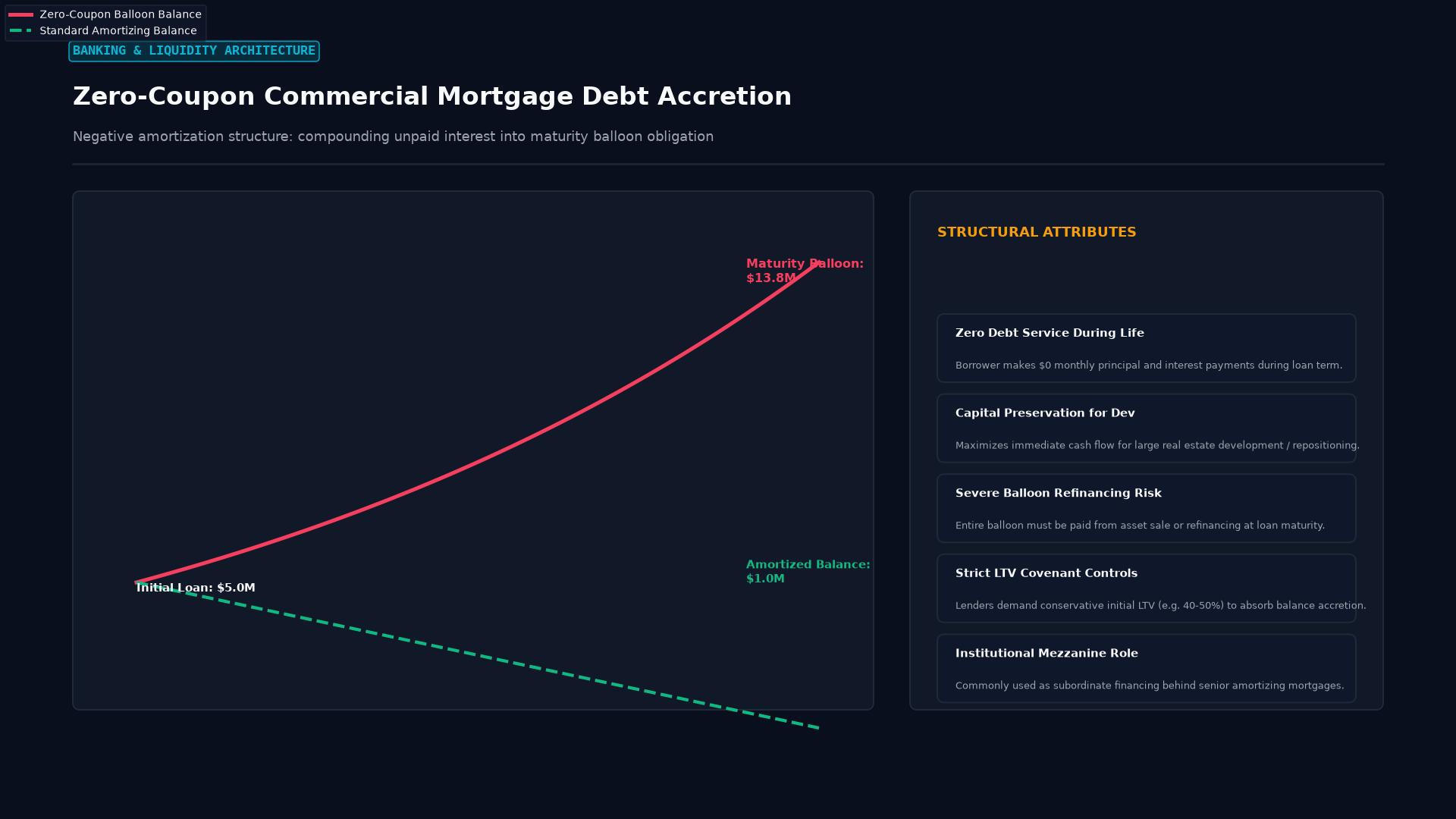 Figure: Commercial real estate financing structure: compounding unpaid interest into an expanding debt balance culminating in a single maturity balloon payoff.
Compounding Balance Formula
The total balloon debt obligation owed at loan maturity ($B_T$) is calculated using the standard compound interest formula:
$$B_T = B_0 \times \left(1 + \frac{r}{n}\right)^{n \times T}$$
Where:
- $B_0$ is the initial loan principal disbursed at closing.
- $r$ is the nominal annual contractual interest rate.
- $n$ is the compounding frequency per year (typically monthly, $n = 12$, or semi-annually, $n = 2$).
- $T$ is the total loan tenor in years.
Numerical Example:
A commercial real estate developer secures an 8-year zero-coupon mortgage of $12,000,000 at a fixed interest rate of 7.00% compounded annually to fund land acquisition and infrastructure preparation for an industrial logistics park:
$$B_8 = $12,000,000 \times (1 + 0.07)^8 = $12,000,000 \times 1.718186 \approx $20,618,234$$
Throughout the 8-year construction and leasing phase, the developer makes zero debt payments to the lender. At the end of Year 8, the developer must refinance the completed, cash-flowing industrial park or sell parcels to pay the bank the full balloon balance of $20,618,234.
When and Why Borrowers Use Zero-Coupon Mortgages
Zero-coupon debt is tailored specifically for real estate assets characterized by long construction or stabilization horizons where interim operational cash flows are negligible or zero:
               DEVELOPMENT PHASES SUITED FOR ZERO-COUPON FINANCING

    Phase 1: Acquisition & Permitting  ──► Zero Operating Revenue
    Phase 2: Master Site Preparation   ──► Zero Operating Revenue
    Phase 3: Vertical Construction     ──► Zero Operating Revenue
    Phase 4: Property Leasing Out      ──► Initial Rent Commences
    Phase 5: Stabilized Occupancy      ──► Substantial Net Operating Income (NOI)
                                           Refinance Zero-Coupon Balloon!
1. Large-Scale Land Development
Raw land generates zero rental income while requiring substantial capital for zoning approvals, environmental remediation, and civil utility installation. Forcing a developer to service debt interest out of pocket during a 5-year entitlement process threatens insolvency. A zero-coupon structure matches debt repayment to parcel sales.
2. Major Commercial Property Turnarounds
Private equity real estate funds acquiring blighted, vacant, or environmentally compromised commercial buildings face multi-year gut renovations. Because tenant leases cannot be signed until construction is complete, zero-coupon structures eliminate debt-service default risk during construction.
3. Corporate Real Estate Arbitrage and Synthetic Leases
Credit tenants with high credit ratings sometimes structure zero-coupon financing through special purpose vehicles (SPVs) to construct mission-critical corporate headquarters, deferring payments until corporate occupancy commences.
Lender Underwriting and Risk Mitigation Criteria
Because lenders face compounding loan balances and collect zero cash flow for years, zero-coupon mortgages carry heightened risk. Institutional lenders (such as life insurance companies, pension funds, and private debt funds) enforce strict underwriting safeguards:
| Underwriting Parameter | Standard CRE Mortgage | Zero-Coupon CRE Mortgage | Lender Rationale |
|---|---|---|---|
| Initial Loan-to-Value (LTV) | 65% to 75% | 30% to 50% Maximum | Ensures compounded balloon will not exceed future property value |
| Projected Maturity LTV | Amortizes downward | Under 65% of Stabilized Value | Protects lender against real estate market cyclical downturns |
| Debt Service Coverage Ratio (DSCR) | 1.25x to 1.40x required | Not Applicable (0.0x) | Compensated by deeper sponsor equity and land equity |
| Borrower Recourse | Non-recourse with standard bad-boy carveouts | Often requires completion guarantees or partial recourse | Ensures developer finishes construction and secures tenant leases |
| Interest Rate Pricing | Modest credit spread | Premium Spread (150-300 bps higher) | Compensates lender for illiquidity and back-loaded credit risk |
Structural Risks of Zero-Coupon Mortgages
Both borrowers and lenders must manage significant financial hazards inherent to non-amortizing compounding debt:
1. Balloon Refinancing Risk
The primary threat to the borrower is the refinancing cliff. If prevailing commercial mortgage rates surge, credit markets seize (as in 2008), or property valuations decline near maturity, the borrower may be unable to secure a replacement mortgage large enough to cover the compounded balloon balance. Without outside capital, foreclosure ensues.
2. Collateral Cushion Erosion
If the real estate development experiences unexpected delays (such as protracted litigation or environmental challenges) and local property values stagnate, the compounding loan balance rapidly catches up with property value. The equity cushion vanishes, pushing the loan into an underwater position where total debt exceeds collateral value.
3. Asymmetric Tax Implications
For taxable lenders, the IRS Original Issue Discount (OID) rules require the recognition of imputed taxable interest income annually, even though zero cash is received. Consequently, non-bank private debt lenders issuing zero-coupon mortgages are typically tax-exempt institutions, foreign sovereign wealth funds, or private equity vehicles structured through offshore partnerships.
Frequently Asked Questions
Can a homeowner get a zero-coupon mortgage for a primary residence?
No. In modern regulated financial systems, consumer zero-coupon residential mortgages are effectively barred. Regulations such as the Dodd-Frank Act’s Ability-to-Repay (ATR) rule and Qualified Mortgage standards prohibit residential loans with negative amortization or mandatory unhedged balloon payments, protecting consumer homeowners from predatory repayment shocks.
How does a zero-coupon mortgage differ from a reverse mortgage?
While both involve negative amortization where interest compounds without monthly payments, their objectives and demographics differ completely. A reverse mortgage (such as a Home Equity Conversion Mortgage or HECM) is a government-regulated product for senior homeowners (typically age 62+) that pays cash to the borrower against their home equity, with repayment deferred until death or permanent relocation. A zero-coupon mortgage is an institutional commercial development loan structured for business entities.
What happens if the property sells before the loan maturity date?
If the property is sold or refinanced before the stated maturity, the borrower executes an early payoff. The outstanding payoff amount is calculated as the original principal plus all interest compounded up to the exact date of payoff. Some contracts include prepayment penalty clauses or guaranteed minimum yield hurdles (yield maintenance) to ensure the lender achieves its projected internal rate of return (IRR).
Ready to trade forex?
Open a free demo account with a regulated broker. Practice with virtual funds before risking real money.