Zombie Debt
Old, charged-off, time-barred, or discharged consumer debt that has exceeded statutory collection periods or legal enforceability, acquired by debt buyers for pennies on the dollar who attempt to revive and collect it.
Zombie Debt
Zombie debt refers to old, uncollected consumer debt that has been charged off by the original creditor, legally discharged in bankruptcy, or extinguished by the expiration of statutory limitations. Named for its ability to “rise from the dead,” zombie debt is purchased from originators by secondary and tertiary debt buyers for fractions of a cent on the dollar. Collection agencies then deploy aggressive communications, psychological pressure, and legal maneuvers to entice consumers into making payments, thereby resurrecting obsolete liabilities into legally enforceable claims.
In retail banking, consumer credit markets, and debt collection regulation, zombie debt represents a contentious intersection of contract law, credit reporting standards, and financial consumer protection. Understanding the legal lifecycle of defaulted credit accounts is essential for assessing consumer credit portfolios, evaluating distressed asset-backed transactions, and avoiding financial traps that compromise personal balance sheets.
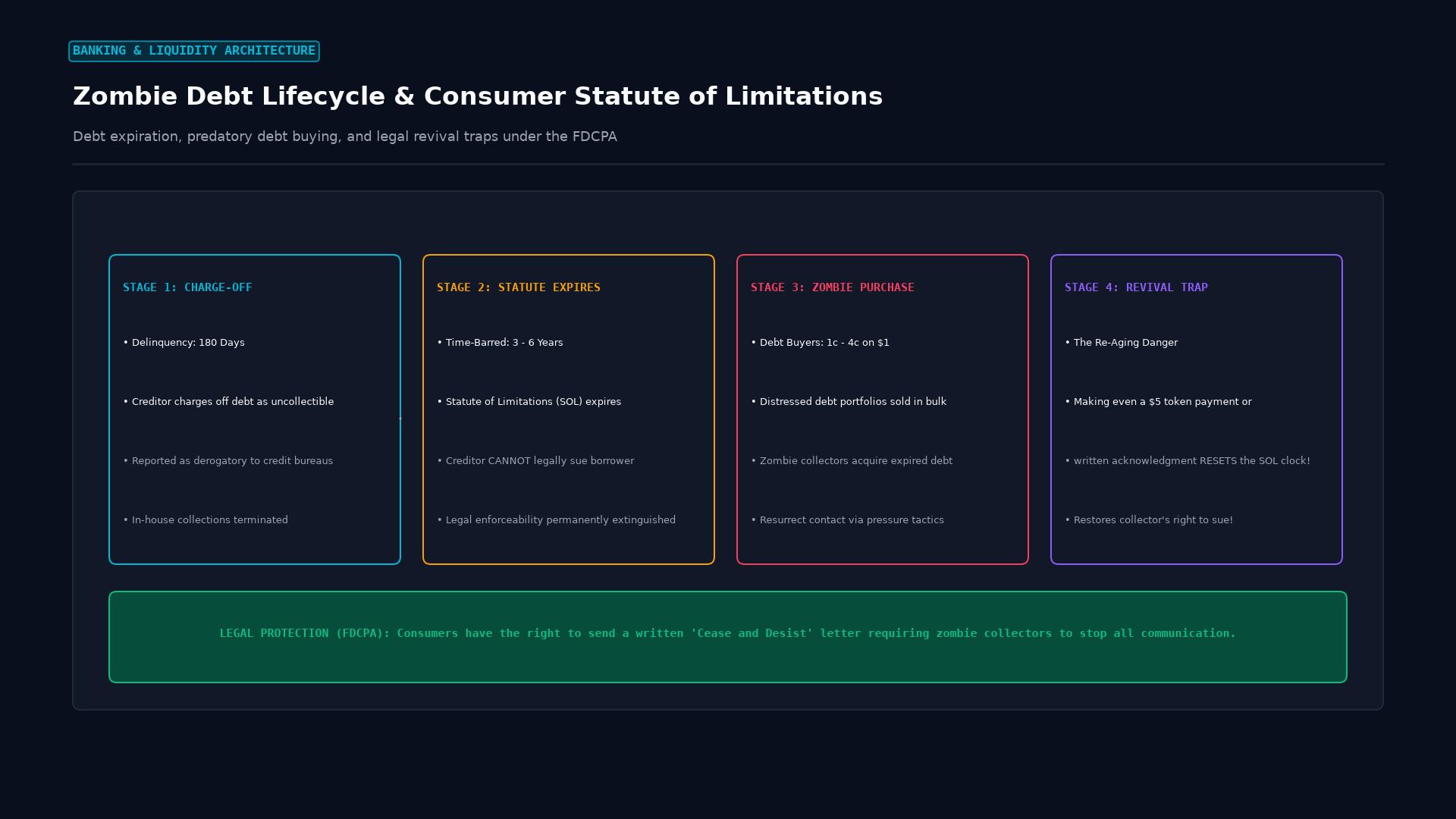 Figure: The lifecycle of time-barred consumer debt: legal expiration under the statute of limitations, secondary junk debt buyer resale, and revival traps under the FDCPA.
The Secondary Distressed Debt Marketplace
When consumer borrowers default on revolving credit cards, personal loans, or medical bills, originators follow a standardized accounting and collection sequence dictated by banking regulations:
+--------------------------------------------------------------------------+
|                  Classification of Consumer Debt Portfolios              |
+--------------------------------------------------------------------------+
|  Debt Tier       | Account Status         | Typical Secondary Sale Price |
+------------------+------------------------+------------------------------+
|  Fresh Paper     | 30 to 90 days past due | 20¢ to 45¢ per dollar of par |
|  Primary Paper   | Charged off (180 days) | 4¢ to 10¢ per dollar of par  |
|  Secondary Paper | Failed 1st collector   | 1.5¢ to 4¢ per dollar of par |
|  Tertiary Paper  | Out of statute / aged  | 0.1¢ to 1¢ per dollar of par |
+--------------------------------------------------------------------------+
The Charge-Off Mechanism
Under Federal Financial Institutions Examination Council (FFIEC) uniform guidelines, commercial banks must write off revolving credit card accounts once payments are delinquent for 180 days. A charge-off is an internal accounting entry: the bank recognizes a bad-debt loss, claims a corporate tax deduction, and removes the asset from active loan receivables.
However, a charge-off does not forgive the consumer’s contractual liability. Banks bundle thousands of charged-off files into massive digital spreadsheets, selling them in bulk through portfolio purchase agreements.
Debt Buyers and Portfolio Warehousing
Purchasers range from publicly traded debt acquisition giants (such as Encore Capital Group and PRA Group) to small, regional collection shops. When debts fail to yield cash after multiple collection cycles, they are sold down the tier hierarchy.
By the time debt reaches tertiary or “warehouse” status, it has aged six to twelve years. A debt buyer acquiring a $5,000 credit card balance for $25 (0.5% of par) achieves an astronomical return on invested capital if they can pressure the consumer into paying even $500.
Legal Architecture: Statute of Limitations vs. Legal Obligation
A foundational legal reality of consumer finance is the distinction between the legal obligation to pay and the legal remedy to enforce collection in court:
+--------------------------------------------------------------------------+
|                   Obligation vs. Judicial Enforceability                 |
+--------------------------------------------------------------------------+
|                                                                          |
|  [ Original Contractual Obligation ] ───► Never Fully Disappears         |
|                                           (Unless Discharged in Bankrupt)|
|                                                                          |
|  [ Judicial Enforcement Window ]     ───► Governed by State Statute      |
|  (Right to Sue for Judgment/Garnish)      of Limitations (SOL)           |
|                                                                          |
|  [ Expiration of SOL ]               ───► Debt Becomes "Time-Barred"     |
|                                           Collector Loses Judicial Club  |
|                                                                          |
+--------------------------------------------------------------------------+
The Statute of Limitations (SOL)
Every state legislature establishes a statutory limitations window for breach of contract claims. For written contracts and open-ended revolving credit, statutory limits typically span three to six years (extending up to ten years in select jurisdictions like Rhode Island):
- Once the statute of limitations expires, the debt is classified as time-barred.
- The creditor retains the right to ask the consumer to pay voluntarily.
- The creditor loses the legal standing to obtain a court judgment, garnish wages, or freeze bank accounts.
The Dangerous “Revival Trap” (Re-Aging Zombie Debt)
The defining tactic in the zombie debt industry is the intentional revival of time-barred liabilities. In most jurisdictions, statutory law allows an expired statute of limitations to be completely restarted:
[ Expired Time-Barred Debt: Zero Judicial Exposure for Consumer ]
                                │
                                ▼
[ Collector Phone Call: Offers "Settlement" or Asks for $10 "Good Faith" ]
                                │
                                ▼
[ Consumer Sends $10 Payment OR Signs Acknowledgment Letter ]
                                │
                                ▼
[ LEGAL TRAP: Partial Payment Resets Statute of Limitations to Day Zero ]
                                │
                                ▼
[ Collector Sues Consumer in Local Court for Full $5,000 + Compound Interest ]- The Nominal Token Payment: A collection agent contacts a consumer regarding an eight-year-old $4,000 debt. The collector states, “If you pay just $15 today, we will show you are acting in good faith.” The moment the $15 clears, contract law treats the partial payment as reaffirmation of the entire debt contract. The statute of limitations resets, restoring the collector’s full legal power to sue for the remaining $3,985 plus accrued legal fees.
- Written Acknowledgment: Signing an agreement that recognizes the debt as valid can also restart the statutory clock, transforming an uncollectible claim back into an active lawsuit risk.
Consumer Protection Statutes and Regulatory Frameworks
Federal regulators have constructed strict legal barriers to combat abusive zombie debt practices:
+--------------------------------------------------------------------------+
|                     Federal Legal Defense Framework                      |
+--------------------------------------------------------------------------+
|  Statutory Regime          | Core Prohibition Protecting Consumers       |
+----------------------------+---------------------------------------------+
|  CFPB Regulation F         | Prohibits filing or threatening a lawsuit   |
|  (12 CFR Part 1006)        | on time-barred debt under any circumstances |
|  Fair Debt Collection      | Bars deceptive, harassing, or misleading    |
|  Practices Act (FDCPA)     | tactics; mandates Debt Validation Notices   |
|  Fair Credit Reporting Act | Mandates removal of derogatory marks after  |
|  (FCRA, 15 U.S.C. § 1681)  | 7 years from original delinquency date      |
|  US Bankruptcy Code        | Absolute injunction against collecting on   |
|  (11 U.S.C. § 524)         | debts discharged in Chapter 7 or 13 filings |
+--------------------------------------------------------------------------+
1. CFPB Regulation F (November 2021)
Issued by the Consumer Financial Protection Bureau, Regulation F codified an explicit federal prohibition: a debt collector may not bring, or threaten to bring, a legal action against a consumer to collect a time-barred debt. Even implying that litigation could occur violates federal law, entitling consumers to statutory damages of up to $1,000 per violation under the FDCPA, plus actual damages and attorney fees.
2. Fair Credit Reporting Act (FCRA) 7-Year Obsolescence
Debts cannot linger on consumer credit reports forever. Section 605 of the FCRA mandates that consumer reporting agencies (Equifax, Experian, TransUnion) purge charged-off accounts seven years plus 180 days from the original date of delinquency (DOFD).
Unscrupulous collectors engage in illegal credit re-aging, submitting falsified recent delinquency dates to credit bureaus to poison a consumer’s credit score. Re-aging is a severe federal offense that credit bureaus must correct immediately upon receiving dispute documentation.
3. Bankruptcy Discharge Injunctions
When a debtor receives a bankruptcy discharge under Chapter 7 or Chapter 13, Section 524 of the Bankruptcy Code issues an automatic, permanent statutory injunction against creditors. Discharged debts are legally dead. Any debt buyer attempting to collect on a discharged debt violates federal court orders, exposing the agency to contempt sanctions, punitive damages, and mandatory legal fees.
Consumer Defense Playbook: Neutralizing Zombie Claims
When contacted by collectors attempting to revive stale accounts, consumer financial specialists follow a disciplined, four-step protocol:
[ Contact Received from Debt Collector ]
                   │
                   ▼
[ DO NOT Acknowledge Debt & DO NOT Pay Any Money ]
                   │
                   ▼
[ Send Written Debt Validation Letter within 30 Days (FDCPA § 809) ]
                   │
                   ▼
[ Demand Chain-of-Title, Original Creditor Agreement & DOFD ]
                   │
                   ▼
       ┌───────────┴───────────┐
       ▼                       ▼
 [ Debt is Time-Barred ]  [ Fails to Validate Chain ]
 - Send Cease & Desist    - Demand Complete File Deletion
- Cite CFPB Reg F Ban - Dispute Credit Bureau Tradelines- Absolute Payment Freeze: Never agree to make a “good faith” token payment, provide bank routing details, or admit personal responsibility for the balance over the phone.
- Demand a Debt Validation Notice: Under FDCPA Section 809, collectors must provide written validation detailing the original creditor, balance breakdown, and consumer dispute rights. If the collector bought a spreadsheet containing only a name and phone number with zero underlying contract records, they cannot legally validate the claim.
- Audit the Statute of Limitations: Determine the governing state’s contract limitation window and cross-reference it against the date of first default.
- Issue a Formal Cease and Desist: Once an account is verified as time-barred, consumers can issue a written directive under FDCPA § 805(c) ordering the agency to halt all telephone, mail, and electronic communications.
Frequently Asked Questions
Can a debt collector sue me for zombie debt?
No, not if the debt is time-barred under your state’s statute of limitations. Under CFPB Regulation F, filing a lawsuit or even threatening legal action on time-barred debt is a direct violation of federal law. If a collector does file a lawsuit, you must file an answer asserting the statute of limitations as an affirmative defense, which results in dismissal with prejudice.
Does paying $10 on an old debt hurt my financial standing?
Yes, severely. Making a small token payment can trigger the legal revival trap, resetting the statute of limitations back to day zero. This transforms an uncollectible, time-barred debt into an active legal liability, exposing you to immediate litigation, bank levies, and wage garnishments.
How long can zombie debt remain on my credit report?
Under the federal Fair Credit Reporting Act, negative collection tradelines must be deleted from your credit report after seven years from the original delinquency date. Even if a collector resells the account or attempts to re-age the file, the credit bureaus are legally required to remove the entry once the seven-year window closes.
Ready to trade forex?
Open a free demo account with a regulated broker. Practice with virtual funds before risking real money.