Zombie Bank
An insolvent financial institution with an economic net worth below zero that continues operating because government bailouts, implicit deposit guarantees, and central bank liquidity facilities sustain its liability structure while regulators exercise forbearance.
Zombie Bank
A zombie bank is a commercial bank or financial institution that is economically insolvent, with the true market value of its assets falling below its total outstanding liabilities. Despite possessing a negative economic net worth, the institution avoids closure, receivership, or liquidation because government guarantees, emergency central bank liquidity injections, and regulatory forbearance shield its balance sheet from market discipline.
The terminology was introduced in 1987 by financial economist Edward J. Kane during the United States Savings and Loan (S&L) crisis. Kane described how insolvent thrifts continued operating because deposit insurance funds (specifically the Federal Savings and Loan Insurance Corporation, or FSLIC) lacked the capital reserves to shut them down and reimburse depositors. In modern macroeconomics, zombie banking represents a structural market failure that distorts credit allocation, subsidizes inefficient enterprises, and depresses national productivity for decades.
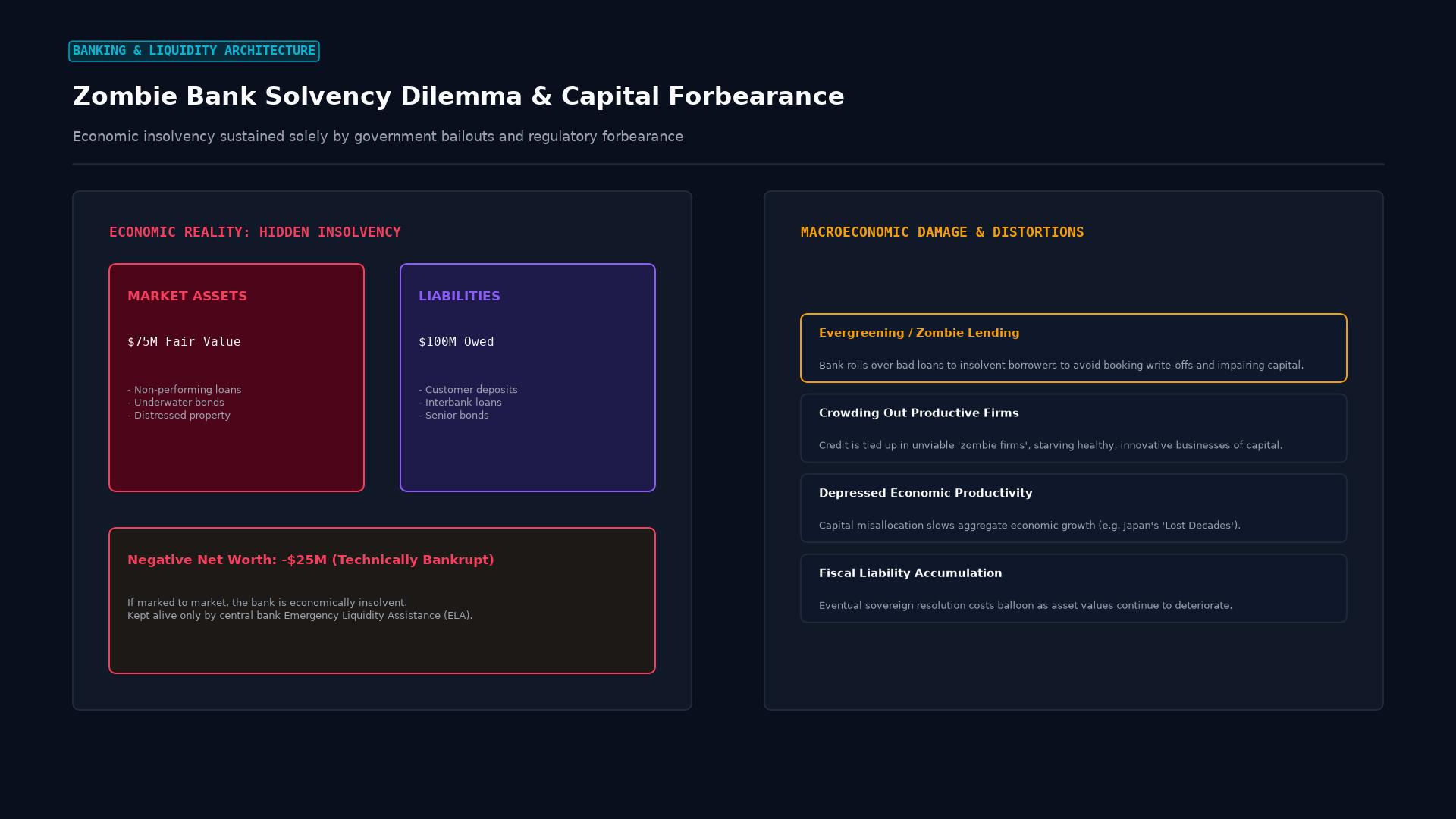 Figure: Economic insolvency trap: market liabilities exceeding true asset values sustained only by government bailouts and regulatory forbearance, triggering zombie lending.
Historical Case Studies in Zombie Banking
The dynamics of zombie banking have shaped several of the most prolonged financial crises of the modern era:
1. The US Savings and Loan Crisis (1980s)
When the Federal Reserve under Paul Volcker raised short-term interest rates to 20% to conquer inflation, thousands of savings and loans faced devastating asset-liability mismatches. Thrifts held 30-year fixed-rate residential mortgages yielding 6% to 8%, while their cost of short-term retail deposits surged past 12%.
Regulators, unwilling to acknowledge the insolvency of hundreds of thrifts, enacted accounting forbearance. They permitted thrifts to defer loan losses, invent fictitious regulatory goodwill assets, and engage in high-risk commercial real estate and junk bond speculation to “gamble for resurrection.” When the crisis finally terminated in the late 1980s, the newly formed Resolution Trust Corporation (RTC) liquidated hundreds of institutions, costing American taxpayers over $120 billion.
2. Japan’s Lost Decades (1990s to 2000s)
Following the collapse of the Japanese asset price bubble in 1990, urban commercial real estate and equity prices plummeted by more than 70%. Japan’s major city banks were left holding colossal mountains of non-performing loans (NPLs).
Rather than seizing collateral and forcing borrower liquidations, Japanese banks practiced zombie lending (oigashi). Banks extended additional credit to bankrupt property developers, construction giants, and retailers just so those borrowers could service their existing interest payments. Writing off the debts would have depleted the banks’ Tier 1 regulatory capital, triggering forced restructuring by the Ministry of Finance. This prolonged forbearance locked capital and labor into stagnant enterprises, cementing decades of economic deflation.
3. The European Sovereign Debt Crisis (2010 to 2012)
In the aftermath of the 2008 global financial crisis, regional banks across Spain (the cajas), Greece, Italy, and Ireland held massive portfolios of distressed real estate loans and devalued domestic government bonds. European regulators delayed severe asset quality reviews, relying on European Central Bank (ECB) Long-Term Refinancing Operations (LTRO) to provide cheap funding.
The interdependence between insolvent domestic banks and fiscally strained sovereign governments formed a destructive sovereign-bank doom loop. Banks purchased domestic sovereign bonds to generate carry yield, while the sovereign backed the banks’ deposit guarantees, ensuring that any sovereign downgrade threatened immediate banking insolvency.
Accounting Architecture: How Insolvency Is Hidden
Zombie banks remain legally capitalized through accounting treatments that mask mark-to-market economic losses:
+--------------------------------------------------------------------------+
|                  Accounting Cloaks for Underwater Assets                 |
+--------------------------------------------------------------------------+
|  Mechanism               | How It Conceals True Balance Sheet Distress   |
+--------------------------+-----------------------------------------------+
|  Held-to-Maturity (HTM)  | Bonds purchased at par are recorded at book   |
|  Classification          | value, ignoring massive paper losses caused   |
|                          | by rapid benchmark interest rate hikes        |
|  Evergreening Credit     | Banks grant new credit to distressed debtors  |
|  Facilities              | specifically to service past-due interest,    |
|                          | preventing loans from migrating to NPL status |
|  Delayed Loss Reserves   | Management models optimistic future recovery   |
|  (Inadequate CECL/ECL)   | rates to minimize current-period loan loss    |
|                          | charges against regulatory common equity      |
|  Regulatory Goodwill     | Regulators permit banks to treat unamortized   |
|  Concessions             | acquisition premiums as core regulatory Tier 1|
|                          | capital, inflating official solvency metrics  |
+--------------------------------------------------------------------------+
Under mark-to-market accounting, balance sheet assets are revalued to prevailing market prices daily. When interest rates rise sharply or borrower default risk escalates, asset values drop immediately, depleting common equity.
Zombie banks survive by categorizing depreciated fixed-income securities as Held-to-Maturity (HTM). Under both US GAAP (ASC 320) and IFRS (IFRS 9), HTM assets are insulated from market fluctuations, allowing an institution whose economic equity is completely wiped out on an exit-value basis to present compliant regulatory capital ratios on paper.
The Macroeconomic Zombie Spiral
When an economy permits zombie banks to endure, the contagion spreads throughout the real economy:
[ Insolvent Zombie Banks Preserved via Regulatory Forbearance ]
                             │
                             ▼
[ Zombie Banks Must Avoid Writing Down Loans to Insolvent Borrowers ]
                             │
                             ▼
[ Banks Extend Subsidized Evergreening Credit to Dying Zombie Firms ]
                             │
                             ▼
[ Capital Starvation for Innovative, Productive Startups & SMEs ]
                             │
                             ▼
[ Market Sclerosis: Depressed Productivity Growth & Stagnant Wages ]- Capital Misallocation: Bank lending departments cut credit lines to healthy, expanding companies to preserve capital for evergreen loans to insolvent legacy debtors. Productive enterprises are starved of investment capital.
- Zombie Congestion: Unviable companies (zombie firms) that should be liquidated are kept alive artificially. They maintain excess production capacity, depress product prices, and bid up commercial wages and raw material costs, dragging down the profit margins of healthy competitors.
- Impaired Monetary Policy Transmission: When a central bank adjusts baseline interest rates, the transmission mechanism breaks down. Zombie banks hoard excess liquidity to bolster their internal reserves rather than passing credit easing into commercial loans.
Detecting a Zombie Bank: Key Financial Ratios
Institutional equity analysts, short sellers, and credit rating agencies monitor specific financial ratios to identify banks operating in economic insolvency:
+--------------------------------------------------------------------------+
|                    Zombie Bank Diagnostic Scorecard                      |
+--------------------------------------------------------------------------+
|  Financial Ratio         | Healthy Bank Benchmark | Zombie Bank Alert    |
+--------------------------+------------------------+----------------------+
|  Price-to-Book (P/B)     | 1.0x to 1.8x           | Persistently < 0.4x  |
|  The Texas Ratio         | Less than 30%          | Exceeds 85% to 100%  |
|  Net Interest Margin     | 2.5% to 4.5%           | Collapsing < 1.2%    |
|  NPL Coverage Ratio      | > 100% of bad loans    | Deficient < 40%      |
|  Discount Window Reliance| Zero / Occasional      | Persistent / Daily   |
+--------------------------------------------------------------------------+
The Texas Ratio
Developed by banking analyst Gerard Cassidy during the 1980s Texas banking collapse, the Texas Ratio compares credit problems directly against tangible equity cushions:
$$\text{Texas Ratio} = \frac{\text{Non-Performing Loans} + \text{Real Estate Owned (REO)}}{\text{Tangible Common Equity} + \text{Loan Loss Reserves}}$$
When the Texas Ratio approaches or exceeds 100%, existing bad loans are large enough to consume the bank’s entire equity cushion and loss reserves. Any subsequent loan default pushes the institution into immediate book insolvency.
Price-to-Book Ratio (P/B) Discount
Public equity markets often diagnose zombie banks long before regulators act. When a bank’s shares trade at 0.2x or 0.3x of reported book value for multiple quarters, equity markets are signaling that the reported book assets are fictional. Investors discount the balance sheet to account for unacknowledged credit impairments and underwater securities.
Regulatory Reforms and Resolution Architectures
To eliminate the systemic incentives that cultivate zombie institutions, post-crisis financial regulation introduced aggressive resolution mechanisms:
1. Prompt Corrective Action (PCA)
Enacted in the US under the Federal Deposit Insurance Corporation Improvement Act of 1991 (FDICIA), PCA establishes mandatory regulatory intervention triggers tied strictly to capital ratios. When a bank’s Tier 1 Risk-Based Capital ratio drops below statutory minimums (or Tangible Equity falls below 2%), regulators are legally prohibited from granting discretionary forbearance. They must enforce capital restoration plans, restrict deposit interest rates, halt dividend distributions, and initiate receivership within strict deadlines.
2. Basel III Capital Surcharges and Stress Testing
The Basel Committee on Banking Supervision introduced the Capital Conservation Buffer (2.5%) and Global Systemically Important Bank (G-SIB) surcharges. Comprehensive Capital Analysis and Review (CCAR) stress tests subject banks to severe hypothetical macroeconomic shocks. Banks that fail stress tests must suspend share buybacks and recapitalize immediately.
3. Bail-In Frameworks
Under the European Bank Recovery and Resolution Directive (BRRD) and international Financial Stability Board (FSB) standards, modern resolutions mandate that junior debt holders and uninsured creditors absorb losses (bail-in) before sovereign taxpayers inject capital (bailout). This structure prevents governments from keeping unviable banks alive indefinitely.
Frequently Asked Questions
What is the difference between a zombie bank and a failed bank?
A failed bank has been closed, seized, or placed into receivership by bank regulatory authorities (such as the FDIC). A zombie bank is fundamentally insolvent in economic reality, but regulators allow it to continue daily operations through legal forbearance, emergency loans, or accounting concessions.
Why do governments tolerate zombie banks?
Governments fear the immediate economic fallout of closing large institutions. Liquidating a major bank can trigger interbank panic, freeze commercial payroll systems, force massive taxpayer payouts from deposit insurance funds, and cause a sharp political backlash. Authorities often choose forbearance in the hope that general economic recovery will heal balance sheets over time.
How does central bank quantitative easing contribute to zombie banking?
Prolonged quantitative easing and ultra-low interest rates reduce bank borrowing costs to near zero, while central bank asset purchase programs accept low-quality collateral at subsidized rates. This cheap liquidity allows insolvent banks to fund themselves indefinitely, removing the market pressure to write off bad assets or raise private equity capital.
Ready to trade forex?
Open a free demo account with a regulated broker. Practice with virtual funds before risking real money.