ZZZZ Best
A 1980s commercial carpet cleaning and building restoration company founded by Barry Jay Minkow that operated as an elaborate Ponzi scheme and multi-million-dollar accounting fraud, culminating in catastrophic bankruptcy and landmark auditing regulatory reforms.
ZZZZ Best
ZZZZ Best Co., Inc. was a Southern California carpet-cleaning and building-restoration company established in 1982 by teenage entrepreneur Barry Jay Minkow. Celebrated across national media outlets as a prodigy of American capitalism, Minkow orchestrated one of the most brazen securities frauds and Ponzi schemes in modern financial history. At its peak in early 1987, ZZZZ Best held a public market valuation exceeding $280 million on the NASDAQ exchange, despite the fact that over 85% of its reported revenues and contracts were completely fabricated.
The subsequent unraveling and bankruptcy of ZZZZ Best exposed systemic vulnerabilities in the independent auditing profession, the limitations of passive regulatory reviews, and the structural loopholes governing reverse mergers and penny stock underwriting. The scandal prompted landmark congressional investigations that reshaped the American Institute of Certified Public Accountants (AICPA) fraud-detection standards, laying the conceptual groundwork for modern forensic accounting and the Sarbanes-Oxley Act of 2002.
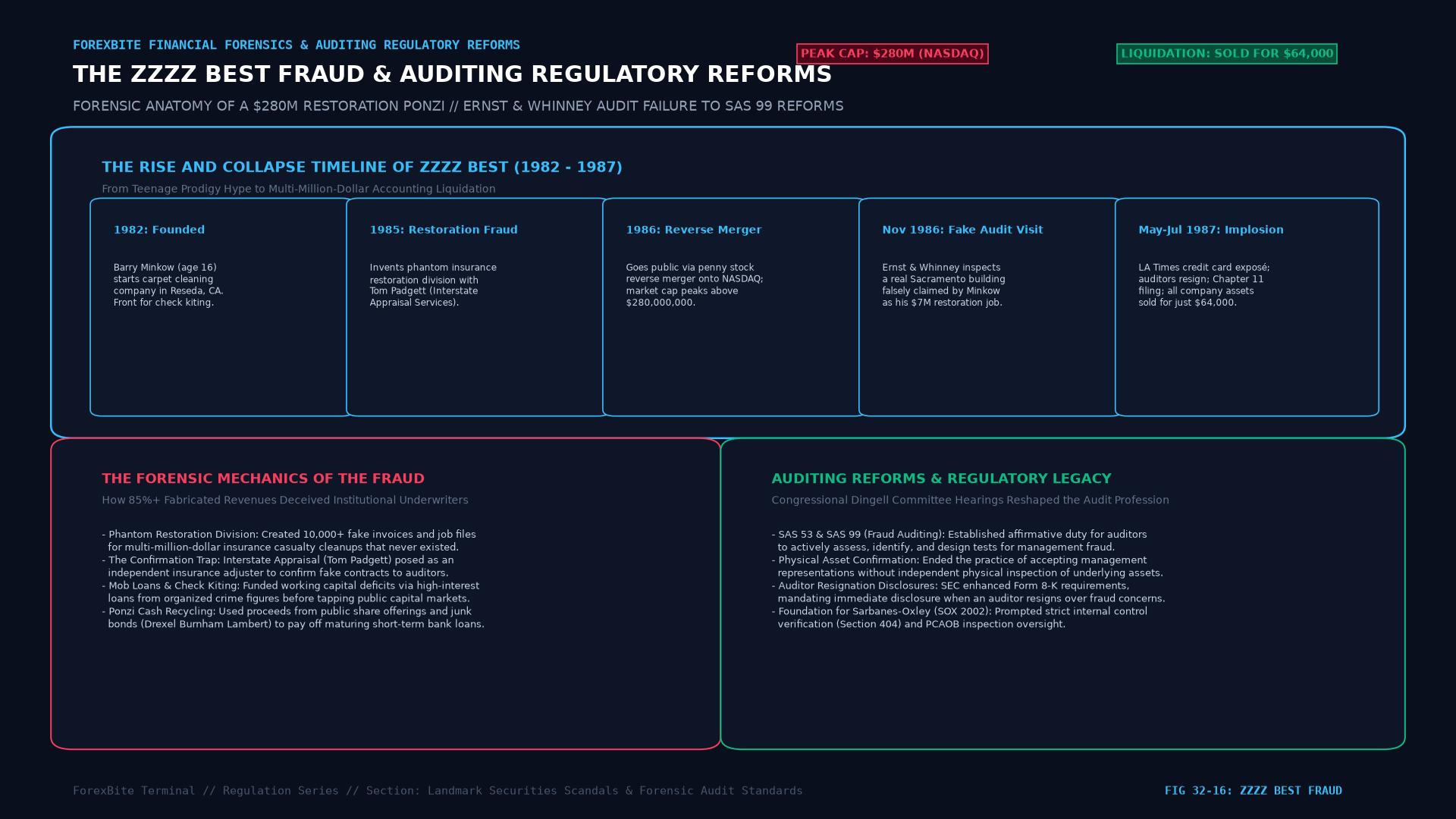 Figure: The rise and fall timeline of ZZZZ Best alongside the forensic mechanisms of the $280M phantom restoration scheme and resulting SAS 99 fraud auditing reforms.
The Forensic Anatomy of the Fraud
While ZZZZ Best maintained authentic residential carpet-cleaning vans operating in the San Fernando Valley, carpet cleaning was a low-margin, capital-intensive front. To satisfy Minkow’s lavish lifestyle and finance corporate growth, the enterprise engaged in a multi-layered criminal architecture:
+--------------------------------------------------------------------------+
|                  The Operational Pillars of the ZZZZ Best Fraud          |
+--------------------------------------------------------------------------+
|  Operational Layer     | Forensic Mechanics & Execution                  |
+------------------------+-------------------------------------------------+
|  Phantom Insurance     | Fabricated multi-million-dollar structural fire |
|  Restoration Division  | and flood restoration jobs for insurance giants |
|  Paperwork Factory     | Thousands of forged invoices, work orders, and  |
|  (Interstate Appraisal)| completion sign-offs generated by Tom Padgett   |
|  Check Kiting & Loans  | Factoring fake receivables to mob loan sharks   |
|                        | (Jack Catain) and siphoning bank credit lines   |
|  The Ponzi Recycling   | Using new investor proceeds and secondary stock |
|  Loop                  | sales to pay interest and fees on old borrowings|
+--------------------------------------------------------------------------+
1. The Insurance Restoration Mirage
Minkow recognized that private carpet cleaning could never justify institutional valuations. He invented a commercial restoration division specializing in repairing catastrophic water, fire, and structural building damage for major casualty insurers.
To corroborate these fictitious multi-million-dollar contracts, Minkow recruited an associate, Thomas Padgett, who operated a shell company named Interstate Appraisal Services. Whenever prospective lenders or underwriters sought verification of an insurance restoration job, they were directed to Padgett. Padgett answered telephone inquiries, confirmed bogus job specifications on letterhead, and verified that insurance carriers had approved multi-million-dollar claims payable to ZZZZ Best.
2. Credit Card Fraud and Check-Kiting
During the company’s early years, when operational expenses exceeded incoming cash, Minkow engaged in continuous check-kiting between multiple bank accounts, exploiting clearing float times. Concurrently, ZZZZ Best fraudulently charged thousands of dollars to customers’ credit cards, altering charge slips after completing modest residential cleaning visits.
Deceiving the Independent Auditors: The Sacramento Stunt
As ZZZZ Best prepared for a major public underwriting and an ambitious $25 million junk-bond offering arranged by Drexel Burnham Lambert to acquire competitor Key Serv Group, independent auditors demanded physical verification of the company’s largest contracts.
In 1986, the prominent national accounting firm Ernst & Whinney (now Ernst & Young) took over the audit. A senior audit partner insisted on conducting a mandatory physical site inspection of a reported $7 million insurance restoration project on an eight-story commercial office building in Sacramento, California.
[ Auditor Demands Physical Site Inspection of $7M Sacramento Restoration Job ]
                                     │
                                     ▼
[ Minkow Discovers Unfinished Commercial Building Under Real Construction ]
                                     │
                                     ▼
[ Co-Conspirator Bribes Building Security Guard with Cash Kickbacks ]
                                     │
                                     ▼
[ Minkow Erects Phony ZZZZ Best Signs, Rents Equipment, Stages Phony Workers ]
                                     │
                                     ▼
[ Ernst & Whinney Auditors Given Guided Tour; Check Off "Physical Verification" ]
The Sacramento building was real, but it had suffered no flood damage, and ZZZZ Best had never been hired by the property owners. Minkow bribed a building security guard, gained weekend access, installed professional commercial signs stating “ZZZZ Best Building Restoration Operations,” moved in construction equipment, and paid actors to wear hard hats and carry blueprints.
The audit partner toured the staged facility, observed the active workers, checked the box for physical site inspection, and issued an unqualified clean audit opinion. The auditors failed to check land title registries, verify building permits with the Sacramento Department of Building and Safety, or independently contact the actual property owners.
Collapse and the Confidentiality Loophole
The house of cards collapsed with stunning speed in the spring of 1987:
- The Investigative Exposé: On May 22, 1987, the Los Angeles Times published a front-page investigative report detailing hundreds of unauthorized credit card charges generated by ZZZZ Best against residential customers.
- Short Seller Scrutiny: Quantitative short sellers, led by investor Mark Moroze, began investigating the reported insurance restoration jobs. Finding zero public building permits or recorded property insurance claims, they aggressively shorted the stock.
- Auditor Resignation: Alarmed by discrepancies, Ernst & Whinney resigned as independent auditors on June 2, 1987.
- The Confidentiality Gag: Under contemporary professional ethics rules governing accountant-client privilege, Ernst & Whinney felt barred from publicly announcing that Minkow had committed fraud. Because SEC Form 8-K disclosure deadlines allowed several days for filing, and because the firm gave Minkow time to respond to their resignation, public investors remained entirely in the dark. Minkow falsely told reporters that the auditor resigned due to routine billing disputes.
On July 2, 1987, Barry Minkow resigned from ZZZZ Best citing severe health complications. Six days later, the company filed for Chapter 11 bankruptcy. When the court-appointed bankruptcy trustee liquidated the entire physical assets of the firm, the auction yielded barely $64,000. The remaining $280 million in public shareholder equity and millions in unpaid supplier credit were permanently wiped out.
+--------------------------------------------------------------------------+
|                  Financial Carnage of the ZZZZ Best Collapse             |
+--------------------------------------------------------------------------+
|  Peak NASDAQ Equity Market Capitalization   | $280,000,000+              |
|  Reported 1987 Gross Revenues               | $50,000,000                |
|  Actual Proportion of Fabricated Revenue    | Exceeded 86%               |
|  Physical Cash Recovered in Liquidation     | $64,000                    |
|  Criminal Sentencing of Barry Minkow        | 57 Felony Counts (25 Years)|
+--------------------------------------------------------------------------+
Regulatory Fallout and Auditing Reforms
The collapse of ZZZZ Best triggered sweeping congressional scrutiny. The House Subcommittee on Oversight and Investigations, chaired by Representative John Dingell, summoned Minkow, Ernst & Whinney partners, and SEC commissioners to testify.
The Dingell hearings revealed that independent auditing had devolved into a tick-the-box exercise that relied entirely on documents provided by company management:
+--------------------------------------------------------------------------+
|                  Post-ZZZZ Best Auditing Regulatory Reforms              |
+--------------------------------------------------------------------------+
|  Historical Flaw Exposed  | Statutory & Regulatory Reform Enacted        |
+---------------------------+----------------------------------------------+
|  Auditors asserted they   | AICPA issued SAS 53 (now SAS 99 / AU-C 240): |
|  were not detectives and  | auditors are legally required to plan and    |
|  had no duty to find fraud| execute procedures to detect material fraud  |
|  Relying on client-       | Mandatory independent third-party confirmation|
|  provided confirmations   | of receivables directly from primary sources |
|  Secret auditor           | SEC tightened Form 8-K disclosure windows;   |
|  resignations             | mandates immediate public disclosure of firm |
|                           | accounting disputes and auditor resignations |
+--------------------------------------------------------------------------+
1. The Genesis of Statement on Auditing Standards No. 99 (SAS 99)
Prior to the scandal, accounting firms maintained that a routine audit was designed to verify whether financial statements conformed to GAAP, not to uncover intentional management deception.
In response to congressional pressure, the AICPA issued SAS 53 and SAS 54, which subsequently evolved into SAS 99 (Consideration of Fraud in a Financial Statement Audit). Under SAS 99, auditors are legally required to maintain professional skepticism, conduct mandatory fraud brainstorming sessions before commencing field work, and design testing protocols aimed specifically at identifying management override of internal controls.
2. Mandatory Verification Architecture
The scandal established mandatory audit procedures for capital-intensive contracts:
- Auditors cannot rely on intermediary appraisal entities (such as Interstate Appraisal Services). They must verify contract validity directly with the end-paying institutional insurance carrier.
- Physical site inspections must be independently corroborated via local municipal building department permits, county property tax registries, and direct contact with building owners.
Forensic Red Flags: How Financial Analysts Detect Similar Frauds
For equity research analysts, quantitative credit officers, and forensic investigators, the ZZZZ Best financial statements exhibited glaring red flags:
[ Net Income Reports Explosive Double-Digit Growth ]
                         │
                         ▼
[ Compare Against Cash Flow from Operations (CFO) ]
                         │
                         ▼
[ DIVERGENCE ALERT: Net Income Surges while Operating Cash Burn Accelerates ]
                         │
                         ▼
[ Audit Working Capital: Accounts Receivable Surging Faster than Sales ]
                         │
                         ▼
[ Days Sales Outstanding (DSO) Spikes Dramatically: Cash Is Never Collected ]- Cash Flow vs. Net Income Divergence: While ZZZZ Best reported millions in paper operating profits, its Statement of Cash Flows revealed severe operational cash burn. Phantom revenues generate paper accounts receivable, but they never generate physical cash deposits.
- Exploding Days Sales Outstanding (DSO): Because fictional restoration jobs could never be collected, accounts receivable aged relentlessly. The company’s DSO ballooned, a classic indicator of channel stuffing or revenue fabrication.
- Extreme Concentration in Unknown Entities: The overwhelming majority of the company’s restoration contracts originated from a single appraisal entity (Interstate Appraisal Services). Heavy customer or counterparty concentration in an entity with no public corporate footprint is a prime signal of corporate fabrication.
Frequently Asked Questions
How old was Barry Minkow when he took ZZZZ Best public?
Barry Minkow founded ZZZZ Best in 1982 at age sixteen, operating out of his parents’ garage in Reseda, California. By the time the company completed its reverse merger and reached its peak market valuation of $280 million on the NASDAQ exchange in 1987, Minkow was only twenty years old.
Why did Ernst & Whinney fail to detect the fraud during the Sacramento visit?
The auditors failed because they relied on a surface-level visual inspection arranged by Minkow rather than independent corroborating evidence. Minkow bribed a security guard to enter an uncompleted building undergoing legitimate construction, put up corporate banners, and brought in staged workers. The auditors did not cross-reference city building permits, review property deeds, or speak with the true property owner to verify whether ZZZZ Best had been hired.
What is the primary auditing rule change resulting from ZZZZ Best?
The primary reform was the enactment of explicit auditor responsibility for fraud detection, formalized in SAS 53 and later refined into SAS 99 (AU-C Section 240). Previously, auditing firms claimed they were not responsible for detecting sophisticated management fraud. SAS 99 made professional skepticism, fraud-risk assessment, and independent external verification mandatory requirements for all audits.
Ready to trade forex?
Open a free demo account with a regulated broker. Practice with virtual funds before risking real money.