Accounts Receivable
Accounts Receivable (AR) represents the legally enforceable claims for payment held by an enterprise for goods delivered or services rendered on credit terms, reported as a current liquid asset on the corporate balance sheet.
What Are Accounts Receivable?
Accounts Receivable (AR), often termed trade receivables, constitutes the aggregate monetary balance owed to an enterprise by commercial customers or retail clients for merchandise supplied or services rendered on open credit terms.
Because payment has not yet been received in cash, the transaction creates a contractual debtor-creditor relationship. On the corporate balance sheet, AR is classified as a current asset under the assumption that obligations will be collected within normal commercial operating terms—typically 30, 60, or 90 days.
Accounts receivable functions as commercial grease in wholesale, manufacturing, and business-to-business (B2B) trade. Offering trade credit enables buyers to inspect products and process payables, expanding overall sales volume while requiring the seller to maintain adequate liquidity to finance the working capital float.
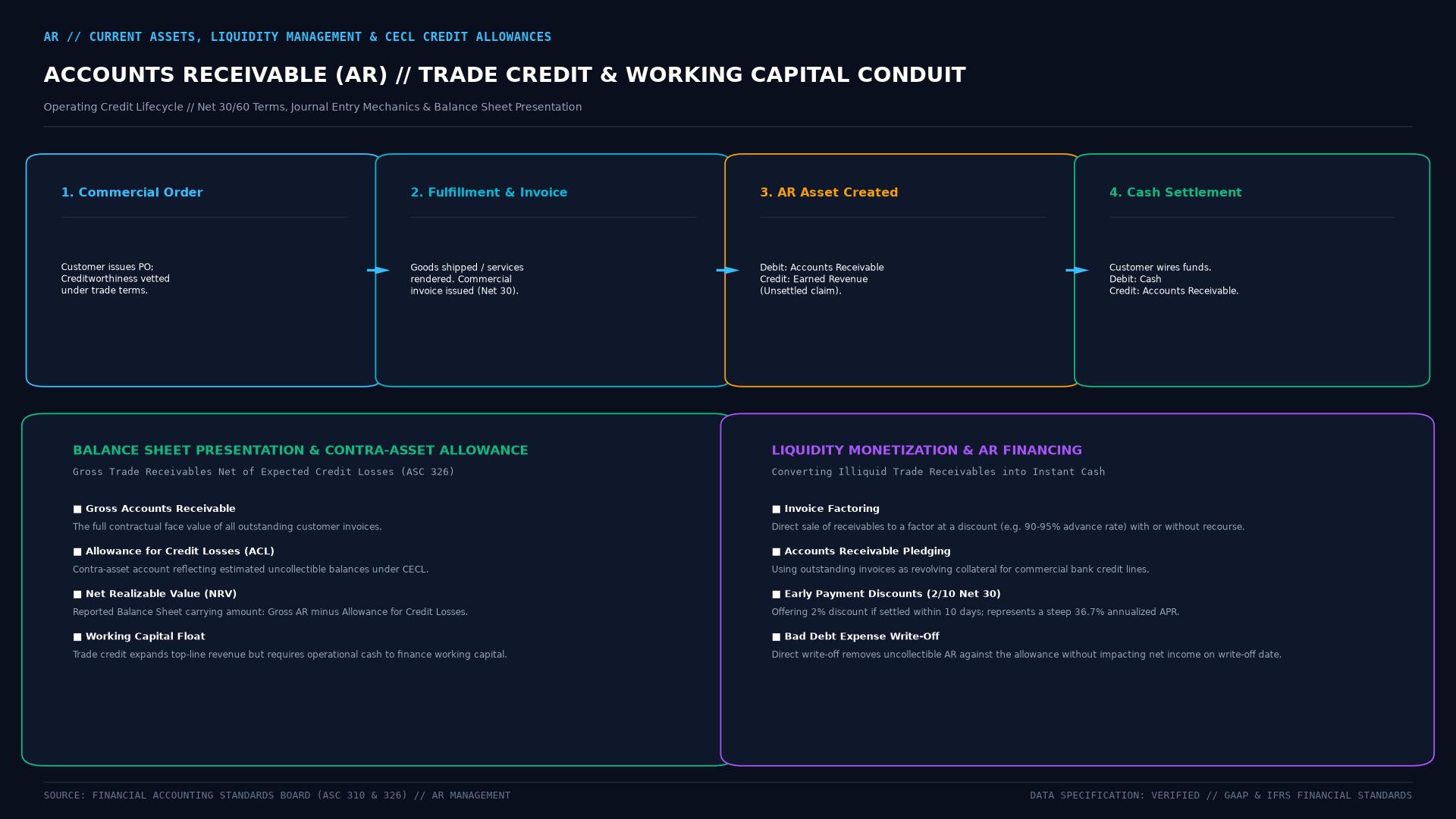 Figure: The Accounts Receivable (AR) operational credit cycle: customer order underwriting, invoice issuance under Net 30/60 terms, double-entry ledger mechanics, CECL contra-asset allowances under ASC 326, and receivables monetization via factoring and asset-backed credit facilities.
Technical Mechanics & Mathematical Formulas
Financial analysts evaluate accounts receivable quality, liquidity conversion speed, and default risk using specific operational metrics:
1. Accounts Receivable Turnover Ratio
Measures the velocity at which an enterprise collects its average credit receivables across a financial year: $$\text{AR Turnover} = \frac{\text{Net Credit Sales}}{\text{Average Accounts Receivable}}$$ $$\text{Average Accounts Receivable} = \frac{\text{Beginning AR} + \text{Ending AR}}{2}$$
A higher ratio reflects efficient credit vetting and rapid collections, whereas a declining ratio signals liquidity traps or deteriorating customer credit profiles.
2. Days Sales Outstanding (DSO)
Converts the turnover ratio into the average calendar days required to collect payment: $$\text{DSO} = \left( \frac{\text{Average Accounts Receivable}}{\text{Total Credit Sales}} \right) \times 365 = \frac{365}{\text{AR Turnover}}$$
3. Net Realizable Value (NRV)
Under GAAP and IFRS, receivables cannot be carried above their net recoverable balance. Sellers must offset gross receivables by an allowance account: $$\text{Net Accounts Receivable} = \text{Gross AR} - \text{Allowance for Credit Losses (CECL)}$$
Comparative Matrix: Accounts Receivable vs Other Balance Sheet Balances
| Attribute | Accounts Receivable (AR) | Accounts Payable (AP) | Notes Receivable | Accrued Revenue |
|---|---|---|---|---|
| Balance Sheet Category | Current Asset | Current Liability | Current or Non-Current Asset | Current Asset |
| Obligation Nature | Customer owes business for credit sales | Business owes supplier for vendor invoices | Formal promissory note with interest & maturity | Revenue earned but unbilled at period end |
| Documentation | Sales invoice & purchase order | Vendor bill & receiving report | Legally executed promissory contract | Time logs, milestone progress sheets |
| Interest Rate | Typically 0% (subject to late penalties) | Typically 0% (supplier credit terms) | Stated annual interest rate coupon | None |
| Typical Tenor | 30 to 90 days | 15 to 60 days | 90 days to multi-year maturities | Reclassifies to AR upon billing |
Real-World Case Study: Global Semiconductor Distributor Managing Extended Cash Conversion
In 2022, an electronics distributor experienced a rapid surge in revenue from $120 million to $180 million. However, despite record operating profits, the company faced an unexpected cash crunch:
- Root Cause Analysis: To win tier-1 hardware contracts, sales teams had extended payment terms from Net 30 to Net 90. Furthermore, large multinational clients delayed payments to an average of 105 days. As a result, Accounts Receivable surged from $10 million to $52 million, locking up cash in uncollected customer credit.
- Strategic Correction: The treasury team established a supply chain invoice discounting program with a commercial bank. Under this arrangement, the bank advanced 90% of certified invoices within 24 hours at SOFR + 1.25%, transferring collection administration to the lender.
- Outcome: The distributor converted $35 million of static receivables into cash, reduced effective Days Sales Outstanding to 18 days on cash collections, and funded inventory replenishment without issuing dilutive equity.
Frequently Asked Questions (FAQ)
What happens when an account receivable cannot be collected?
When customer default is confirmed (e.g., bankruptcy), the company writes off the balance by debiting the Allowance for Doubtful Accounts (or credit loss reserve) and crediting Accounts Receivable. This reduces gross receivables while leaving net income unaffected if the bad debt provision was previously expensed.
Can a company pledge accounts receivable as loan collateral?
Yes. Pledging or assigning accounts receivable is common in asset-based lending (ABL). Commercial banks evaluate the debtor aging schedule and advance revolving credit facilities equal to 70%–85% of eligible, non-delinquent invoices.
How does factoring differ from holding accounts receivable?
Holding accounts receivable means the company manages its own credit risk and waits for settlement. In factoring, the business sells its invoice claims outright to a financial institution (factor) at a discount, transferring the waiting period and, in non-recourse arrangements, customer credit default risk.
Ready to trade forex?
Open a free demo account with a regulated broker. Practice with virtual funds before risking real money.