The Role of Central Banks in Forex: How Monetary Policy Moves Currencies
Central banks are the most powerful actors in the global forex market. Learn how the Fed, ECB, BoJ, and BoE make decisions, what tools they use, and how to read their signals before the market fully prices them in.
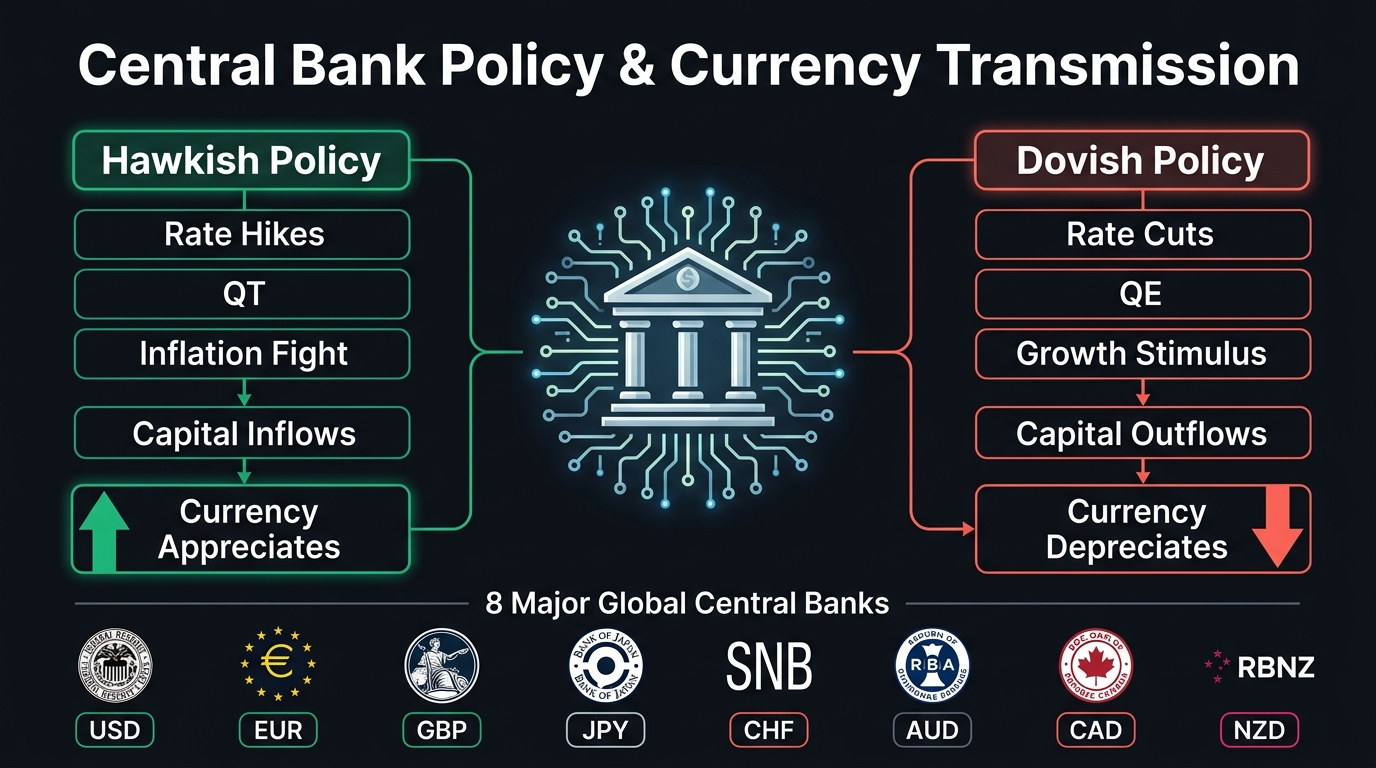
No other entity influences currency prices the way a central bank does. Governments can talk about exchange rates. Finance ministers can intervene verbally. But when a central bank raises or cuts rates — or even signals it’s considering doing so — currencies move in response, often dramatically.
Understanding how central banks operate, what signals they send before acting, and which voices carry the most weight is one of the highest-leverage fundamental skills in forex trading.
What Central Banks Do and Why It Matters for Forex
A central bank is the monetary authority of a country (or economic region). Its primary mandates typically include:
- Price stability: Keeping inflation near its target (commonly 2%)
- Employment: Many central banks (notably the US Federal Reserve) have a dual mandate including maximum employment
- Financial stability: Preventing banking system crises
To achieve these goals, central banks use several monetary policy tools — each of which has direct implications for currency prices.
The Primary Monetary Policy Tools
1. The Benchmark Interest Rate
The most powerful tool. Setting the rate at which commercial banks borrow from the central bank overnight ripples through every interest rate in the economy — mortgages, corporate loans, savings accounts, and forex swap rates.
Forex impact: Rate hikes → currency strengthens. Rate cuts → currency weakens.
Read the detailed mechanism in interest rates and forex.
2. Forward Guidance
Central banks have learned that signaling future policy can move markets almost as much as the policy itself. When the Fed Chair says “we anticipate keeping rates restrictive for an extended period,” markets immediately reprice rate expectations across all forex pairs involving USD.
Forward guidance vocabulary in 2026:
| Phrase | Meaning | Forex Implication |
|---|---|---|
| “Higher for longer” | Rates will stay elevated | Currency remains supported |
| “Data dependent” | No firm direction; watching incoming data | High uncertainty; volatility |
| “Gradual normalization” | Cuts coming, but slowly | Mild downward pressure on currency |
| “Remain vigilant” | Inflation still a concern | Hawkish bias; currency supported |
| “Watching financial stability” | Rates may be cut for stability reasons | Dovish signal |
| “Confident inflation is returning to target” | Rate cuts becoming more likely | Bearish for currency |
3. Quantitative Easing (QE) and Quantitative Tightening (QT)
QE: The central bank purchases government bonds (and sometimes other assets) to inject money into the financial system. This expands the money supply, pushes down long-term rates, and tends to weaken the currency.
QT: The central bank allows bonds to mature without reinvestment (or actively sells bonds), reducing money supply. This tightens financial conditions and tends to support the currency.
In 2026, the Fed and ECB are both in QT mode — reducing balance sheets after the massive QE programs of 2020–2022. The pace of QT is itself a market-moving variable.
4. Foreign Exchange Intervention
Some central banks directly intervene in the forex market by buying or selling their own currency. This is rare among developed market central banks but notable:
- Bank of Japan: Has intervened multiple times in USD/JPY to slow yen weakness (2022, 2024)
- SNB (Swiss National Bank): Has historically intervened to cap CHF strength
- Emerging market central banks: Frequently intervene to manage exchange rate volatility
Direct intervention can create sharp, sudden moves of 1–3% in minutes. Being on the wrong side of an intervention without a stop-loss is catastrophic.
The Major Central Banks in 2026
Federal Reserve (Fed) — USD
Structure: 12 regional banks; policy decisions made by the Federal Open Market Committee (FOMC).
Meetings: 8 per year. The December and March/June meetings tend to be the most significant for annual policy setting.
Key figures: The Fed Chair (Jerome Powell through 2026) is the most market-moving voice. Vice Chair and regional Fed presidents also move markets, particularly in the days between FOMC meetings (“inter-meeting commentary”).
What traders watch: FOMC statement, Fed Chair press conference, Summary of Economic Projections (“dot plot”), Fed minutes (released 3 weeks after each meeting).
The dot plot is particularly important: it shows where each FOMC member expects the fed funds rate to be at year-end over the next 3 years. When dots shift significantly, markets reprice immediately.
European Central Bank (ECB) — EUR
Structure: Governed by the Governing Council (25 members: 6 executive board members + 19 national central bank governors).
Meetings: 8 per year, alternating between Frankfurt and other EU cities.
Key figures: ECB President (Christine Lagarde) is the most market-moving. Chief Economist (Philip Lane) also influential on policy direction.
What traders watch: ECB monetary policy statement, Lagarde press conference, ECB Economic Bulletin, speeches from hawkish and dovish council members (who frequently disagree publicly).
2026 context: ECB has been in a cutting cycle since mid-2024. The pace of cuts and terminal rate expectations are the primary EUR drivers.
Bank of Japan (BoJ) — JPY
Structure: Policy Board of 9 members.
Meetings: 8 per year. Surprise policy shifts possible outside scheduled meetings.
Key figures: BoJ Governor (Kazuo Ueda). The BoJ is historically the most opaque major central bank — policy pivots often occur without clear advance warning.
2026 context: The BoJ is conducting its first genuine rate normalization cycle in 17 years, raising from negative rates (-0.1%) toward 0.5–1.0%. Every BoJ statement is watched intensely by JPY pair traders.
Intervention risk: With USD/JPY having tested multi-decade highs, the Japanese Ministry of Finance (MoF) retains the authority to intervene in the FX market. Verbal warnings from Finance Minister precede physical intervention.
Bank of England (BoE) — GBP
Structure: Monetary Policy Committee (MPC), 9 members.
Meetings: 8 per year. Publishes a Monetary Policy Report quarterly (includes economic forecasts).
Key figures: BoE Governor (Andrew Bailey). MPC votes are published with individual dissent records — hawks and doves on the committee are easily identified.
What’s unique: BoE publishes the minutes of each meeting simultaneously with the decision (unlike the Fed’s 3-week delay), and individual vote tallies are disclosed. A 6-3 vote for a rate hold vs. an 8-1 vote signals very different forward expectations.
Reading the Signal: Before, During, After
Before the meeting (2–3 weeks prior):
- Read the most recent speeches from the central bank governor and senior officials
- Note what economic data the central bank has explicitly flagged as most important
- Track market expectations via implied probabilities from overnight index swaps (OIS)
At the meeting:
- The rate decision is the first signal — but usually already priced
- The statement accompanies it — read for changed language vs. the previous statement
- The press conference provides real-time market-moving information
After the meeting:
- Minutes (released 2–3 weeks later) reveal the internal debate
- Subsequent speeches from members clarify direction
- The next major data releases (CPI, employment) will determine whether market expectations shift again
Key Takeaways
- Central banks are the most powerful actors in forex; their interest rate decisions and forward guidance are the primary medium-to-long-term drivers of currency direction
- Four main tools: benchmark rate (most important), forward guidance, quantitative easing/tightening, and direct FX intervention
- Learn central bank communication vocabulary — specific phrases like “higher for longer” or “data dependent” have precise policy implications
- The four central banks with greatest forex market impact in 2026: Fed (USD), ECB (EUR), BoJ (JPY — undergoing historic rate normalization), BoE (GBP)
- Read primary sources: FOMC statements, ECB press conferences, BoE MPC minutes — news summaries often lose the nuance that moves markets
- The dot plot (Fed’s rate projection) and BoE’s voting records are unique transparency tools that give direct forward guidance
Next: Macroeconomic Indicators | How to Read an Economic Calendar
Related strategies: Interest Rates and Forex | News Trading

Ready to Practice This Strategy?
Test what you learned on a free, risk-free demo account before risking real money.