Forex Trading Styles: Scalper, Day Trader, Swing Trader, or Position Trader?
Your trading style determines everything from which pairs you trade to how long you sleep. Learn the 4 main forex trading styles, what each demands, and how to choose the right fit for your life.
Before you pick a strategy, an indicator, or a broker, you need to answer a more fundamental question: what kind of forex trader do you actually want to be? Not which style sounds most exciting. Which one you can realistically sustain given your life as it is right now.
The four main trading styles — scalping, day trading, swing trading, and position trading — are not interchangeable. Each one demands a different time commitment, a different psychological profile, and a completely different set of tools and strategies. Choosing the wrong one is one of the most expensive beginner mistakes, because it sets you up to fail before you’ve even started.
The Four Main Forex Trading Styles
Scalping
Time in trade: Seconds to a few minutes
Trades per day: 20–100+
Timeframes: 1-minute, 5-minute
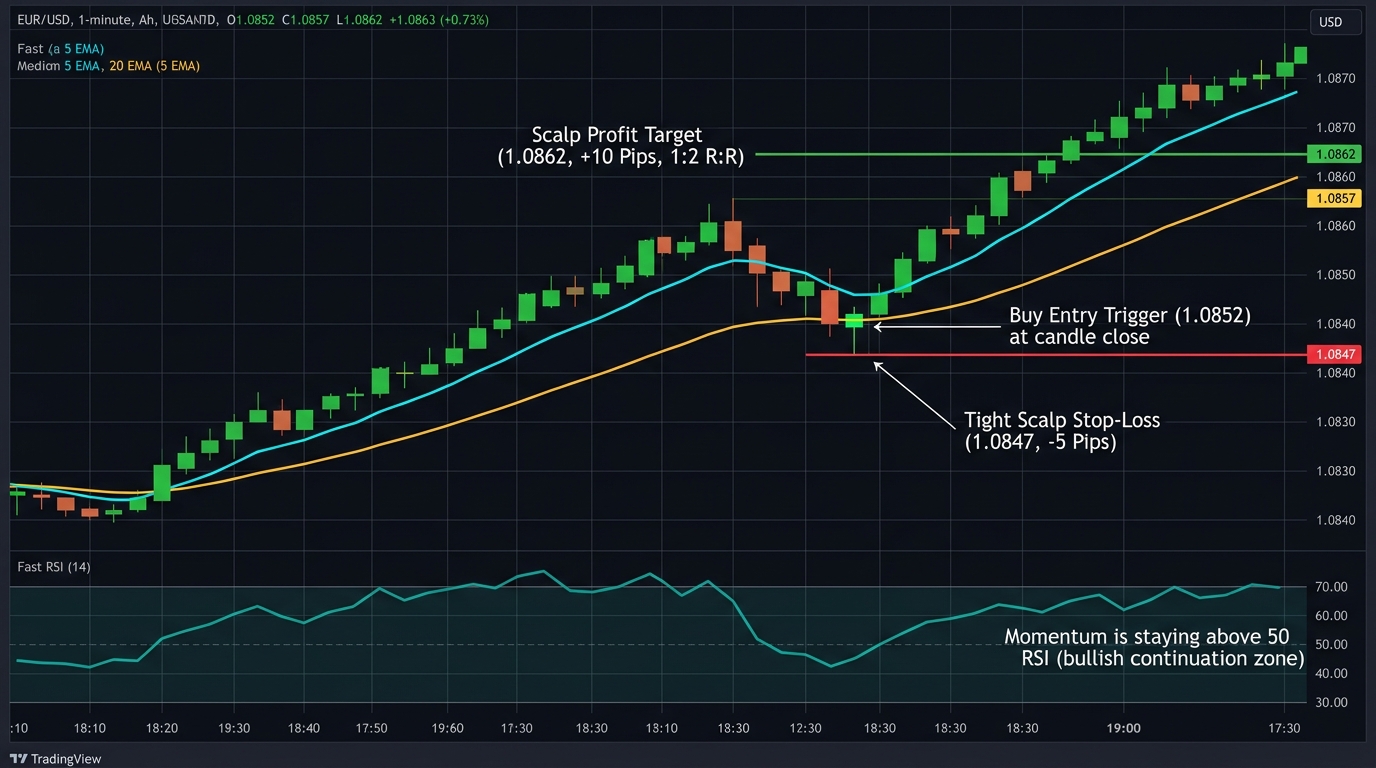
Scalping is the fastest form of forex trading. The goal is to take many small profits from tiny price movements, closing each trade within minutes. A scalper might target 5–15 pips per trade with tight stops of 3–8 pips.
The appeal: you’re rarely in the market overnight, so you avoid swap charges and the uncertainty of holding through major news events.
The reality: scalping is extraordinarily demanding. You need near-constant market attention during your trading hours. You need a broker with extremely tight spreads (1–2 pip spreads eat the entire profit margin on a 5-pip target). Execution must be fast. Slippage costs matter enormously at this scale.
Scalping also exposes you to high-frequency price noise. A single misread, a slow execution, or a moment of distraction can turn a profitable session into a losing one.
Scalping is best suited for: Experienced traders who can dedicate 4–8 focused hours per day, have access to a low-latency, low-spread broker, and are psychologically comfortable with very high trading frequency. It is rarely appropriate for beginners.
Day Trading
Time in trade: Minutes to a few hours (always closed before the NY close)
Trades per day: 2–10
Timeframes: 15-minute, 30-minute, 1-hour
Day traders open and close all positions within the same trading day. No positions are held overnight. The day starts with an analysis of the market, sessions are actively managed, and everything is closed before the New York close (5pm EST).
This style is more suitable for beginners than scalping because:
- Lower trading frequency means less pressure
- More time to analyze each setup
- No overnight risk or swap concerns
The requirement is still significant: active market hours participation. If you’re working a full-time job in a different time zone, genuine day trading is difficult to execute consistently.
Day trading is best suited for: Traders who can commit to 3–6 focused hours per day during a specific major session (London or New York), who want to avoid overnight risk, and who find scalping too fast-paced.
Swing Trading
Time in trade: Hours to several days
Trades per week: 2–10
Timeframes: 4-hour, Daily
Swing trading captures larger price movements — “swings” in price that develop over one to several days. A swing trader might analyze the market once or twice a day, enter on a 4H setup, set a stop-loss and a take-profit, and let the trade run.
This style is genuinely compatible with a part-time trading approach. You don’t need to watch your screen all day. You check in at specific times, manage open positions, and look for new setups. Most of the work happens outside market hours.
The tradeoff: you hold positions overnight, which means overnight price gaps and swap charges (or income, depending on direction). You also need to size positions to withstand intraday volatility without being stopped out prematurely.
Swing trading is best suited for: Part-time traders with full-time jobs, people who prefer fewer, higher-quality trades over frequent activity, and those who respond well to having time to think before acting.
Position Trading
Time in trade: Weeks to months
Trades per month: 1–5
Timeframes: Weekly, Daily
Position trading is the closest forex equivalent to long-term investing. Traders take a macroeconomic view — based on interest rate differentials, GDP trends, inflation data, or central bank policy — and hold a position for weeks or months.
The analysis is primarily fundamental rather than technical. A position trader might track a central bank’s rate-hiking cycle and build a long position in the currency of the country raising rates.
This style requires the least day-to-day time commitment but the most macroeconomic knowledge. It also demands the highest psychological tolerance for holding through periods of adverse price movement that might last days or weeks before the thesis plays out.
Position trading is best suited for: Traders with strong macroeconomic and fundamental analysis skills, high risk tolerance for short-term drawdowns, and limited availability for daily market participation.
Style Comparison Table
| Attribute | Scalping | Day Trading | Swing Trading | Position Trading |
|---|---|---|---|---|
| Trade duration | Seconds–minutes | Minutes–hours | Hours–days | Weeks–months |
| Time per day needed | 4–8h active | 3–6h active | 30–60min | 30min or less |
| Trades per week | 100+ | 10–50 | 2–10 | 1–4 |
| Typical profit target | 5–15 pips | 20–50 pips | 50–200 pips | 200–1000+ pips |
| Overnight risk | None | None | Yes | Yes |
| Swap impact | Minimal | None | Moderate | Significant |
| Best for | Experienced, full-time | Semi-full-time | Part-time | Fundamental analysts |
| Minimum starting capital | $2,000+ | $1,000+ | $500+ | $2,000+ |
| Difficulty level | Very high | High | Medium | Medium–High |
How to Choose Your Style
There is no universally “best” trading style. The best one is the one you can actually execute consistently with your real life constraints. Answer these questions honestly:
1. How many hours per day can you realistically dedicate to trading?
- Less than 1 hour → Position trading or swing trading
- 1–3 hours → Swing trading
- 3–6 hours → Day trading
- 6+ hours, full attention → Day trading or scalping
2. Are you comfortable holding positions overnight?
- No → Day trading or scalping
- Yes → Swing trading or position trading
3. What is your psychological response to loss?
- Quick, frequent small losses frustrate you → Swing or position trading
- Holding a losing trade for days is psychologically painful → Day trading
- Both → Reconsider whether trading is right for you at this time
4. What is your strength: technical analysis or macro/fundamental understanding?
- Technical → Scalping, day trading, or swing trading
- Fundamental/macro → Position trading
5. How much capital do you have?
- Under $1,000 → Start with demo or micro account; swing trading suits lower capital best
- $1,000–$5,000 → Day or swing trading
- $5,000+ → Any style, but match to other factors
The Lifestyle Match: The Non-Negotiable
One thing experienced traders consistently emphasize: never fight your lifestyle. If you have a demanding job and try to scalp during lunch breaks, you will make impulsive decisions because you’re rushed. If you’re a stay-at-home parent with unpredictable availability, day trading will produce anxiety and broken discipline.
Your trading hours must be protected, consistent, and genuinely available. If they’re not, reduce the frequency of your style until they are.
A swing trader who checks the market reliably for 45 minutes at 7am and 7pm will consistently outperform a wannabe day trader who checks erratically throughout the day from a smartphone.
Starting Recommendation for Beginners
If you’re starting out and are unsure, begin with swing trading on the 4-hour chart. Here’s why:
- The signals are more visible and easier to evaluate than on 1H or below
- You have time to think through each trade without being rushed
- It’s compatible with a normal working schedule
- The win rate per trade tends to be higher because you’re capturing larger, more meaningful moves
- It teaches you all the core skills (analysis, entry, stop-loss, position sizing, journaling) without the extreme pace pressure of scalping
As your skills and available time grow, you can shift styles — or run multiple styles on different portions of your capital.
Key Takeaways
- The four main forex trading styles are scalping, day trading, swing trading, and position trading — each with fundamentally different time requirements, risk profiles, and skill sets
- Choose based on your actual available time, lifestyle, and psychological profile — not based on which sounds most profitable
- Scalping and day trading require significant time commitment and are harder for beginners; swing trading is the most beginner-accessible style
- Position trading requires strong macroeconomic knowledge and high drawdown tolerance
- Never try to force a trading style that conflicts with your schedule or personality — it creates the conditions for discipline failure
- Start with swing trading on the 4H chart if you’re unsure, and adjust as you gain experience
Next in this module: What Is a Forex Trading Plan? | How Much Money Can You Risk?

Ready to Practice This Strategy?
Test what you learned on a free, risk-free demo account before risking real money.