Forex Day Trading: Strategy, Sessions, and Setup Guidelines
Day trading forex means opening and closing all positions within a single trading session. Learn which sessions are best, the essential setup rules, position sizing for active trading, and the discipline requirements that separate profitable day traders from the majority who lose.
Day trading is the most active form of retail forex trading — all positions opened and closed within the same trading session, no overnight exposure, multiple trades per week or per day. It demands more from the trader than swing or position trading: more screen time, faster decisions, tighter discipline, and a deeper understanding of intraday market behavior.
It’s also the style most beginners attempt first, often drawn by the idea of daily income and fast feedback loops. The reality is more nuanced: day trading in forex can be consistently profitable, but it has a steeper learning curve than swing trading and is significantly less forgiving of psychological weaknesses.
What Day Trading Is (and Isn’t)
Day trading: All positions are closed before the end of the trading session. No overnight swaps. No weekend gap risk. Maximum exposure time: one trading session.
What it’s not: Scalping (positions held for seconds to minutes) is a subset of day trading but generally refers to much higher frequency and tighter targets. This lesson covers standard day trading: 1–5 trades per day on 15M–1H charts.
The core advantage: No overnight risk. You’re not exposed to gap openings, unexpected news while you sleep, or weekend geopolitical events.
The core challenge: You must be profitable within narrow time windows. A swing trade has days to recover from a temporary adverse move. A day trade has hours.
The Best Sessions for Day Trading
Forex market behavior varies dramatically by session. Day traders need high liquidity and directional movement — both are concentrated in specific windows.
| Session | Time (GMT) | Best Pairs | Activity Level |
|---|---|---|---|
| Sydney | 22:00–07:00 | AUD/USD, NZD/USD, NZD/JPY | Low |
| Tokyo | 00:00–09:00 | USD/JPY, AUD/JPY, EUR/JPY | Moderate |
| London | 07:00–16:00 | EUR/USD, GBP/USD, EUR/GBP | Very High |
| New York | 13:00–22:00 | All major pairs | Very High |
| London/NY overlap | 13:00–16:00 GMT | EUR/USD, GBP/USD | Highest |
The London/New York overlap (13:00–16:00 GMT) is the highest-volume window in the forex market. Spreads are tightest, moves are most directional, and technical setups resolve most cleanly. For most day traders on EUR/USD and GBP/USD, this 3-hour window produces the majority of their tradeable opportunities.
The London open (07:00–09:30 GMT) is the second most important window: the UK session brings significant volume after the quiet Asian session, and price frequently makes its first directional move of the day.
Day Trading Strategies for Forex
Setup 1: Opening Range Breakout (ORB)
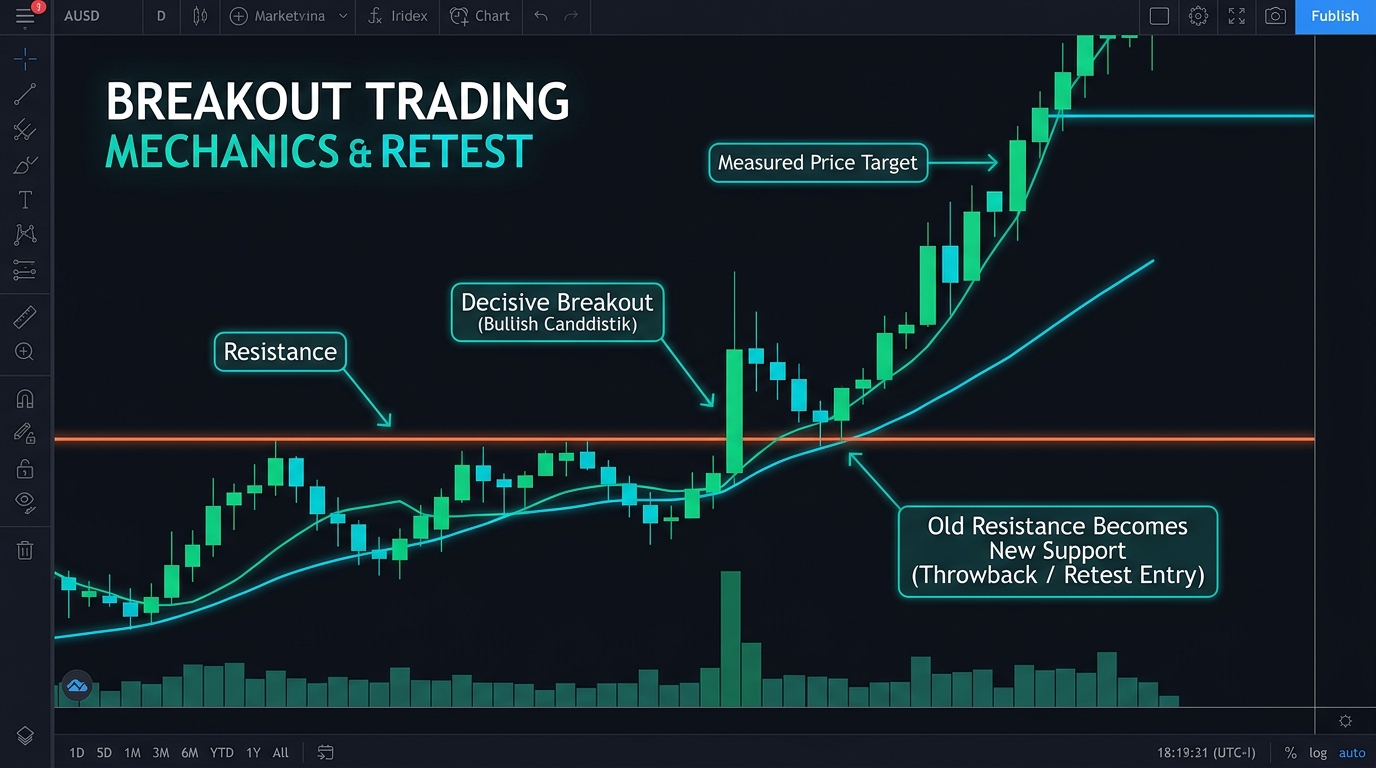
Concept: Define the high and low of the first 30–60 minutes of the London session (or the NY open). Trade the breakout when price clears either boundary with volume and momentum.
| Step | Action |
|---|---|
| 1. Mark range | Note the high and low of the first 60 minutes |
| 2. Wait for break | Price closes a 15M candle beyond the range high or low |
| 3. Entry | Buy (breakout high) or sell (breakout low) at next 15M open |
| 4. Stop-loss | Inside the range (below high, above low) + 10 pip buffer |
| 5. Take-profit | 1.5–2× the range height beyond the breakout point |
| 6. Avoid | Taking the breakout if a major news event is scheduled within 30 minutes |
Setup 2: VWAP / EMA Pullback (Intraday Trend)
Concept: In a trending intraday session, price pulls back to the 20 EMA or VWAP (Volume Weighted Average Price) on the 15M chart and rejects it — enter in the trend direction.
| Step | Action |
|---|---|
| 1. Establish trend | Price trending above/below 20 EMA on 1H chart |
| 2. Wait for pullback | Price retraces toward 20 EMA on 15M chart |
| 3. Confirmation | Rejection candle at the 20 EMA (bullish engulfing for longs) |
| 4. Entry | Next 15M candle open |
| 5. Stop-loss | Below the rejection candle low (long) |
| 6. Take-profit | Previous session high (or 2× risk distance) |
Setup 3: Pivot Point Bounce
Use daily pivot levels (PP, R1, S1) as defined support and resistance zones. Trade bounces from these levels during the active sessions. Detailed rules in the Pivot Points lesson.
Position Sizing for Day Trading
Day trading with 1% risk per trade and 3–5 trades per day requires careful total exposure management.
Daily maximum loss limit: Set this before the session. Recommended: 3% of account. If hit, stop trading for the day.
Session sizing:
- If you’re taking 3 trades per session and each risks 1%, your maximum daily exposure is 3% (if all three stop out simultaneously)
- This is acceptable for uncorrelated setups
- If two trades are in the same direction on correlated pairs, treat them as 1.5% combined risk
Use the position size calculator for each trade. Day trading creates time pressure that encourages skipping this step. Don’t. A mistyped lot size on a 30-pip stop can create a loss that sets back a week of progress.
The Discipline Requirements
Day trading amplifies every psychological trait — positive and negative. The feedback loop is faster: wins and losses accumulate within hours. This creates specific discipline challenges:
The “one more trade” problem: After meeting your target for the day, the temptation to keep trading is high. Pre-commit to a maximum trade count (e.g., 3 per day). When that number is reached, close the platform.
After-loss impatience: Missing a move and then entering a lower-quality setup to “catch up” is responsible for a significant portion of day trader losses. Define minimum setup criteria and only trade when all criteria are met.
Boredom trading: During low-volatility windows (Asian session for major pairs), the temptation to trade something, anything, produces entries that wouldn’t survive scrutiny. Define the sessions you’ll trade and trade nothing outside them.
Screen time management: Watching charts for 8 hours is not more productive than watching for 2–3 focused hours. Decision quality degrades with mental fatigue. Most profitable day traders trade specific windows (London open + NY open) rather than all day.
Day Trading vs. Swing Trading: Which Is Right for You?
| Factor | Day Trading | Swing Trading |
|---|---|---|
| Time commitment | 2–4 hours of active screen time/day | 30–60 minutes/day to check positions |
| Number of trades | 1–5 per day | 3–10 per week |
| Overnight risk | None | Present (gaps, news events) |
| Feedback loop | Fast (results known same day) | Slower (days to know outcome) |
| Psychological demand | High | Moderate |
| Learning curve | Steep | Moderate |
| Transaction costs | Higher (more trades = more spread) | Lower |
Neither is universally better. Day trading suits people who can commit focused morning or afternoon windows with full attention. Swing trading suits those who cannot commit daily screen time but can check charts once or twice per day.
Key Takeaways
- Day trading means all positions opened and closed within one session; no overnight exposure
- The London/NY overlap (13:00–16:00 GMT) is the highest-volume, most technically reliable window for day trading major pairs
- Three reliable setups: Opening Range Breakout, EMA pullback in intraday trend, and pivot point bounce
- Daily loss limit (3%) must be set before the session and enforced mechanically; never negotiate with it after the fact
- Common failure modes: overtrading in low-volatility windows, “one more trade” after meeting targets, and quality degradation from excessive screen time
- Day trading has a higher psychological demand than swing trading; start with swing trading to develop discipline before transitioning to higher-frequency activity
Next: Scalping Strategies | Swing Trading
Related strategies: Pivot Points | EMA Crossover and ADX

Ready to Practice This Strategy?
Test what you learned on a free, risk-free demo account before risking real money.