Goal Setting for Forex Traders: How to Define Success Before You Start
Vague trading goals produce vague results. Learn how to set specific, measurable, and realistic trading goals using the SMART framework, and how goal clarity connects to system design and risk management.
“I want to make money trading forex” is not a goal. It’s an aspiration without structure. Most retail traders start with this vague intention, and it’s part of why most fail — not because the intention is wrong, but because it provides no framework for the decisions that follow.
Proper goal setting in trading is not motivational exercise. It’s functional infrastructure. Your goal determines your risk parameters, your strategy selection, your required starting capital, and how you’ll evaluate whether you’re actually succeeding.
Why Trader Goals Are Different From General Goals
Most goal-setting advice focuses on ambition: dream big, aim high. Trading requires the opposite emphasis: calibrate to reality, then build toward ambition.
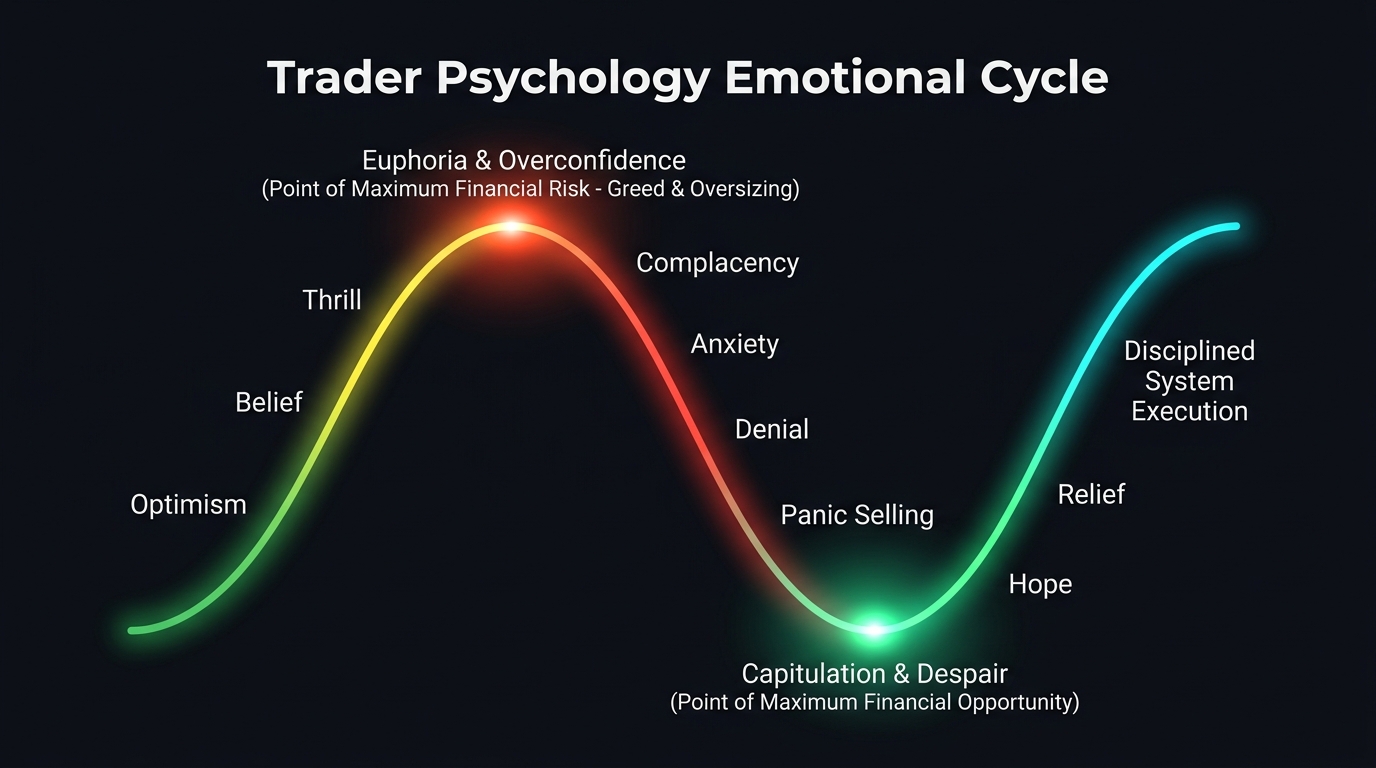
A trader who sets a goal of 50% monthly returns will risk too much per trade (impossible to compound at 50% with disciplined 1% risk), take low-quality setups (compulsion to trade anything to hit the number), and operate in a state of constant psychological pressure. The goal itself creates the failure conditions.
A trader who sets a goal of 5–10% annual return with a maximum 10% drawdown will risk appropriately, be selective, and create the conditions for compounding real money over time.
The difference between those two traders, given the same initial capital, after 5 years? Compounding 10% annually on $10,000 produces $16,105. Attempting to compound 50% monthly — and failing spectacularly, as almost all such attempts do — produces a depleted account and no capital to compound.
The SMART Framework for Trading Goals
SMART goals are: Specific, Measurable, Achievable, Relevant, and Time-bound. Applied to forex:
| Component | Bad Goal | SMART Goal |
|---|---|---|
| Specific | “Make money” | “Achieve consistent profitability on a $5,000 account” |
| Measurable | “Get better at trading” | “Achieve a 55%+ win rate and 1:2 average RR” |
| Achievable | “50% returns per month” | “6–12% annual return” |
| Relevant | “Trade every day” | “Trade only A-grade setups in trending conditions” |
| Time-bound | “Eventually become profitable” | “Complete 6 months of demo trading by March 2026” |
Three Tier Goal Framework
Experienced traders structure goals in three tiers: process, performance, and financial.
Tier 1: Process Goals (Most Important)
Process goals measure whether you’re executing correctly — independent of market outcomes. These are entirely within your control.
Examples:
- “Follow my trading plan rules on 100% of trades this month”
- “Complete a journal entry for every trade within 24 hours”
- “Never remove a stop-loss after it’s set”
- “Take only setups that meet all 5 entry criteria”
Process goals are the foundation. A trader who executes their plan perfectly — even with a bad month due to market conditions — is building the habits that produce long-term profitability. A trader who abandons their process when losing is building the habits that produce long-term failure.
Tier 2: Performance Goals
Performance goals measure the statistical quality of your trading over time.
Examples:
- “Achieve a win rate of 50–60% across at least 30 trades this quarter”
- “Maintain an average risk-reward ratio of 1:2 or better”
- “Limit average loss to 1% of account per trade”
- “No single losing trade exceeds 2% of account”
Performance goals are evaluated over sample sizes of 20–50+ trades, not individual trades or single weeks. A single bad week proves nothing statistically. A consistent pattern over 50 trades is meaningful.
Tier 3: Financial Goals
Financial goals are the outputs of good process and performance — not the starting point.
Examples:
- “Grow a $5,000 account by 8–12% in year one”
- “Fund a live account after 3 profitable months of demo trading”
- “Increase position sizes by 25% after 6 months of documented positive expectancy”
Critical rule: Financial goals should be set below what you calculate the system should produce. Build in a margin for learning curve, unfavorable market conditions, and the inevitable discrepancy between theoretical and live performance.
Realistic Return Expectations in 2026
Many beginning traders arrive with expectations shaped by social media and broker marketing that dramatically misrepresent professional trading performance. Here is the reality:
| Trader Level | Annual Return Range | Drawdown Tolerance |
|---|---|---|
| Professional fund manager (top quartile) | 15–25% | 10–20% max |
| Retail trader (consistently profitable) | 8–20% | 10–15% max |
| Retail trader (skilled intermediate) | 5–15% | 10–20% max |
| Retail trader (beginner, first year) | 0–10% (or negative) | Focus on process, not returns |
| Prop firm targets | 8–15% in challenge | 5–10% max drawdown |
These numbers are conservative compared to what you’ll see advertised. They also reflect what’s sustainable — not what’s possible in a single lucky month. A trader averaging 12% annually with a controlled drawdown is outperforming the majority of hedge funds.
Goal Examples by Stage
Stage 1: Complete Beginner (First 3 Months)
Primary goal: Learn and apply the fundamentals correctly. Financial goals are irrelevant at this stage.
- Study: Complete the Getting Started module in full before placing any trades
- Demo trading: Open a demo account with realistic starting capital ($5,000–$10,000 simulated)
- System: Choose one strategy, define all its rules in writing
- Journal: Start journaling from day one — record every simulated trade
- Metric: Track rule adherence (was the plan followed?), not profit
Stage 2: Demo-to-Live Transition (Months 3–9)
Primary goal: Validate that the system has positive expectancy before risking real money.
- Process: 100+ demo trades with documented results
- Performance: Win rate and average RR showing positive expectancy over 60+ trades
- Transition trigger: 3 consecutive profitable months on demo, no more than 5% max drawdown
Stage 3: Small Live Account (Months 6–18)
Primary goal: Replicate demo performance with real money. Psychology changes; returns often drop initially.
- Financial goal: Preserve 90%+ of starting capital in first 3 months
- Performance goal: Match demo win rate and RR within 10%
- Position sizing: Start at 50% of planned position sizes; scale up after 2 months
Stage 4: Full Live Trading (18 Months+)
Primary goal: Consistent execution, compounding, and gradual growth.
- Financial goal: 8–15% annual return on risk capital
- Process goal: <5 rule violations per month
- Scale: Increase position sizes proportionally with account growth (percentage-based sizing does this automatically)
Writing Your Goal Statement
Before your first trade, write a single goal statement that addresses all three tiers:
"For the next 6 months, I will:
- PROCESS: Follow my EUR/USD 4H swing trading system rules on 100% of trades
- PERFORMANCE: Maintain a win rate above 50% and average RR of 1:2 across at least 30 trades
- FINANCIAL: Grow my $5,000 demo account by 5–10% while keeping drawdown below 8%

I will review this goal monthly. If process goals are being met but performance goals aren't,
I will adjust the system based on journal data, not emotion."
Print it. Review it before each trading week. Adjust quarterly based on actual data.
Key Takeaways
- “Make money” is not a goal — a trading goal must be specific, measurable, time-bound, and calibrated to realistic expectations
- Structure goals in three tiers: process (execution discipline), performance (statistical quality), and financial (account growth) — in that priority order
- Realistic annual returns for consistently profitable retail traders: 8–20%, with maximum drawdowns of 10–20%
- Beginners should spend the first 3–6 months focused entirely on process goals (plan adherence, journaling, rule compliance) — financial goals are meaningless at this stage
- The transition from demo to live should be triggered by documented positive expectancy, not by impatience
- Review goals monthly; adjust based on journal data and actual results, not based on emotional responses to winning or losing streaks

Ready to Practice This Strategy?
Test what you learned on a free, risk-free demo account before risking real money.