How Much Money Can You Risk Trading Forex? (2026 Guide)
How much capital should you start with? How much should you risk per trade? This lesson gives you the exact numbers, the formulas, and the honest context that most beginner guides skip.
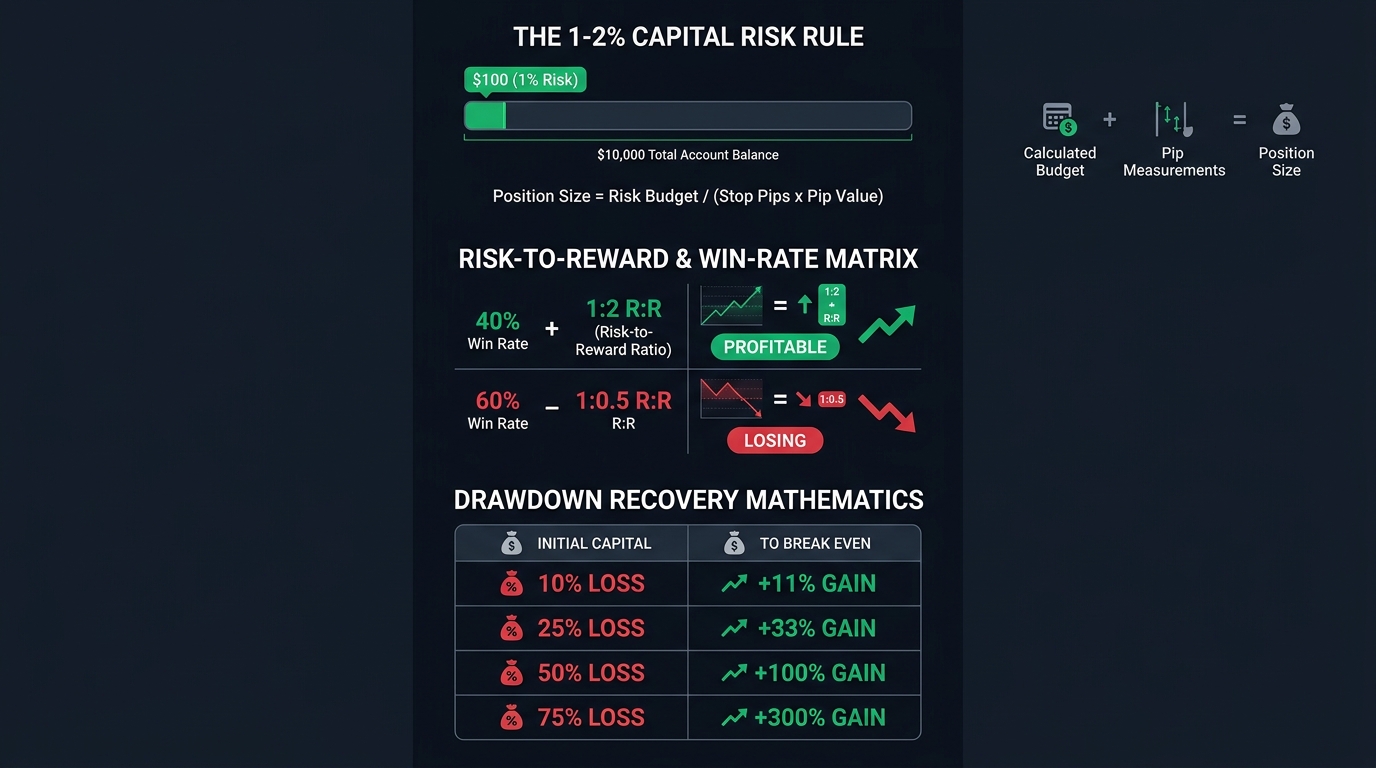
Every piece of trading advice that starts with “it depends on your goals” is dodging the question. Here’s the direct answer: you should risk no more than 1–2% of your trading account balance per trade, and your starting trading capital should be money whose complete loss would not alter your standard of living in any meaningful way.
Those two numbers — 1–2% per trade, risk capital only — are the foundation of everything that follows.
How Much to Start With
The minimum capital question has two separate answers: the technical minimum (what brokers allow) and the practical minimum (what actually gives you a fair chance to learn and progress).
Technical Minimums (What Brokers Accept)
| Account Type | Typical Minimum Deposit | Minimum Trade Size |
|---|---|---|
| Micro account | $50–$100 | 0.01 lots (micro lot) |
| Mini account | $100–$500 | 0.1 lots (mini lot) |
| Standard account | $500–$2,000 | 1 lot (standard) |
| ECN/Raw account | $200–$1,000 | 0.01 lots |
Starting with $100 is technically possible. But with $100 and 1% risk per trade, your risk budget is $1. The math of position sizing makes it almost impossible to trade meaningful pairs with appropriate stop-losses without violating your own risk rules.
Practical Minimums (What Actually Works)
| Starting Capital | What It Allows | Realistic for |
|---|---|---|
| $500–$1,000 | Micro/mini lots, swing trading | Learning the basics with real consequences |
| $1,000–$3,000 | Mini lots, most strategies viable | Intermediate beginners |
| $3,000–$10,000 | Full flexibility, standard lots accessible | Traders with proven system |
| $10,000+ | Professional-scale risk management | Experienced traders |
One thing experienced traders consistently say in retrospect: they wish they had started with more. Not because more money makes you a better trader, but because under-capitalization forces you to take excessive leverage, which magnifies both losses and emotional pressure.
If you can only start with $500, start with $500 — but trade it as if it were $50,000. Meaning: keep leverage low, use appropriate position sizes, and focus on the process rather than the dollar returns.
The 1% Rule: Why It’s the Most Important Number in Retail Trading
The 1% rule states that you should never risk more than 1% of your total account balance on any single trade. On a $5,000 account, that’s a maximum risk of $50 per trade.
This feels tiny when you’re just starting. That reaction — “I can’t make real money risking $50 per trade” — is one of the most common psychological traps in beginner trading.
Here’s the math that explains why 1% is the right number:
Survival Rate at Different Risk Percentages
Assume a strategy with a 50% win rate (coinflip). What happens to a $10,000 account after 10 consecutive losing trades?
| Risk Per Trade | Account After 10 Losses | Account After 20 Losses | Account After 50 Losses |
|---|---|---|---|
| 0.5% | $9,511 | $9,046 | $7,783 |
| 1% | $9,044 | $8,179 | $6,050 |
| 2% | $8,171 | $6,676 | $3,642 |
| 5% | $5,987 | $3,585 | $769 |
| 10% | $3,487 | $1,216 | $5 |
| 20% | $1,073 | $115 | $0 |
At 2% risk, 50 consecutive losses leaves you with 36% of your original capital — recoverable. At 10% risk, 50 losses reduces the account to essentially zero. In forex, even a good strategy can produce 10–15 consecutive losses during unfavorable market conditions. That’s not failure — it’s normal statistical variance. The 1% rule keeps you in the game through those periods.
How to Calculate Your Per-Trade Risk
The calculation has three inputs:
- Account balance (what’s currently in your account)
- Risk percentage (how much of that balance you’re willing to lose, typically 1%)
- Stop-loss distance (how far price needs to move against you for the trade to be invalid, in pips)
Formula:
Risk Amount ($) = Account Balance × Risk Percentage
Position Size (lots) = Risk Amount ÷ (Stop-Loss Pips × Pip Value per Lot)
Example:
- Account: $5,000
- Risk: 1% = $50
- Stop-loss: 25 pips on EUR/USD
- Pip value (1 standard lot, USD account): $10 per pip
Position size = $50 ÷ (25 × $10) = $50 ÷ $250 = 0.20 lots (2 mini lots)
Use the position size calculator to run this calculation for any pair and stop-loss distance instantly.
What Is “Risk Capital”?
Risk capital is money that, if completely lost, does not affect your ability to pay rent, buy food, meet your loan obligations, or fund any other life necessity. It is genuinely disposable.
This is not a technicality. Trading under financial pressure — with money you need — creates a specific form of psychological distortion. The knowledge that you can’t afford to lose produces a cascade of bad decisions:
- Removing stop-losses because a loss would be too painful to accept
- Oversizing positions to try to recover quickly
- Holding losing trades beyond rational justification
- Taking trades you wouldn’t otherwise take, just to feel like something is happening
All of these are predictable responses to trading with money you can’t afford to lose. All of them accelerate losses.
There is no workaround for this. If you don’t have genuine risk capital available, the correct choice is to trade a demo account until you do.
The Hidden Cost of Under-Capitalization
Many beginners deposit the minimum ($100–$500) and immediately struggle because the maths of position sizing don’t work at 1% risk. They either:
- Use excessive leverage to compensate (high risk)
- Trade with a larger risk percentage (also high risk)
- Or trade so small that there’s no meaningful learning feedback
The third option is fine for pure practice. The first two accelerate account death.
If you’re starting with under $1,000, consider treating the entire amount as practice money and focusing entirely on process metrics (win rate, average risk-reward, discipline adherence) rather than dollar returns. The skills you build transfer directly to larger accounts. The bad habits you build at high leverage with small accounts transfer too.
Practical Benchmarks by Account Size
| Account | 1% Risk | With 25-pip SL on EUR/USD | Lot Size | Monthly Target (5% gain) |
|---|---|---|---|---|
| $500 | $5 | 0.02 lots | Micro | $25 |
| $1,000 | $10 | 0.04 lots | Micro | $50 |
| $5,000 | $50 | 0.20 lots | Mini | $250 |
| $10,000 | $100 | 0.40 lots | Mini | $500 |
| $25,000 | $250 | 1.00 lots | Standard | $1,250 |
Notice that even at $10,000, a realistic 5% monthly return (which is excellent by professional standards) generates $500/month. That’s honest context. Trading is not a get-rich-quick mechanism. It’s a skill-based endeavor with professional returns in the 5–20% annual range for good traders.
What About Leverage?
Leverage allows you to control a larger position than your account balance alone would permit. It amplifies both gains and losses proportionally.
The key insight: leverage does not change how much you risk per trade if you use proper position sizing. If you calculate your lot size based on a $50 maximum loss, you risk $50 whether you’re using 10:1 or 100:1 leverage. What leverage changes is the margin required to hold the position.
Where leverage becomes dangerous is when traders use maximum leverage to take the largest possible position without regard for their stop-loss distance. That’s not trading — that’s gambling.
For most beginners, keeping effective leverage below 10:1 eliminates most of the danger. Read the full lesson on forex leverage for the complete mechanics.
Key Takeaways
- Risk no more than 1–2% of your account balance per trade — this is the single most important number for long-term survival
- The practical starting capital minimum is $1,000–$3,000; under $500 creates position sizing constraints that force either excessive leverage or no meaningful practice
- Only trade with genuine risk capital — money whose complete loss would not affect your life. Trading under financial pressure produces predictable, destructive decision patterns
- Use the position size calculator to calculate exact lot sizes — never estimate
- Leverage is not inherently dangerous if position sizing is correct; it becomes dangerous when used to maximize position size rather than optimize capital efficiency
- Realistic return expectations for good traders: 5–20% annually. Monthly targets above 10% require taking risks that are incompatible with long-term account survival
Continue: Goal Setting for Forex Traders | Risk Management Basics

Ready to Practice This Strategy?
Test what you learned on a free, risk-free demo account before risking real money.