What Is a Forex Trading Plan? (And How to Build One That Actually Works)
A forex trading plan is a written rulebook that governs every trade you take. Learn what it must include, why most traders skip it, and how to build one step by step in 2026.
Most traders who blow up their accounts do it twice. The first time teaches them nothing because they had no plan. The second time, they realize the lesson was always the same: winging it is not a strategy.
A forex trading plan is a written document that spells out exactly how you will approach every aspect of trading — what you will trade, when, why, how much you will risk, and when you will walk away. It is not optional. It is the single most important document you will create as a trader, and most retail traders never write one.
What a Trading Plan Is (And What It Isn’t)
People confuse a trading plan with a trading system. They are not the same thing.
A trading system is a set of entry and exit rules — the mechanical signals that tell you when to buy or sell. A trading plan is the broader framework that contains your trading system, plus everything else: your risk rules, your goals, your capital allocation, your psychology protocols, your review schedule.
Think of it this way: a trading system answers “how do I enter this trade?” A trading plan answers “should I be trading at all right now, and if so, under what conditions and with how much money?”
Without the plan, the system is just a collection of rules floating in a vacuum.
Why Most Traders Skip It (And Pay the Price)
The uncomfortable truth is that writing a trading plan is boring. It requires self-reflection, honesty about your weaknesses, and a willingness to commit to rules that will sometimes stop you from taking trades you really want to take.
Traders who skip it tend to share a predictable pattern:
- They start strong, riding early beginner’s luck
- They increase position sizes after a winning streak
- They break their own mental rules after a losing streak, trying to “get it back”
- They eventually take one oversized trade that ends the account
The plan exists specifically to prevent this cycle. It installs the guardrails before you need them, not after.
The 7 Core Components of a Forex Trading Plan
1. Your Trading Goal
Not a vague aspiration. A specific, measurable, time-bound target.
Bad goal: “I want to make money trading forex.”
Good goal: “I want to achieve an 8–12% annual return on a $5,000 account with a maximum monthly drawdown of 5%, reviewed quarterly for the first year.”
The goal determines everything else. If your goal is 8–12% annually, you will trade very differently than if you are chasing 100% in six months. The latter almost always ends badly.
2. Your Capital and Risk Allocation
This section defines exactly how much money is in play and what portion can be lost.
| Parameter | Typical Retail Trader | Professional Approach |
|---|---|---|
| Account balance | All available savings | Strictly ring-fenced risk capital |
| Max risk per trade | 5–10% (too high) | 0.5–2% |
| Max daily loss limit | None | 3–5% of account |
| Max monthly drawdown | None | 8–10% of account |
| Leverage used | Maximum available | 10:1 to 30:1 |
Your trading capital must be money you can afford to lose entirely without affecting your life. If losing it would cause genuine hardship, it should not be in a trading account.
3. Your Trading Style and Schedule
Your trading style must match your lifestyle, not your ambition. If you work a full-time job and can only check charts in the evening, you are not a day trader. Forcing a mismatch between your style and your available time is one of the fastest paths to failure.
Review the four main trading styles and choose the one that realistically fits your situation. Then define your trading hours explicitly. “I will only look at charts between 20:00 and 22:00 GMT on weekdays” is infinitely better than “I’ll check whenever I have time.”
4. The Markets You Will Trade
Beginners should start with one or two currency pairs and learn them deeply. EUR/USD and GBP/USD are the most liquid and most heavily documented pairs in the world. Jumping between 15 pairs means you never develop the feel for any individual pair’s behavior.
Define this in writing: “I will trade EUR/USD and USD/JPY exclusively for the first six months. I will only add new instruments after a 60-day period of profitable trading.”
5. Your Trading System (Entry and Exit Rules)
This is where your actual strategy lives. Your trading plan should reference your trading system by name, summarize its core logic, and specify:
- The timeframes you trade on
- The indicators or price action signals required for entry
- The exact conditions for a long vs. short entry
- Where your stop-loss is placed and why
- Your profit targets and take-profit logic
- Whether you scale in or out of positions
The system itself should be documented separately in full detail. The trading plan references it and sets the context for when it is and isn’t appropriate to use.
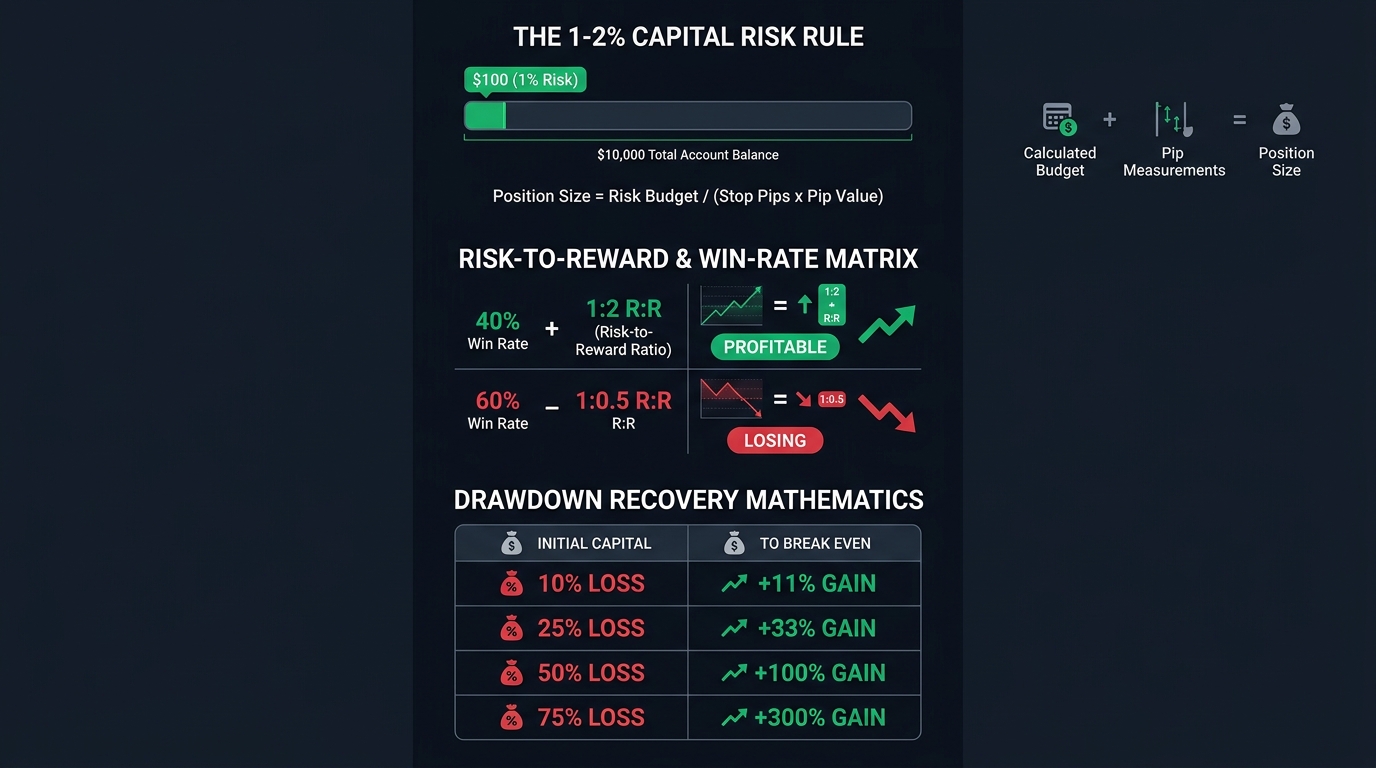
6. Risk Management Rules
This is the section that saves accounts. It must be non-negotiable.
Risk Management Rules (Example):
- Risk no more than 1% of account per trade
- Maximum 3 open trades simultaneously
- Stop trading for the day if daily loss exceeds 3%
- No trading 30 minutes before or after major news events
- No increasing position sizes after a losing trade
- Review all trades monthly, no exceptions
The rules above are not suggestions. Once written into your plan, they are binding. If you find yourself arguing against your own rules in the heat of a trade, the rules win. Every time.
For a deeper look at how to set these parameters, read the lesson on risk management basics and how much money you can risk.
7. Your Review and Improvement Schedule
A trading plan without a review process is a document you wrote once and forgot. Build in a structured review cycle:
- Daily: Log every trade — entry price, exit price, result, and one observation
- Weekly: Review win rate, average win/loss, any rule violations
- Monthly: Assess overall performance against your goal, look for patterns in losing trades
- Quarterly: Reassess the plan itself. Is the system still working? Do any rules need updating?
Your trading journal is the raw material for these reviews. Without it, the reviews are guesswork.
Trading Plan vs. Trading System: Side by Side
| Aspect | Trading Plan | Trading System |
|---|---|---|
| Scope | Your entire trading operation | Your entry/exit signals |
| How often it changes | Rarely (quarterly review) | As needed based on market conditions |
| Primary purpose | Governance and structure | Signal generation |
| Who it protects against | Yourself (emotion, impulsivity) | The market (adverse price moves) |
| Required? | Absolutely | Yes, but it lives inside the plan |
A Simple Template to Get Started
You do not need a 30-page document. A one-page trading plan that you actually follow beats a comprehensive plan that lives in a drawer.
Section 1 — My Goal Write one sentence: specific target, time horizon, acceptable drawdown.
Section 2 — My Capital How much is in the account, what percentage I risk per trade, my max daily loss.
Section 3 — My Schedule Which hours I trade, which markets, on which days. Be specific.
Section 4 — My System Name of strategy, entry conditions, exit conditions, stop-loss placement.
Section 5 — My Rules 5–10 hard rules I will not break. Write them. Sign and date them.
Section 6 — My Review Dates The specific calendar dates I will review performance — set them now.
Print it. Put it next to your screen. Review it before every trading session.
What a 2026 Trading Plan Looks Like Differently
The core components of a trading plan have not changed in 30 years. What has changed is the context:
- Algorithmic competition is real. Retail traders in 2026 compete on infrastructure, data, and discipline — not just pattern recognition. Your edge must be behavioral and systematic.
- Prop firm challenges have changed the landscape. Many traders now build plans specifically designed to pass funded account evaluations. The rules are stricter, but the discipline they enforce is exactly what your personal plan should demand.
- Economic volatility is elevated. With geopolitical risk and central bank policy divergence at multi-decade highs, your plan must include specific protocols for high-volatility periods.
None of this invalidates the fundamentals. It makes them more important.
Key Takeaways
- A trading plan is not a trading system. It is the governance framework that contains your system and everything else.
- The plan’s primary purpose is to protect you from impulsive, emotional decisions made in real time.
- It must include: your goal, capital rules, trading style, instrument selection, system summary, risk management rules, and a structured review schedule.
- One page that you follow consistently is better than fifty pages that you ignore.
- Pair your plan with a detailed trading journal to make every review meaningful.
- Review your plan at least quarterly. Update it when your circumstances or market conditions change significantly.
The traders who last over the long run are rarely the ones with the best entries. They are the ones with the clearest rules about what they will and will not do, and the discipline to follow them when it matters most.
Next in this module: Forex Trading Style — Which Approach Fits You?

Ready to Practice This Strategy?
Test what you learned on a free, risk-free demo account before risking real money.