Dealing Desk vs. Non-Dealing Desk Brokers: Key Differences Explained
Dealing Desk and Non-Dealing Desk brokers handle your orders fundamentally differently. Understand how each model works, which gives you better execution, and why it matters for your specific trading style.
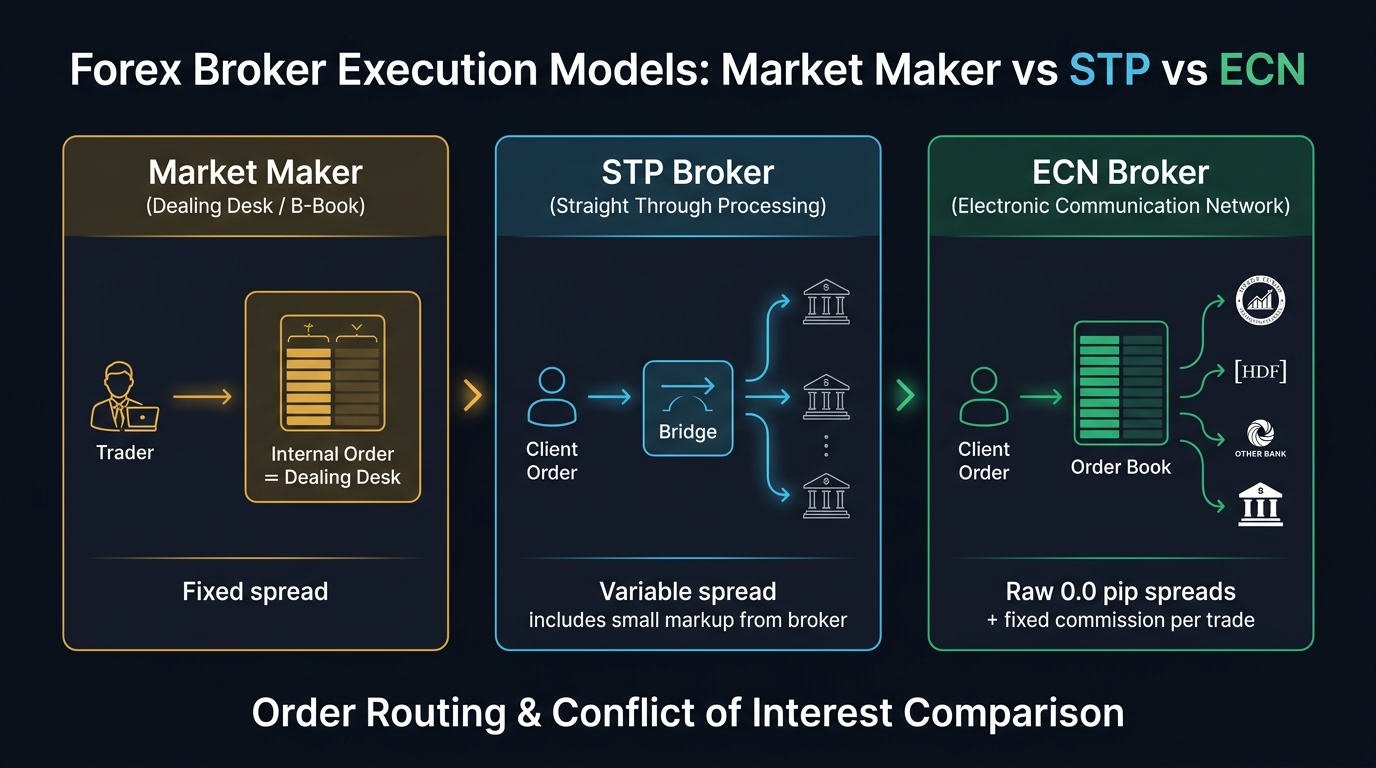
In the Different Broker Types lesson, we covered the three major broker models (Market Maker, STP, ECN) from a technical standpoint. This lesson addresses the most important practical distinction — Dealing Desk vs. Non-Dealing Desk — and what it means for your everyday trading experience.
What Is a Dealing Desk?
A Dealing Desk (DD) broker has a team (or system) that actively manages orders internally. When you submit a trade, it’s reviewed by the dealing desk before execution:
- The desk may accept your order at the quoted price
- It may reject the order and requote at a different price
- It may fill the order internally without routing it to the external market
This is how traditional market makers operate. The “desk” originally referred to actual people. Today it’s mostly automated, but the principle is the same: your order doesn’t go directly to the market.
Practical effect for traders:
- Spreads are typically fixed (the desk holds the spread constant)
- Requotes can occur in fast-moving markets (the quoted price has changed before the desk executes)
- Slippage is less common in normal conditions
What Is a Non-Dealing Desk?
A Non-Dealing Desk (NDD) broker routes orders directly to external liquidity providers without manual or desk intervention. Your order hits the market immediately, filled at the best available price from the liquidity pool.
Two variants:
- STP (Straight-Through Processing): Order goes to a single or small number of liquidity providers
- ECN (Electronic Communications Network): Order enters a competitive pool of multiple liquidity providers and other market participants
Practical effect for traders:
- Variable spreads (reflecting real market supply/demand)
- Very rare requotes (orders fill at current market price)
- Slippage can occur — but can be positive (better than quoted) or negative
Side-by-Side Comparison
| Feature | Dealing Desk | Non-Dealing Desk |
|---|---|---|
| Order routing | Internal (manual or automated desk) | External liquidity providers |
| Spread | Fixed | Variable |
| Requotes | Possible in fast markets | Very rare |
| Slippage | Rare in normal conditions | Possible; can be positive or negative |
| Transparency | Lower (you don’t see interbank pricing) | Higher (prices reflect real market) |
| Minimum deposit | Lower ($50–$500) | Higher ($200–$2,000) |
| Commissions | None (spread includes fees) | Sometimes (ECN brokers) |
| Conflict of interest | Yes (structural) | No (or minimal for STP) |
Does “Non-Dealing Desk” Mean Better Execution?
Not necessarily. The execution quality depends on the quality of liquidity providers and the broker’s infrastructure — not just whether they label themselves NDD.
A well-run regulated market maker (Dealing Desk) with tight fixed spreads and fast execution can be preferable to a poorly run NDD broker with volatile spreads and slow connectivity to liquidity providers.
What actually determines execution quality:
- Quality and number of liquidity providers (for NDD)
- Server infrastructure and latency
- Regulatory oversight (enforces conduct standards)
- Track record on withdrawal and dispute resolution
Requotes: Still a Problem?
Requotes were a significant concern with Dealing Desk brokers before 2015. In fast markets, the broker’s quoted price would change by the time execution was confirmed, prompting a requote at the new price.
In 2026, most regulated Dealing Desk brokers have automated their execution enough that requotes are rare during normal market hours. They still occur during extreme events (news releases, flash crashes) — and this is where NDD brokers have a genuine advantage: orders fill at the actual market price, however that price has moved.
For traders who regularly trade news events or major economic releases, the NDD model provides meaningful execution benefits. For swing traders who avoid the immediate post-news window, the distinction matters less.
Which Is Better for You?
| Trader Profile | Recommended Model |
|---|---|
| Beginner, small account (<$1,000) | Dealing Desk (lower minimums, simpler) |
| Swing trader, 3–10 trades/week | Either; focus on regulatory quality |
| Day trader, 10–30 trades/week | NDD/STP (tighter variable spreads net better over high frequency) |
| Scalper, 30+ trades/week | ECN (tightest spreads essential for scalping economics) |
| News trader (trades around events) | NDD strongly preferred (no requotes during news) |
The Most Important Filter
Regardless of Dealing Desk vs. Non-Dealing Desk, the single most important criterion remains: Is the broker regulated by a reputable authority?
A regulated Dealing Desk broker is vastly safer than an unregulated NDD broker. Regulation enforces:
- Client fund segregation
- Conduct standards that limit manipulation
- Dispute resolution mechanisms
- Negative balance protection
The DD/NDD distinction is a secondary consideration. Regulation is primary.
Key Takeaways
- Dealing Desk brokers manage orders internally; Non-Dealing Desk brokers route orders directly to external liquidity providers
- DD brokers typically have fixed spreads, possible requotes in fast markets, and an inherent conflict of interest (structural, not necessarily malicious)
- NDD brokers have variable spreads, rare requotes, and no conflict of interest — but execution quality depends on infrastructure and liquidity provider quality
- Requotes are less common from regulated DD brokers in 2026 than historically, but NDD still has an advantage during news events
- For swing traders: both models work; prioritize regulation over execution model. For scalpers and news traders: NDD/ECN is meaningfully better
- Regulatory status always takes priority over the DD/NDD distinction
Previous: Different Forex Broker Types | Forex Broker Due Diligence

Ready to Practice This Strategy?
Test what you learned on a free, risk-free demo account before risking real money.